

Public Art Near Me: 8 Murals and Sculptures Around Jenks
You've got an hour between the grocery run and school pickup, and the only photo on your phone from this week is a receipt. Park once in The Ten District, walk the ten blocks between the Arkansas River and the Midland Valley railroad tracks, and you'll pass more art than visitors see on a dedicated museum afternoon.
That's the honest answer to a "public art near me" search in Jenks. The walking version comes first because it's free and it's ours. The Tulsa and Route 66 stops come after, sorted by what you get on the ground, where to park, and what to skip when the weather or the crowd turns on you.
Best first move: park along Main Street, walk toward the river end, then work west toward the tracks. One spot covers the whole district.
Nationally, 79% of Americans had visited, attended, or watched an arts and culture event in person in the previous year, and 70% agreed the arts improve the image and identity of their community, according to the 2023 Americans for the Arts public opinion study. People are already outside looking at things. This is just where to point the car, starting with the blocks you can walk.
Table of Contents
1. The Ten District Main Street Art Walk - Start at the river and walk west
2. Gathering Place Tulsa Public Art - Add the Zink Lake overlook on the same drive
4. Woody Guthrie Center and Brady Arts District - Making an afternoon of it
5. Greenwood Rising and Greenwood Avenue Art - What most art guides get wrong here
6. Philbrook Museum of Art Sculpture Gardens - How to visit without rushing it
7. Blue Whale of Catoosa on Route 66 - Turn the drive into a Route 66 art run
1. The Ten District Main Street Art Walk
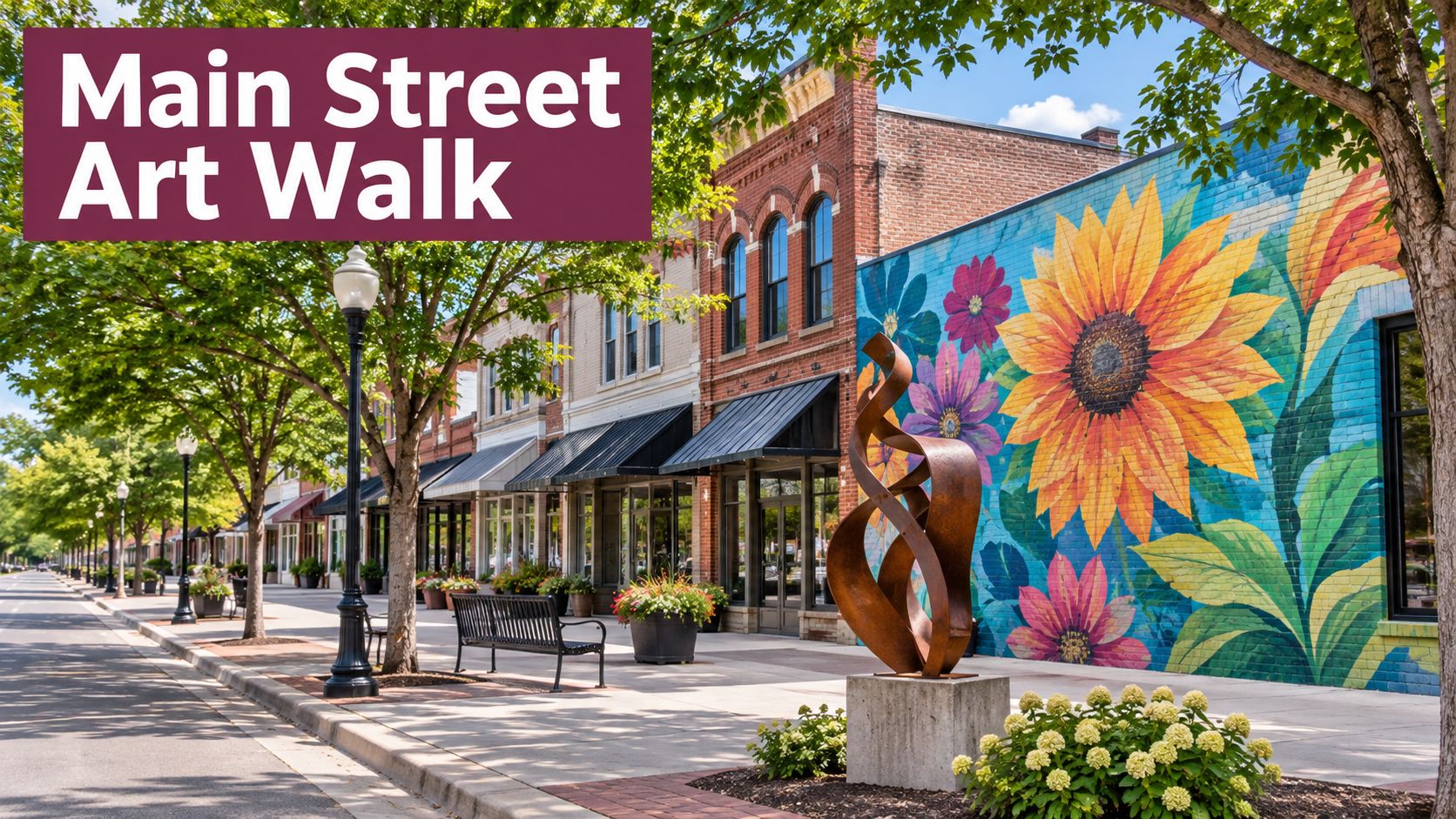
Main Street is where most of us see public art without planning to. Murals on brick, a sculpture or two, gallery windows, and seasonal pieces that appear around festivals and markets. The district runs ten blocks from the river to the railroad tracks, so the pace is a stroll, not a hike.
A Main Street block on a green spring morning.
Start at the river and walk west
You'll cover the district in under an hour if you don't stop. You will stop.
Park once on Main: street spaces along Main and the blocks just off it turn over fastest on weekday mornings.
Walk it one direction: start at the river end and head west toward the Midland Valley tracks so you aren't backtracking past the same storefronts.
Ask inside: shop and gallery staff know what went up last month, and festival pieces don't always make it onto a map.
Access matters more than a pin. Most listings confirm an artwork exists and stop there. They rarely say whether the route is step-free, where accessible parking sits, or whether there's a bench in the shade. In Seattle's winter 2025 public-space engagement, 57% of 382 respondents supported better wayfinding while 57% of 385 supported adding art along a corridor, per the Seattle Department of Transportation summary. That's the test we'd apply here too.
Our downtown art walk guide tracks what's up right now, block by block, so you're not hunting a mural that came down in March.
2. Gathering Place Tulsa Public Art
Gathering Place is the largest concentration of outdoor art within a short drive of Jenks, and general admission is free. Sculptures and designed elements are spread across the grounds rather than lined up in one spot, so budget a half day and wear shoes you can walk in.
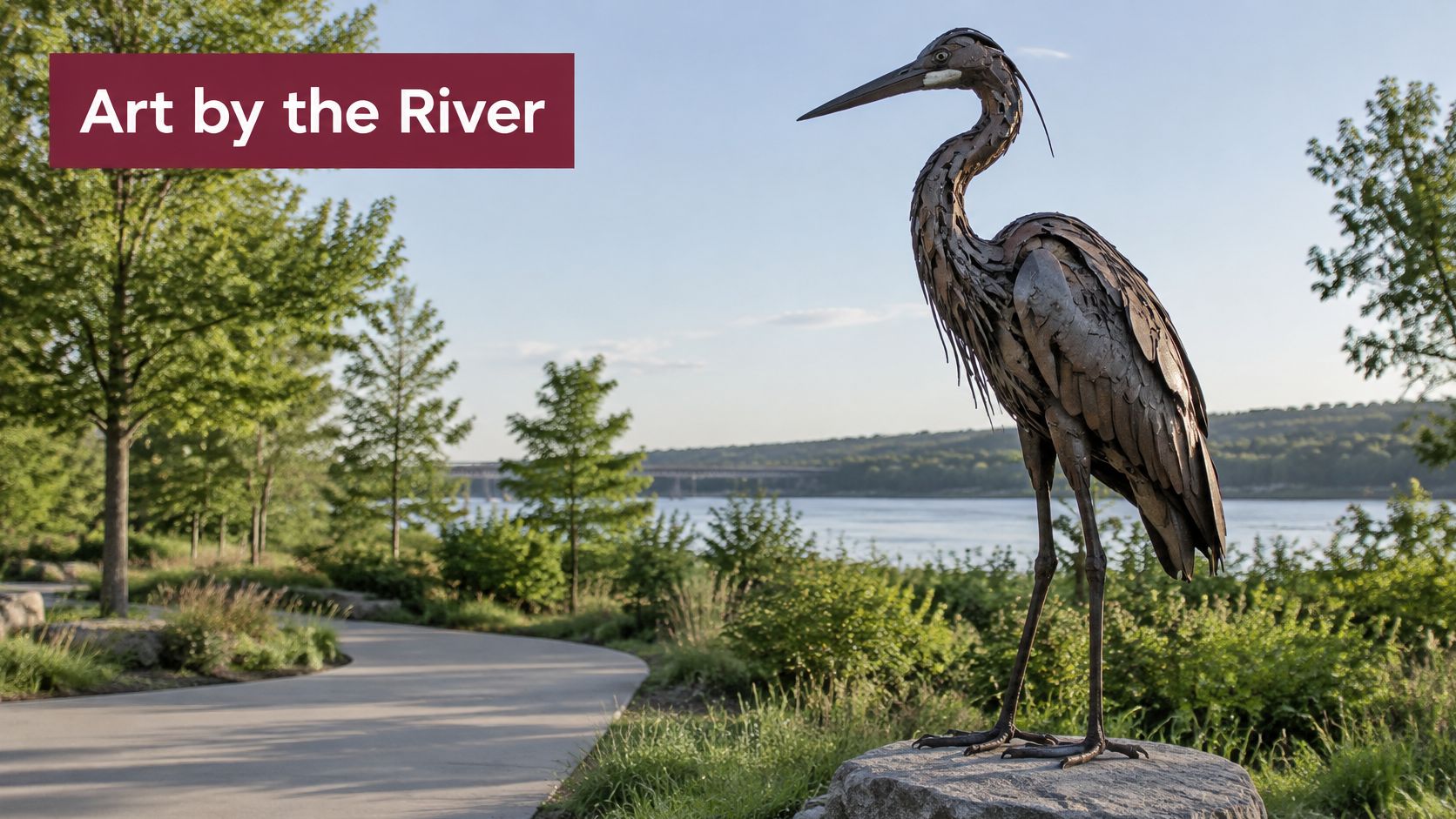
The piece below sits beside a paved path near the water, which is typical of how art is placed there: part of the surroundings, not fenced off from it.
Add the Zink Lake overlook on the same drive
Head north on Riverside Drive from Jenks and you'll reach the park first, then the Zink Lake Overlook murals closer to downtown near 19th Street and Riverside Drive. The City of Tulsa and River Parks Authority opened that installation to the public on September 27, 2024, and it features work from 11 local artists, per the City of Tulsa announcement. Two stops, one road, no rerouting.
Arrive early on weekends: the lots fill before mid-morning in good weather.
Bring water and sunscreen: shade is generous but not continuous, and July on the river is unforgiving.
Eat on the way back south: Riverside and Peoria both give you options without circling downtown.
Because the overlook is outdoors, daytime is the practical window. Weather and riverfront conditions decide the rest.
3. Guthrie Green in Downtown Tulsa
Say you drive up for a Friday evening show on the green and don't buy a single ticket. You'll still spend money, and that's the part worth planning for.
Arts attendees do exactly that. A Connecticut Arts and Economic Prosperity IV study built on 151,802 audience-intercept surveys found the typical arts attendee spent $24.60 per person per event beyond admission, while the state's nonprofit arts and culture sector generated $653 million in total economic activity and supported 18,314 full-time-equivalent jobs, according to the Connecticut impact study. Free programming doesn't mean a free evening out. Budget for dinner and parking instead of a ticket.
Guthrie Green, named for Woody Guthrie, works best as a gathering spot where art and ordinary life overlap. You come for the space, stay for whatever is happening on it.
Parking and timing
Use a downtown garage or meter: street parking near the Brady district disappears fast on event nights.
Walk the block: the green sits close enough to the Woody Guthrie Center to hit both without moving the car.
Check listings first: some evenings are quiet, some are packed, and the difference changes the whole visit.
If you're already heading to the Brady Arts District, this is a ten-minute addition. If you're making a special trip, pair it with something indoors.
4. Woody Guthrie Center and Brady Arts District
Tulsa has been putting public money into public art since the late 1960s, when the city developed one of the nation's earliest Percent for Art ordinances. The rule directs 1% of qualifying vertical-project funding toward art, and the city says the policy has helped produce a collection of more than 400 permanent and temporary works, according to the City of Tulsa arts office. That's why so much of the metro's large-scale work sits on civic buildings, in parks, and along streets rather than only in galleries.
The Woody Guthrie Center anchors the Brady Arts District and covers the singer's life and work through exhibits and archives. The surrounding blocks carry murals and public pieces, so the museum is the reason you drive up and the neighborhood is the reason you stay.
Making an afternoon of it
Confirm hours and tickets directly: the museum's official site is the only source worth trusting on holiday closures.
Park once: pick a garage near Brady and walk the district rather than leapfrogging between stops.
Eat within walking distance: lunch nearby turns a ninety-minute museum visit into a proper outing.
For most Jenks residents this is a straight shot up the Broken Arrow Expressway, which makes it the easiest Tulsa cluster to do on a whim. Go slow. The district rewards walking more than driving.
5. Greenwood Rising and Greenwood Avenue Art
Some stops on this list are about looking. This one is about understanding, and it deserves its own block of time rather than a tag-on at the end of a Tulsa afternoon.
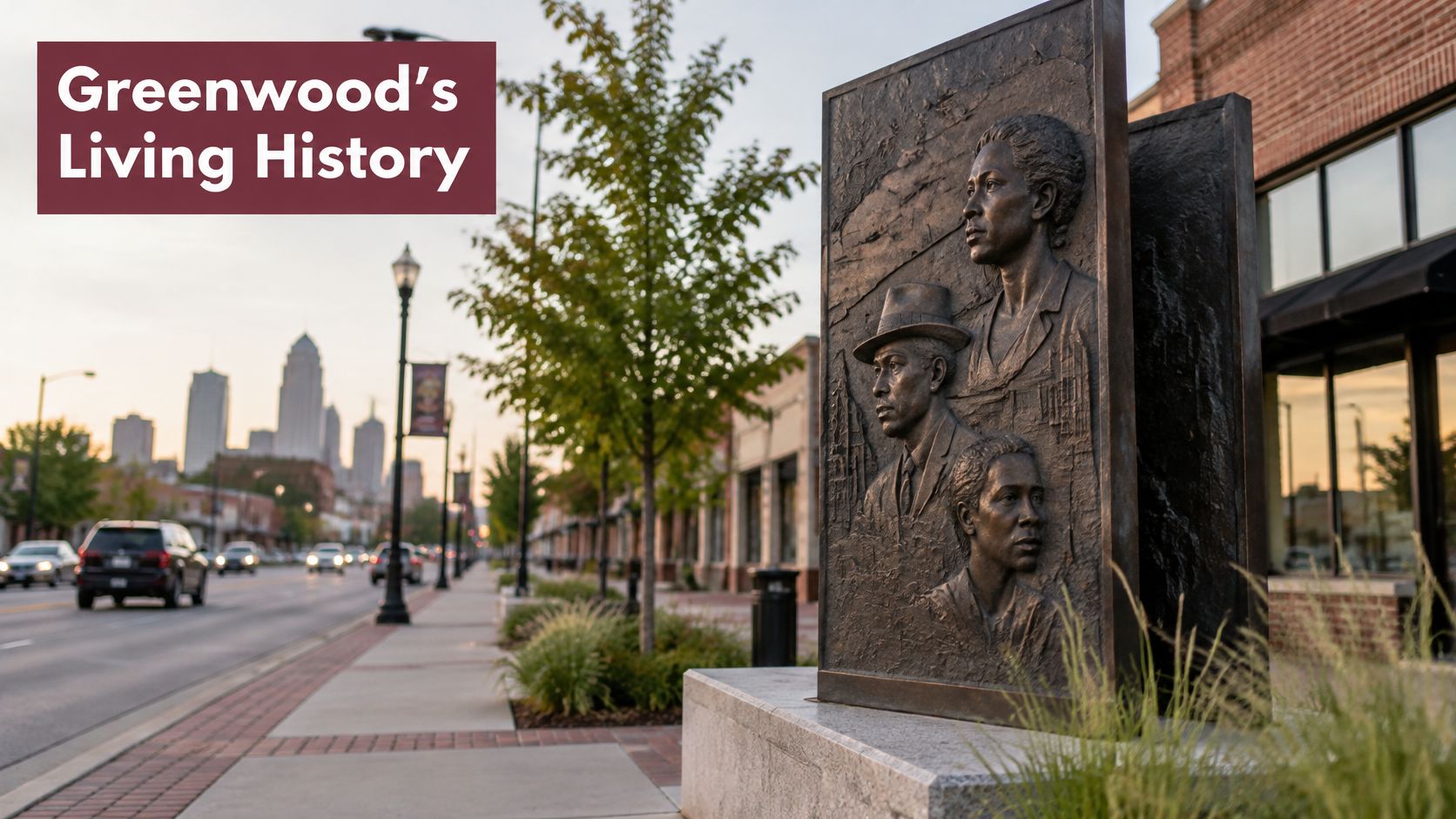
Greenwood Rising sits on North Greenwood Avenue and tells the story of the Greenwood district and the 1921 Tulsa Race Massacre. Outside, the corridor holds markers and artwork that speak to the community's history and resilience.
What most art guides get wrong here
"Public art near me" pages list coordinates without context. They rarely say who made the work, whose history it represents, how residents shaped it, or whether it's temporary. That absence matters most in a historic neighborhood.
Investment in public space can be structured to reach the people who live there. Michigan's FY2025 placemaking program reported 1,180,498 square feet of public space revitalized, with every $1 of state investment attracting $10.47 in private investment, and 70% of projects in communities at or below the state's median household income, per the Michigan Economic Development Corporation. The lesson travels: who benefits is a design decision, not an accident.
Look for the label. A piece with an artist name, a date, and a sponsor line is a different thing from a painted wall. When there's no attribution, ask before you assume it's an official installation.
Plan at least an hour indoors, then walk the outdoor markers to understand the neighborhood layout. If you want to know who made a piece and how to find more work by Oklahoma artists, our guide to finding local artists is the place to start.
6. Philbrook Museum of Art Sculpture Gardens
Philbrook is a drive stop, not a walk stop. From downtown Jenks you leave our ten blocks behind and head into Tulsa for a former family estate whose formal grounds hold sculpture alongside the museum's collections. It earns the drive on its own terms, so give it its own morning rather than squeezing it between other stops.
A sculpture garden is curated, which is a different thing from a city's public inventory. Cities do try to count what they have: in 2024, a census identified 11,364 artworks in public spaces across Bernalillo County, New Mexico, according to the City of Albuquerque Arts and Culture Department. Nobody has run that count for Jenks, which is why the reliable inventory here is the walk you take.
How to visit without rushing it
Gardens before galleries: walk the grounds while you're fresh and the light is good, then go inside.
Spring and fall: the plantings carry half the experience, and summer heat flattens it.
Check admission and hours on the museum's site: rates and closures change seasonally.
Take the full lap: the grounds reward a slow circuit, and skipping the far paths means missing half the sculpture you drove over for.
Photo rules indoors vary by gallery, and our guide to taking pictures in art galleries covers what's usually fine and what isn't. The gardens are a friendlier place to experiment with a camera. If the visit gets you thinking about art on your own walls, this wall art advice for music lovers is a reasonable read.
7. Blue Whale of Catoosa on Route 66
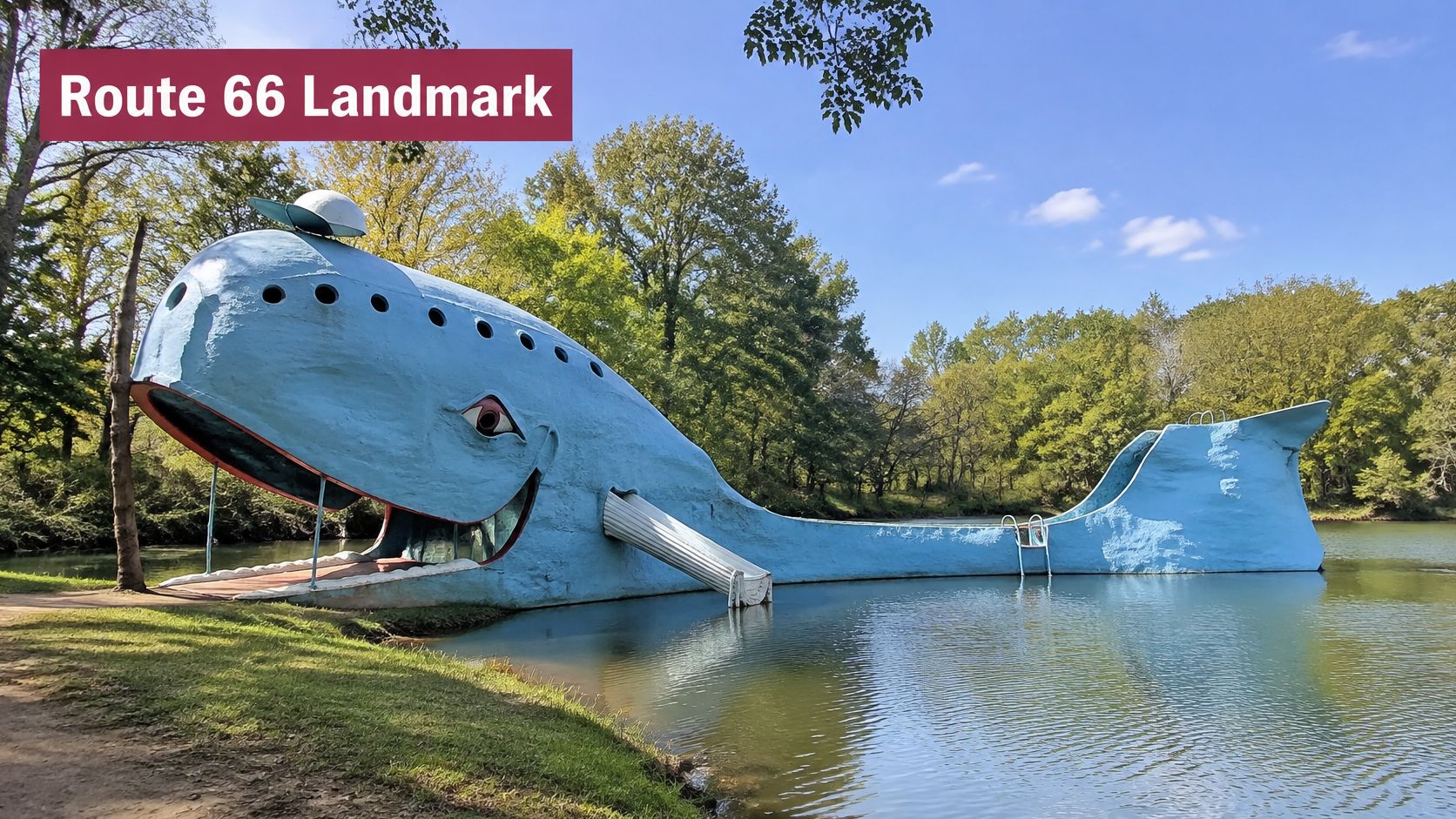
The Blue Whale sits beside Route 66 in Catoosa, northeast of Tulsa. Built as a private swimming spot, it has become one of the highway's most recognizable folk-art landmarks. The whale and pond make a quick outdoor stop, especially for families who want a break from the car.
Turn the drive into a Route 66 art run
Route 66 art is spread along the road rather than gathered at one venue. A City of Tulsa call for artists lists 34 traffic-control-box locations along the corridor, also known locally as 11th Street, Southwest Boulevard, and Admiral Place. The Route 66 traffic-control-box art project document gives a sense of the art you may spot while driving through Tulsa.
The Oklahoma Department of Transportation's public art collection lists named works at sites around the metro, including “Oklahoma Welcomes You” at Tulsa Airports Improvement Trust and “OTA Creek Turnpike” by Carolyn Braaksma. For a Jenks-based outing, treat these as route-side discoveries, not stops with the same setup as a museum or sculpture garden.
Check current access rules: access at the whale has changed over the years, so check before setting out.
Go earlier in the day: parking and photos are generally easier before the busier part of the day.
Keep the stop short: twenty minutes is plenty, then continue west toward Sapulpa.
For more ideas closer to our home base, browse this guide to the best public art installations around Jenks.
8. Sapulpa Route 66 Downtown Murals
Sapulpa makes a good westbound detour from The Ten District when you want a small-town art stop alongside historic storefronts. The downtown murals are spread across a few walkable blocks, so plan to park once and explore on foot. Small-town murals can be hard to locate, so pick two or three spots before leaving Jenks.
Doing Sapulpa right
Choose a starting block before you set out. Midweek is a quieter time to visit; Saturday afternoons bring more traffic through the corridor. Leave room for lunch in town if you want to make the drive a relaxed outing rather than a quick photo stop.
Seasonal note: In December, the Route 66 Christmas Chute brings crowds and lights to the same downtown blocks. Parking can get tight after dark.
For a closer-to-home walk, see our guide to public art and murals around Jenks.
How the eight public art stops compare from Jenks
Use downtown Jenks as the anchor: the Main Street Art Walk is the only stop you can explore on foot without leaving town. The other seven require a drive, with Tulsa offering several options and the Route 66 stops making a longer outing.
Item | Location | Best For | Walk or Drive from Jenks | Admission |
|---|---|---|---|---|
The Ten District Main Street Art Walk | Downtown Jenks, along Main Street | Casual art viewing, families, and a stroll between shops | In Jenks; walkable around downtown | Free |
Gathering Place Tulsa Public Art | Gathering Place, along the Arkansas River in Tulsa | Families, outdoor art, and a half-day park visit | Short drive north from Jenks | General admission is free |
Guthrie Green in Downtown Tulsa | Downtown Tulsa, near the Brady Arts District | Outdoor events and a stop alongside other downtown attractions | Drive to downtown Tulsa | Free during open hours |
Woody Guthrie Center and Brady Arts District | Brady Arts District, downtown Tulsa | Music fans, local history, and street art | Short drive north from Jenks; explore the district on foot | Museum admission; check the center's official page for current details |
Greenwood Rising and Greenwood Avenue Art | Greenwood Avenue, Tulsa | Greenwood history and a thoughtful cultural visit | Drive to Tulsa; walk the outdoor corridor | Admission applies; check Greenwood Rising's official page for current rates |
Philbrook Museum of Art Sculpture Gardens | Philbrook Museum of Art, Tulsa | Garden walks and indoor-outdoor art | Drive to Tulsa | Admission applies; check Philbrook's official page for current rates |
Blue Whale of Catoosa on Route 66 | Route 66, Catoosa | Families, photos, and a quick roadside stop | Drive northeast from Jenks | Check current access rules |
Sapulpa Route 66 Downtown Murals | Downtown Sapulpa | Small-town murals and Route 66 history | Easy drive from Jenks | Most murals are visible from the street |
Turn It Into a Half-Day Loop
An hour covers Main Street. An afternoon covers exactly one drive, so pick a cluster and do it properly: the Tulsa group (Guthrie Green, the Brady Arts District, Philbrook) or the Route 66 pair (the Blue Whale, then Sapulpa). Chasing both in the same afternoon turns the day into a car trip with art breaks. For families with restless kids, the Route 66 pair is the easier sell.
Greenwood Rising sits outside that logic. Give it a full morning or afternoon of its own.
Keeping part of the day in Jenks has a practical upside. In 2015, U.S. nonprofit arts and culture organizations generated an estimated $63.8 billion in economic activity and supported 2.3 million jobs, and analysis of 212,691 audience surveys found the typical attendee spent $31.47 per person per event beyond admission, according to the national Arts and Economic Prosperity report. Meals, parking, and shopping follow the art. In 2023, U.S. arts and cultural economic activity increased 6.6% after inflation, per the U.S. Bureau of Economic Analysis.
Run the day as a loop, then. Start on Main because it is free and walkable, drive out for one cluster, and come back for dinner downtown so the day ends where it started.
Before you go, confirm hours for any museum or ticketed venue, check the district calendar for seasonal installations and market days, and leave slack in the schedule. Good weather makes every stop run long.
If you are hauling kids, snacks, and a change of clothes, the beach, city, and trail packing lists cover the day-trip basics.
The Ten District is where downtown Jenks keeps its public art, its galleries, and its outdoor markets in the same ten blocks, from the Arkansas River west to the Midland Valley railroad tracks. Start your walk on Main Street, then let the district point you toward the Tulsa and Route 66 stops that fill out a full day. Plan your visit at The Ten District and check the calendar before you come.


Comments