

How to Find Local Artists in Jenks: Start Downtown
Your Saturday is open. There's a bare wall behind the register, a spring market booth that still needs filling, or a family room that could use something other than the same three prints everyone else has. You type "local artists near me" into your phone and get a list that could be for any city in the country.
The artists aren't hiding. Most of them are within a twenty minute drive of Main Street, and the fastest way to find them is to walk into the places that already show their work. The part that takes practice is everything after the hello: the date, the fee, and the page you both sign.
Table of Contents
Where Local Artists Show Their Work in Jenks and Tulsa
Start with what's walkable. The Ten District runs ten blocks west of the Arkansas River to the historic Midland Valley railroad tracks, and it packs independent shops, galleries, outdoor markets and festival tents into a stretch you can cover on foot in one afternoon. A dedicated group of local merchants came together to rebrand and promote Jenks' downtown community, and you can feel it in how the district works: shop owners trade names. Ask who threw the mugs in the window display and you'll leave with two more artists to look up.
That's how people find art. In the U.S. National Endowment for the Arts' 2017 Survey of Public Participation in the Arts, 54.3% of American adults, roughly 128 million people, attended an artistic, creative or cultural activity during the previous year, and 23% of adults visited an art exhibit (National Endowment for the Arts). The same survey found that roughly one-third of adults disagreed their neighborhood or community offered many arts and cultural activities, with similar shares saying event information was difficult to find. The work exists. The listings lag behind it.
On the Jenks riverfront, a short walk from Main Street, Mvskoke Waters Gallery at 500 Riverwalk Terrace, Suite 115 is the clearest entry point to Native and culturally focused work in the area. The Muscogee Nation runs it as an arts and culture venue with ties to the annual Mvskoke Art Market at River Spirit Casino Resort, and published hours are Tuesday through Saturday, 10 a.m. to 6 p.m. (Muscogee Nation). A Tuesday lunch hour works. So does a Saturday morning before the Riverwalk fills up.
Ask this at the desk: "Who's showing here in the next two months, and who else in town is doing similar work?" Staff answer the second question without hesitating, and that answer never turns up in a search result.
Across the river, a repeatable Tulsa stop
The Tulsa Artists' Coalition Gallery at 9 Reconciliation Way in Tulsa's Arts District presents roughly ten month-long shows a year plus one or two group exhibitions, so one visit puts you in front of several working artists instead of one (Visit Tulsa). During exhibitions it's open Thursday through Saturday, 6 to 9 p.m., with visits available by appointment outside those hours. Pair it with First Friday Art Crawl, the decades-old monthly evening when museums, exhibits and galleries across the district open free or at reduced admission (Visit Tulsa). One evening, several venues, and a real chance to talk with the person who made the work.
Tulsa's public art adds a free second layer. The city's Percent for Art ordinance, developed in the late 1960s, requires one percent of all vertical projects to be dedicated to art, and more than 400 permanent and temporary artworks can be found across civic buildings, streets and public spaces (City of Tulsa). Treat that as a self-guided map for a Sunday when the gallery doors are locked.
Here's the lookup version, with the hours worth checking before you drive.
Source | Location | What You Find | Best Time to Go |
|---|---|---|---|
The Ten District | Downtown Jenks, ten blocks west of the Arkansas River | Independent shops, galleries, outdoor markets and festivals | Check the event calendar before you visit |
Mvskoke Waters Gallery | 500 Riverwalk Terrace, Suite 115, Jenks | Native and culturally focused work by Muscogee artists | Tuesday to Saturday, 10 a.m. to 6 p.m. |
Tulsa Artists' Coalition Gallery | 9 Reconciliation Way, Tulsa Arts District | About 10 month-long shows and one or two group exhibitions a year | Thursday to Saturday, 6 to 9 p.m. during exhibitions; appointments otherwise |
First Friday Art Crawl | Tulsa Arts District | Museums, exhibits and galleries open free or at reduced admission | Monthly, first Friday evening |
Tulsa public art | Civic buildings, streets and public spaces citywide | More than 400 permanent and temporary artworks from Percent for Art | Any time; self-guided |
A Saturday that works looks like this. Coffee and a wander through our downtown art walk guide in the morning, Mvskoke Waters before lunch, a drive north in the late afternoon, then the Arts District once the galleries switch the lights on at six. If a visit turns into a purchase rather than a booking, tips for collecting art in Colorado covers framing, lighting and how to ask about price without turning it into a negotiation, and that etiquette travels to Oklahoma without a scratch.
Build a Longlist Before You Reach Out
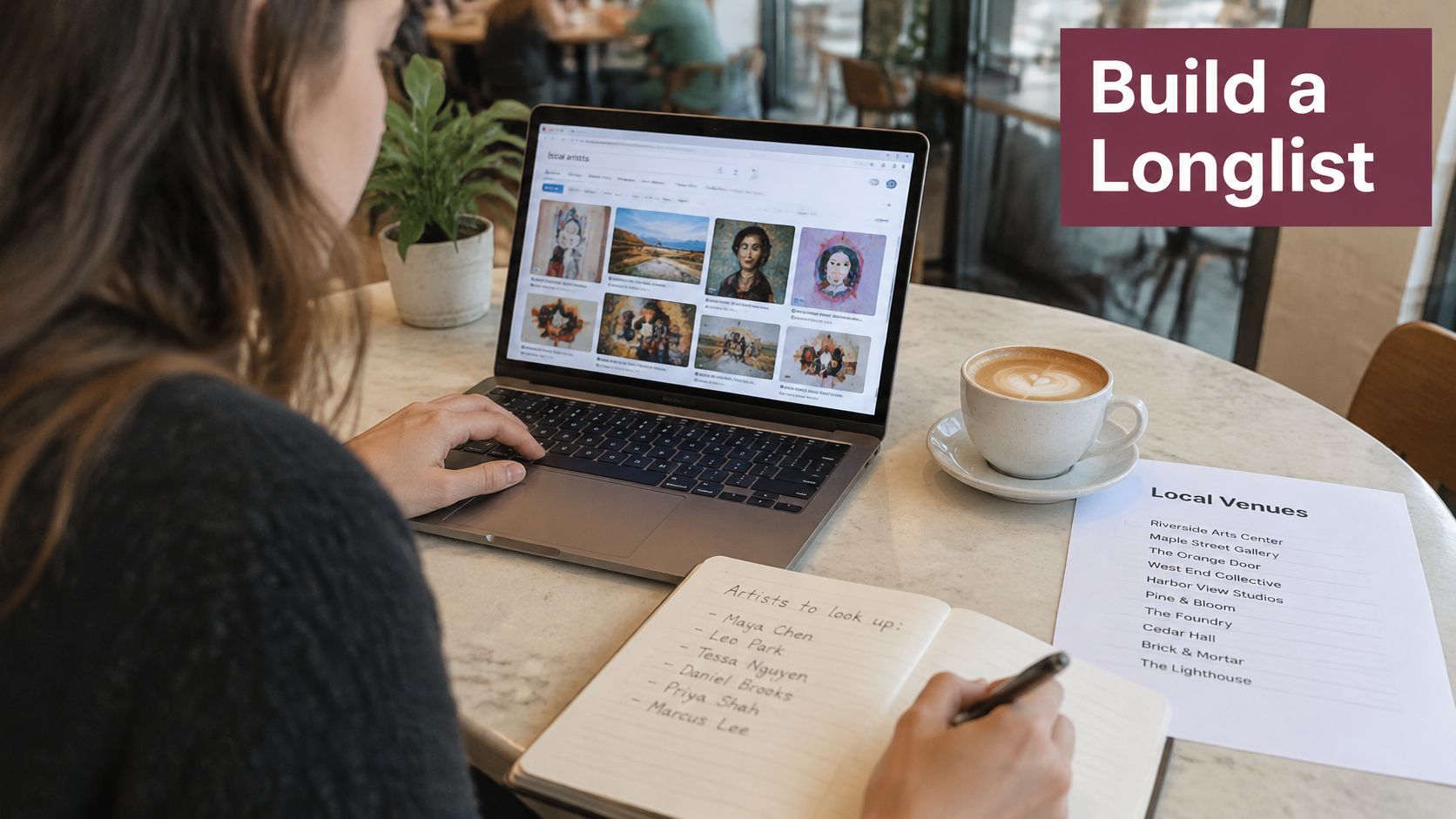
One name isn't a plan. Before you send a single message, build a longlist of 20 to 30 candidates in a plain spreadsheet and only then start cutting. That number sounds high until you remember how many of those names will be booked, mislocated, or wrong for a family audience on a Saturday morning.
Mine the places you already visited. Pull names from gallery desks, market vendor lists and public art plaques. You aren't researching strangers, you're writing down people whose work you've stood in front of.
Ask the institutions that meet artists early. Libraries, schools, the universities and makerspaces around the metro often know emerging makers before a gallery does. A community workshop instructor is usually a working artist with a portfolio and a teaching schedule.
Cross-check every name against two independent sources. A gallery exhibition page plus a festival vendor list is enough. One social profile isn't, because plenty of strong artists post twice a year.
Verify the word "local." Record the practice address or service radius, recent exhibit history, medium, and whether they can legally work at your venue. Someone who posts from Tulsa may keep a studio two counties away.
Ask who keeps showing up. Shop owners on Main Street, market regulars, the people who return to every First Friday. Repetition is the signal, not follower count.
Add the artists a gallery list skips. Emerging makers, artists holding day jobs, youth, Indigenous and disabled artists are exactly who a venue-first list leaves out, and they're often the ones who say yes.
Keep the research in one place so the next step doesn't stall. A single sheet with columns for name, source, medium, location and first contact date is enough, and it beats a camera roll of business cards.
Visibility is uneven, and that's the reason for the work. In the National Endowment for the Arts' follow-up survey, the share of adults who reported seeing or interacting with artists in the prior year fell from 57.8% in 2019 to 47.5% in 2022 (National Endowment for the Arts). In the same body of research, roughly 30% of surveyed adults viewed local artists primarily as hobbyists while 27% viewed them as wage-earning workers. Public perception won't tell you who can deliver a commission, so your own sheet has to.
The artists who most need the work are often the hardest to find through a search bar. In a 2025 survey of more than 2,500 women artists, 79% said artistic communities and peer networks were vital to their careers, while only 25% felt treated equitably in the art world (2025 research on women artists in the art world). Peer networks carry careers here, which means word of mouth reaches people a directory never will. Start with the outdoor markets around downtown Jenks, where the same vendors come back season after season.
Online discovery is a supplement, not a substitute. In 2024, 18% of global art-market sales were conducted online, according to the Art Basel and UBS Global Art Market Report 2025. The rest still moves through rooms where two people meet.
Write an Outreach Message Artists Will Answer
Vague emails get deleted. Artists receive a steady stream of "we love your work, let's collaborate" notes that ask them to guess the date, the venue, the scope and whether anyone is paying. A clear first message is the difference between a reply and silence.
Say who you are and where. Name your organization and the specific place: a booth on Main Street in downtown Jenks, a wall in a Tulsa gallery, a table at a Saturday market.
Name the date and the format. A Saturday booth, a six-week mural, a one-night pop-up. Say whether it's a one-time appearance or a recurring one.
State the budget, or say plainly that you want to discuss a paid rate. Artists price their time by reading this line first, because it tells them whether the work is speculative.
Describe the fit and why you chose them. Medium, scale, audience, and the specific piece you saw at a First Friday opening or a market table. That sentence is what proves you're not mass-mailing.
Ask one clear question and offer two times. "Would a call Tuesday or Thursday work?" is easy to answer. Four questions in one email get filed away.
Keep the whole message under 150 words, and put the ask in the first two lines where a phone screen will show it.
Hi [name], we run a monthly market booth on Main Street in downtown Jenks and saw your ceramic work at a First Friday opening in Tulsa's Arts District. We have one Saturday booth open in May and a paid fee to discuss. Would a call on Tuesday or Thursday work?
The slips that cost you the artist: sending a generic collaboration email that names no date or budget, asking for free work in exchange for exposure, and attaching large files without asking first. Each one reads as a project that hasn't been thought through.
A good reply confirms the date, names a fee range and asks one question of their own about space, power or weather cover. If you get silence, follow up once about a week later, then move to the next name on the sheet. Chasing a third time wastes the week you could spend booking someone who answers in two days.
Score Candidates Before You Commit
A score sheet is what stops the most likable artist from beating the most reliable one. Set your criteria before you look at the names, the same way you'd approach choosing a charity team building program: decide what matters, then score.
Research on rural community art practice lands on a transparent selection matrix, with community connection weighted highest and fee fit lowest (rural community art practitioner study). Rate each criterion from 1 to 5, multiply by its weight and compare totals across the shortlist.
Criterion | Weight | What to Check |
|---|---|---|
Community connection | 25% | Ties to the neighborhood, past local shows, relationships with venues and residents |
Artistic quality | 20% | Portfolio consistency, finished work, fit with the event or site |
Audience accessibility | 20% | Work that suits families, varied ages and visitors who arrive without a car |
Operational readiness | 20% | Insurance, reliable replies, install or setup plan, accessibility of the work |
Fee and budget fit | 15% | Whether the quoted fee matches your budget and includes materials and installation |
Total | 100% | Rate each criterion 1 to 5, multiply by its weight and compare totals |
Have at least three reviewers score independently, then talk through any large gaps before deciding. A single reviewer tends to reward work they'd personally hang in their own house.
Reliability tells you more than reach. An artist who answers within two days, sends a setup plan without being asked and confirms the date in writing is worth more to a downtown event than one with a bigger following and no local shows.
Watch for popularity bias. A candidate with strong social reach and no local exhibition history should score lower on community connection, not higher on artistic quality. Invite the top five to eight to a paid concept conversation, never a free audition.
If two candidates tie, pick the one whose work suits families and visitors who arrive without a car. That's the crowd a downtown Jenks event lives or dies on, and it's also the audience most organizers picture wrong. When you're building the calendar around the booking, event planning services around Jenks is where the logistics questions tend to surface.
Settle Fees, Insurance and Cancellation Terms in Writing
Put every agreement in writing before any work starts, including a two-hour market booth. Not because artists are unreliable, but because downtown events move: a rain date shifts, a wall gets repainted, a sponsor drops out. A short written page is what stops a good relationship from becoming a bad story.
Fee. State the flat rate or commission and spell out what it covers: materials, travel, install time, teardown. Say when it's paid and whether a deposit applies. For anything larger than a booth, agree the deposit up front and put the balance date on the same page.
Insurance. Ask whether the artist carries liability coverage for public installations. If they don't, find out whether your organization can add them to its policy for the event. Get that answer before the piece goes up.
Usage and credit. Decide who holds photo and reproduction rights, and exactly how the artist is credited on signage, social posts and any printed program. Photographers and muralists care about this line more than they care about the fee.
Cancellation. Write down what happens if it rains, the venue closes or either side backs out, and whether a kill fee applies.
Speculative work. Don't ask for finished pieces before the agreement is signed. Unpaid pitches shift the risk onto the artist, and the strongest ones stop replying.
Money is where local events go wrong. Cost is one of the top barriers people name for skipping cultural events, according to a 2025 cultural-participation survey of 1,187 respondents (2025 cultural participation survey). Vagueness doesn't protect anyone's budget.
Written terms aren't unique to visual art. Creator terms for selling music covers the same categories for musicians, and the list is identical: fee, rights, credit, cancellation. Read one and you'll recognize every clause you need. If the piece is going outdoors, our guide to temporary public art installations covers what changes.
Finish with a one-page checklist that both the organizer and the artist sign. Treat these as planning terms rather than legal advice, and have a lawyer review any contract involving public installations or commissions before signing.
Book Your First Local Artist This Season
Pick one event this season. A Saturday market booth, a First Friday pop-up, or a public art feature in the district. Choose the strongest candidate from your shortlist, confirm the date, fee terms and cancellation rule in writing, then send the booking confirmation the same day.
Resist the urge to start with a large commission. A first booking works better as a small, paid trial, because a booth or a one-wall hang tells you whether the artist's reliability matches the portfolio. You'll learn more in six hours on Main Street than in three weeks of email.
Before you lock the date, scan local art events around the district so your booking doesn't land on top of a festival that already fills the sidewalks. The best slot is often the quiet weekend nobody else claimed.
After the event, write down what happened: attendance, sales or visitor response, and whether you'd both do it again. Track response rate, attendance, sales and repeat participation rather than social-media reach, because a post that travels and a booth that sells are two different results.
The honest answer to how to find local artists in Jenks is that it's a walking problem before it's a research problem. The first conversation almost always starts at a market table or a gallery door, not in an online form. Get the name, follow up while the visit is fresh, and put the terms on paper before anyone lifts a paintbrush.
The Ten District is where our downtown's galleries, markets and public art meet in one walkable stretch, and we built it to make introductions like these easier. Browse what's on, then come spend a Saturday on Main Street and start the conversation yourself. Visit The Ten District to see who's showing this month.


Comments