

8 Public Art Murals to See Around Jenks and Tulsa
You've got a free morning in Jenks, someone wants to take pictures, and nobody wants to spend the whole day driving between painted walls. Start with public art along Main Street in The Ten District, then choose a Tulsa or nearby-town stop that gives the outing a different feel.
Our downtown corridor stretches west from the Arkansas River toward the historic Midland Valley railroad tracks. That makes Main Street a sensible starting point for a walk with shop browsing or lunch built in, rather than a mural hunt that sends you back to the car after every photograph.
The choices below include murals, commemorative installations, sculpture, and places to learn about commissioning public art. They aren't interchangeable: Greenwood deserves time and historical context, Gathering Place suits a family outing, and a Route 66 detour works better by car.
Check before leaving. Confirm current installations, artist credits, operating hours, and access conditions. A photograph online isn't proof that a wall still looks the same.
Separate outdoor access from indoor admission. Seeing neighborhood art and visiting a history center or museum can involve different schedules and requirements.
Keep the route flexible. Weather, repainting, construction, and community projects can change what's visible.
Table of Contents
1. Public Art Along Main Street in The Ten District, Jenks - Make Main Street a walk, not a parking circuit
2. Greenwood Rising and the Greenwood District, Tulsa - Leave room for reading and reflection
3. Woody Guthrie Center and the Brady Arts District, Tulsa - Start on Archer, then see what's open
4. Gathering Place Public Art, Tulsa - Let the family's pace determine the route
6. Public Art in Broken Arrow's Downtown - Look beyond the obvious photo wall
7. Tulsa Artist Fellowship and Community Mural Commissions - Plan for the wall's life after painting
8. Blue Dome District Street Art, Tulsa - Decide whether this is a photo walk or a night out
Build a Route That Feels Like a Local Outing - Match the route to the people coming
1. Public Art Along Main Street in The Ten District, Jenks
Main Street is the easiest place to start without turning the outing into a logistics project. The Ten District connects the Arkansas River side of downtown with the historic Midland Valley railroad tracks, with independent shops, dining, and public art along the corridor. Use the downtown Jenks public art trail as a starting point, then check what's currently on view.
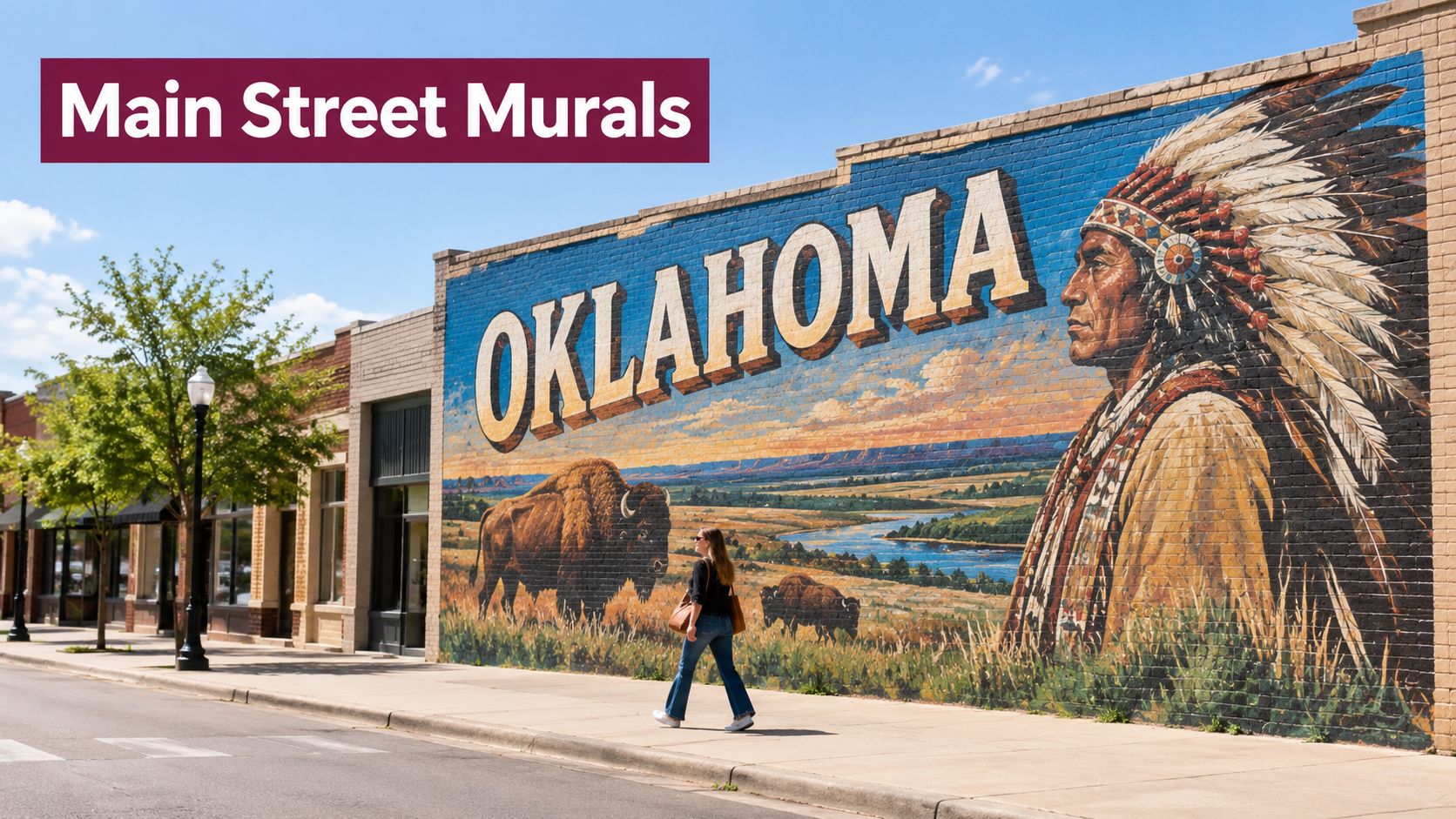
The advantage here is the walk between the pieces. Oklahoma themes fit the district's emphasis on local heritage and creativity, but the storefronts and everyday activity matter just as much as the painted surface. A drive-by can show you a wall; walking lets you notice the artist credit, the building around it, and smaller installations you might otherwise miss.
For a family visit, make the art part of a normal downtown morning. Browse a shop, pause at a mural, and stop for lunch when everyone's ready rather than trying to finish a rigid checklist.
Make Main Street a walk, not a parking circuit
Park once. Choose a legal space with enough permitted time for your outing, then explore on foot rather than moving the car between nearby pieces.
Try a weekday morning. That's a sensible first choice for photographs; evenings and market days can require more patience around sidewalks and storefronts.
Ask locally. A Main Street shop may know about recent installations or work underway that hasn't reached your saved map.
Keep entrances clear. Take pictures without blocking a business door, crossing, or another visitor's route.
If you're planning an event around a wall, ask about property permission and sidewalk use well ahead of time. Public visibility doesn't make a mural available as an event backdrop without coordination.
2. Greenwood Rising and the Greenwood District, Tulsa
Visit Greenwood for the history before the photograph. Greenwood Rising, at 322 N. Greenwood Avenue, provides context for the Greenwood District and the 1921 Tulsa Race Massacre. Start with the history center, then walk the surrounding blocks with a better understanding of the people and businesses represented there.
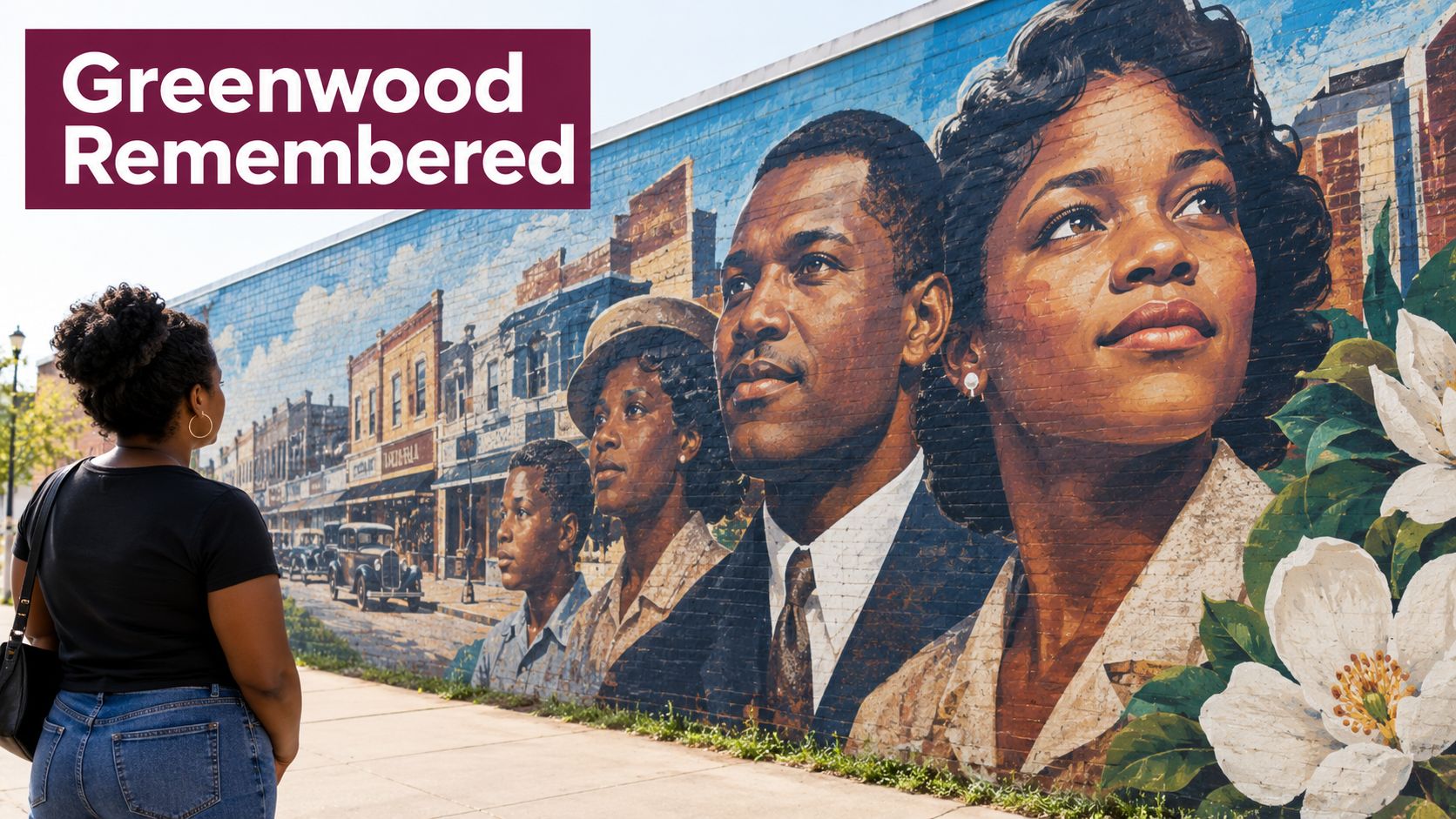
Murals and commemorative installations here aren't neighborhood decoration. They connect visitors with the memory of a Black business district that was destroyed and the community that rebuilt it. The Ten District's discussion of why public art matters to communities is useful background for thinking about that distinction.
A documented nearby example is the Detroit Avenue underpass project, where four murals, completed in 2024, honor Greenwood's resilience after the massacre through collaboration among RE:site Studios, the Oklahoma Arts Council, cultural-history organizations, photographers, and the Oklahoma Department of Transportation, as described in Polyvision's Greenwood project account.
Give the people represented on the wall more attention than the composition of your selfie.
Leave room for reading and reflection
Check Greenwood Rising's current hours and visitor guidance directly before leaving Jenks. A weekday visit may be a better fit if you want quieter time to read, but don't assume the center and every nearby space share the same access conditions.
For photographs, include the installation's surroundings when it helps explain the story. Read plaques and credits before choosing a caption, and avoid treating a memorial as a playful pose location.
This is a good destination for adults and families prepared to discuss difficult history. Don't squeeze it between hurried meal reservations or make it the last stop when everyone's already tired.
3. Woody Guthrie Center and the Brady Arts District, Tulsa
Start at 102 E. Archer Street, where the Woody Guthrie Center gives the outing a specific Oklahoma story to follow. The Okemah-born singer and songwriter's work offers context before you step outside into the galleries, music venues, and public-facing art of downtown Tulsa.
Older guides may call this area the Brady Arts District. For current planning, check listings under the Tulsa Arts District, and confirm that any venue or artwork you hope to see is accessible. A saved mural photo can point you to a wall that has since changed.
From Jenks, the practical draw is the shift from an indoor visit to a walk outdoors. Give the center enough time, then explore nearby streets at your own pace. The artwork is spread through an active arts district, not arranged as one marked mural trail.
Start on Archer, then see what's open
Check the center's current schedule, admission details, and visitor guidance before driving in. For parking, choose a garage or lot that suits the full visit, and read posted terms if you may stay into the evening.
Once parked, keep your route flexible. Current gallery access and visible street art can guide your walk better than a photo of a particular wall, which may have been repainted. For pictures, step back far enough to include the surrounding venue or storefront. That context can show how the art fits into the district.
The mix makes this a useful stop for groups with different interests. One person can focus on Guthrie's songwriting history; another can spend the rest of the visit looking at buildings and street art. Allow time for both rather than treating the center as a quick photo stop.
There's a practical trade-off: an open neighborhood walk offers variety, but it does not guarantee a particular mural will be on view. If one wall is your main destination, verify its location and condition separately before setting out. For the drive from Jenks, check current navigation on the day instead of assuming one route will be simplest.
4. Gathering Place Public Art, Tulsa
Gathering Place is an art-and-park outing, not a wall-mural tour. At 2650 S. Riverside Drive, along the Arkansas River, its sculptures and installations are encountered among playgrounds, trails, and gardens. That makes it a useful choice when children need room to move and the adults still want something worth stopping to examine.
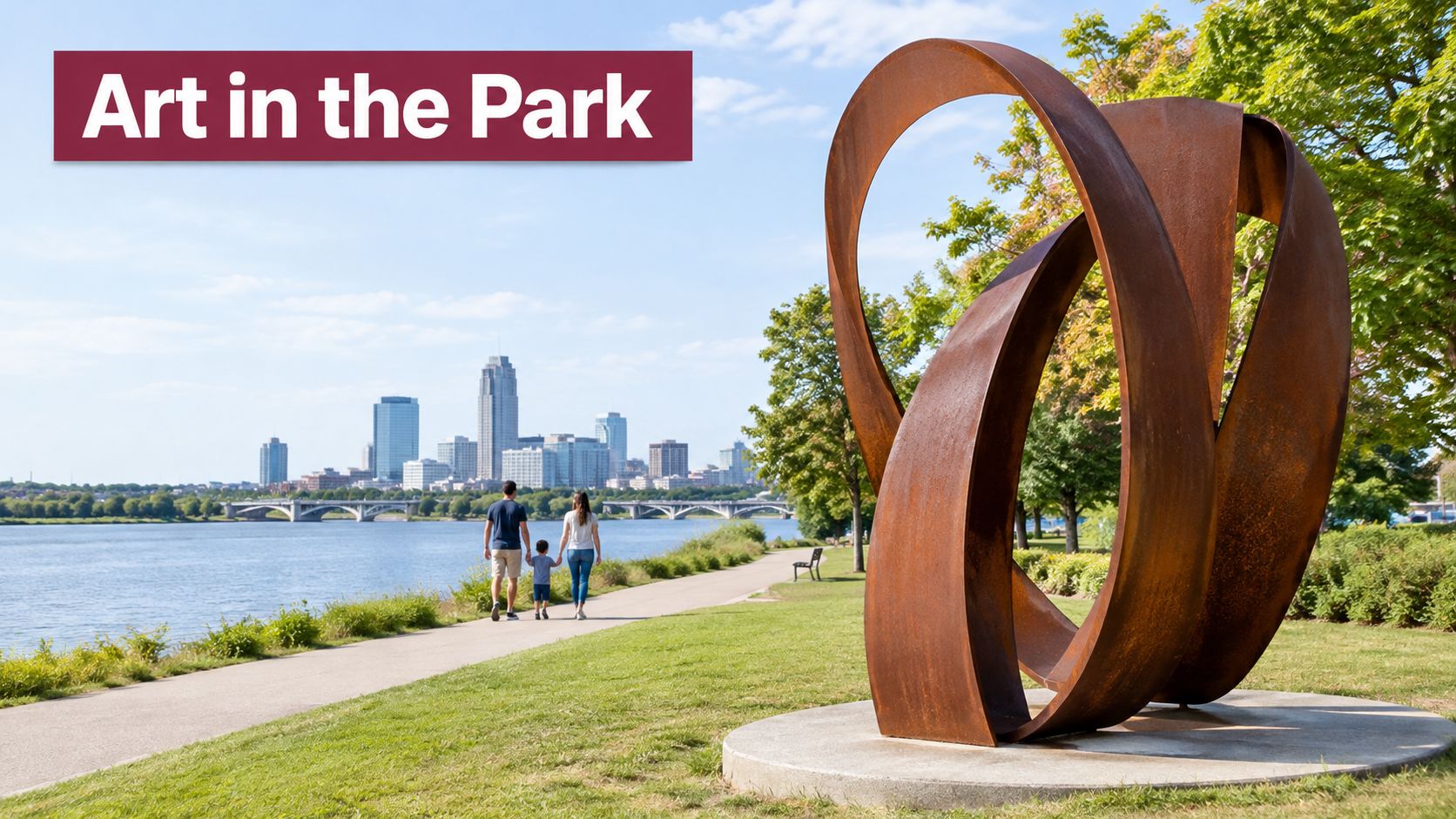
The park opened in 2018 with funding from the George Kaiser Family Foundation. Its riverfront setting also gives a Jenks visitor a natural connection to the Arkansas River corridor back home, without pretending the trip is a continuous mural walk from Main Street.
For photography, think about art in the setting. A sculpture beside a path or garden often makes more sense when you leave some of that setting in the frame. Don't step into planting beds or climb an artwork to get a cleaner angle.
Let the family's pace determine the route
Pick up or consult a current park map before heading toward a specific piece. Check the recommended parking and entrance arrangements, then choose a route that suits the people coming with you.
An early weekend arrival or a weekday visit is a reasonable planning choice for a quieter walk, but weather and scheduled activities can change that experience. In hot weather, make shade, water, and breaks more important than completing an art circuit.
Family planning rule: Choose the park because you want a park day with art included, not because everyone needs to stand still for photographs.
You can pair the visit with time along the Arkansas River trail or a meal nearby, but don't overfill the schedule. Compared with Main Street, this outing asks for more attention to walking distances, rest stops, and the interests of younger visitors.
5. Route 66 Murals and Signage in Tulsa and Sapulpa
A roadside wall can tell you as much about a place as the sign beside it. Route 66 art in Tulsa and Sapulpa ties painted walls and vintage imagery to the highway's history. Tulsa's Cyrus Avery is widely associated with the highway's creation as the Father of Route 66.
From Jenks, Sapulpa works as a westward detour when you have time for a meal and a walk through older commercial blocks. Treat Tulsa and Sapulpa as separate stops on a flexible drive. Recognizable Route 66 images may be spread out, and a wall shown in an old photo may no longer be accessible.
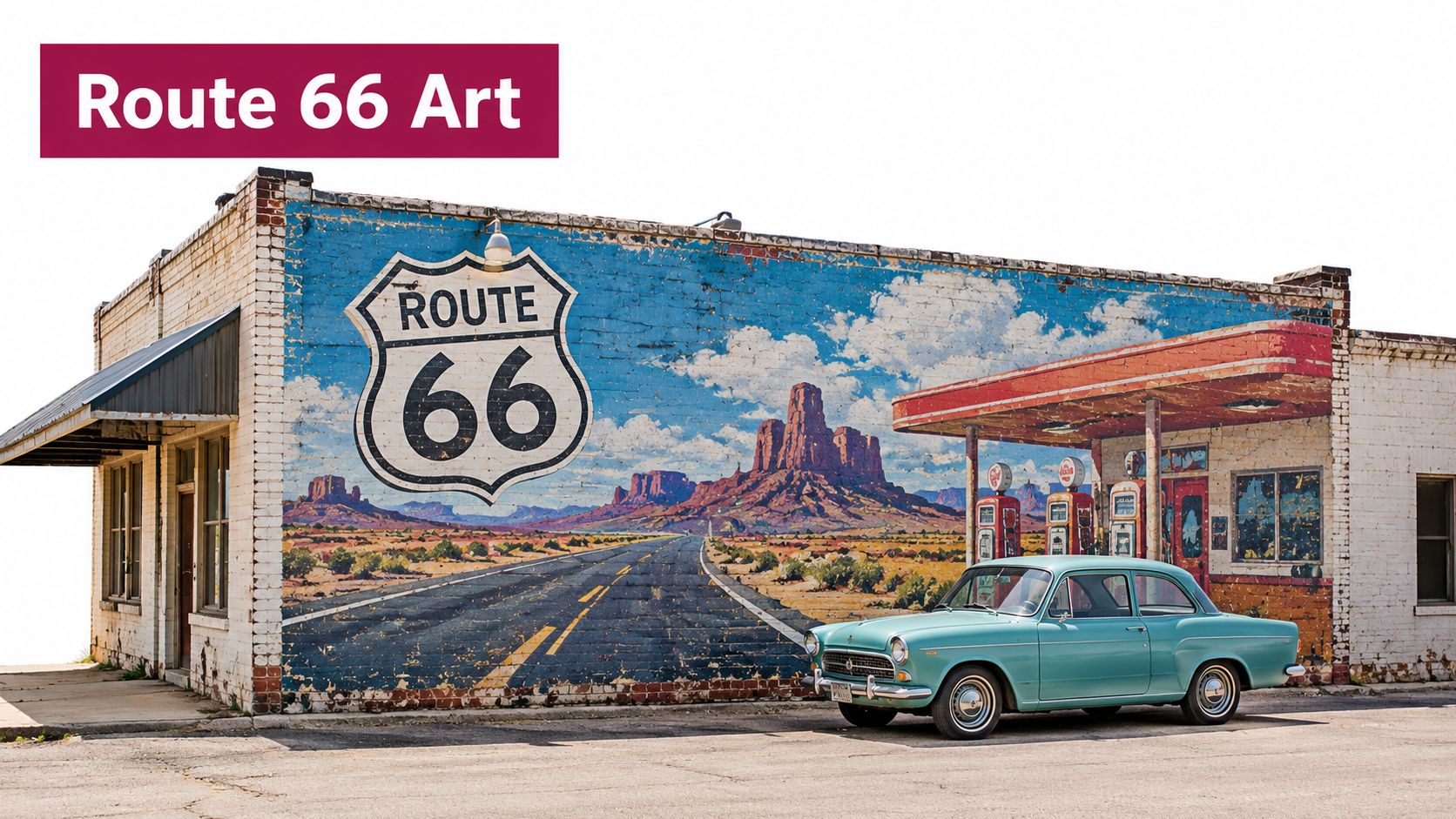
Before setting out, check which artworks are still there and where you can safely stop. Ask a local shop or visitor information about current installations, and use legal parking rather than pulling over wherever a wall catches your eye. Let a passenger manage directions, or stop the car before searching for the next mural. A meal stop gives the drive a purpose beyond collecting photos.
The Ten District's guide to interactive public art installations offers a useful lens for these stops: notice how people encounter art in a place, not just how it looks in a frame.
Tulsa's public procurement documents also show why roadside mural assignments differ. The Route 66 underpass mural procurement sets a $40,000 all-in budget; the Route 66 retaining-wall request lists $9,900, including installation-related expenses. These are budgets for different projects, not a general price list. Site preparation, equipment, insurance, and safe access all affect what a roadside wall requires beyond paint.
6. Public Art in Broken Arrow's Downtown
Broken Arrow is a good second outing when you want another walkable downtown rather than another museum visit. East of Tulsa and accessible from Jenks, its downtown public art is best approached as part of the storefront and civic-space experience. Don't arrive expecting every piece to be gathered into a single outdoor gallery.
Make this a comparison with Main Street, not a competition. Notice where artists place work, whether you can read the credit from the sidewalk, and how a mural fits the building that carries it.
For example, a family could spend the morning in The Ten District, return to the car after lunch, and choose a Broken Arrow downtown walk if everyone still has energy. That's more realistic than trying to combine several Tulsa neighborhoods and another town into the same day.
Look beyond the obvious photo wall
Walk the storefront blocks slowly and look up as well as straight ahead. Wall art can be easy to miss when you're watching shop windows, and smaller pieces may reward a closer look more than a distant photograph.
Before leaving, check current city announcements and local listings for new installations or work in progress. If you're making the trip for a specific piece, confirm the wall rather than relying on a broad description of downtown art.
Pair art with something else. Choose a restaurant or shop stop so the visit remains worthwhile if an installation has changed.
Read parking restrictions. Don't assume a space allows the same duration as your usual spot in Jenks.
Compare carefully. Look at artist recognition, pedestrian access, and maintenance, not just the size or brightness of the mural.
For Jenks business owners, that last point is particularly useful. A wall can look impressive online and still be awkward to view in person. The sidewalk experience matters more than the promotional photograph.
7. Tulsa Artist Fellowship and Community Mural Commissions
Tulsa Artist Fellowship can help visitors learn about working artists in the city, but its programming is not a guaranteed mural stop. Check current events and access details before building a visit around it. For a casual outing, you can pair a confirmed public art stop with a walk through nearby streets; The Ten District's guide to public art spaces offers a useful local reference.
For Jenks business owners and neighborhood groups, the more practical connection is how a mural commission comes together. Begin with the wall itself: confirm who owns it, get written permission, and ask the relevant city about approvals before setting an artist's schedule.
Plan for the wall's life after painting
A commission needs more than an artist and a design. Check the surface condition, public viewing access, and whether equipment will be needed to reach the site. Budget and planning should also account for preparation, suitable finishing, inspections, and future maintenance. Talk with residents about who should shape the imagery and how the community represented in the work will take part.
Funding research can start with this guide to Tulsa funders, but a listing does not establish that a specific mural qualifies for a grant. Ask the funder about eligibility before relying on support in a project budget.
The University of Oklahoma–Tulsa Founders Student Center mural offers a nearby example of a considered process. Its concept proposal began in October 2020, and completion followed in July 2022, after research, feasibility work, planning, sourcing, and stakeholder discussions, according to OU–Tulsa's public art account.
Before setting an unveiling date, agree on who will handle damage, maintenance, artist credit, and a future property sale. Give the artist and site partners enough time to settle those responsibilities; opening day should not be the first deadline they have to meet.
8. Blue Dome District Street Art, Tulsa
Blue Dome works best when you want a downtown Tulsa walk followed by dinner or an evening out. Its older commercial setting, storefronts, and street art offer a different experience from the quieter, more deliberate visit you should plan in Greenwood.
For photographs, arrive while you still have daylight. Evening activity can make the neighborhood appealing for a meal, but restaurant lighting isn't a substitute for being able to see the whole painted surface clearly.
The art is best approached on foot once you've parked. Look at side walls and the spaces between destinations, while respecting private service areas, closed gates, and working entrances.
Decide whether this is a photo walk or a night out
If pictures are the priority, keep the route short enough to finish before the light fades. A wider photograph can preserve the relationship between a mural and its commercial surroundings, while a detail shot can show brushwork or lettering.
If dinner and drinks are the priority, choose parking or a rideshare arrangement around that plan. Read the terms of a paid lot carefully, and don't count on finding a convenient street space during a busy evening.
The Ten District's discussion of temporary public art installations is relevant here because a saved image shouldn't become a permanent expectation. Confirm a specific wall before making it the centerpiece of the trip.
Keep people out of the shot when possible. Wait rather than asking diners or pedestrians to rearrange their evening.
Stay on public access routes. Street art on a visible wall doesn't invite visitors into an alley workspace or private courtyard.
Credit the artist accurately. Photograph the attribution panel if one is present, and verify anything you can't read.
For Jenks day-trippers, Blue Dome is an easy pairing with another downtown Tulsa destination. It's less useful as a promise of a fixed mural inventory.
Public Art Mural Comparison: 8 Tulsa-Area Highlights
Place or Program | Experience Type | Time and Effort | Expected Experience | Ideal For | Key Advantages |
|---|---|---|---|---|---|
Main Street Public Art, The Ten District, Jenks | Self-guided walk through a concentrated downtown art corridor | A few blocks to ten blocks on foot; free | Oklahoma-themed murals and installations among shops and restaurants | Families, casual visitors, and local heritage fans | Walkable, free, and easy to combine with dining or shopping |
Greenwood Rising and Greenwood District, Tulsa | History center visit followed by a commemorative art walk | Allow a few hours; check hours and parking | Context-rich art and markers connected to Greenwood's history and rebuilding | History-focused visitors, families, and school groups | Significant historical context and a meaningful connection between exhibits and public art |
Woody Guthrie Center and Brady Arts District, Tulsa | Museum visit with an optional arts-district walk | Center visit plus walking nearby; plan parking around events | Oklahoma music heritage with galleries, venues, murals, and street art nearby | Music and cultural heritage fans, families, and rainy-day visitors | Combines an indoor cultural stop with other downtown arts venues |
Gathering Place Public Art, Tulsa | Park visit with art integrated into trails, gardens, and play areas | Longer walk across a large park; free grounds access | Sculptures and installations alongside recreation and river trails | Families, walkers, and cyclists | Art, outdoor activities, and family amenities in one destination |
Route 66 Murals and Signage, Tulsa and Sapulpa | Flexible, car-based route | Requires driving between scattered stops; generally low-cost | Roadside art and signage reflecting Route 66 history | Road-trippers, families, and highway history enthusiasts | Flexible itinerary with a local connection to Route 66 |
Downtown Broken Arrow Public Art | Informal walk among storefronts and civic spaces | Walking and possibly driving between dispersed pieces | Changing public art in a smaller downtown setting | Nearby residents and visitors seeking a quieter outing | Close to Jenks and easy to pair with dining or shopping |
Tulsa Artist Fellowship and Community Mural Commissions | Artist and community project development | High planning effort; requires permission, budgeting, and maintenance planning | Potential commissioned mural or public art project | Business owners, property owners, and community organizers | Connects projects with local artists and helps clarify commission needs |
Blue Dome District Street Art, Tulsa | Casual walk through a downtown dining and nightlife district | Short walking visit; parking may be busier at night | Informal, changing murals and street art | Evening visitors, diners, and fans of less-curated art | Combines street art, dining, and nightlife in a walkable area |
Build a Route That Feels Like a Local Outing
Begin in The Ten District, add lunch or a shop stop along Main Street, and choose a destination that matches the rest of your day. Gathering Place makes sense for a family that wants outdoor time. The Woody Guthrie Center and surrounding arts blocks suit an indoor-and-outdoor afternoon, while Greenwood Rising deserves a visit with room for reading and reflection.
Don't measure success by how many walls you photographed. A comfortable walk, a meaningful conversation, and a meal at a local business make a better outing than rushing across the metro to reproduce someone else's pictures.
Match the route to the people coming
For families. Consider walking tolerance, weather, rest opportunities, and whether the day needs a playground rather than another posed photograph.
For history-focused visitors. Start with interpretation and allow the surrounding art to deepen that context.
For photographers. Verify the wall, choose daylight, and include artist credits and surroundings in your notes.
For organizers. Look at access, ownership, maintenance, and resident participation alongside the design.
Before leaving, check current pieces, operating hours, parking rules, and artist credits. Ask about step-free routes and places to rest if anyone in your group needs them; a mural being outdoors doesn't automatically make its viewing area accessible. The questions raised by inclusive design for transit hubs are useful prompts for evaluating a public-art route, without assuming any particular local stop meets those principles.
There's also a civic responsibility behind these outings. The University of Cincinnati's mural study found an association between murals and increased pedestrian activity after accounting for neighborhood density and demographic factors, while also identifying affordability concerns in mural areas. More attention isn't the same thing as shared benefit.
For downtown Jenks, that means supporting existing shops, recognizing artists, and asking residents what public art should represent. For property owners, it means planning what happens after installation, including upkeep and continued public access.
A good local route leaves you with more than a camera roll. You understand something about Greenwood's history, Oklahoma's creative work, or the businesses and neighbors around a Main Street wall. Keep the plan manageable enough to notice those things.
The Ten District offers downtown Jenks public-art walking information alongside coverage of Main Street shops, dining, and community life. Visit The Ten District to plan your starting walk, then choose a Tulsa-area art stop that fits your family's interests and available time.


Comments