

Can You Take Pictures in Art Galleries in Jenks
You're standing in a downtown Jenks gallery with your phone in hand, and a painting catches the light just right. Before you tap the camera, look for the sign at the entrance or ask the person at the desk. In Jenks and across the Tulsa metro, casual photography is often allowed, but permission depends on the gallery, the exhibition, the artwork, and what you plan to do with the image.
The safest rule is simple: take only a handheld, non-flash photo for personal use unless staff tells you otherwise. A picture for your own memory or a private message is different from a posed portrait session, a business post, editorial coverage, or an image you plan to sell. That distinction matters in every space, from a major Tulsa museum to a small rotating gallery near Main Street. For more on capturing artwork for collectors, it helps to think of a gallery photo as documentation with limits, not an automatic right to reproduce the work.
If you're exploring independent spaces around downtown Jenks shops and galleries, you'll usually find that the rules are easy to follow. Read the notice, keep your phone quiet and steady, avoid flash, and ask before you make the visit into a photo shoot.
Table of Contents
Walking Into a Jenks Gallery With Your Phone Out - Three types of photography
Why Some Galleries Say No to Cameras - Conservation comes first - Copyright can belong to someone else - Visitors need room to look
The Default Rules That Apply Almost Everywhere - Use the smallest setup - Keep personal use personal - Run the thirty-second check
How Gilcrease, Philbrook, and The Ten District Galleries Compare - What this means on Main Street
How to Ask Permission Without Making It Weird - Listen for the kind of yes
What Happens When a Local Shop or Artist Wants the Photo Too - A notice should answer the practical questions - Make event expectations visible
A Quick Checklist Before You Raise Your Phone - Questions locals often ask
Walking Into a Jenks Gallery With Your Phone Out
A friend walks into a small gallery along Main Street, sees a wall filled with Oklahoma scenes, and pulls out a phone. Then comes the pause. Is the artist upstairs going to mind? Is the gallery okay with it? Does posting the picture to Instagram change the answer?
Those are the right questions, but the first one isn't just can you take pictures in art galleries. The better question is, what kind of picture are you taking, where are you taking it, and what will happen to the image afterward?
Three types of photography
A quick snapshot is the least complicated case. You're holding your phone, you aren't using flash, you aren't blocking the room, and you want a personal reminder of the visit. Many museums and galleries allow that kind of photography in permanent-collection areas when signs permit it.
A posed session is different. A portrait, prom photo, group shoot, or family picture can take more time and space, especially if you bring extra equipment or ask people to repeat a pose. Commercial photography goes further still. If a shop, real-estate company, publication, artist, or event organizer wants to use the image publicly, permission should be settled before the camera comes out.
The local rule of thumb: A quick personal snapshot may be fine. Anything organized, posed, paid, published, or promotional deserves a polite ask first.
That distinction applies during an ordinary visit and during a downtown event. A visitor may photograph a detail that caught their eye, while an artist or business owner preparing promotional material needs a clearer agreement. The Ten District's smaller galleries may have different owners, lenders, and exhibition arrangements, so don't assume one room's permission carries into the next.
When the sign isn't obvious, ask. “Are personal, non-flash photos okay in this gallery?” is enough to start. If the answer is yes, follow any conditions they give you. If the answer is no, put the phone away and enjoy the work without turning a normal visit into an awkward exchange.
Why Some Galleries Say No to Cameras
A photography restriction usually protects something specific. Gallery staff aren't trying to make visitors feel unwelcome. They may be protecting a fragile object, honoring an artist's rights, or keeping a narrow room comfortable for everyone.
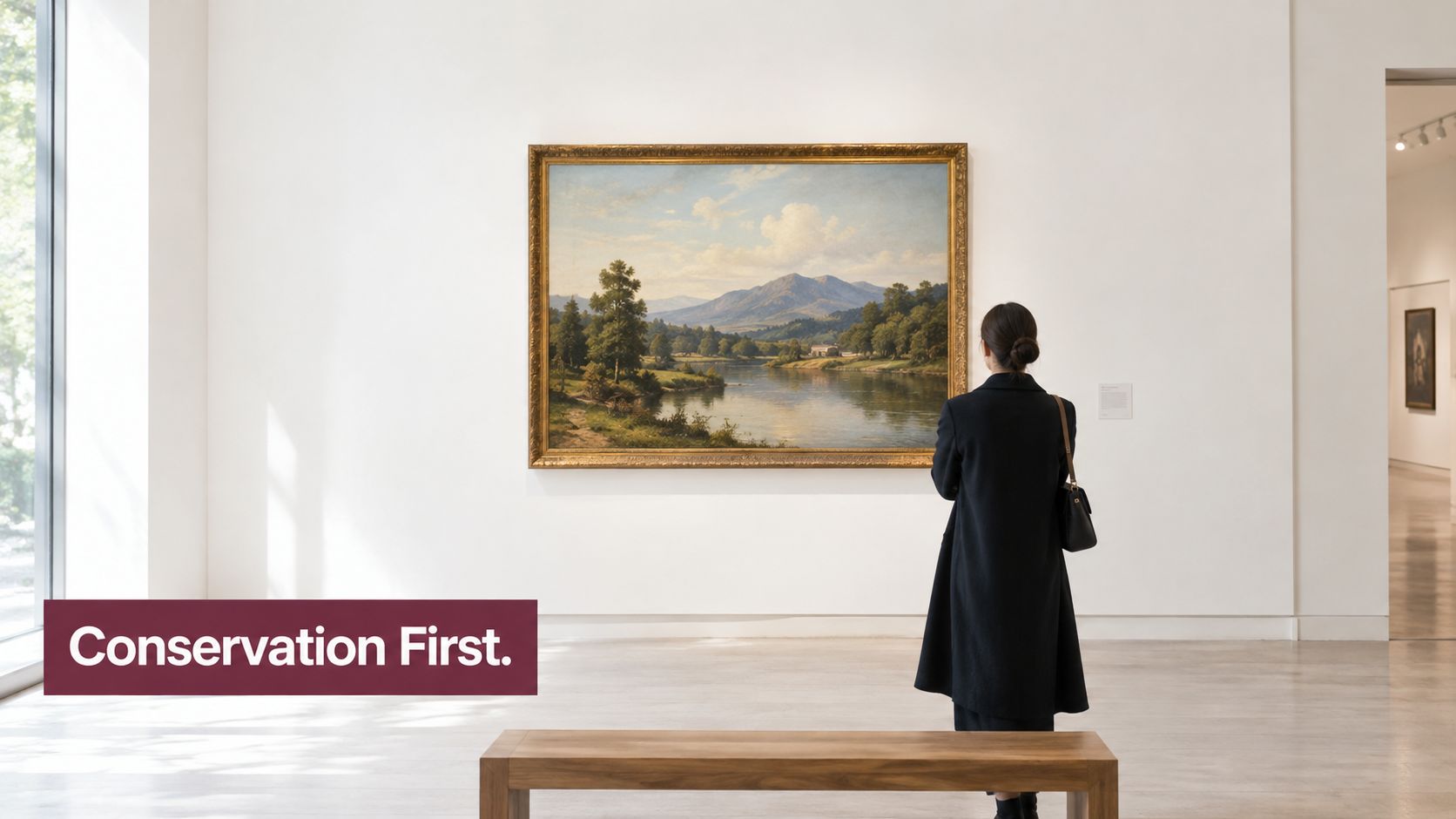
Conservation comes first
Light exposure can damage artwork over time. Conservation evidence describes that damage as cumulative and irreversible, with fading or color changes depending on the total exposure an object receives. That's why a gallery may permit a phone photo while banning flash.
A National Gallery technical study measured a modern photographic flash at approximately 600 lux-seconds per exposure and compared it with an annual recommended exposure of 600,000 lux-hours for oil and tempera paintings. The study also noted that museums generally prohibit visitor flash photography. Sensitive works, including photographs, works on paper, textiles, and objects made with unstable pigments, may have stricter limits. (National Gallery conservation bulletin)
One phone flash probably won't visibly change a painting by itself. Repeated flashes from many visitors create an avoidable exposure, so museums control the habit rather than arguing about each individual picture.
Copyright can belong to someone else
A gallery may own the physical canvas without owning the copyright in its image. That issue becomes especially important with contemporary art, borrowed works, temporary exhibitions, and displays assembled from several lenders.
Penlee House Gallery and Museum prohibited photography partly because many displayed paintings remained under copyright. Derby Museum and Art Gallery restricted photography in its Joseph Wright gallery to prevent unauthorized publication of object images. Those examples show why a gallery can say, “You may look, but you may not photograph,” even when the artwork is hanging in a public room.
Visitors need room to look
Tripods, selfie sticks, external lights, and posed groups change the experience for everyone nearby. A person trying to read a label shouldn't have to walk around a camera setup, and another visitor may not want to appear in a public image.
The same concern appears in documented museum policies that prohibit flash and require advance approval for posed photography. In Tulsa, Gilcrease Museum tells visitors to check gallery entrances and labels for a photography-prohibited icon, while banning flash, tripods, monopods, and selfie sticks. (Gilcrease visitor information)
A no-photo notice is usually about the work, the artist, the lender, or the room. Treat it as a practical boundary, not a personal rebuke.
The Default Rules That Apply Almost Everywhere
You can avoid most uncomfortable moments by following a short set of habits from the second you enter. These rules work well in a small Jenks gallery, a museum exhibition in Tulsa, or a public-art stop around Jenks public art spaces.
Use the smallest setup
Keep the camera handheld. A phone is usually the least disruptive option because it doesn't need a stand, light, or large bag of equipment. Leave the flash off, skip the tripod and selfie stick, and don't use an external light unless staff has approved it.
Stay far enough away that you won't bump a frame or block another visitor. If a room is crowded, wait for a clear moment instead of leaning across someone's view.
Keep personal use personal
Personal use generally means keeping the picture as a memory, sending it to a friend, or sharing a normal visit post on social media when the gallery allows that use. It doesn't automatically give you permission to reproduce the artwork in a product listing, advertisement, publication, business announcement, or paid campaign.
Virginia Museum of Art, for example, permits photography in permanent-collection galleries and allows social-media sharing, but prohibits publication, sale, reproduction, distribution, or other commercial exploitation without authorization. It also requires permission from the museum and relevant copyright holders for editorial, advertising, or commercial photography. (Virginia Museum of Art photography policy)
Run the thirty-second check
Before you raise your phone, look for a sign, an icon beside the doorway, or a note on the artwork label. If you see a restriction, follow it for that work or room, even if photography is allowed elsewhere.
Then ask yourself:
Flash off: Is the flash and any automatic light disabled?
Handheld only: Have you left the tripod, monopod, and selfie stick out of the room?
Room for others: Can visitors pass and view the work without moving around you?
Purpose clear: Is this for your personal memory, or does it support a business, article, class, or project?
Permission confirmed: If the purpose is public or commercial, have you asked the right person?
That checklist keeps a simple phone photo simple.
How Gilcrease, Philbrook, and The Ten District Galleries Compare
Rules around Tulsa are similar, but the differences matter once you bring equipment or plan to publish a photo. Gilcrease and Philbrook set out visitor policies, while a smaller The Ten District gallery may rely on an entrance notice, front-desk staff, or the artist hosting the space.
Institution | Personal Photos | Flash | Tripods / Selfie Sticks | Commercial Use |
|---|---|---|---|---|
Gilcrease Museum | Generally allowed in galleries and on museum grounds unless a work or area is marked otherwise | Prohibited | Prohibited, including monopods | Ask the museum first |
Philbrook Museum of Art | Non-flash personal snapshots are encouraged unless marked otherwise | Non-flash photography expected | Tripods and selfie sticks prohibited | Separate permission required |
Tulsa Air and Space Museum & Planetarium | Handheld personal photography and video allowed unless an exception is posted | May be restricted in some areas | Monopods may be allowed, while tripods and external lights require advance permission | Permission required for educational or commercial use |
The Ten District galleries | Check the entrance notice and ask staff when unclear | Follow the posted rule | Ask before bringing equipment | Obtain written permission before promotional use |
Philbrook draws a clear line between a visitor taking a quick snapshot and a planned portrait session. Portraits, group shoots, and prom pictures in the gardens require a purchased permit, so do not treat them like casual photography at the desk. Review the Philbrook visitor rules before arranging a session.
The Tulsa Air and Space Museum & Planetarium permits personal-use photography and video with handheld cameras and monopods unless a posted exception applies. Tripods and external lights require advance permission from its Marketing Department. Flash may also be restricted in some areas for conservation reasons, according to the museum's press information.
What this means on Main Street
The Ten District galleries can change exhibitions, display borrowed work, or operate events with different staff from one visit to the next. Use the Jenks art galleries and dealers guide to identify local spaces, then follow the notice at each entrance.
For an ordinary visit, bring only your phone, turn off the flash, and keep the photo for personal use unless staff approve something broader. A planned shoot needs an early conversation. Ask before arriving so the gallery can protect the artwork, manage visitor space, and tell you exactly where you may stand.
How to Ask Permission Without Making It Weird
At a Jenks gallery, ask the person at the front desk before you raise your phone. In an open studio, ask the artist. Do it before taking any pictures, unpacking equipment, or aiming the camera at a specific work.
Use a question that names your plan:
“Are personal, non-flash photos okay in this room?”
“May I share a picture of this artwork on my personal Instagram?”
“I'm writing about local galleries. May I photograph the room for an editorial post?”
“I'd like to use an image for my Jenks business. Who needs to approve that?”
“Is this piece covered by a no-photo restriction?”
“Can I take pictures?” is too broad. Staff may approve a quick personal snapshot while prohibiting business use, publication, event photography, or images showing other visitors. Give them enough detail to answer the request you actually have.
Listen for the kind of yes
A clear yes comes with conditions you can follow. A conditional yes may prohibit flash, people in the frame, close-ups of certain works, or social-media sharing. Repeat the condition back if anything remains unclear.
A polite no still gives you a useful next step. Thank the staff member, put your phone away, and ask whether the gallery offers an approved image, postcard, catalog, or online collection view.
Philbrook's published visitor rules distinguish a quick, non-flash personal snapshot from posed photography. Portraits, group shoots, and prom pictures in the gardens require a purchased permit, so treat a planned session as a separate request rather than casual visitor photography.
If a notice is missing or confusing, ask directly: “The notice isn't clear to me. What photography is allowed here?” For a planned return visit, call or email with the date, equipment, intended use, and whether identifiable visitors may appear. That information helps small galleries around The Ten District prepare an answer before you arrive and manage the space without an awkward conversation at the desk.
For organizers working with local businesses and artists, review these stakeholder communication resources before sending the request. Clear details make permission easier to grant or decline.
What Happens When a Local Shop or Artist Wants the Photo Too
A Jenks artist may spend a morning preparing a wall for visitors, then hear a customer ask to photograph one particular piece. The artist wants people to remember the work, but the painting may be on loan, the image may be needed for a future catalog, or the customer may intend to use it in a business post.
The conversation works best when both sides name the purpose. A visitor can say, “I'd like this for a personal post,” while a shop owner can answer, “Personal sharing is fine, but please don't use it in an advertisement.” That small clarification protects the artist without making ordinary foot traffic feel unwelcome.
A notice should answer the practical questions
For a gallery or shop, a short entrance notice can cover the basics:
Personal snapshots: State whether handheld, non-flash photos are allowed.
Restricted works: Mark individual pieces or rooms that cannot be photographed.
Equipment: Explain whether tripods, selfie sticks, or external lights are prohibited.
People in frames: Ask visitors not to photograph identifiable guests without consent.
Public use: Tell businesses, bloggers, and event organizers to request permission before publishing or promoting.
That approach is clearer than a blanket “no cameras” rule when the actual concern is commercial reproduction or a particular loan.
The same care applies when an artist sells work online. Someone researching selling art through a Shopify marketplace still needs to confirm who owns the rights to each image and artwork before publishing it. A gallery's permission to take a picture doesn't automatically transfer reproduction rights to the photographer.
Make event expectations visible
During a district art walk or downtown Jenks art festival, organizers should publish the photography notice at entrances and identify no-photo works individually. Businesses seeking promotional images should get written permission before using artwork or identifiable visitors in advertising.
That isn't excessive paperwork for its own sake. It tells the lender, artist, visitor, and shop owner what will happen to the image. Visitors then know when a quick photo is welcome and when the right choice is to admire the work, ask first, or use an approved image supplied by the artist.
A Quick Checklist Before You Raise Your Phone
You are halfway into a Jenks gallery when your phone is already in your hand. Pause at the entrance, read the sign, and check the artwork label before opening the camera. The same habit works at Gilcrease, Philbrook, and other Tulsa museums, where one exhibition or loan may have stricter rules than the rest.
Step | What to Do | Why It Matters |
|---|---|---|
Look first | Read the entrance sign and artwork labels | Restrictions may apply to one work or exhibition |
Use handheld gear | Keep the phone or camera in your hand | Large equipment can obstruct visitors |
Disable flash | Turn off flash and external lights | Light exposure can harm sensitive artwork |
Protect the room | Stay clear of frames, labels, and walkways | Visitors need an unobstructed view |
Check the purpose | Separate personal sharing from business or editorial use | Permission to photograph is not permission to publish commercially |
Ask when unsure | Speak with staff or the artist before shooting | A quick question resolves unclear rules |
Questions locals often ask
Can I post a permitted gallery photo on Instagram? Usually, yes, if personal photography is allowed. Follow every restriction on the sign or label, and avoid presenting the image as an endorsement.
Can I photograph a painting for my business? Ask before taking the picture. Commercial, editorial, advertising, and product use may require approval from the gallery and the copyright holder.
Can I bring a tripod for a family picture? Ask first. Tripods and selfie sticks are commonly prohibited, and posed photography may require a permit or interfere with other visitors.
What if another visitor appears in my photo? Reframe the shot when possible. Avoid publishing identifiable guests without their consent, especially in business or promotional material.
For planning galleries, shops, public art, and nearby stops, use the downtown Jenks guide and The Ten District hub. These resources can help shape an afternoon route, but they do not replace checking each venue's signs.
The Ten District brings together independent shops, galleries, dining, public art, and community events across downtown Jenks. Bring your phone, check the rules, and ask before raising it when the purpose or equipment falls outside ordinary personal photography.


Comments