

What Is a Pop Up Market? a Downtown Jenks Guide
A pop up market is a group of independent vendors selling from one location for a fixed run of days or weeks, then closing or moving on. In downtown Jenks, the important question isn't just what you can buy, but who has permission to use the space.
If a booth can open beside Main Street, does that mean a food truck can park next to it? Not necessarily. For shoppers, the difference may be hard to see. For organizers in The Ten District, it affects the application, the site layout, and which vendors can participate.
Table of Contents
What a Pop Up Market Is on Main Street - What makes it different from downtown itself
Pop Up Market, Pop Up Shop, or Farmers Market - A quick way to classify what you're seeing
Permits and Food Rules for Downtown Jenks - Food vendors need a location-specific answer - Separate the organizer's job from the vendor's job
How a Pop Up Market Runs From Application to Teardown - Before vendors arrive - On the ground in downtown Jenks
Who Sells, Who Shops, and Who Runs It - Why people decide to come now - Access begins before arrival
Real Jenks Listings to Check Before You Go - Turn the listing into a confirmed stop - Keep the downtown context in view
Plan Around the Schedule Before You Commit - For shoppers - For organizers
What a Pop Up Market Is on Main Street
Think of a seasonal patio that opens for a limited stretch, except several sellers share the space. Each has a separate display and checkout, while an organizer handles the overall schedule and arrangement. The closing date is intentional, not a sign that the businesses failed.
The University of Gloucestershire's Surveying the Pop-Up Scene describes temporary retail settings that can include stalls, food vendors, galleries, cafés, boutiques, and other short-term experiences. Around Main Street in Jenks, that flexibility could let makers use otherwise underused space without each taking on a permanent storefront.
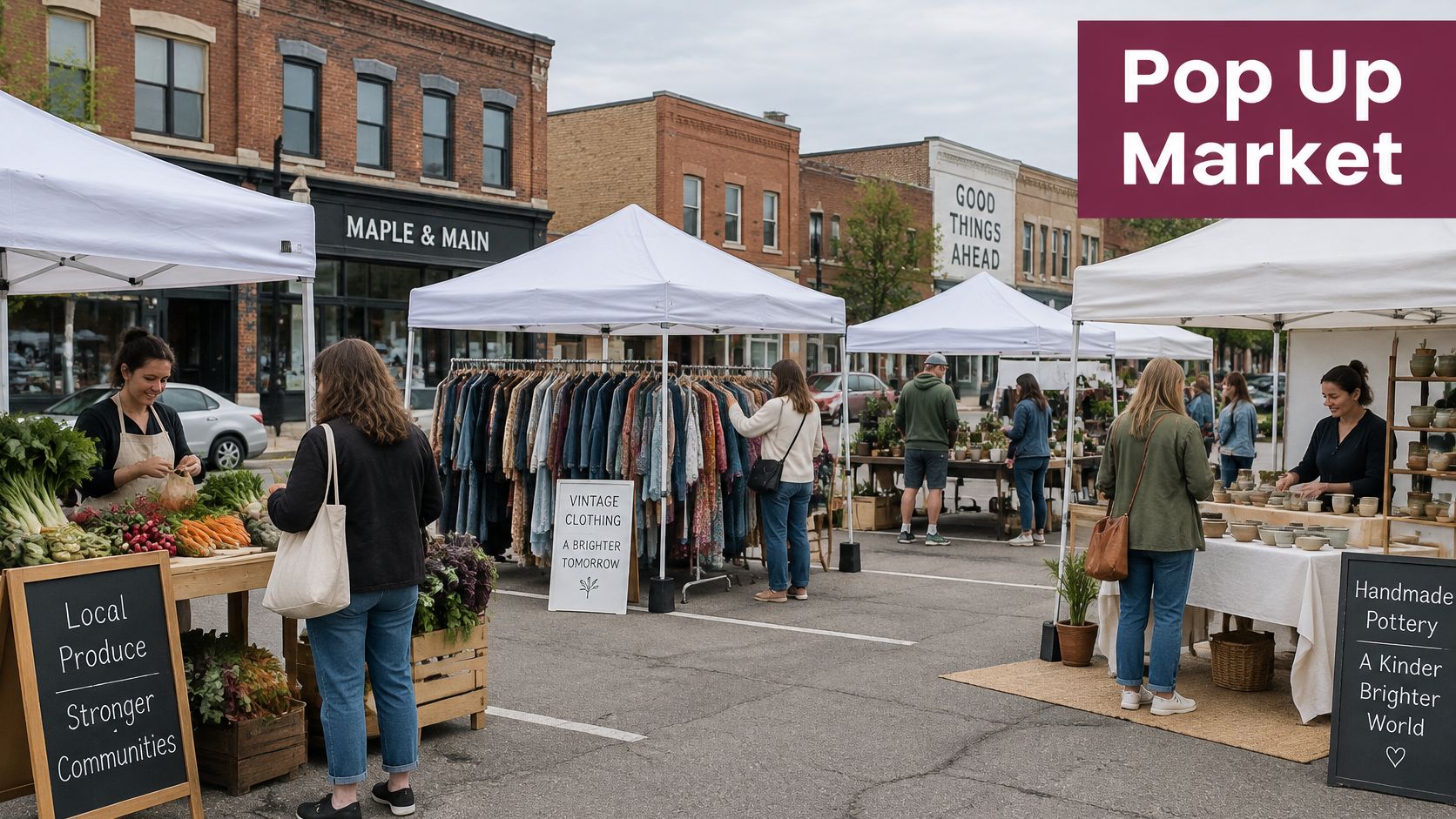
Say you're walking along Main Street and notice a row of booths. A potter has mugs arranged on shelves, a clothing seller has a rack beside a vendor sign, and a maker is explaining how a piece was made. You check the posted dates before deciding whether to browse now or return another day.
That's a hypothetical visit, not a promised Jenks vendor lineup. But it shows what you should be able to understand on arrival: who's selling, where the market begins, and when it ends.
A temporary market should feel easy to enter, not difficult to figure out.
What makes it different from downtown itself
The Ten District is the downtown Jenks district around Main Street. It's a place, not a temporary event. Its independent shops, dining establishments, galleries, and gathering spaces provide the setting in which a pop-up might operate.
A market borrows a defined piece of that setting for a limited run. The booths may leave, but neighboring storefronts still need usable entrances, delivery access, and customers who can find their way through the block.
Pop Up Market, Pop Up Shop, or Farmers Market
How Pop Up Formats Differ
Format | Vendor Mix | Typical Schedule | Usually Run By | Best Use |
|---|---|---|---|---|
Curated pop up market | Several independent vendors | Fixed dates, days to weeks | Organizer or property manager | Testing many vendors at once |
Single-brand pop up shop | One company's products | Short run, often a few weeks | The brand itself | Product launches and sampling |
Farmers market | Growers and food producers | Recurring weekly or seasonal | City, nonprofit, or association | Regular local produce and goods |
Permanent storefront | One business | Multi-year lease | The business owner | Ongoing retail |
These are useful working distinctions, not interchangeable event names. A temporary checkout table doesn't automatically make something a market, and a gathering outdoors doesn't automatically make it a farmers market.
For a Jenks visitor, the label should help answer a practical question: are you arriving to browse several independent businesses, visit a particular brand, or shop a recurring producer market?
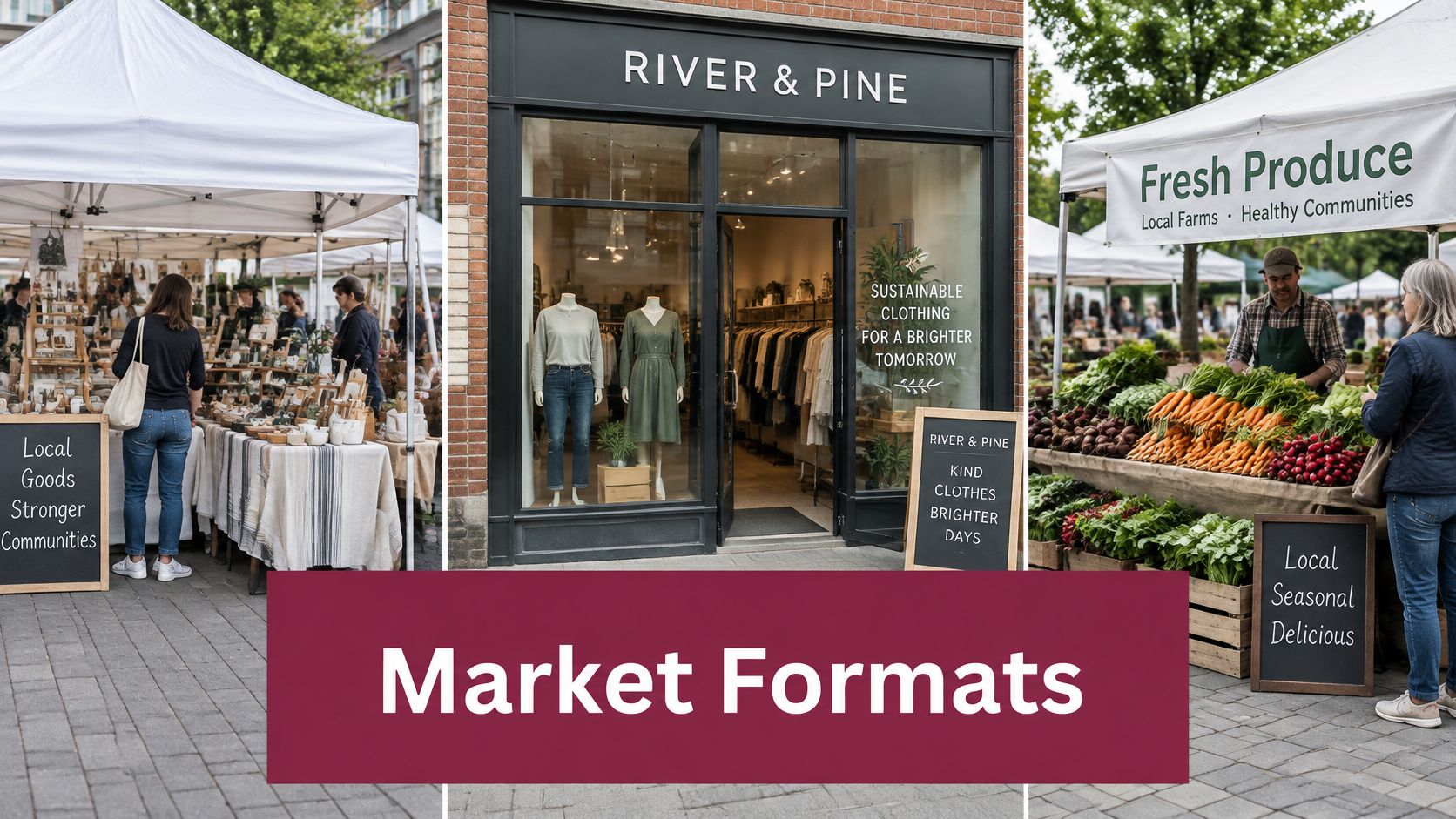
A quick way to classify what you're seeing
Say an organizer brings several independent makers together near Main Street for a themed weekend with shared music programming. That's a pop up market. If a single brand takes a temporary room to demonstrate and sell its own products, it's closer to a pop up shop.
A recurring produce gathering remains a farmers market even if its location changes. Its central purpose is connecting shoppers with growers and food producers, rather than assembling a short-lived assortment around a particular retail theme.
Ask these questions:
Vendor mix: Are several independent businesses selling, or is everything from the same company?
Duration: Is there a defined final date, or an ongoing recurring schedule?
Shared experience: Does an organizer coordinate the vendors, visitor information, and programming?
For an organizer considering space in downtown Jenks, choose the format before naming the event. A curated market makes sense when the purpose is to test a mix of vendors together. A single-brand shop fits a business that needs control over its display, demonstrations, and checkout.
Neither format guarantees profit. FashionUnited's reporting on pop-up retail distinguishes possible outcomes such as awareness, customer feedback, and testing a neighborhood from straightforward financial success. A temporary space is a business experiment, not automatically an inexpensive substitute for a store.
Permits and Food Rules for Downtown Jenks
Permission for a retail booth is not blanket permission for food trucks. Before advertising a downtown Jenks market, an organizer needs to establish exactly where it will operate and which activities that location can accommodate.
For a public-property event, The Ten District's Jenks pop-up hosting guide explains that the City of Jenks requires a Special Event Application at least 90 days before the event, with a $250 application fee for a for-profit event. Special-event approval doesn't replace other potentially necessary permissions, including zoning, health, tent, or park permits.
That distinction matters along Main Street. A proposed event footprint may include private property, city-controlled streets, public rights-of-way, or park space. A property owner's agreement and the city's approval answer different questions.
Food vendors need a location-specific answer
The City of Jenks adopted Unified Development Ordinance says food carts and trucks may not operate in a city right-of-way unless they're part of an approved special event; in the Riverfront Tourist Commercial District, they're generally prohibited except within an approved planned unit development, food-truck court, or approved special event. The ordinance also allows merchandise to be offered, displayed, or sold, and customers served, from the sidewalk, while allowing only non-motorized carts to be located on sidewalks.
Those distinctions can change a proposed layout near downtown or the Arkansas River. An organizer can't treat a parked food truck, a merchandise table, and a non-motorized cart as equivalent uses of the same space.
Practical rule: Ask about the actual vendor activity and equipment, not just whether a market is allowed.
Before accepting booth registrations, put the operational questions in writing:
Property boundaries: Who controls each part of the proposed footprint?
Unloading: Where can vendors stop, and where must vehicles wait?
Vehicle deadlines: When must setup vehicles leave the selling area?
Vendor parking: Where will sellers park after unloading?
Additional review: Which food, tent, zoning, or park permissions still need confirmation?
Separate the organizer's job from the vendor's job
The organizer should provide a clear explanation of what the event approval covers. Vendors should identify what they sell, how they prepare or serve it, and what equipment they intend to bring.
Our guide to becoming a vendor in Jenks is a useful companion for sellers preparing to participate. It shouldn't be mistaken for approval to occupy a particular location.
Start the application process earlier than you think you need to. It's easier to adjust a draft site plan than to explain to accepted vendors why their promised space or food service can't operate.
How a Pop Up Market Runs From Application to Teardown
A smooth market day starts with a sequence, not a tent. For a Jenks organizer, the permit process sets the calendar; vendor approval, payment, load-in, and teardown should fit inside it.
Before vendors arrive
Start with the city application. File the Special Event Application on the required advance timetable and account for the applicable for-profit application fee. Don't make nonrefundable commitments on the assumption that submitting paperwork guarantees approval.
Separate applying from choosing dates. Tulsa's Downtown Midweek Market vendor rules require new vendors to submit an application and scheduling form, while previously approved returning vendors submit only the scheduling form; its fees are $10 per market in advance or $20 on market day, with advance payment due Monday at 11:59 p.m. before the Wednesday event, and fees are non-refundable. Those are Tulsa's terms, not a Jenks price schedule, but they demonstrate how clearly a nearby market can state its obligations.
Confirm acceptance and assigned dates. The manager should send a written acceptance before requesting the final participation payment. Include the approved product category, assigned space, event hours, and an on-site contact so a vendor doesn't arrive expecting something different.
Publish your own payment and cancellation terms. Tell sellers when payment is due, what it reserves, and what happens if weather disrupts the event. Don't leave vendors guessing whether an application submission means they've secured a booth.
On the ground in downtown Jenks
Match load-in to the approved plan. Send the unloading location, vehicle waiting area, parking instructions, and setup deadline before market day. Have vendors rehearse their display using our craft fair booth setup ideas, rather than discovering missing supports or awkward table placement beside Main Street.
Open with clear aisles and visible information. Keep stock boxes, payment lines, and display racks inside the assigned footprint. Post prices and accepted payment methods where a shopper can see them without blocking another booth.
Coordinate departure instead of releasing every vehicle at once. Follow the approved teardown and vehicle-access instructions, then remove merchandise, fixtures, packaging, and waste. Leave neighboring doors and routes usable throughout the process, not just after the final tent comes down.
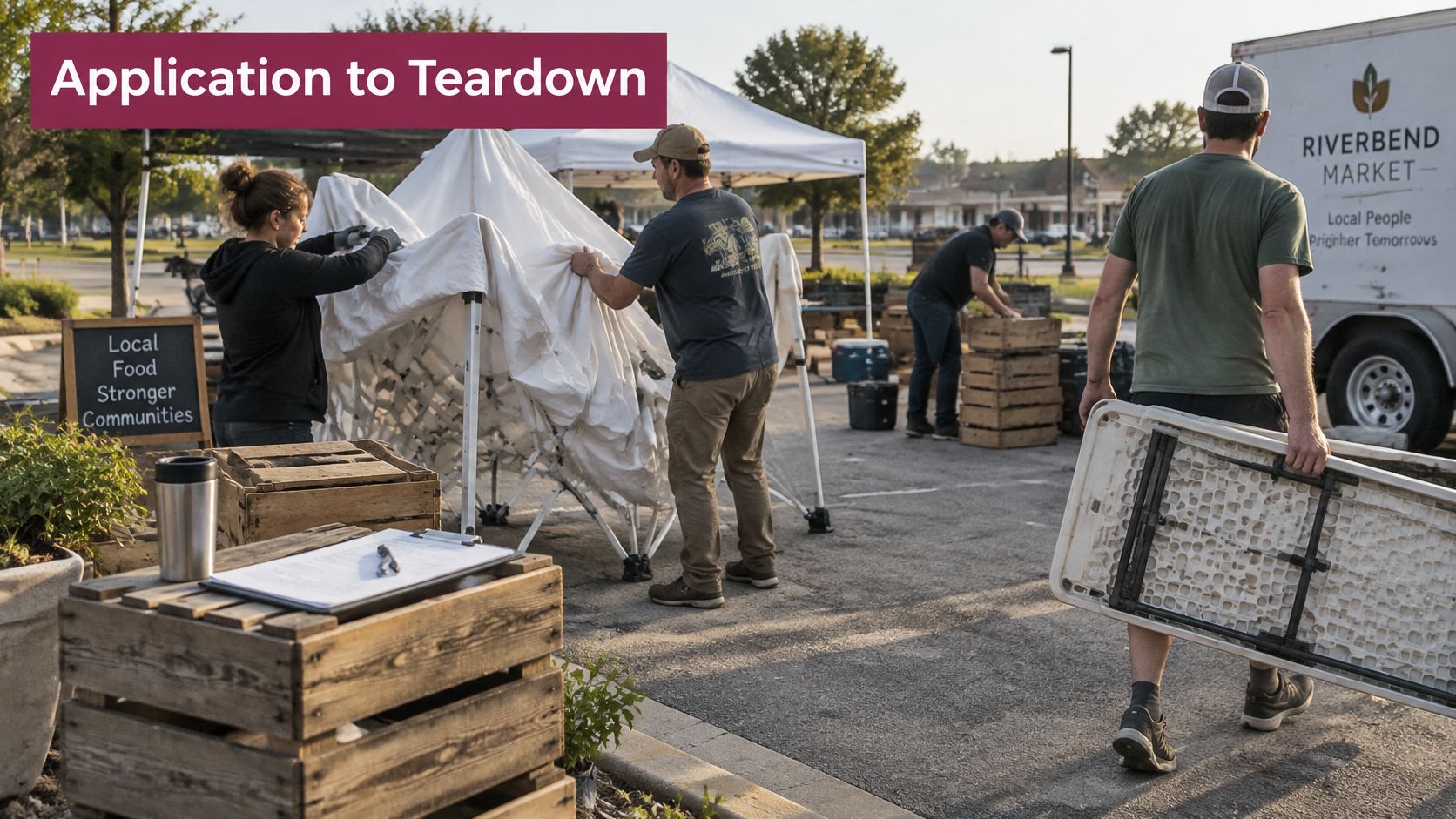
Before leaving, have each vendor record sales, stock-outs, and questions shoppers asked. That small closing task gives the next event a better starting point than a vague impression that the afternoon felt busy.
Who Sells, Who Shops, and Who Runs It
Who Gains and Risks in a Pop Up Market
Party | What They Gain | What They Risk | Question to Ask First |
|---|---|---|---|
Vendors | Low-cost product test and first sales data | Booth fees, unsold stock, uneven foot traffic | What is my total cost per market day? |
Shoppers | A time-limited reason to visit | A wasted trip if hours or vendors change | Are the hours and vendors confirmed? |
Organizers | A program and a reason for repeat visits | Weak attendance, weather, permit delays | Is the special-event application filed within the required advance window? |
Downtown neighbors | Visitors who might not walk past | Crowding, parking pressure, blocked access | Where will vehicles and deliveries go? |
A maker may judge the day by purchases. A shopper may judge it by whether the advertised sellers were present. A neighboring business may care most about whether its entrance stayed accessible.
That's why attendance alone isn't enough to describe a successful Main Street market.
Why people decide to come now
A study in the Journal of Retailing and Consumer Services identifies time scarcity and enjoyable shopping experiences as central influences on pop-up consumer response, with stronger effects on product-level choices than on long-term brand attitudes. A finite opportunity can encourage a visit, but it doesn't establish lasting loyalty by itself.
For a Jenks vendor, the useful question is what shoppers do. Do they buy, ask about a different size, return later, or request information about future availability? For the organizer, demonstrations and thoughtful programming can provide a reason to attend beyond browsing tables.
A food-centered gathering also deserves its own expectations. Our Jenks America Food Truck Festival guide provides a local companion for readers comparing event formats, rather than assuming every market has the same food lineup or operating arrangements.
Access begins before arrival
A market-access study published by Taylor & Francis identifies convenience, consistency, communication, and customer psychology as recurring barriers across markets in nine countries, with transportation, location, and language among the most common problems. Calling an event community-oriented doesn't resolve those barriers.
For downtown Jenks, organizers should ask:
Getting there: Can someone reach the entrance without a car, and is the walking route explained?
Using the space: Can visitors move through with a stroller or mobility device and find somewhere to rest?
Understanding costs: Are prices, payment methods, and any assistance-program acceptance advertised clearly?
Fitting the day: Can families and shift workers reasonably attend during the posted hours?
A welcoming market removes uncertainty before a visitor leaves home.
A beautiful row of booths can still exclude residents if the hours, route, language, or prices make participation difficult.
Real Jenks Listings to Check Before You Go
A real address helps turn the definition into a possible outing, but a directory entry isn't the same as a confirmed event.
The FindHomegrown Jenks Farmers Market listing gives the address as 301 E. Main St., Jenks, Oklahoma 74037, describes the market as open year-round, and lists Monday from 9 a.m. to 6 p.m., Tuesday through Friday from 9 a.m. to 3 p.m., and Saturday from 9 a.m. to 3 p.m. The entry also showed no vendors had joined at the time of publication, so treat those details as a schedule to verify, not a guarantee of occupied stalls.
The year-round description also shows why labels need care. A directory's use of market terminology doesn't establish that an operation fits a fixed-run pop-up format.
Turn the listing into a confirmed stop
Say you're planning a Main Street errand and considering adding a market visit. Before leaving, seek confirmation that sellers will be present that day, rather than relying solely on the directory's posted hours.
Ask whether the gathering is indoors or outdoors and where visitors should enter. Then check the parking arrangement. Don't assume a convenient unloading area is available for shopper parking, or that a nearby lot belongs to the event.
Our guide to outdoor markets near Jenks can help you compare possible outings. Confirm each event separately, especially if you're making a special trip from elsewhere in the Tulsa metro.
Keep the downtown context in view
A dedicated group of local merchants came together to rebrand and promote Jenks' downtown community. Accurate, usable visitor information supports that work better than an attractive announcement without a confirmed place or schedule.
The Ten District stretches west from the Arkansas River toward the historic Midland Valley railroad tracks. A market stop can fit into time on Main Street, but its listing should still stand on its own.
Write down:
Address: The exact destination and entrance.
Day's hours: A current confirmation, not just a saved screenshot.
Vendor presence: Whether sellers are expected when you plan to arrive.
Parking choice: A legal place to leave the car without obstructing deliveries or access.
Plan Around the Schedule Before You Commit
A good Jenks market plan should survive a simple question: what would make this trip worthwhile for the person arriving? Shoppers need a dependable visit. Vendors need a useful test. Organizers need a purpose they can evaluate after teardown.
For shoppers
Confirm the destination: Verify the address, day's hours, and participating vendors before making a special trip.
Choose parking beforehand: Check the event's directions and preserve access for neighboring businesses.
Check the event type: Use our guide to flea market hours when comparing market schedules, rather than assuming every temporary selling event follows the same pattern.
For organizers
Resolve permission first: Establish the application timetable, property status, and approvals before committing to a space.
Write down the target: Decide whether you're testing sales, collecting customer feedback, building awareness, or inviting voluntary mailing-list signups.
Measure useful outcomes: Track sales per visitor, average transaction value, conversion rate, repeat visits, and vendor sales per operating hour. Compare those results with the target, not just the crowd size.
For local planning context, our Free Market Intelligence Report is free and delivered immediately after the lead form is submitted. It covers hundreds of data points for all ten downtown Jenks blocks, including foot traffic patterns, demographic profiles, consumer spending behavior, daytime population, and market growth trends.
Pick a candidate date, count backward through the city's required application window, and confirm the property and permit status before choosing a space. That's a stronger beginning than reserving booths first and trying to make the location work afterward.
We publish practical guidance for downtown Jenks markets, vendor participation, and planning a selling space. Visit The Ten District to explore local market guides and use our Free Market Intelligence Report to put a proposed Main Street location in context before committing.


Comments