

8 Downtown Scavenger Hunt Ideas for Jenks, Oklahoma
You've got the kids, a visiting cousin, and a Saturday plan to walk around Main Street. Give everyone a few things to find before you leave the car, and an ordinary downtown Jenks walk becomes a reason to look up, compare answers, and stop somewhere new.
The best downtown scavenger hunt ideas don't require an app or an elaborate prize. They need a route that makes sense, clues you can solve, and a finish that happens before everyone gets hungry.
The Ten District spans ten downtown blocks from the Arkansas River to the historic Midland Valley railroad tracks, giving us storefronts, railroad connections, dining stops, and public art to build around. That's the district's footprint, not a requirement to walk every block.
For young children: Choose a short picture hunt with a planned snack stop.
For visiting adults: Try architectural details, dining bingo, or a photo walk.
For a bigger outing: Make the river or Tulsa a separate leg rather than stretching a Main Street hunt beyond everyone's patience.
These are formats you can put together yourself, not advertised events or standing merchant promotions. Check the route and ask permission before making any business part of the game.
Table of Contents
1. The Ten District Main Street Heritage Hunt - Build clues around what's still standing
3. Downtown Jenks Dining Bingo Crawl - Make the merchant arrangement explicit
4. Riverwalk to Main Street Connector Hunt - Walk the connector before inviting the group
5. Tulsa Gathering Place Nature and Art Scavenger Hunt - Let accessibility determine the route
6. Blue Dome and Brady Arts District Scavenger Hunt - Choose architecture or galleries as the main attraction
7. Downtown Festival Scavenger Hunt for Organizers - Keep participation easy for vendors
8. Downtown Jenks Public Art Photo Hunt - Judge attention, not camera equipment
Pick One Route, Park Once, and Start Walking - Make the final decisions before leaving home
1. The Ten District Main Street Heritage Hunt
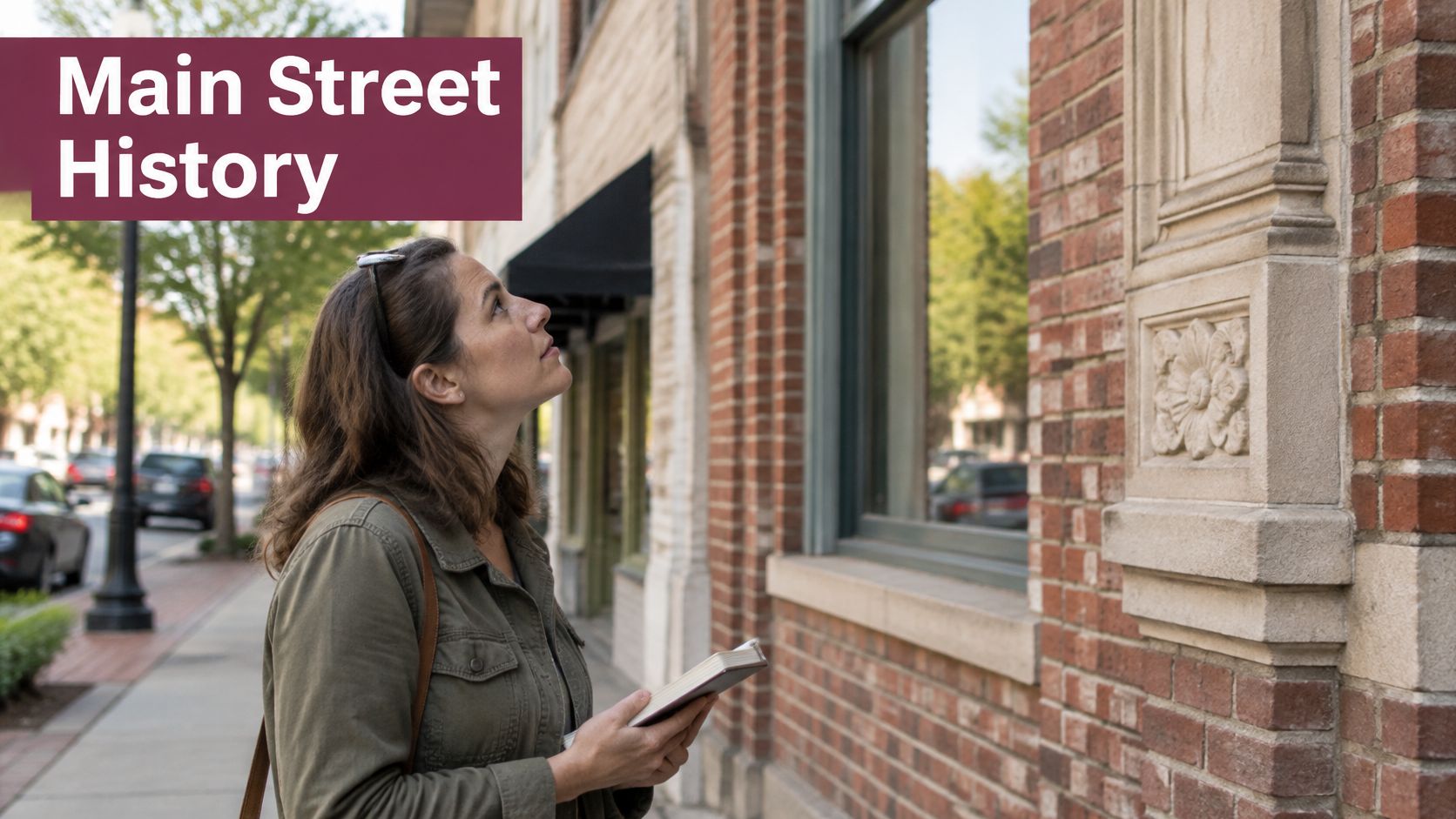
Start with the buildings, not obscure trivia. A good heritage clue asks players to notice brick patterns, recessed entrances, upper-story windows, or lettering they can see from a public sidewalk.
For a river-to-railroad version, begin toward the Arkansas River end of The Ten District and work west along Main Street. Keep the railroad connection interpretive: participants can think about how a railroad town developed without approaching the tracks or entering railroad property.
Build clues around what's still standing
Say your visiting cousin likes history but the kids don't. Give the adults a question about a façade and let younger players find a matching shape in the same building. Everyone can work on the same stop without needing the same reading level.
Try prompts such as find an entrance set back from the sidewalk or sketch a brick pattern above a window. Verify each answer yourself, and don't assign a construction date or original use unless you have documentation.
For practical boundaries, the City of Jenks downtown district page identifies Main Street between First Street and Fifth Street, free Main Street street parking, and additional parking at Jenks Commons Park, 220 E. A Street.
Local planning rule: Park once and walk. Moving the car between clues turns a pleasant Main Street outing into a parking exercise.
Finish at a café or restaurant you've checked in advance. Clues based on permanent architectural features will outlast clues tied to a changing window display or tenant.
2. Jenks Family Clue Hunt for Kids on Main Street
A preschooler doesn't need a question about railroad history. A picture of a circle, a flower, or a striped awning gives them something understandable to look for while the grown-ups enjoy Main Street.
Make a card with large pictures and room for a check mark. Let children point, describe, or ask an adult to photograph their finds rather than making writing part of the assignment.
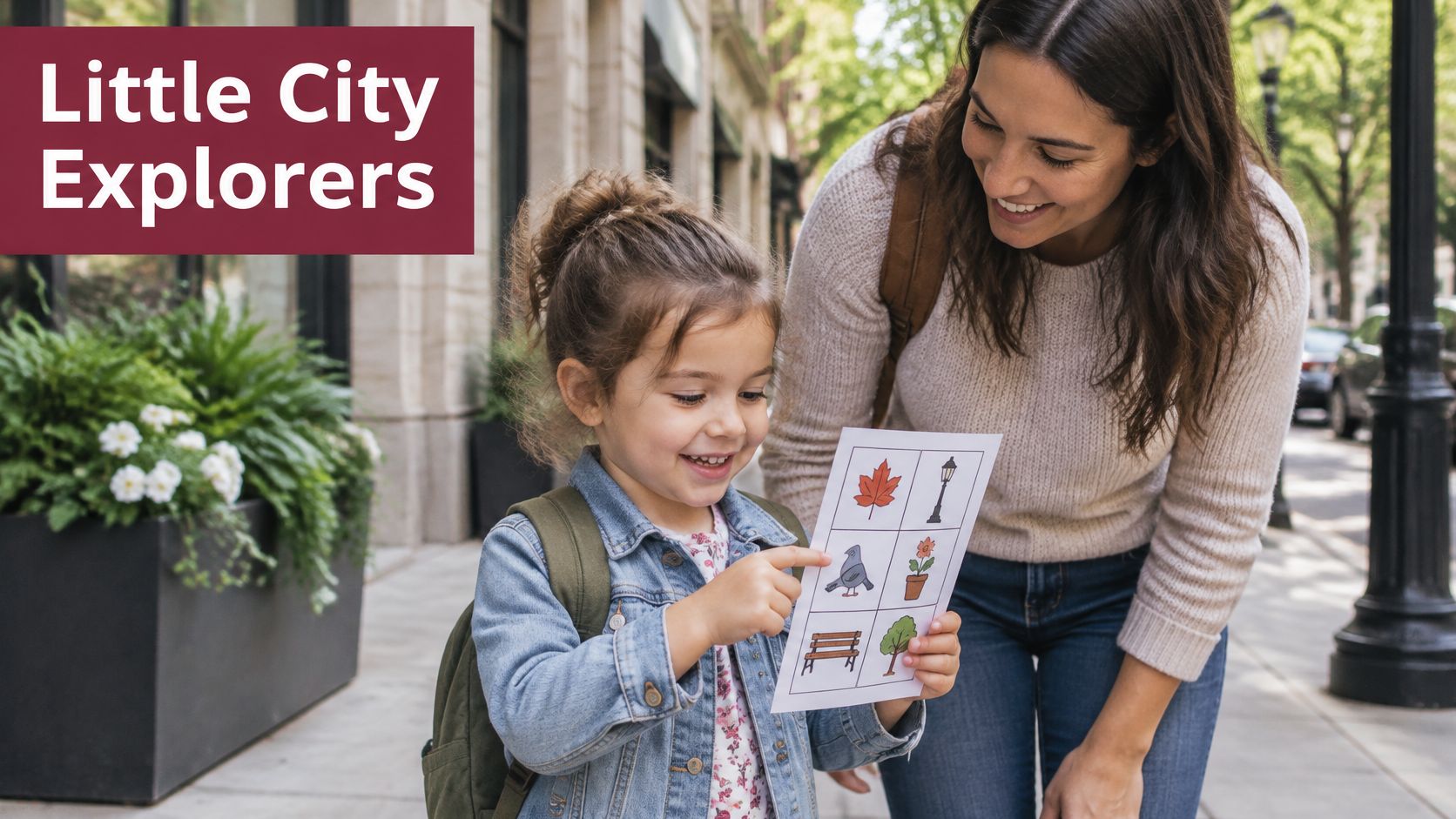
For a mixed-age family, give younger children the picture card and older children a descriptive challenge, such as finding something made from both wood and metal. Keep everyone together rather than sending the strongest readers ahead.
Use look-only tasks: Find a leaf shape or a bright doorway without collecting objects or touching merchandise.
Assign supervision clearly: An adult should know which children they're watching, particularly at crossings.
Plan the finish: Carry stickers or another small reward, and identify a restroom and snack option before starting.
The PlayAtMe scavenger-hunt safety guide recommends visible boundaries, adult supervision, short loops, meeting points, and changing plans when weather makes an outing unsafe. Apply those principles to our downtown, where driveways, traffic, and business entrances need attention.
Don't make speed part of the score. Children should stop to examine a clue, not race toward the next crossing.
In summer, choose a cooler part of the day and carry water. If thunder, excessive heat, or tired children change the mood, hand out the reward and finish early. Completing a card isn't more important than getting everyone back comfortably.
3. Downtown Jenks Dining Bingo Crawl
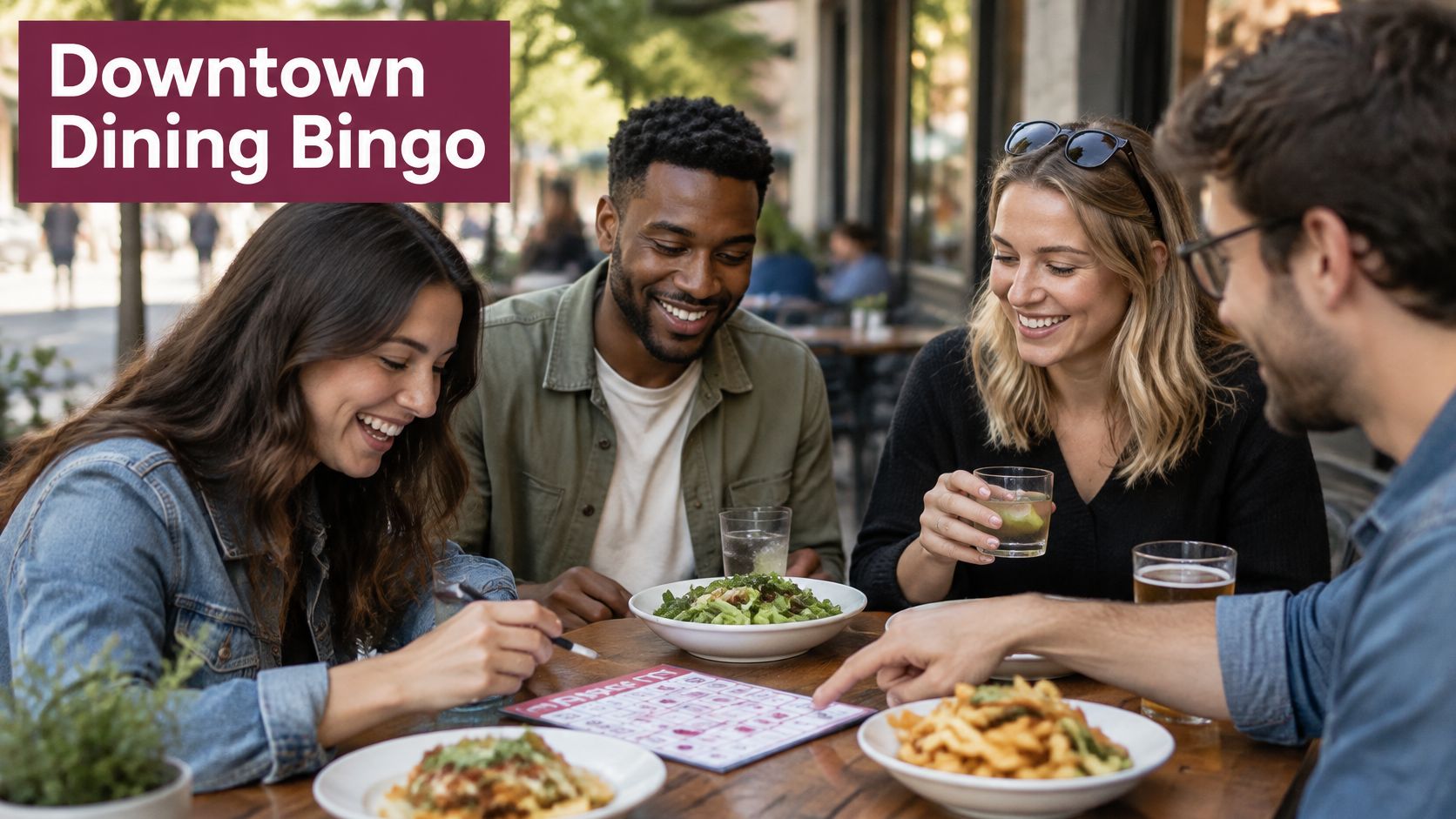
Dining bingo works best when it feels like a meal with a game attached, not an obligation to buy something at every storefront. Build the card around experiences: read a seasonal menu, share a dessert, notice a locally themed decoration, or choose a drink you haven't tried.
Use flexible wording. Order a seasonal special is easier to maintain than a square naming a dish that might disappear before your group arrives.
Make the merchant arrangement explicit
For a casual evening with friends, players can mark their own cards. For a public promotion, get each restaurant's agreement before promising stamps, discounts, prizes, or staff participation.
A workable example is a group that meets for coffee, explores Main Street, and finishes with dinner. Some squares involve purchases, while others involve observation, so nobody has to exceed their budget to participate.
Keep purchases optional: Offer observation-based alternatives with equal credit.
Make redemption clear: Print the finish date and approved prize pickup location on any promotional card.
Respect service: Don't ask staff to solve clues during a rush or hold tables while players wander elsewhere.
Tourism's broader local value is a reason to distribute stops thoughtfully: a Frontiers in Sustainable Cities article summarizing tourism economics reports that every $1 of direct tourism spending generates an additional $0.73 in broader economic activity. That's economic context, not a promise about a Jenks bingo event.
The useful local measure is simpler: did people enjoy themselves, discover another business, and feel free to return?
4. Riverwalk to Main Street Connector Hunt
Treat this as a longer outing for willing walkers, not the default route for a family with a tired toddler. The appeal is the change of setting, from the Arkansas River edge to the storefront scale of downtown Jenks.
Keep the clues about that transition. Ask players to photograph a river view, identify a change in walking surface, and find an architectural detail once they reach Main Street.
The City of Jenks parks and recreation page describes the Aquarium Trail along Aquarium Drive, also identified as 101st Street, from Elm Street toward the pedestrian bridge near 96th Street and Riverside, connecting the Oklahoma Aquarium and Jenks Riverwalk with regional trails. That establishes real route anchors, but it doesn't verify every crossing or sidewalk segment you might use to reach Main Street.
Walk the connector before inviting the group
Don't draw a straight line on a map and assume it's a comfortable pedestrian route. Check crossings, sidewalk continuity, construction, and the return journey in person.
Choose a clear turnaround: Players should know where the river portion ends and the downtown portion begins.
Carry water: Don't depend on a business being open at the moment someone needs a drink.
Protect the return: Use a verified loop, or retrace a comfortable route rather than improvising a shortcut.
Use our Jenks weekend trip planner to organize the broader day around the walk and meal stops.
A connector hunt should make the connection enjoyable. If the walking link feels awkward or unsafe, make the river and Main Street separate outings instead.
This version suits adults who want walking to be a substantial part of the day. It's a poor fit when everyone really wants lunch and a quick look around.
5. Tulsa Gathering Place Nature and Art Scavenger Hunt
Gathering Place is the Tulsa alternative when your group wants a park outing rather than storefront clues. Keep it separate from a downtown Jenks walking route, then return to Main Street for dinner if everyone still has energy.
Build the hunt around observation: contrasting leaf shapes, a reflection, a textured surface, or a view that includes the Arkansas River. Don't require children to collect plants, leave paths, or crowd a play feature to get an answer.
For example, a grandparent and child could work together on a texture card. The child finds something smooth or rough, while the adult describes it or takes a photograph from an accessible path.
Let accessibility determine the route
Before leaving, consult the park's official information for current hours, visitor rules, and a map. Choose a compact portion of the grounds rather than promising to cover every attraction.
The practical barriers discussed in Scavify's scavenger-hunt planning guidance, including stairs, uneven surfaces, and clues dependent on sight or hearing, are useful checks for this outing.
Check the surface: A route needs to work for the actual wheelchair, walker, or stroller coming with your group.
Offer equivalent answers: Let participants describe, point, photograph, or listen where appropriate.
Keep scoring equal: An accessible alternative should earn the same credit as the original task.
Shorter can be better. A comfortable loop with seating and an obvious return point is more useful than an ambitious route that separates the group.
Leave the Jenks dinner plan flexible. Hungry, tired children won't enjoy another hunt after the park, but they may enjoy choosing where everyone eats.
6. Blue Dome and Brady Arts District Scavenger Hunt
If someone suggests the Brady Arts District, clarify the meeting place before anyone drives. Use the current Tulsa Arts District name on your route sheet, and treat it and Blue Dome as distinct route choices rather than assuming the whole group wants a long cross-downtown walk.
This outing suits adults, teens, and visitors who enjoy architectural details and art. Start with visible exterior features, then add galleries only after checking opening hours and visitor policies.
A workable example is a Blue Dome architecture hunt in which players identify curved forms, contrasting building materials, and a sign designed to be seen from a distance. The landmark gives the route a recognizable anchor without requiring speculative historical answers.
Choose architecture or galleries as the main attraction
An exterior hunt can continue when a gallery is closed. A gallery-centered hunt needs more coordination and shouldn't depend on staff explaining the game.
Pick a specific meeting point: Give everyone the same landmark and a clear return location.
Check parking before arrival: Look for current signs, restrictions, and event notices rather than assuming a weekday space will be available.
Keep art prompts respectful: Ask participants to notice color or composition, not touch work or interrupt visitors for photographs.
Worth deciding beforehand: Is this an art outing with optional clues, or a competitive game? Galleries are much easier to enjoy when nobody's rushing through them for points.
For a version closer to home, use our downtown art walk planning guide to think through a Jenks-based route.
Don't automatically combine Tulsa sightseeing with another full hunt in Jenks. Choose the walking destination first, then make dinner or shopping the relaxed part of the day.
7. Downtown Festival Scavenger Hunt for Organizers
A festival hunt should help people explore the event without making vendors manage another job. Place clues where participants can see them, and send completed cards to a central finish table.
The Downtown Commons offers a concrete gathering point to consider. The Jenks Chamber's downtown overview identifies a permanent stage, food-truck access, and space used for concerts, movies, and festivals; those features don't mean the space is automatically available for your event.
For example, a market organizer could ask visitors to find a vendor's posted symbol, identify a material used by a maker, and locate the designated results table. Vendors should approve any task involving their booth before the card goes to print.
Keep participation easy for vendors
Use our guide to finding vendors for a Jenks event when assembling the event, then explain the hunt separately to participating businesses.
Keep clues visible: Don't make shoppers interrupt a sale to obtain an answer.
Separate entry from purchasing: Let people finish without buying from every participant.
Assign a finish-table volunteer: Vendors shouldn't have to settle scoring disputes.
Publish boundaries: Keep clues away from loading areas, traffic lanes, and restricted spaces.
If you add QR codes, provide paper equivalents and immediate confirmation after scanning. A Taiwan heritage-site study found that visitors used AR trigger points to access artifact information, a useful example of attaching meaningful content to discovery rather than making the scan itself the entire activity.
For Jenks, that content might explain a merchant's craft or a building detail, with the owner's approval. A simple paper card still wins when mobile coverage, battery life, or volunteer capacity makes technology another obstacle.
8. Downtown Jenks Public Art Photo Hunt
Give photographers a visual problem rather than a location list. Ask them to frame an artwork with surrounding architecture, capture a detail from the sidewalk, or show how light changes its appearance.
This makes a Main Street photo hunt interesting even when participants already know the area. It also avoids turning every stop into the same pose in front of an object.
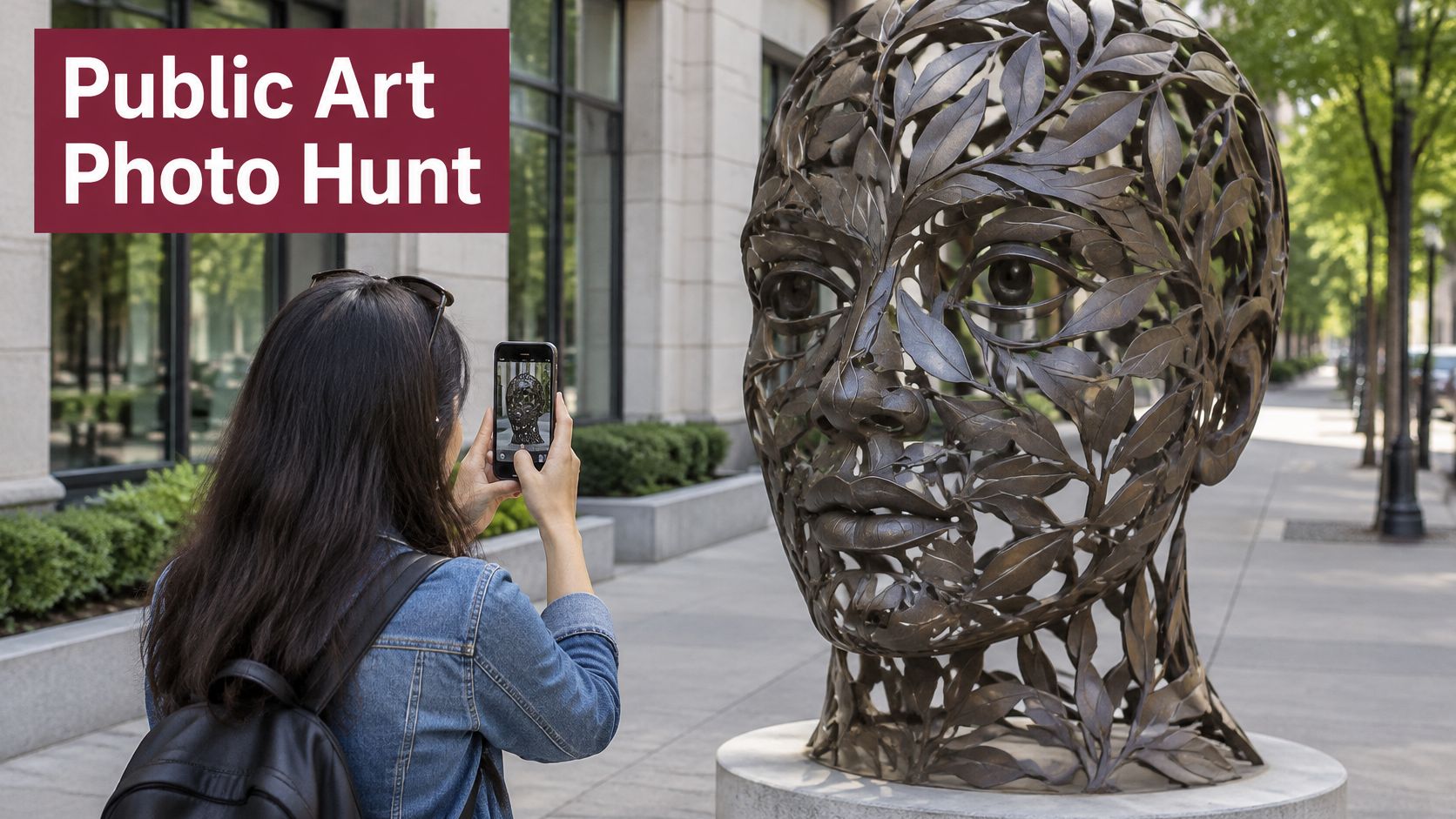
Treat the image as inspiration for framing, not a location clue. Verify every Jenks artwork on your route before printing its description, since a photograph alone doesn't establish where a piece stands today.
Judge attention, not camera equipment
Say a family arrives with a phone and a teenager brings a dedicated camera. Give credit for finding the subject and explaining the composition, not sharpness, editing, or expensive equipment.
Use safe viewpoints: Nobody should step into Main Street or climb a structure to reproduce an angle.
Respect bystanders: Wait for a clear frame and avoid making strangers part of the challenge.
Keep sharing optional: Use an existing event hashtag only if the organizer has established one, and get permission before posting identifiable participants.
For an indoor extension, consult our guide to taking pictures in art galleries and follow each gallery's rules. Permission to look at art isn't blanket permission to stage a photo challenge around it.
Start early if you want a quieter background, but don't promise an empty sidewalk. A successful photograph can include the everyday activity of our downtown without interrupting it.
How the Downtown Scavenger Hunt Ideas Compare
Item | Best For | Setup Needed | Where It Runs |
|---|---|---|---|
The Ten District Main Street Heritage Hunt | History and architecture enthusiasts | Clue cards; no equipment needed | Downtown Jenks Main Street |
Jenks Family Clue Hunt for Kids on Main Street | Young children and families | Picture checklist; optional small reward | Downtown Jenks Main Street |
Downtown Jenks Dining Bingo Crawl | Adults exploring local dining | Bingo cards, business coordination, and prizes | Downtown Jenks restaurants and cafés |
Riverwalk to Main Street Connector Hunt | Visitors combining nature and downtown stops | Route planning and current trail information | Arkansas River trail area and downtown Jenks |
Tulsa Gathering Place Nature and Art Scavenger Hunt | Families and park visitors | Clue sheet and park map | Gathering Place in Tulsa |
Blue Dome and Brady Arts District Scavenger Hunt | Arts, architecture, and nightlife visitors | Clues; check venue hours and parking | Blue Dome and Brady Arts districts in Tulsa |
Downtown Festival Scavenger Hunt for Organizers | Festival and market attendees | Printed cards, clues, volunteers, and prizes | Downtown Jenks festival or event areas |
Downtown Jenks Public Art Photo Hunt | Families, photographers, and first-time visitors | Photo checklist and phone or camera | Public art locations in downtown Jenks |
Pick One Route, Park Once, and Start Walking
Choose the hunt that fits your group this weekend, not the one that looks best on paper. For a first visit, the Main Street Heritage Hunt is the most straightforward choice: find an appropriate parking space toward the river end if available, follow a checked route west, and finish with a meal in the district.
Families with young children should trim that plan immediately. A picture card, a comfortable loop, and a reward in someone's pocket will do more good than a beautifully written history quiz nobody wants to finish.
Before printing anything, walk the exact route with the clue sheet in hand. Look at it from the position of the shortest child, the person using a mobility aid, and the adult trying to keep everyone together.
Make the final decisions before leaving home
Confirm the clues: Check that storefront details, displays, and artwork still match your descriptions.
Choose the stopping point: Decide where you'll finish if weather, fatigue, or hunger interrupts the route.
Bring a paper backup: A printed card keeps a dead phone from ending the outing.
Set a reunion plan: Everyone should know where to wait and which adult to contact if the group separates.
Don't hide essential information inside a riddle. Restrooms, boundaries, crossings, and the meeting place belong in plain language where everyone can find them.
If you're organizing for the public, separate your creative walk from an advertised promotion. Businesses need to approve any promised participation, and public-space use may require coordination with whoever manages the location.
Afterward, ask what people enjoyed. Keep the clue that made everyone look closely at a building; remove the stop that caused confusion or sent the group back across the street.
Our downtown doesn't need an elaborate game to be worth exploring. A thoughtful hunt gives us a reason to slow down, notice the details between destinations, and make a familiar Main Street walk feel different.
The Ten District shares local stories and guides to downtown Jenks shops, dining, public art, and community events. Visit The Ten District to choose a meal stop or another downtown activity to pair with your scavenger hunt.


Comments