

How to Host a Pop Up Shop in Jenks: A Permit-First Plan
You've found the space. Maybe it's a vacant storefront on Main Street, maybe it's a tent in a park for one Saturday, and the owner has already said yes. What you don't have yet is the permit, and in Jenks that's the detail that decides whether your date holds.
How to host a pop up shop here is, first, a filing question rather than a merchandising one. Work out which approvals your setup triggers and how far ahead each one has to be filed, and the spot, budget, footprint, parking and scorecard all arrange themselves around a date you can keep.
Table of Contents
Permits and the Booking Decision - Count Back From Your Opening Date - The Questions That Decide Your Date
Choosing the Spot on Main Street - What to Bring Back From the Walkthrough
Running the 90-Day Launch Timeline - Where These Launches Stall
Layout and Staffing Within a Small Footprint - Work From the Walkway Inward
Scoring the Pop-Up and Whether It Paid Off - The Measurement Mistake - What the Money Actually Says
Permits and the Booking Decision
A Saturday pop-up can be ready to trade and still miss its opening date because the application went in too late. Check the permit path before you commit to a date or take on a lease. The setup determines which approvals apply, and the longest lead time sets the earliest workable opening.
Setup | Permit or approval | Timing | Key limit |
|---|---|---|---|
Public property, park or right-of-way | City of Jenks Special Event Application, $250 fee for for-profit events | At least 90 days before the event | Does not replace zoning, health, tent or park permits |
Seasonal sales or sidewalk display on private property | Temporary Use Permit | Before the activity begins | Seasonal sales up to 42 days per calendar year |
Food cart or food truck | Temporary or Conditional Use Permit per location, plus Jenks and state licenses | Before operating at each location | Prohibited in downtown districts except the Downtown Commons park area or an approved special event |
Start with the location and activity, not the shop name. A tent in a city park, a six-week retail run on Main Street and a food truck at the Downtown Commons each trigger different approvals. Put every approval on the calendar; the earliest deadline controls your opening date.
Submit the city's Special Event Application at least 90 days before the event. For a for-profit event, the $250 fee is due before approval. The application covers the event, not separate zoning, health, alcohol, tent, amusement or park permits. The organizer is also responsible for extraordinary city costs, including personnel, barricades, directional signs, cleanup and property damage.
A single event can involve several applications. Vendors, tents, amplified sound and generators may each require a separate conversation with the relevant authority. List each item and its approval requirement before you promise a date.
Count Back From Your Opening Date
Subtract 90 days from your target opening date. That is the application deadline, not the day to begin asking what paperwork you need. The application package requires a lease or owner authorization, so secure written permission while keeping your commitment conditional on approvals.
Ask for authorization that takes effect only if the required permits are granted. Avoid signing a lease you cannot exit if an application is denied. A landlord's offer for a week six weeks away may sound attractive, but it cannot shorten the city's 90-day lead time.
The Questions That Decide Your Date
Check these four points before committing to a Saturday:
Does the event touch public property? A sidewalk, park, easement or street closure can trigger the special event process and its 90-day lead time.
Will you sell food, and is the location allowed? Downtown food-cart and food-truck sales are limited to the Downtown Commons park area or an approved special event.
Does each part of the concept need separate approval? Check vendors, tents, amplified sound and generators individually.
Will approvals be in hand by opening day? If the schedule does not allow it, choose a later date.
A date aligned with an event already happening in town can give a pop-up a ready-made reason to visit. Choose the date only after checking that the permits, location and operating limits fit.
The booking decision can also shape the next step for the business. The Ten District's personalized incentive roadmap outlines up to $250,000+ in available incentives for new retail and restaurant concepts, including TIF district opportunities, façade grants and development programs. For basic registration and record-keeping questions, the Snyp guide for new sole traders offers general guidance.
Choosing the Spot on Main Street
Pick the spot before the date. Start with the frontage you want in The Ten District and decide whether it sits on private property, public property or the right-of-way, because that single answer selects your row in the table above.
Then walk it with a tape measure. Storefronts along Main Street's boutique row can look generous from the road and shrink once a sandwich board, a queue and a stroller are in the picture.
What to Bring Back From the Walkthrough
Curb and clear width: note the curb height and how much sidewalk stays open after your display goes in.
Loading: find where a delivery vehicle can stop without blocking traffic, and ask whether load-in has to happen before the shop opens.
Written authorization: ask the property owner, in writing, whether they'll authorize the temporary use. A verbal yes is worth little when the city asks who approved it.
Park permits: if any part of the event belongs in a park, budget for a park permit on top of everything else.
Door findability: stand across the street and check whether someone driving in from Elm or 96th can spot the entrance.
Nobody remembers the clever name on the window if they couldn't find the door.
Record what the spot looks like at the hours you intend to trade. Count people walking past between 10 and 11 on a Saturday, then again at 2, and write both numbers into the site packet before you sign anything.
Setting the Budget Line by Line
Numbers first, venue second. In 2024, 44% of pop-ups cost less than $5,000 to set up, according to CEOWORLD figures reported in Spring Fair's retail coverage. Treat that as a floor for a simple booth, not a plan for an event with staff, insurance and a permit fee.
Build the budget in categories you'll still recognize after the fact:
Space: rent or any owner charge, plus the special event fee if you're on public ground.
Compliance: insurance, the certificate of insurance naming the venue or city, and any vendor certificates.
Build: tent, tables, fixtures, signage, extension cords, battery lighting.
Payment: the point-of-sale setup plus a backup terminal or hotspot and a cash box with small bills.
People: greeting, checkout and replenishment shifts, costed realistically.
Promotion: printed cards for Main Street merchants, a social post, a door sign.
Inventory: including the portion you may carry home.
Then add a contingency line for a slow approval. A permit that lands two weeks late doesn't just shift a date, it leaves you paying for space you can't trade in.
The go or no-go line: decide before opening what contribution, after permits, fees and labor, makes the event worth repeating. Write the number down. It's the difference between a decision and a feeling.
Keep the reconciliation categories identical to the planning categories, so the after-action numbers compare to the plan without translation. If you're building this alongside a nonprofit partner or a community group, our notes on event planning for nonprofits cover the shared-cost side.
Running the 90-Day Launch Timeline
Ninety days is enough time if you use it in order. Here's the sequence I'd run, and why each step sits where it does.
Secure the venue and confirm zoning before you sign. Zoning is the answer that can void everything downstream, so it goes first, not after the deposit.
At 60 to 90 days out, submit public-space, street-closure or event applications. Toast's guide to starting a pop-up shop puts permit processing at four to eight weeks, which is exactly why this window is the one organizers most often miss.
At 30 to 45 days out, finish sales-tax registration and any signage, tent, sound, generator, food or beverage approvals. These are the filings that come back with questions, so they need room for a second submission.
At least two to three weeks before opening, close out the paperwork: the certificate of insurance, vendor certificates, temporary-occupancy approval and written confirmations from everyone whose name appears on a permit.
Assemble the site packet. A scaled floor plan with fixture dimensions, customer-flow paths, emergency exits, exit signage, fire extinguishers, temporary occupant load, run-of-show, lease or owner authorization, and insurance naming the venue or city as additional insured.
Run a permit matrix listing each approval's authority, submission date, lead time, responsible person and status. No merchandise gets loaded until every occupancy and safety dependency is cleared.
Where These Launches Stall
Three failures show up again and again. Signing a lease before zoning is confirmed. Treating a short run as exempt from licensing because it's only nine days. Leaving crowd, food or temporary-structure approvals out of the plan entirely, then discovering them at load-in.
The paperwork doesn't care that the run is short.
Then there's the part that isn't paperwork. A dedicated group of local merchants came together to rebrand and promote Jenks' downtown community, and that network is the fastest route to vendors, borrowed fixtures and the word of mouth that makes a short run look busy on day one. Start those conversations early, and use our guide to finding vendors for an event when you're short a maker or two.
Layout and Staffing Within a Small Footprint
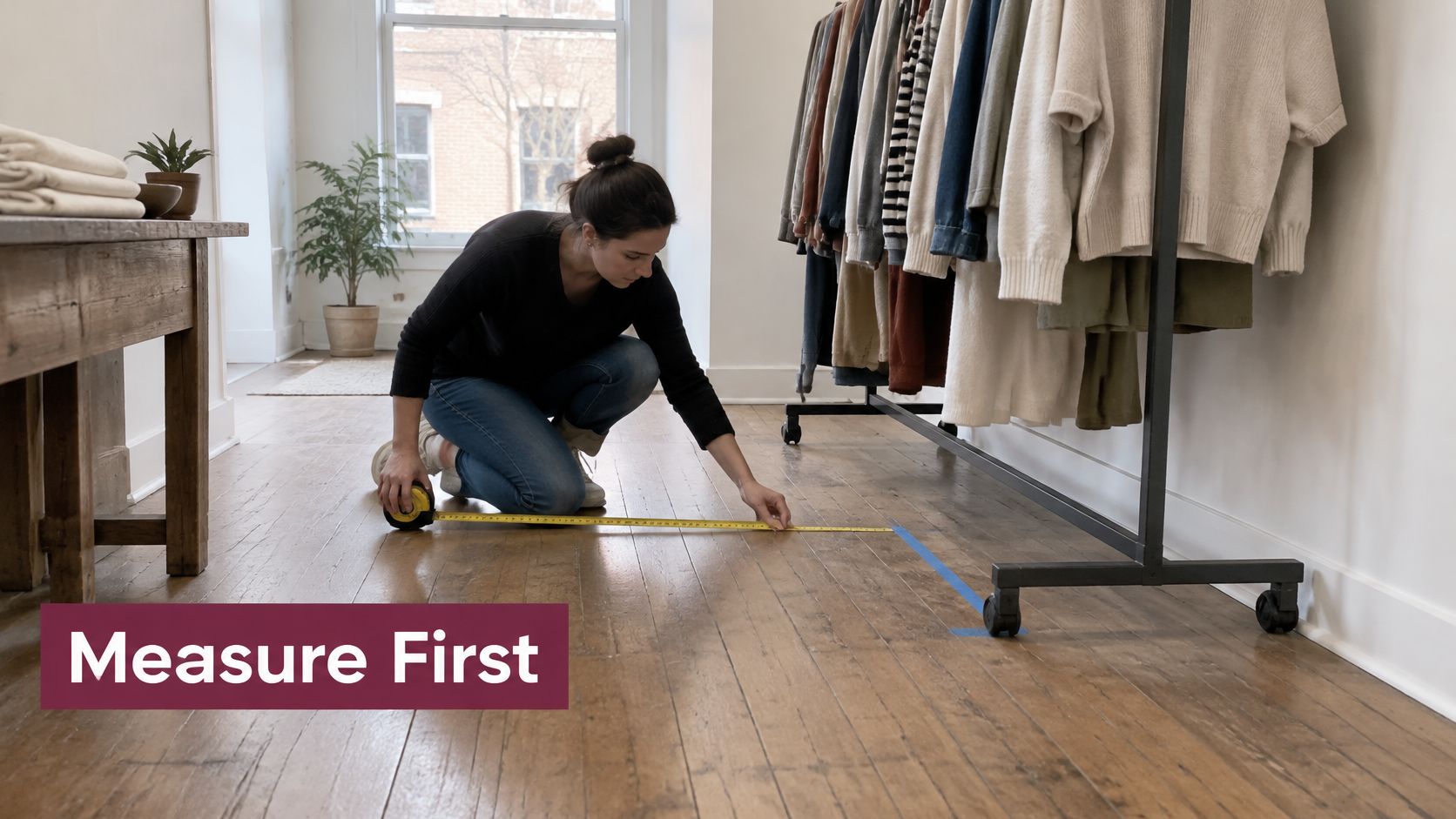
Measure before you merchandise. Jenks treats seasonal sales as a defined activity: a Temporary Use Permit must be obtained before it begins, the sales area is capped at the lesser of 20% of the parking spaces required for the main business or 2,000 square feet, and displays cannot reduce a pedestrian walkway below five feet, per the city's zoning materials. Those three numbers shape every layout decision on Main Street.
Work From the Walkway Inward
Measure the available floor, then subtract the walkway. Whatever is left is your selling area. Draw it, don't estimate it.
Put the destination product where the walkway can see it. A shopper should know what you sell from the sidewalk, without stepping inside.
Map four zones in order: greeting near the door, demonstration or fitting behind it, checkout on the exit path, replenishment out of the customer flow.
Name one person per zone before opening day. Shared responsibility on a three-person shift means nobody owns the queue.
Shape the line so it doesn't eat the walkway. A floor mark or a second register position costs less than a blocked entrance.
Then run three checks with a real body in the space. Can someone with a stroller pass the display? Can staff reach stock without crossing the checkout line? Can a shopper read prices from the walkway?
If a display needs a sign explaining where to stand, the layout is doing the wrong work.
Density beats breadth in a small footprint. One strong category, faced and priced clearly, outsells four categories competing for the same six feet of shelf. Finish with a to-scale sketch you can hand to staff and to the city if anyone asks. Booth configurations that work at craft fairs translate well to a storefront corner, which is why our craft fair booth setup ideas are worth reading before you buy fixtures.
Checkout Backups and Food Limits That Keep Sales Moving
Food is where the paperwork multiplies. Under the Jenks Unified Development Ordinance, a food-truck operator needs a Temporary or Conditional Use Permit for each operating location, an Occupational Tax License from Jenks, liability insurance, an Oklahoma State Department of Health mobile-food license and an Oklahoma Tax Commission sales-tax permit. A truck generally may not stay at one address more than 12 hours, or operate there more than three consecutive days or five total days in a 30-day period without City Council approval.
Carts and trucks are prohibited in the Downtown and Downtown Core districts except in the Downtown Commons park area or during an approved special event. That's the rule that decides whether food belongs inside your pop-up at all or needs to sit under an event permit umbrella with its own vendor list.
Payment is the quieter risk. Sweden's central bank found that only slightly more than 10% of small businesses could accept card payments offline, 9% could not charge when their point-of-sale system was unavailable, and 3% reported another inability to charge, per the 2025 payments report from Sveriges Riksbank. Related Swedish research cited there found 30% of retail and service businesses did not accept cash. Different country, same exposure: a temporary seller with one terminal and no signal is a seller with no revenue.
Test the recovery path, not the terminal. Before opening, switch off the network and complete a sale, a refund and a manual receipt. If that takes more than a minute, fix it now.
Post your accepted payment methods in every promotion and on a sign at the door, keep a cash box with small bills, and staff a fallback checkout when the line grows past what the walkway allows. Readable prices cut the queue of people who line up only to ask. Keep a non-QR way to pay as well, since families, tourists and older shoppers don't all carry the same setup.
Parking and Promotion for a Main Street Pop-Up
A shopper who cannot tell where to park may skip the stop. Downtown Jenks offers free street parking on Main Street, with additional parking at Jenks Commons Park at 220 E. “A” Street, according to the Jenks Downtown District parking information. Point out the street spaces for quick visits and the park for longer browsing.
Give visitors the route before they arrive. Put clear parking directions in your event post, on printed cards and on a sign at the entrance. A simple map can answer the question faster than a caption.
Post parking directions ahead of opening: explain where to look for a quick Main Street stop and where to park for a longer browse.
Identify a drop-off and loading location: choose a place where a vehicle can pause without blocking traffic and a hand truck can reach the door.
Brief every shift: make sure staff can give consistent parking directions and point visitors to the nearest restroom.
Promotion should cover the practical details as well as the product: event date, hours, parking and what will be for sale. Ask Main Street merchants to hand out printed cards, and collect sign-ups from visitors who want updates about future events. If Pinterest is part of the promotion mix, how FoPost handles Pinterest content explains an option for scheduling pins so event details can keep appearing after opening day.
Keep displays, loading and pedestrian flow in view when choosing the footprint. A booth cannot assume every customer parks out front, and a storefront cannot treat the sidewalk as private space. Visitors making a longer day of it can include the stop alongside other Main Street shops and dining, using the Jenks weekend trip planner.
Scoring the Pop-Up and Whether It Paid Off
Treat the shop as a funnel with a rent bill. Count four numbers every hour: qualified passersby, entries, transactions and revenue.
Metric | How to calculate | Benchmark or check |
|---|---|---|
Entry rate | Entries divided by qualified passersby | Track against your own baseline each hour |
Purchase conversion | Transactions divided by entries | Storefront pop-ups commonly cite 20% to 40%; general retail guidance reads about 12% low, 30% medium, 45% high |
Average transaction value | Revenue divided by transactions | Compare each trading block against target |
Lead capture | Consented email or SMS sign-ups from non-buyers | Count as a result in its own right |
Contribution margin | Gross sales minus payment fees, tax, shrinkage, labor, rent, permits and promotion | Reconcile within 24 hours |
The benchmark row is a reference point rather than a target, since it comes from storefront pop-ups in general. Shopify's pop-up shop guide is the source for the funnel math and the conversion bands, and it's worth reading before you print a single sign.
The Measurement Mistake
Dividing sales by total event attendance hides the answer you need. In a district that draws families and day-trippers, a big attendance number can make a weak storefront look decent. The denominator that matters is entries through your door.
Between trading blocks, change one thing at a time: assortment, signage, queue layout or staffing. Changing the ads while conversion sits flat buys traffic the shop can't convert.
What the Money Actually Says
Reconcile the day within 24 hours: point-of-sale totals, payment fees, tax, inventory shrinkage, labor, rent, permits and promotion. The number you want is contribution margin, not gross sales. Watching budget against actuals line by line is the same discipline a finance team runs, and AI2Fin's notes on spotting budget variances early translate well to a five-week run.
Awareness counts too. In a survey of organizations that ran at least one pop-up in 2019, more than 80% considered it successful and 58% planned to host another, while surveyed brands most often reported improved market visibility at 51% and increased sales and greater social-media engagement at 46% each, per Footwear News. If sales were modest and your lead list doubled, you didn't fail. You bought data.
The Ten District runs ten blocks of downtown Jenks from the Arkansas River to the historic Midland Valley tracks, and it's where a pop-up gets its foot traffic, its neighboring merchants and its parking plan. Before you file a single form, spend an afternoon walking Main Street and see which storefront, corner or park space would carry the run you have in mind. Start at The Ten District to see what's happening downtown and which businesses already call Main Street home.


Comments