

How to Find Vendors for an Event in Jenks, Oklahoma
Your event is on the calendar, the block is reserved, and you have three food trucks and a guy with a sound system in a group text. Then the city emails about the application, and the question changes from who's available to who's documented.
Most guides to how to find vendors for an event start with a search and stop at a quote. That order is backwards for a downtown district. Vendors you can't document are vendors you can't use, no matter how good the tacos are.
The sequencing that works in Jenks starts with the city's clock, moves through the paperwork each vendor type carries, and only then gets to the brief, the search, the scoring and the signature.
Table of Contents
Lead Times and Paperwork by Vendor Type
If your event needs a stage, a sound system, a generator, a security crew or a headliner, the clock has been running for months. High-demand production teams are often booked nine to twelve months in advance, especially in the busy stretches from March through June and September through December, according to published event planning guidance. A recurring festival or a seasonal outdoor market on Main Street should begin research that far out for staging, sound, power, security, sanitation and headline entertainment.
Everything else can move faster, but not much. The same guidance puts the typical proposal-to-selection cycle at roughly four to eight weeks for mid-sized events, and that already includes writing the request, reviewing responses, asking follow-up questions and signing.
Four inputs come first: the date, the venue, the format and the budget. A quote built on a date you're still debating is worth nothing by the time you compare it to the next one.
Where Each Vendor Type Falls on the Calendar
Vendor type | Start sourcing | First document to request | Verify first |
|---|---|---|---|
Staging, sound, power and security | 9-12 months ahead for peak dates | Written service scope and staffing plan | Load-in and power needs for the exact site |
Food trucks | At least 8 weeks ahead | Oklahoma State Department of Health mobile food license | Location is covered by a Temporary or Conditional Use Permit |
Concessions and food vendors | At least 8 weeks ahead | Certificate of insurance | Product-liability limits meet the Tulsa-area minimum |
Beer, wine or spirits | At least 90 days ahead | Oklahoma ABLE Commission special event license | Which party holds the license for the event |
Makers, craft and retail vendors | 4-8 weeks ahead | Oklahoma Tax Commission sales-tax permit | Booth size, power and tent needs |
Entertainment and performers | 9-12 months for headline acts, 4-8 weeks for local performers | Written performance agreement with insurance | Arrival and teardown windows |
Food trucks and concessions sit in the middle, not because they're slow but because their permits run on a separate city clock the event application doesn't control. Alcohol sits further back still. Any event pouring beer, wine or spirits needs the license question settled before the application goes in, and that question is really about which party holds it: the organizer, the venue or a licensed caterer.
For entertainment, the venue and the act are one decision. Our guide to entertainment venues near Jenks is a useful starting point when you're matching a performer's technical needs to a real room or lot.
Jenks Permits and the 90-Day Filing Clock
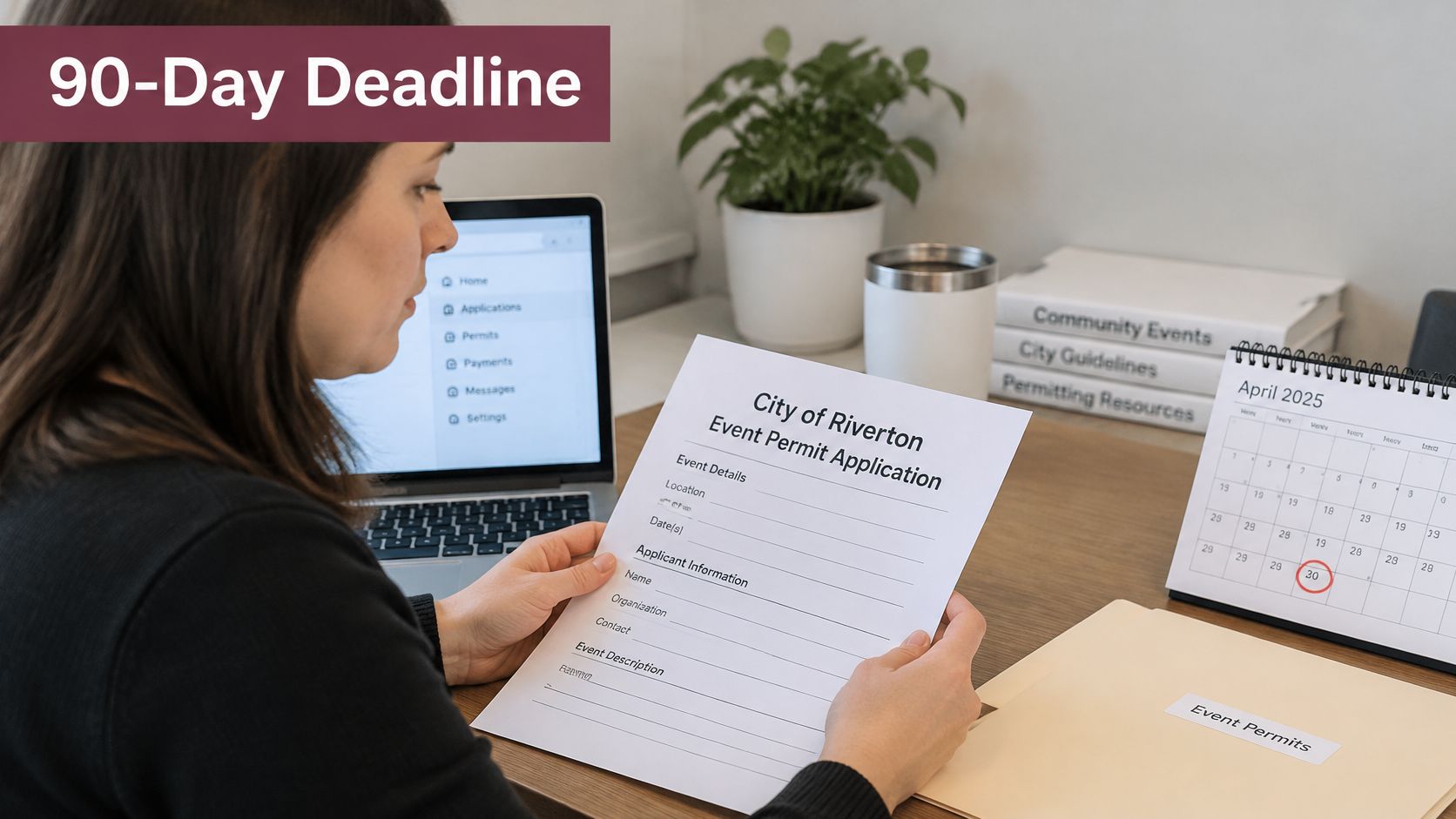
The vendor search runs on the city's calendar. Any event that touches public property, a public right-of-way, an easement or another city resource answers to one fixed number: the City of Jenks Special Event Application must be filed at least 90 days before the event, per the city's special event application. Exceptions are granted only for special or unusual circumstances.
Filed applications go to the Special Events Committee for review, then to City Council for approval or denial. That two-step path is why recruiting can't wait until spring. The plan you submit has to show where trucks park, where the power comes from, which lane closes and who cleans up afterward, and none of that exists until your vendors are chosen. Work backward from the filing date and a late-spring event needs its vendor list settled in winter. If a nonprofit board is filing, event planning for nonprofits in Jenks covers the roles and approvals that trip up first-time filers.
The Fee Question Worth Asking Twice
Budget the fee, then confirm it, because the city's own materials don't agree. The downloadable application states there is no application or approval fee, while the city's current online form says for-profit applications require a $250 fee before approval. Get the answer in writing before that line goes into your budget, and keep the reply in your event file.
What a Food Truck Needs Before You List It
A truck can't just sign your vendor form. Jenks requires a Temporary or Conditional Use Permit from the Planning Department for every location where the truck operates, plus an Occupational Tax License, current liability insurance, an Oklahoma State Department of Health mobile food-establishment license and an Oklahoma Tax Commission sales-tax permit, as set out in the city's food truck permit requirements and process.
The permit is tied to the location. A truck approved for one spot on Main Street isn't automatically cleared for the lot two blocks over, and the city can require an outdoor vendor to relocate or adjust operations during a special event. Walk the exact footprint with the vendor before you file: where the generator sits, where the line forms, which direction the service window faces.
Other cities build the vendor list straight into the filing, which shows what a deadline like ours protects. The District of Columbia's 2025 planning guide requires organizers to submit a preliminary vendor list at least 30 days before an event, carry public-liability coverage, meet ADA standards and secure propane permits for food vendors, per HSEMA's 2025 special events planning guide. Your vendor decisions aren't separate from the application. They are the application.
Write the Vendor Brief Before You Call Anyone
One document, sent to every candidate, is the difference between comparing proposals and comparing sales pitches. Write it before the first call, because the brief is what turns a phone conversation into something you can score. It also does double duty for your filing: attendance, footprint and setup windows are the same details the city paperwork asks for, so a solid brief means vendors hand you finished answers instead of figures you have to chase down later.
It includes these items, in the order that keeps you organized:
Date, hours and rain date. The Saturday, plus the Sunday you'd move to if weather turns. Vendors price a rain date differently, so name it.
Attendance by hour. A single day total hides the peak. A market that peaks at 11 a.m. needs different staffing than one that builds at 6 p.m.
The exact location. A named block, not "downtown." The west end of Main near the Midland Valley tracks tells a driver something. Downtown Jenks doesn't.
Services by category. Food, sound, power, sanitation, security and rentals, each listed separately with quantities.
Setup and teardown windows. When the street closes, when the first truck can move in, when the last one must be gone.
Budget range. A range, not a wish. Set it too low and the vendors you want will pass; set it too high and every bid lands at the top of it.
Insurance requirements. The limits and the requirement to name the organizer on the certificate.
Accessibility. Accessible routes, accessible restrooms, shaded seating and a quiet spot away from the speakers.
Power and water. How many circuits, where the hookups are, and whether the site has any at all.
Proposal deadline. A date and a time, not "as soon as possible."
Here's the same brief in miniature. A Saturday makers market on a closed block of Main Street, three food trucks, six craft booths, one sound system, roughly 400 visitors across four hours, setup from 6 a.m., street reopened by 6 p.m., with a budget range you've already agreed internally. Every vendor answers that.
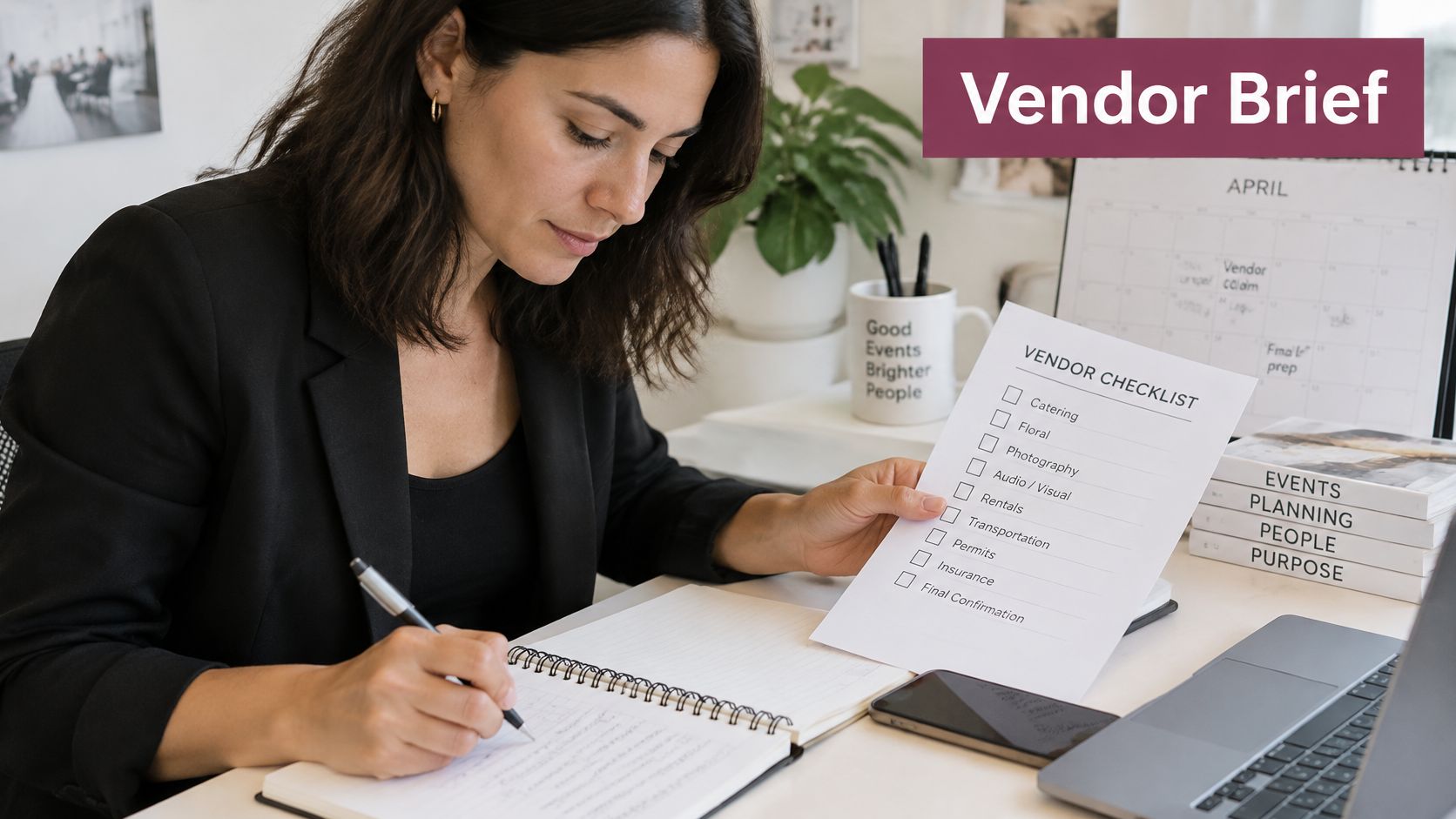
Send the identical brief to every candidate and give them at least four business days to respond. That window isn't arbitrary: the Cvent 2026 Global Planner Sourcing Report, which surveyed 1,650 professional planners, found that nearly 97% of respondents said a structured RFP and sourcing approach saved them both time and money, and most planners expect vendor responses within four business days regardless of event size.
If the truck-heavy lineup is the part you're unsure about, the Jenks America Food Truck Festival page shows how that kind of lineup comes together downtown. Then run the test. If a vendor has to ask a question the brief should have answered, the brief needs another pass before it goes to anyone else.
Find and Reach Candidates Downtown and Across Tulsa
Start with the people who already live with the street. The merchants along Main deal with deliveries, foot traffic and closures every week, and they know which loading zones work and which vendor setups have failed in front of their windows. A dedicated group of local merchants came together to rebrand and promote Jenks' downtown community, and that network is the shortest path to a name worth calling.
Next, ask the venue or your city contact who has worked similar events on the same ground. Then widen out to peer organizers in Broken Arrow, Bixby, Sapulpa and Tulsa, who will tell you plainly who showed up on time and who left a mess. Word of mouth beats a web search in this category every time, because nobody reviews a tent company online.
For categories nobody local covers, run targeted searches and check primary sources: the vendor's own site, its license records, its last two event references. Aim for three to five candidates per category, which is the range recommended in a review of supplier selection methods. The same research found organizations tend to apply hard minimum requirements during preselection, then move to price bidding and qualitative analysis for the final choice.
Send this, not a text. Subject line naming the event and date, the brief attached, a request for a proposal on the same scope, and a reply date four business days out.
Sending to a handful is normal, not excessive. In Knowland's 2024 State of the Meetings Industry survey reported by PCMA, two out of five planners sent RFPs to up to five venues, and more than one-third sent them to as many as 10.
Log every contact with the date it went out, because that record carries into the scoring step and settles arguments later. If a maker wants to sell event shirts, Raccoon Transfers on DTF apparel printing explains how short-run printing works, which helps you judge whether they can deliver by the date. And if the gap in your lineup is entertainment, finding local artists around Jenks is where to start.
Score Proposals with Pass-Fail Gates
Apply gates first, score second. A bid that fails a gate is out no matter how good the price looks, and gates are the cheapest due diligence you'll run all year.
Tulsa treats a special-event approval as one piece of a stack. The City of Tulsa lists separate Health, Alcoholic Beverage, Tent, Park, Vendor, Sales and Amusement Ride permits that an outdoor event may also need, and when concessions are approved, the applicant must carry product-liability coverage of $175,000 per individual and $1 million for multiple individuals from a single occurrence or accident, per the City of Tulsa special events page. Serving beer, wine or spirits also requires a Public, Charitable or Special Event License from the Oklahoma ABLE Commission.
Gate | What to request | Benchmark |
|---|---|---|
Product liability for concessions | Certificate of insurance naming the organizer | $175,000 per individual and $1 million per occurrence |
Food service license | Oklahoma State Department of Health mobile food license | Required for food trucks |
Sales-tax compliance | Oklahoma Tax Commission sales-tax permit | Food trucks must hold one |
Alcohol service | Oklahoma ABLE Commission special event license | Required before any beer, wine or spirits are served |
Comparable experience | Two references from events of similar size | Same crowd size and hours |
Staffing and delivery | Named staffing plan with arrival times | Matches your setup and teardown windows |
Score What Survives the Gates
Publish the rubric in the request so everyone bids against the same wall. Weigh operational reliability, safety and compliance, guest experience, comparable-event performance, total cost and community fit, and set those weights before proposals land, not after you've seen a favorite. Keep the scoring sheet with your event file.
The trap is the lowest headline price. It usually leaves out delivery, cleanup, power drops or insurance, so compare total cost on identical line items. Put delivery, tear-down, staff count and certificate of insurance on every quote and the cheap bid stops looking cheap.
A vendor who won't put a number, a reference or a certificate in writing has already told you something about the job.
Sustainability and inclusion claims need the same treatment. UNDP's 2025 procurement guidance for hospitality and conference services treats waste, water, climate action, accessibility, local satisfaction and recognized certifications as sourcing criteria rather than marketing language, per the UNDP sustainable procurement guidance. Ask for a named certification or a written waste, sourcing and accessibility plan, and score it under community fit so a small vendor with a credible plan isn't shut out by paperwork it doesn't need. If you'd rather hand the whole vendor-coordination piece to someone else, our list of event planning services in Jenks includes planners who handle referrals and vendor management.
Contract Terms and Backup Vendors Before You Sign
Passing the gates earns a vendor a place at the table. The signature is a separate decision, and the portfolio is the least useful thing in it.
Test contingency with one blunt question. Ask what happens if the main piece of equipment fails the morning of the event, and listen for a name, a phone number and a replacement timeline. Vague reassurance is your answer.
Then put the specifics on paper. Every contract should state:
Measurable deliverables, not adjectives. Square footage, wattage, staff count, service hours.
Arrival and teardown deadlines, with the street closure times in the same document.
Payment milestones, tied to delivery rather than to the calendar.
Change-order approval, so a verbal "we'll add that" can't become an invoice.
Cancellation and postponement rules, including who eats the deposit if weather cancels.
Indemnification, escalation contacts and remedies such as refunds or replacement costs.
Insurance covering the full period, setup and breakdown included, not just public hours.
Treat vendor risk as part of selection. Verify references yourself against events of similar size and complexity, as this event vendor management guide recommends, and size the deposit to what you can absorb if the vendor never shows. For any vendor named in your permit application, get the signature before filing. A contract signed afterward still has to match what the committee approved.
Keep a backup shortlist for catering, power, security, sanitation, staging and tenting, and spread large deposits across suppliers instead of concentrating them with one. A single failure can take the whole day down with it. Staying on good terms after signing matters as much as the terms themselves, and MODERN LYFE's guide on how to manage hotel and restaurant vendors covers keeping those lines open through event week.
If the vendor won't write a remedy into the contract, you don't have a contract yet. You have a promise.
Confirm Your Vendor Shortlist Before the 90-Day Mark
Pick your date, count back 90 days, and write that day on the calendar in marker. The application has to be filed by then, so every vendor decision works backward from it.
Sort your list into two piles. The first pile holds vendors you must have committed before filing: food trucks, concessionaires, anyone whose permit, footprint or utility draw appears in the application. Their locations, power needs and equipment are the substance of the plan the committee reviews. The second pile holds everyone you can finalize after filing, such as a face painter, an extra craft booth or an acoustic act that needs a microphone and nothing else.
Get the brief out this week, with a reply deadline that leaves room for reference and insurance checks before the filing date. Two weeks of slack is not generous. It's the difference between swapping a vendor and explaining to a committee why your application changed twice.
Before the calls start, walk the district. The Ten District runs ten blocks from the Arkansas River to the Midland Valley tracks, and the shops, kitchens and venues you're recruiting are already there. Start with The Ten District to see the downtown layout and the independent shops and restaurants on Main Street, then walk the blocks once with the brief in hand. You'll spot the load-in problems, the shade, the power access and the corners where a truck won't fit. A driver who sees the curb prices the job differently than one working from a phone description.
The first call is the hardest one. The brief makes every call after it easier.


Comments