

Event Planning for Nonprofits in Jenks: A Local Playbook
The group text already has a date, a food idea, and three people who can “help on the day.” Nobody has named who files the city paperwork, and nobody has written a net number that would make the board cancel if the math fails. That is where a downtown fundraiser in Jenks usually slips, on a Friday when Main Street is already busy and the load-in window is shorter than anyone admitted.
Event planning for nonprofits here is a calendar problem before it is a party. We count backward from the night we want, we price the night as contribution after costs, and we judge it later by who gives again. Attendance is the easy number. It is also the one that hides a leak.
Table of Contents
Build Your Timeline Backward From Event Day - Rows that cannot slip
Set a Net Target and Budget Before You Book Anything - Three cases before you sign
Pick a Venue Downtown or at Central Park - The walk that separates a good site from a risky one
Permits, Insurance and Street Closures in Jenks - What a closure schedule looks like
Promote to the Right Locals Before Invitations Go Out - Say the practical things first
Reconcile Net Results and Start Donor Follow-Up - The second gift window
Build Your Timeline Backward From Event Day
Pick the date, then walk backward. In Jenks the city calendar sets the earliest hard stop, and the rest of the plan hangs off that line.
Milestone | Deadline | Owner | Why it matters |
|---|---|---|---|
Goal and net target set | 6 months before | Board and event chair | Sets the go/no-go gate for every later spend |
Venue chosen and city application filed | 90 days before | Event chair | City requires at least 90 days, exceptions only for unusual circumstances |
Insurance requirements confirmed | 60 days before | Treasurer | Vendor certificates and our own coverage must match what the city application asks |
Vendor and sponsor contracts signed | 45 days before | Volunteer lead | Locks in layout and load-in times |
Volunteer roles and shifts published | 30 days before | Volunteer coordinator | Gives people time to plan around their week |
Marketing push begins | 6 weeks before | Communications lead | Gives first-time guests time to plan |
Street closure and teardown schedule confirmed | 2 weeks before | Event chair | Sets the exact reopening times for affected roads |
Budget reconciled to actuals | Within 2 weeks after | Treasurer | One owner, one reconciliation, before the next planning cycle |
Rows that cannot slip
The city application is the row you cannot compress on your own. An exception exists only for unusual circumstances, so we treat ninety days as the working rule and file before we print a date. Insurance at sixty days and the closure schedule at two weeks are the other lines that stall a downtown weekend if they drift. Contracts, volunteers, and the marketing push are targets we control. They still need a name, or they belong to “the committee,” which means they belong to nobody.
A Friday evening on a busy downtown weekend takes the earlier end of each window. Shop traffic, a neighboring gathering, and a late teardown all eat the same curb space.
Tuff's guide to project implementation is the plain version of what we want on one page: each milestone has a date, an owner, and the task it depends on. If the team cannot point to the next open item without calling a meeting, the timeline is still a wish list.
Set a Net Target and Budget Before You Book Anything
A bigger crowd can still lose money. We start with net contribution, not the gross that looks good in a group text.
List the revenue you can collect: tickets, sponsorships, donations, and auction income. Subtract venue, catering, production, payment processing, marketing, staffing, accessibility supports, insurance, and a contingency line. Count staff hours. Value volunteer time and in-kind gifts at what you would otherwise pay. Small events lose the most money in costs nobody wrote down, especially card fees and the extra hour of teardown.
Practical rule: We approve a go/no-go gate only when projected contribution covers the mission-funded amount plus a reserve. If it does not, we shrink the night or we do not book.
Three cases before you sign
Run the sheet three ways before a venue contract goes out.
Lower attendance: Drop the guest count and see whether fixed costs still clear the mission amount.
Lower ticket price: Hold attendance steady and cut the average ticket. Many first-time families will not pay a gala price on a weeknight.
Sponsorship shortfall: Remove one anchor sponsor. If the night only works with that check, you do not have a plan yet.
A historical nonprofit benchmarking survey summarized by DMLO put mean fundraising and special-event expense at 5.44% of revenue, 7.84% for health and human services, 4.96% for public charities, and 3.41% for education. Those figures are directional. Accounting classifications differ, so we use them only to sanity-check our own expense line before we sign.
Catering is where downtown nights get sloppy. If food is on the sheet, decide what happens to leftovers the way our notes on restaurants and food waste in Jenks lay out, so uneaten trays do not become a disposal bill you never budgeted.
Pick a Venue Downtown or at Central Park
A site can look right on a flyer and still sink the night. The venue you can staff, insure, and describe in one text message is the one to book. Four setups cover almost every Jenks fundraiser.
Option | Where | What the city publishes | What you still arrange |
|---|---|---|---|
Central Park | A Street and Elm Street | Picnic tables, splash park, hours 7 a.m. to 11 p.m. | Availability and any event-specific restrictions |
Veterans Park pavilion | Veterans Park, Jenks | Pavilion use requires a reservation form | Completed and submitted reservation form |
Downtown street event | Streets near Main Street and The Ten District | Street closures need city approval | Barricades, signage, traffic control and reopening times |
Private or indoor space | A hall or storefront you rent yourself | City park listings do not apply | Venue contract and your own insurance requirements |
Jenks Parks and Recreation lists Central Park at A Street and Elm Street, with picnic tables and a splash park, and park hours of 7 a.m. to 11 p.m. That window fits a family fundraiser, a community meal, or a volunteer day. Veterans Park works for a pavilion gathering only once the reservation form is in. Hold the date on your own calendar before you advertise it.
A street event near Main Street hands you foot traffic and the heaviest paperwork. Any closure pulls in the city process, barricades, and a reopening time, so the block you name sets how much lead time the plan needs. A private room skips the park rules and still needs a contract plus your own insurance, and that policy may carry limits a park permit never asks about.
The walk that separates a good site from a risky one
Walk the route at the hour guests will arrive. Check shade, restrooms, and a path a stroller or wheelchair can use. Count parking within a short walk rather than the spaces you hope will stay empty, and ask merchants on the block how the streets run on a comparable evening before you print "plenty of parking."
Six o'clock on a Thursday tells you more than a site photo ever will. If you are comparing indoor rooms nearby, start with entertainment venues around Jenks instead of guessing capacity from a listing image. We do not put a date on a flyer until availability, insurance, and any event-specific restriction are confirmed in writing.
Permits, Insurance and Street Closures in Jenks
If the event uses public property, a public right-of-way, an easement, or other city resources, the application applies. A backyard does not. A closed block near Main Street does.
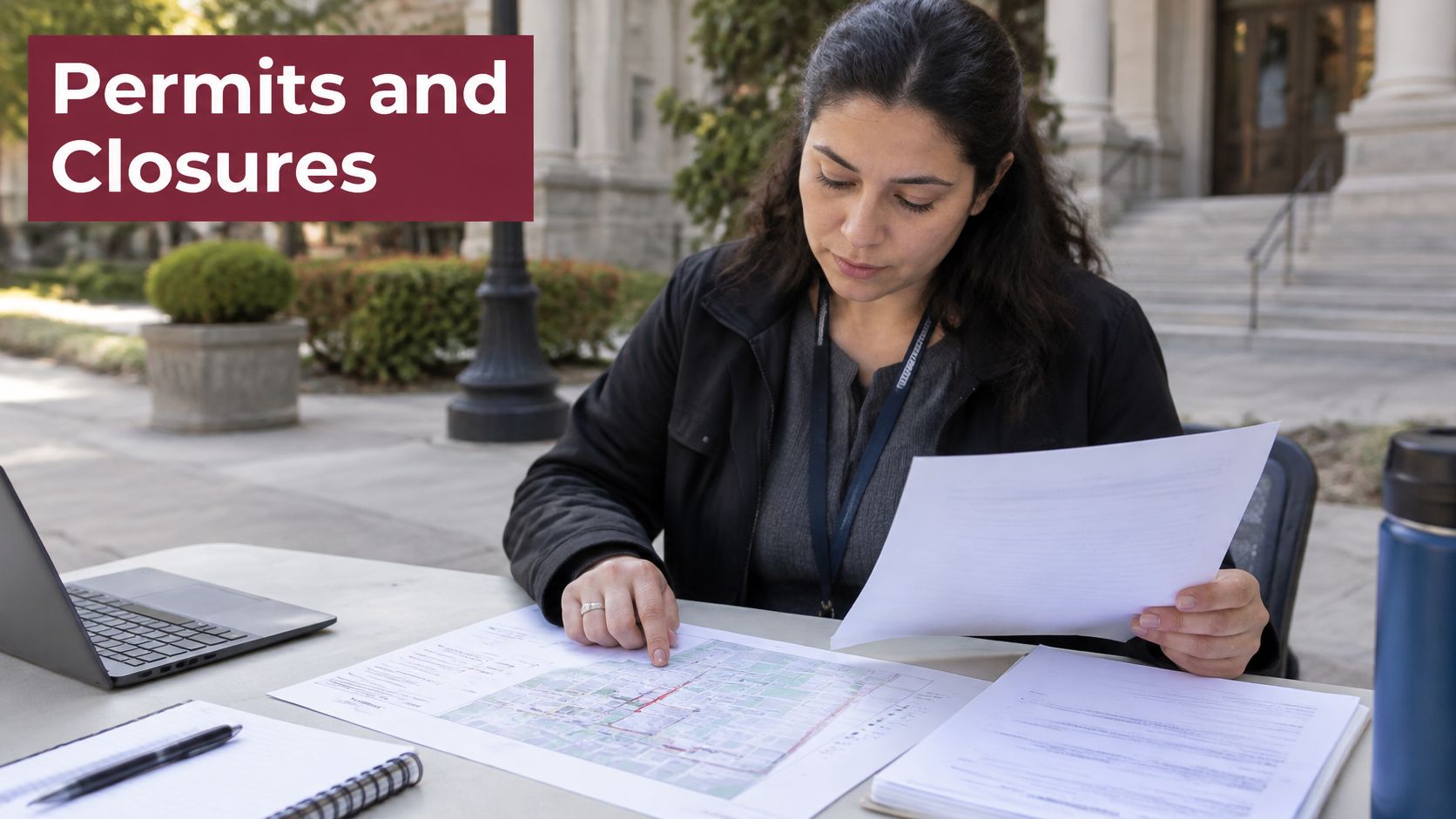
File early. Submit the City of Jenks special-event application at least 90 days before the event. The city may grant an exception for special or unusual circumstances. We still treat ninety days as the rule for a fundraiser, festival, race, or outdoor gathering tied to downtown or The Ten District.
Expect two reviews. The Special Event Committee reviews the packet and sends a recommendation to the City Council for approval or denial.
Know the fee line. Nonprofit applications have no fee. For-profit applications carry a $250 fee.
Plan the closure, not just the party. Street closures require city personnel, approved barricades, directional signage, traffic or crowd control, and security.
Write the clock. Document load-in, barricade placement, emergency access, teardown, and the exact time each road or sidewalk reopens.
What a closure schedule looks like
A City of Tulsa permit record for the 2026 Jenks Fourth of July Boomfest shows the level of timing the city expects: the 96th Street Bridge closure plan set the bridge to close at 8:30 p.m., the event to end at 10 p.m., teardown to begin at 11 p.m., and the bridge to reopen at 11:30 p.m. That permit covered a public right-of-way, a sidewalk closure, a street closure, and fireworks. Your fundraiser may be smaller. The habit is the same. Public hours are not the whole schedule.
The 2023 Jenks Half Marathon permit separated 350 anticipated attendees from 300 participants, with a 7:30 a.m. half-marathon start, a 7:45 a.m. 5K start, and hours listed as 7:30 a.m. to 11 a.m. It named a closure on K Place east of North 3rd Street, plus amplified sound, lane closures, and street closures. A Main Street fundraiser near the Midland Valley tracks should split guests from people on the course or in a booth the same way.
Guests remember the start time. The city remembers when the barricade comes down.
Ask every vendor for a certificate of insurance, and match your own liability coverage to what the application asks before you promise a neighbor you will close their block. If you want a sense of how a full downtown closure feels from the sidewalk, read how locals handle a downtown street festival in Jenks before you copy someone else's layout.
Promote to the Right Locals Before Invitations Go Out
Do not write one flyer for “the community.” First-time prospects, past attendees, recurring donors, sponsors, volunteers, and downtown merchants each need a different ask. A sponsor wants a layout and a logo deadline. A first-time family wants the cost, where to park, and whether a kid can come.
Start the push about six weeks out, send a reminder at two weeks, and send one last note the week of the event. Use the channels people here already check: Main Street windows and sidewalk signs, your own email list, and the social accounts of shops guests already trust. A post from a merchant beats a generic ad. The Ten District is the natural place to start that ask, because the merchants on these blocks talk to the same families all week. If you need a model for the note itself, find event announcement email examples and then rewrite them in plain Jenks language. No gala voice.
Say the practical things first
Put parking, drop-off, the walk from Central Park or your venue, quiet areas, restrooms, and a named phone contact in the first paragraph. Guests ask about getting there, what it costs, and whether they can move through the site. Answer those three before you describe the auction.
Give people one reason to arrive on time, a published start or a specific auction moment, not “come whenever.” Tie the date to what is already on the local calendar through monthly celebrations in Jenks so you are not launching into a weekend that is already full.
Ask every registrant one consented question: how did you hear about this? Next year's plan should start from that field, not from what the committee remembers.
Staff Vendors and Volunteers Around a Shift Roster
People run out before décor does. In 2025, 68% of fundraisers named limited staffing their top event-planning challenge in Bloomerang's survey of more than 250 fundraisers. Plan the roster before you plan the centerpieces.
Build one shift sheet. Every role gets a start, an end, a zone lead, and a backup for that lead. Registration and the donation table never sit with a single name.
Vendor coordinator: One person owns load-in windows, power needs, tent or table placement, and the check-in sheet.
Two-week walk: Meet vendors on site and hand each a one-page note with load-in time, the route they must use, and the street reopening time if they sit on a closed block.
Volunteer briefing: Cover what to say when a guest asks for accessible seating, where lost-and-found goes, and who to call for a medical issue.
Shift check-in: You need to know who is on site when the shift starts. A missing volunteer at 6 p.m. costs more than an extra person at noon.
A food-vendor night has the same staffing shape as a fundraiser with booths. The Jenks America Food Truck Festival is a useful local picture of how trucks, lines, and street space stack up when the guest count and the vendor count are both real.
Confirm critical volunteers two days out by text. Critical means registration, money, and the person holding the barricade plan, not the person handing out stickers.
Reconcile Net Results and Start Donor Follow-Up
A full block is not proof the night worked. Reconcile budget to actuals within two weeks, with the treasurer signing one sheet. Compare net contribution with the target you set before you booked anything.
KPI | Definition | When to check |
|---|---|---|
Net contribution | Ticket, sponsorship, donation and auction income minus all event costs, including labor and in-kind value | Within 2 weeks after |
Cost to raise $1 | Total event cost divided by gross revenue | Within 2 weeks after |
Attendee-to-donor conversion | Share of attendees who made a gift at or after the event | Within 2 weeks after |
Average gift | Total event gifts divided by number of gifts | Within 2 weeks after |
Sponsor renewal | Sponsors who renewed divided by sponsors from the previous event | 90 days after |
Acquisition source | Registration field showing how each guest heard about the event | At registration |
30/90-day retention | Event-acquired donors who gave again in the window divided by all event-acquired donors | 30 and 90 days after |
The second gift window
Sort registrants into first-time prospects, prior attendees, recurring donors, sponsors, volunteers, and high-value supporters. Each group gets its own ask, and registration should have captured consented contact fields you can use.
Within 24 to 48 hours, send a mission-specific thank-you, a receipt, one piece of impact evidence, and one easy next step, such as a volunteer sign-up. Within 30 to 90 days, send a progress note and a renewal or recurring-gift ask that matches that segment.
RallyUp's summary of Fundraising Effectiveness Project figures puts overall donor retention at 43.3%, first-time donor retention at 18.9%, and repeat donor retention at 59.3%. Count retention as event-acquired donors who give again in the window, divided by all event-acquired donors, with duplicates and refunds left out. Do not grade the night before that window closes.
Test two follow-ups at the same timing: an impact story alone, and the same story plus a recurring-gift prompt. Generic thanks and bad contact data are how a crowded night produces almost no second gifts.
Share attendance and the net figure with the merchants and sponsors who stood next to you, then start the next planning conversation with us at The Ten District while the street schedule is still fresh.
The Ten District is the downtown Jenks stretch where these nights land, from Main Street toward the Midland Valley tracks. We help local nonprofits line up co-hosts, volunteer coverage, and a run of show that respects shop hours and street closures. If you are planning a fundraiser on these blocks, visit The Ten District and tell us the date you are counting backward from.


Comments