

Craft Fair Booth Setup Ideas for Downtown Jenks
Six-forty on a Saturday, the truck backed into a spot near the corner, and the river wind finds the canopy before the second leg is locked. That first gust tells you most of what you need to know about setting up in downtown Jenks.
Here are eight craft fair booth setup ideas built for The Ten District, the ten blocks of Main Street running between the Arkansas River and the historic Midland Valley railroad tracks. Narrow sidewalk frontage, wind funneling between brick buildings, a low western sun, and load-in from curbside parking decide which ideas work here. Fairground layouts don't survive it. If your table leans on metals and stones, wholesale jewelry sourcing for pop-up vendors is worth reading before you over-order for one weekend of foot traffic.
Table of Contents
2. Weight Every Leg Before the Wind Picks Up - What to do when the gust front hits
3. Build Vertical Space With Wall Panels and Pegboard - The height ceiling nobody mentions
5. Plan Shade Around the Afternoon Sun - Reading the sun before you set the tent
6. Light the Booth Without Relying on an Outlet - Pick light for detail, not glow
1. Angle Your Tent Toward the Sidewalk on Main Street
You've seen the setup: canopy squared to the curb, table pushed flat against the back wall, and nothing visible from the walkway but shadow. On Main Street the stroll runs past your booth in one direction, so the open front of the canopy should face the sidewalk, not the parking spaces. Slide your table just inside the frame and let the work read from twenty feet out.
A shopper sees two or three vendors moving goods at a downtown craft fair, and the closest one wins.
That distance matters more as a lineup grows. The Ann Arbor Street Art Fair started in 1959 with makeshift booths for 99 local artists and 33 additional Michigan artists, and by 1963 it had stretched to four days and 363 artists, per the fair's own history. More booths means more competition for one glance, so your name, your color, and your focal piece have to land from the aisle.
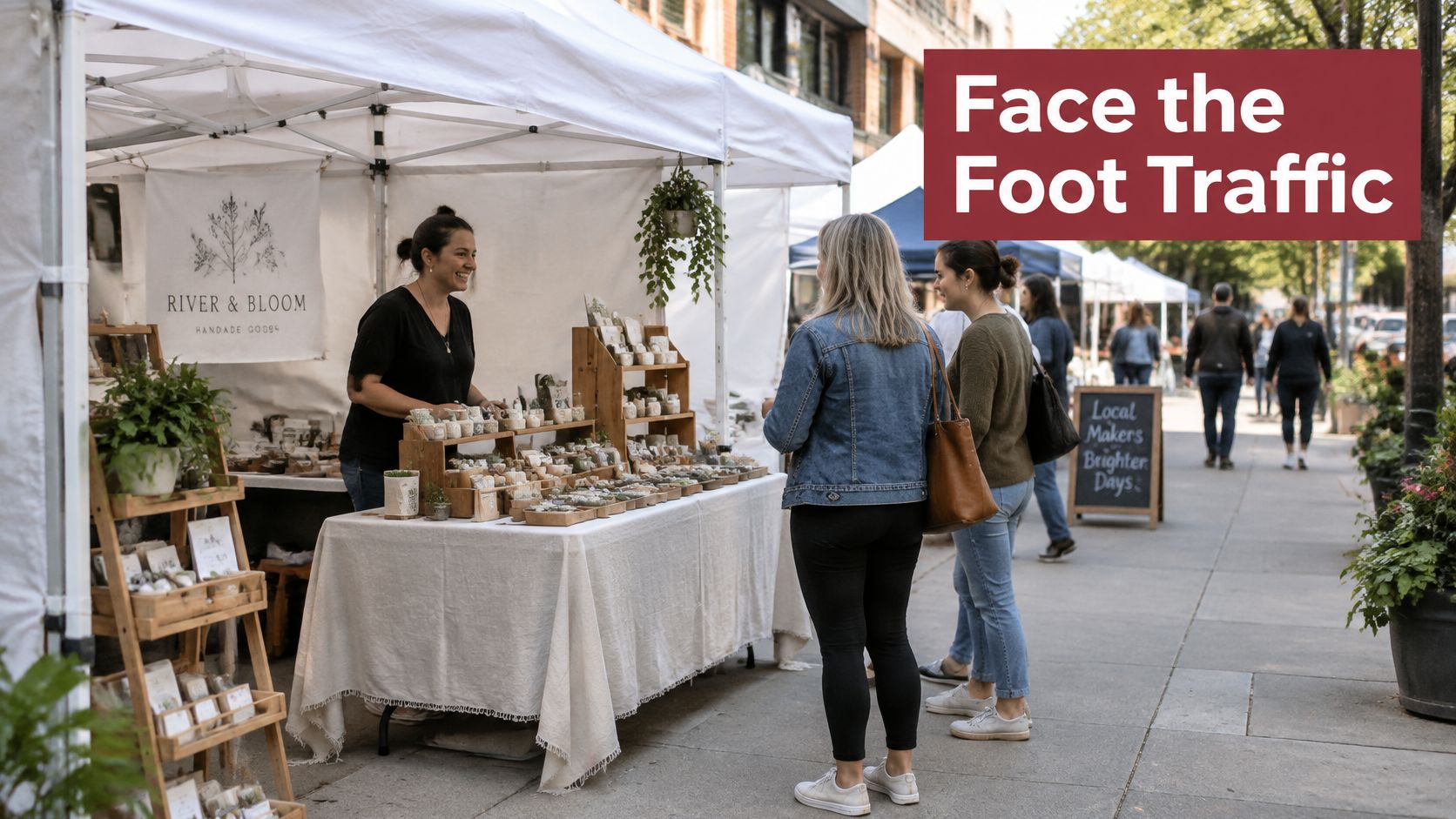
Three things that keep a sidewalk working
Ask the organizer for the exact footprint before you pack the truck. A corner space and a mid-block space aren't the same puzzle.
Put your bestseller at eye level on the front edge. Not under the table, not behind you.
Leave a clear pocket at the booth corner so a couple can step out of the walking flow to talk.
Go narrow and deep rather than wide and shallow. If you're the one recruiting the lineup rather than selling at it, how to find vendors for an event starts with that same footprint map.
2. Weight Every Leg Before the Wind Picks Up
A tent doesn't have to be expensive. It has to be anchored. The canopies that end up leaning into a storefront window are usually the ones whose owners filled four sandbags partway and called it done.
The Downtown Tulsa Market guidelines set a workable baseline for anyone selling in the metro. One booth space means a tent or shade cover no larger than 10 by 10 feet, vendors bring their own tables, chairs and canopies, and every tent leg carries at least 20 pounds.
Treat that last number as a floor, not a target. On a corner lot in Jenks, with wind coming off the river and squeezing between buildings, I'd put the heaviest weights on the two legs facing the wind and keep two more in reserve. Walk around the outside of your own tent the way a shopper will, because the frame shifts after an hour of gusts.
Practical rule: If you can carry all four of your weights in one trip, you've packed for a calm day.
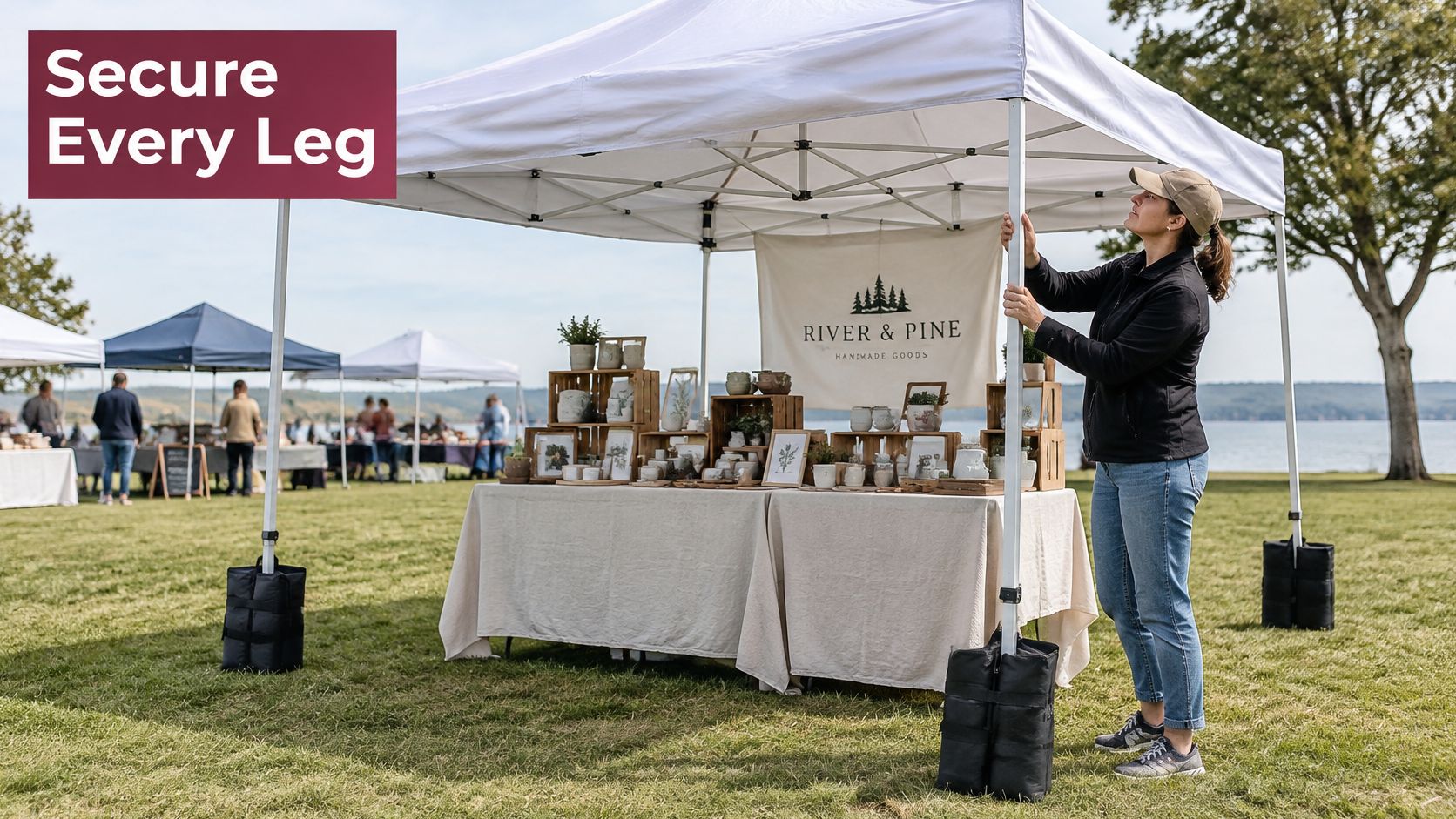
What to do when the gust front hits
Pack weights in their own bin so they come out first and go on first, not last.
Drop the sidewalls when weather is building instead of waiting to see whether the frame holds.
Check the forecast the morning of the fair and lay the booth out around the expected wind direction.
3. Build Vertical Space With Wall Panels and Pegboard
A folding table holds maybe a dozen pieces before it looks picked over. The air above it holds three times that, and it's free. Pegboard panels, slatwall, and folding display walls let you hang jewelry, prints, and small wall pieces without surrendering table surface.
Most makers who do this well run two levels: bestsellers at arm height, lighter items up top where they still read from the walkway. Bungee the panels to the tent frame so they don't rock, and test the whole assembly in your driveway once so you know it takes twenty minutes and not an hour.
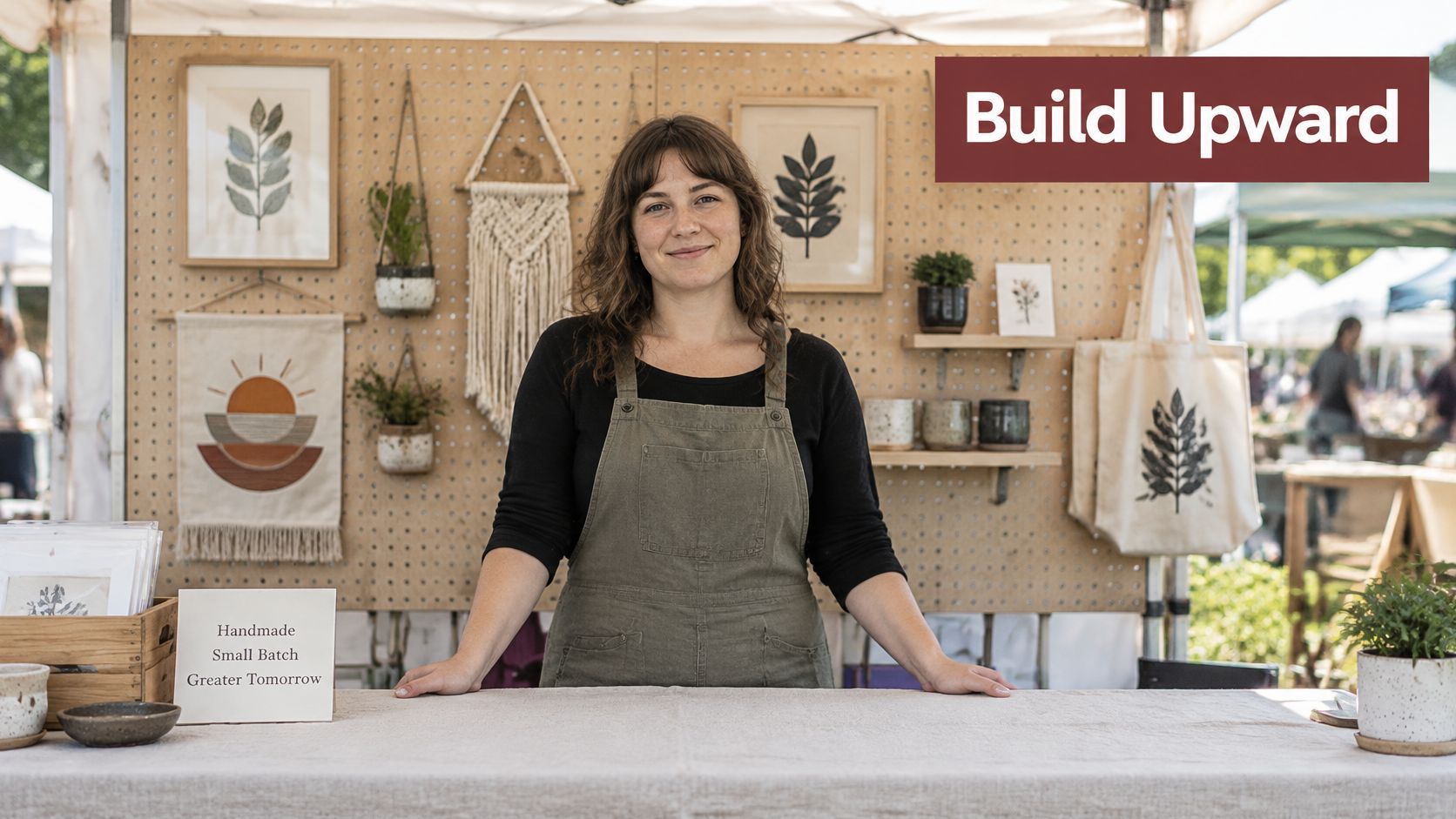
The display logic of a small boutique store front translates almost directly into a ten-foot tent: one focal wall, one category per shelf, and a path that keeps people moving forward.
The height ceiling nobody mentions
Standard setup advice, including The Craft Map's first craft fair checklist, tells you to add height and keep the front open. On a narrow sidewalk those two instructions fight each other. A shelf that juts out at chest height turns your booth into a wall for anyone in a wheelchair, and a rack that runs past seated eye level hides your work from a shopper who's sitting in a folding chair.
Hang the panel flush to your own table, not the aisle. Six inches of overhang is the difference between a browsing lane and an obstacle.
4. Use Risers and Height Changes to Pull Shoppers In
A flat table of product is easy to walk past. The eye needs somewhere to land.
That isn't decoration. A study of retail consumers published through Universiti Teknologi MARA's research repository found product display had the strongest relationship with purchase intention, explaining roughly 35% of the variation. Display organization is the buying environment, not the trim around it.
Say you throw pots. Tallest vase in the back corner, medium bowls on crates in the middle, small mugs on the front edge where hands can reach them. Cover the crates with one cloth in a color that flatters the glaze, then rotate new stock onto the risers through the day so the display never looks half-sold.
Riser habits that hold up outdoors
Keep the top of every riser clear of loose items. Wind finds them, and so do kids.
Use stepped tiers rather than one tall stack. Three heights read as curated, one tower reads as a game of Jenga.
Strap risers to the table or tent frame if your spot catches a crosswind between buildings.
When the work deserves a slower look, the downtown art walk is where this same staging gets tested in front of a bigger crowd.
5. Plan Shade Around the Afternoon Sun
Late afternoon is when a booth in full sun loses customers, not just comfort. Product heats up, colors fade, and shoppers drift to whichever tent offers shade.
The city-listed Jenks Herb and Plant Festival fills Main Street in downtown Jenks with locally grown herbs and plants alongside garden decorations, Oklahoma wine, home décor, jewelry, arts and crafts, birdhouses, and bath-and-body products, according to the city's event listing. That's a wide mix of goods, and several of those categories lose value fast in direct light.
Reading the sun before you set the tent
Which spot bakes depends on the block, the gaps between buildings, and the hour. Ask the organizer which side of the street holds shade in the afternoon and walk the spot yourself if you can.
Turn tables so the sun rakes across the back rather than hitting the product face.
Keep sensitive items in a covered bin until someone asks, then bring one out.
Stash a cooler, water, and a folding chair at the back so you're not leaving your booth to stay upright.
The west end of a block catches the worst of a summer afternoon. If you're selling anything that fades, ask for the other end.
6. Light the Booth Without Relying on an Outlet
Assume you won't have power. Shopify's guide to selling at maker markets notes that some events allow overnight setup while many give vendors access only on the day of the event, and that means no reliable outlet runs to your table.
Battery LED strip lights or clip-on lamps solve it. They brighten the back wall, pull detail out of jewelry and glass, and keep the booth working after the streetlamps come on and storefront light stops reaching your table.
A lighting kit that travels well
Confirm power with the organizer before you buy anything. Ask about amperage, not just "electricity available."
Clip light at the back and aim it forward, so it lights your product rather than your face.
Charge at home, carry spares, and tape every cord flat against the table edge and away from walkways.
Pick light for detail, not glow
Warm string lights photograph beautifully and show nothing. If a buyer can't see the clasp on a bracelet, the lamp is in the wrong place.
7. Give Shoppers a Reason to Stop With a Hands-On Corner
The booth people remember is usually the one where something happened. A bead-stringing station, a leather scrap to feel, a clay sample to squeeze, or a half-finished piece you're working on while you talk. It doesn't take a workshop. One small table, a few finished examples, and a sign that says you're welcome to try it.
Keep the activity simple enough that you can pause mid-motion when a customer wants to buy, and put everything in containers that close with one hand. Small hands belong at the front edge of that table, with sharp tools well out of reach.
A hands-on station costs table space, and space has a price. Find A Market's booth fee survey reported a median craft-fair booth fee of $73, based on 14 listed craft-fair events. At that rate, add the interactive element before you add another decorative shelf.
Worth the trade: one thing people touch beats ten things people can only look at.
If you'd rather not run it alone, how to find local artists covers pairing up on a shared space. And the visitors who linger are the ones who come back next month, the same way issuing wallet passes for cafe regulars keeps coffee-shop faces returning.
8. Pack and Load for Downtown Access
Setup in downtown Jenks means hauling gear from a parking space to a sidewalk spot, often around a corner and through a crowd. Rolling carts with wide, flat wheels handle brick edges and sidewalk seams far better than narrow hand-truck wheels.
The city lists free street parking on Main Street, with additional parking at Jenks Commons Park at 220 E. "A" Street and Downtown Commons Park at 224 E. "A" Street, according to the city's downtown district page. Know which one you're aiming for before you leave the house.
Load-in habits worth building
Pack the truck in reverse order of unloading. Tent and weights by the tailgate, small goods last.
Bring a second person for a heavy canopy, or a cart you can manage alone up a curb.
Tarp the cart for wet weather so product stays dry on the walk from the truck.
Practice the setup at home with a timer and write down the order that worked.
Vendors coming in from Tulsa, Broken Arrow, or Bixby can plan the whole morning with the weekend trip planner.
Booth setup ideas at a glance
Item | Best for | Effort level | Key gear | When it matters most |
|---|---|---|---|---|
Angle Your Tent Toward the Sidewalk on Main Street | Showing products to passing shoppers while keeping the sidewalk clear | Moderate | Canopy, table | Narrow downtown booth spaces with one-way foot traffic |
Weight Every Leg Before the Wind Picks Up | Keeping the canopy, products, and shoppers safe in windy conditions | Moderate; weights add carrying effort | Canopy weights, bungee ties, optional sidewalls | Breezy days and sudden gusts |
Build Vertical Space With Wall Panels and Pegboard | Displaying more products without using extra table space | Moderate; requires secure setup | Pegboard or slatwall, hooks, clips, shelves, bungee cords | Small booths with limited tabletop space |
Use Risers and Height Changes to Pull Shoppers In | Making tabletop products easier to see and browse | Low to moderate | Risers or sturdy crates, display cloth | When products look flat or crowded on a table |
Plan Shade Around the Afternoon Sun | Protecting products and keeping the booth comfortable | Moderate; depends on assigned location | Canopy, optional shade cloth, cooler, small fan | Hot summer afternoons and direct western sun |
Light the Booth Without Relying on an Outlet | Highlighting products at evening events without booth power | Low | Battery-powered LED strips or clip-on lamps, spare batteries | After dusk or where outlets are unavailable |
Give Shoppers a Reason to Stop With a Hands-On Corner | Engaging visitors and explaining how products are made | Moderate; requires staffing | Small demo table, covered supply containers, activity materials | Busy fairs, especially when families and children attend |
Pack and Load for Downtown Access | Moving booth supplies efficiently from parking to a sidewalk spot | Moderate; depends on distance and load | Wide-wheeled cart, labeled bins, tarp | Downtown events with limited parking or a longer carry |
See You on Main Street
A booth can be ready and still feel rushed if the last steps are scattered. Keep the morning's priorities together, then leave room to adjust when you see your exact spot.
Weights packed and binned. Use at least twenty pounds per leg, with extra weight on the side facing the wind.
Panels tested at home. Allow time to secure the display on site, especially if assembly took a while during practice.
Lights charged the night before. Pack spare batteries and keep any cords flat and out of the walking path.
Sun side checked. Look at how the light reaches your assigned spot during the hours you expect shoppers.
Load-in order planned. Pack items in the order you'll need them, and confirm where curbside unloading and parking are permitted.
The Ten District stretches ten blocks west from the Arkansas River to the historic Midland Valley railroad tracks. A dedicated group of local merchants came together to rebrand and promote Jenks' downtown community. That community spirit suits a market day: vendors and visitors share a compact Main Street setting, with shops, galleries, dining, and gathering spaces nearby.
Once your booth is settled, take a short lap when business allows. Main Street offers places to browse and eat between stalls, and a little time away from the table can make the day feel less like a checklist. Set up early, welcome shoppers, and enjoy the district.
If you're preparing for a downtown market or festival, visit The Ten District to learn about the district's events. Then check your assigned spot and load-in details before market morning.


Comments