

How to Become a Vendor at the Ten District in Jenks
An accepted vendor application can still leave you unable to sell in downtown Jenks. The City of Jenks planning document requires temporary sales structures to meet city rules, separate from an organizer's booth approval. If you're figuring out how to become a vendor around Main Street, the safest approach is to clear the legal requirements, confirm your event acceptance, and understand the costs before committing money.
Table of Contents
Permits and Registrations to Line Up First - Keep the application packet together
What Your Tent or Trailer Needs in Jenks - Plan the arrival as well as the display
Apply Step by Step - Build the legal and event packet - Read the fee policy before submitting
Budget for Risk Before You Pay a Booth Fee - Test the things customers will use
Mistakes That Stall First-Time Vendors - Use a nearby market as a budget check
Who Approves a Vendor at The Ten District
A downtown Jenks vendor needs to distinguish event acceptance, state sales authorization, and city setup approval. They answer different questions, and none replaces the others.
The event organizer decides whether your products fit the event, accepts your application, and assigns your selling space.
The Oklahoma Tax Commission handles the sales-tax permit needed for merchandise sales, including the appropriate point-of-sale information.
The City of Jenks sets applicable requirements for temporary structures and their placement.
The Ten District grew from a dedicated group of local merchants who came together to rebrand and promote Jenks' downtown community. That shared downtown identity doesn't mean every market or festival has the same organizer or application.
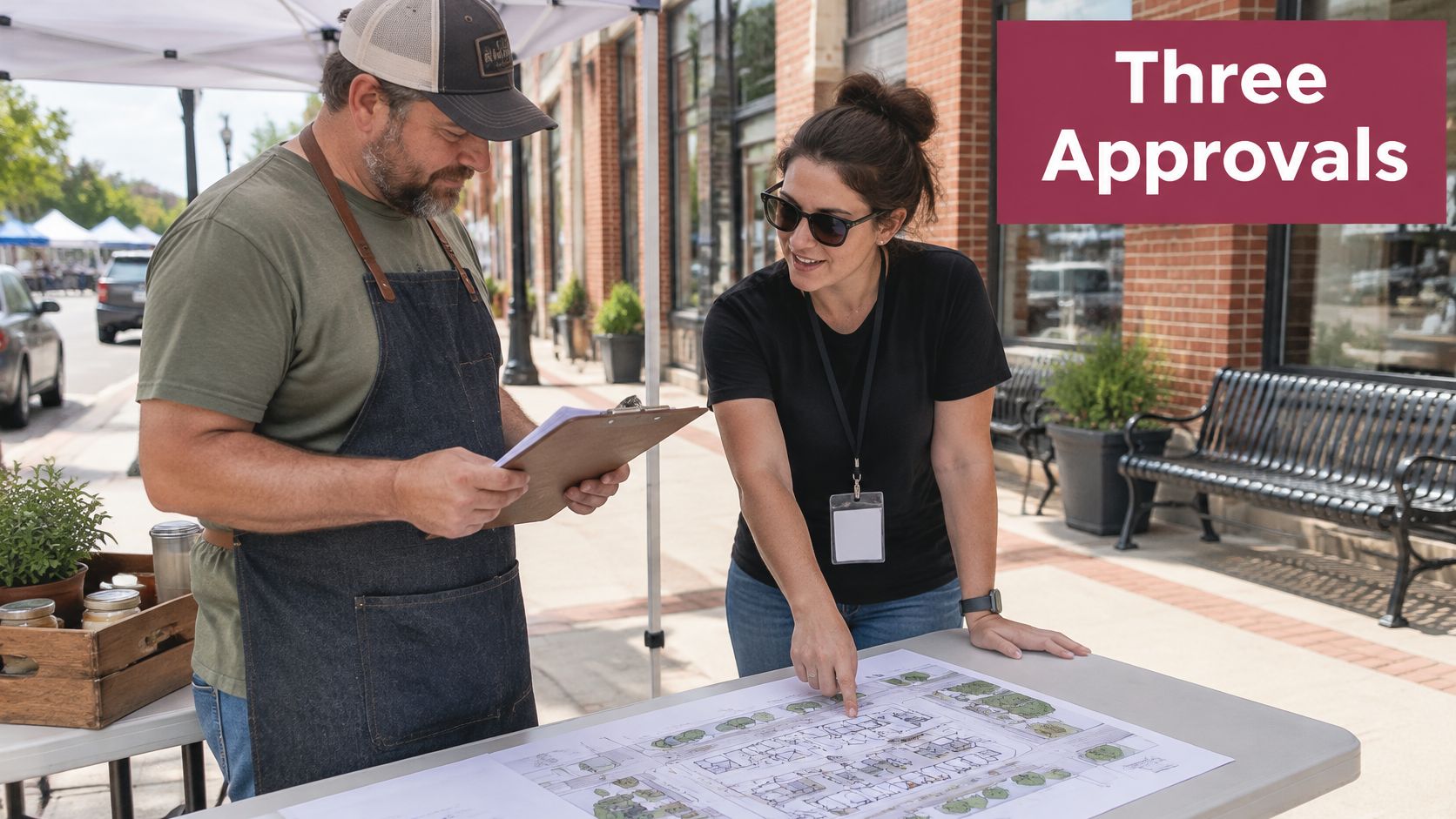
Start with the organizer named on the event listing. Ask whether your space is on a city-controlled street or private property, who coordinates city approvals, and who can confirm your setup is acceptable.
Around Main Street, don't mistake an available patch of pavement for an authorized booth location. You need a named contact and an assigned space, not just a general invitation to participate.
Permits and Registrations to Line Up First
You meet three separate approvals before a booth fee is a sensible payment: the business numbers the sales-tax application requires, an issued Oklahoma sales-tax permit, and a written city answer for the tent, trailer, or display you will use. An organizer can assign the space. That assignment does not issue either of the other two.
Lock the legal business name first and use it on every filing. Applications stall when the personal name, the registered entity, and the booth brand do not match.
The Oklahoma business portal says businesses selling products need an Oklahoma Sales or Use Tax Permit, lists an application cost of $20 plus a handling fee, and identifies an EIN and a Secretary of State filing number as application requirements.
Registrations and fees to secure before applying
Registration | Issued by | Cost | Why vendors need it |
|---|---|---|---|
Employer Identification Number (EIN) | IRS | Free to obtain directly from the IRS | Required on the Oklahoma sales tax permit application |
Oklahoma Secretary of State filing number | Oklahoma Secretary of State | Depends on your entity type and is listed on the state's current fee schedule | Required on the Oklahoma sales tax permit application |
Oklahoma Sales or Use Tax Permit | Oklahoma Tax Commission | Application fee and handling fee described above | Needed to sell merchandise; name Jenks as the point of sale for temporary uses |
City of Jenks structure approval | City of Jenks | The City of Jenks sets its own requirements for each proposed setup, so request them in writing before applying | Tents, trailers, and portable displays must meet applicable building-code provisions and Appearance Review District Guidelines |
I recommend you wait on the issued permit, not the submitted application. For temporary merchandise sales, confirm Jenks is the point of sale. Paperwork for another community does not automatically cover a downtown booth.
The quiet costs sit between those approvals. The state filing fee changes with entity type, so price that filing before you commit to a date. A city answer can require a different stake layout or trailer placement after the gear is already bought. If either file is still open, hold the booth fee.
Keep the application packet together
Save the filing number, EIN documentation, permit application confirmation, and a complete product list in one folder. Label a submitted application separately from an issued permit.
If the concept is closer to a short retail installation than a market booth, the guide to hosting a pop-up shop walks through space and format. The tax paperwork still has to be in order before the merchandise goes on sale.
Check Whether Your Product Needs a Food or Health Permit
A cookie seller, a prepared-meal vendor, and a grower selling raw produce shouldn't assume they follow the same approval path. Describe exactly what you sell and how you handle it before asking which food or health authorization applies.
The Mississippi Department of Agriculture and Commerce guide illustrates why generic permit checklists fall short: it distinguishes raw and processed products, storage practices, sales volume, and categories such as meat, seafood, eggs, plants, and prepared foods. It isn't Oklahoma law, but it shows why a product-specific answer matters.
For a Jenks event, prepare these details before contacting the health department serving Tulsa County:
Product condition: Is it raw, cooked, processed, refrigerated, or shelf-stable?
Preparation location: Do you make it at home, in a commercial kitchen, or at the booth?
Storage and service: Do you hold food between events, offer samples, or assemble orders on site?
Sales scope: What do you expect to sell over the year, and through which channels?
Ask whether your exact activity requires a permit, qualifies for an exemption, or needs another agency's review. Then ask the organizer which documentation it wants on file.
An exemption is useful only when it applies to your actual product and selling method.
Keep the written answer with your other approvals. If you change from packaged goods to on-site preparation, ask again before adding the new offering to your application.
What Your Tent or Trailer Needs in Jenks
Ask the organizer: Who confirms that this exact setup is allowed at this exact location? An assigned booth footprint doesn't necessarily settle the requirements for everything you bring into it.
Jenks' temporary-use provisions address applicable building-code requirements and Appearance Review District Guidelines. That makes the appearance and placement of a portable sales setup relevant, not just whether it fits inside the organizer's marked space.
Prepare a simple setup sheet before asking for approval:
Dimensions: Show the tent, trailer, tables, racks, signs, and any space customers need to approach.
Anchoring: Explain how you'll secure the canopy and whether anything would penetrate the ground.
Utilities: Identify power needs, cords, generators, cooking equipment, or other equipment requiring review.
Placement: Mark the proposed position relative to the street, neighboring booths, entrances, and pedestrian routes.
Plan the arrival as well as the display
For a Main Street event, ask where to unload, when vehicles must leave the selling area, and where vendor vehicles should park afterward. Don't assume parking beside your booth is included.
Our craft-fair booth setup ideas can help with the display itself, but the organizer and city determine what your site allows.
For a private-property event, get the approval responsibilities in writing. Permission from the property owner doesn't settle every city requirement, and a last-minute equipment change can leave the organizer reviewing a setup it never approved.
Event Deadlines Organizers Must Meet
The registered-vendor-list deadline matters more than how late you can finish your display. Under the Oklahoma Tax Commission's special-event rules, organizers submit that list at least 10 days before the event, submit their special-event permit application at least 20 days before, and submit daily sales-tax reports and the final attendee list within 15 days afterward.
Those are organizer obligations, not a promise that applications stay open until the state filing deadline. An organizer may need additional time to review products, resolve missing documents, and assign spaces.
Event deadlines for organizers and vendors
Deadline item | Who files it | Timing |
|---|---|---|
Special-event permit application | Organizer, to the Oklahoma Tax Commission | Before the event, according to the advance filing period above |
Registered vendor list | Organizer | Before the event, according to the vendor-list filing period above |
Sales-tax reporting forms for taxable vendors | Organizer | Provided to vendors selling taxable merchandise or services; confirm the distribution schedule |
Daily sales-tax reports and final attendee list | Organizer | After the event, within the reporting period above |
Ask the organizer when it closes its vendor list, whether it has filed the special-event application, and which tax-reporting forms you'll receive.
If you're considering an event featured in our Jenks America Food Truck Festival coverage, use the event's current organizer information to confirm its application schedule. An editorial event page isn't an acceptance notice.
Practical rule: Have your permit paperwork ready before the organizer closes its list. Don't plan on a late addition rescuing an incomplete application.
Apply Step by Step
Work from a saved checklist rather than assembling documents from scattered messages. Your goal is a complete application that the organizer can review without chasing down your business name, product details, or setup dimensions.
Build the legal and event packet
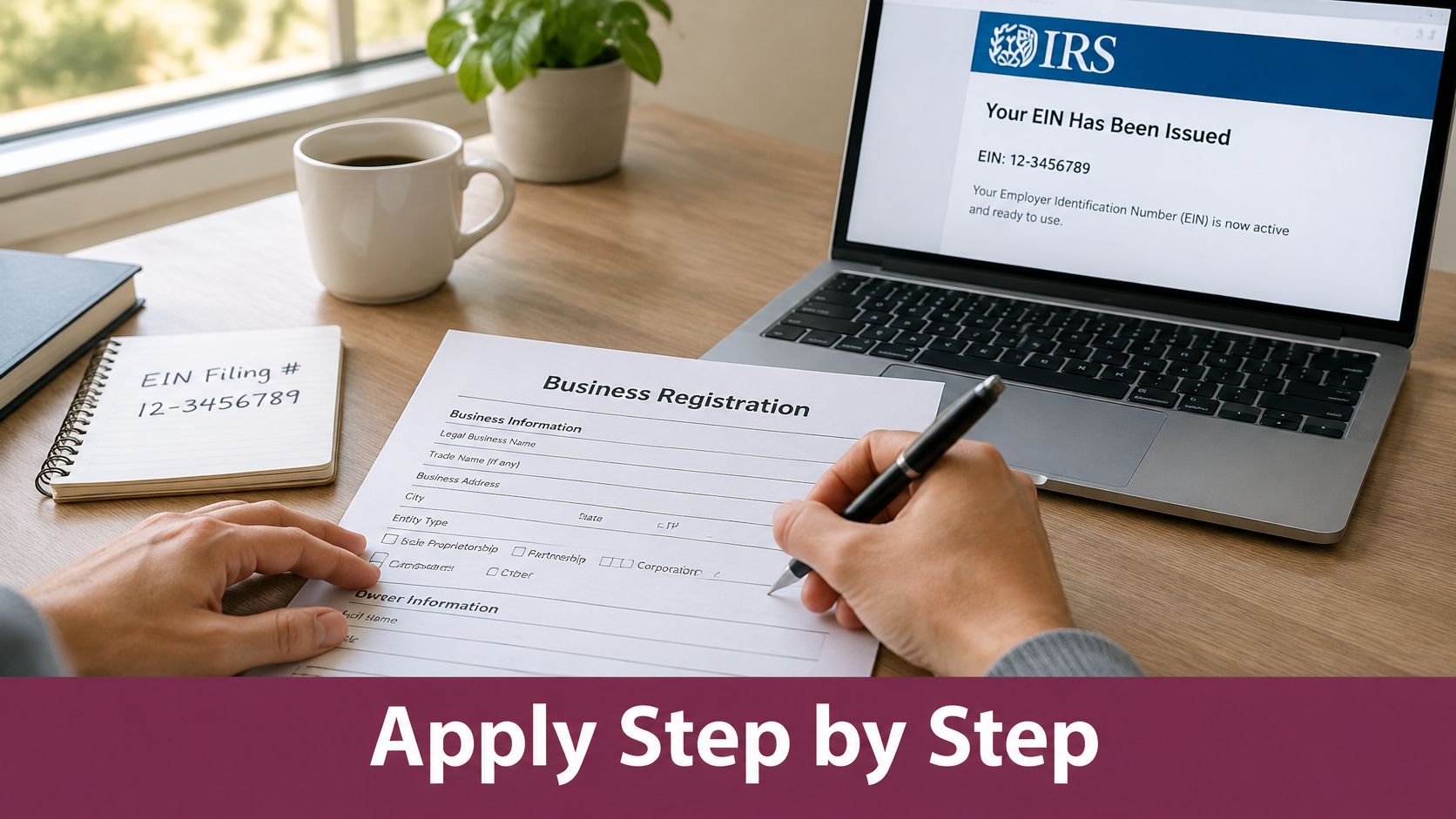
Resolve your business registration. Complete the applicable Oklahoma Secretary of State filing and record the filing number needed for the sales-tax application.
Obtain your EIN. Keep the IRS documentation with your registration information so your identifying details remain consistent.
Apply for the sales-tax permit. Enter the appropriate Jenks point-of-sale information for temporary sales, and distinguish the application receipt from the issued permit.
Request the organizer's current vendor packet. Get its application, vendor-list closing date, event-permit status, and reporting instructions directly from the event contact.
Resolve the setup approval. Submit your tent, trailer, or display information and obtain a written answer about applicable city review, especially on private property.
Assemble the selling details. Include your complete product list, prices, structure measurements, and any food or health documentation. Decide how you'll display and account for sales tax.
Submit a complete application. Attach the documents requested by the organizer before its deadline. Don't substitute a permit application confirmation where an issued permit is required.
Confirm acceptance and list status. Ask for written confirmation that you're accepted and included in the event's registered-vendor information.
Authorize participation costs. Review the cancellation policy and payment deadline before paying booth or membership charges.
Prepare your sales records. Set up a daily sales log before arrival, maintain it during the event, and retain it afterward for reporting.
Read the fee policy before submitting
A nearby example shows why fees need their own review. Tulsa Farmers' Market publishes a $25 nonrefundable application fee, $100 annual membership fee, and Saturday booth fees of $30 to $40, with membership and Applications Committee approval required before participation.
That's a Tulsa benchmark, not a fee schedule for The Ten District. An application charge may be due before a decision, so find out what you're risking rather than assuming every payment is refundable.
Use our outdoor-market planning guide to compare selling formats, then verify each event's actual terms. Pay the booth fee last when the organizer's process allows it, after your legal readiness and place on the vendor list are confirmed.
Budget for Risk Before You Pay a Booth Fee
Three approvals stand between you and a booth fee: legal readiness, the organizer's insurance terms, and written acceptance. Each one can cost money while you are still waiting. Spend only on the approval you are waiting on.
Cost category | What to include before committing |
|---|---|
Legal readiness | Registration, permits, and any required inspection costs while those filings are still open |
Insurance | Coverage limits, covered dates, and additional-insured wording, quoted before you buy gear |
Event participation | Application, membership, booth, and cancellation charges, with the booth charge held until acceptance is written |
Equipment | Canopy, weights, tables, signs, power, and payment hardware once setup rules are clear |
Operating costs | Travel, loading time, labor, packaging, and payment-processing fees |
Inventory exposure | Spoilage, damage, leftovers, and storage after the event |
Work out contribution per sale by subtracting product cost, packaging, and transaction charges from revenue that excludes sales tax. Divide your event-specific costs by that contribution. The result is the unit count you need to break even.
Insurance is the line people buy too soon. Seaside Park's 2025 market application required $1 million per occurrence and $2 million aggregate coverage for its market season. Those figures are not Jenks requirements. They show why you should get the organizer's exact wording before you bind a policy. I would have that quote, including any additional-insured language, before spending on a canopy or weights.
Test the things customers will use
Check the payment reader, the mobile connection, and printed prices before you pack. Some printed QR codes depend on a paid subscription, so read your provider's terms and keep a printed URL or a short text code as a backup. HolaQR's explanation of why rental counter QR codes stop working is useful background for checking whether a printed code relies on a service subscription.
You may not get the booth. Hold event-specific packaging and perishable stock until acceptance is in writing, and ask whether that acceptance also commits you to sales reports or surveys.
Margin check: Money collected for sales tax isn't money available to cover your booth.
Price every item with tax and selling fees already pulled out. Run one date before you commit to a run of dates. Keep the receipts and the actual sales so the next decision rests on your numbers.
Mistakes That Stall First-Time Vendors
An incomplete application can cost you the opportunity before anyone evaluates your products. A polished display photo will not answer an organizer's request for missing permits or an unexplained setup.
You meet three separate approvals, in this order: the organizer's acceptance of your booth, tax readiness, and the city's setup rules for the site. Pay a booth fee only after you know which of those three you are still waiting on. An organizer's yes puts you on the event list. It does not clear a tax account or a setup on the property.
Sellers stall on the same gaps:
Applying before the paperwork is usable. Ask whether the organizer accepts pending documents. If it does not, finish the required approvals before you submit.
Treating acceptance as legal authorization. Keep a separate confirmation for event participation, tax readiness, and city setup. Finish the one still open before you treat the booth as locked.
Leaving another city on the paperwork. Read the location lines before you send a packet for a Jenks booth. A form addressed to a different city will not satisfy a downtown Jenks review.
Missing the vendor-list cutoff. Put the organizer's closing date on your calendar, not only the event date. After that date, a complete packet still misses the published vendor list.
Ignoring who controls the site. Ask whether the booth sits on public or private property and who coordinates the permission. The wrong contact means you wait on an approval that never reaches the person who can grant it.
Use a nearby market as a budget check
Tulsa Farmers' Market vendor costs
Cost item | Figure |
|---|---|
Nonrefundable application fee | $25 |
Annual membership fee | $100 |
Saturday booth fee | $30 to $40 |
These are published Tulsa Farmers' Market charges, not downtown Jenks event prices. They show three kinds of charges to price before you commit: a fee to apply, a fee to join, and a fee for the day. Jenks organizers set their own amounts. Ask for each one in writing so a booth quote does not hide a membership or a nonrefundable application.
Packaging is another stall. Use our packaging design basics to plan a readable presentation, then confirm any product-specific labeling requirements separately.
Save every filing and confirmation in a shared folder, and keep an offline copy on your phone. When someone at the gate asks, you can produce the document for the approval you are still proving.
The Ten District publishes practical guides to downtown Jenks markets, community events, and planning a selling space. Visit The Ten District to see local opportunities, then contact the named event organizer with your product list, permit status, and setup details before you commit to a booth.


Comments