

What is a business improvement district? A Beginner's Guide to Local Renewal
Ever walked through a commercial district and wondered why it feels so clean, safe, and just… alive? There's a good chance a Business Improvement District, or BID, is working behind the scenes.
Think of it as a homeowners' association for a business district. It's a specific, defined area where local property and business owners have agreed to pool their money to make their neighborhood better—cleaner, safer, and more vibrant than what standard city services can provide on their own.
So, What Exactly Is A Business Improvement District?
At its core, a BID is a powerful tool for community-led improvement. It’s a designated zone where local stakeholders vote to pay a special assessment. This isn’t some new city tax; it's a self-imposed fee that goes directly back into improving their own district.
The whole idea is pretty straightforward. A city provides the basics—police patrols, road repairs, that sort of thing. A BID picks up where the city leaves off, funding the extra services that give a neighborhood its unique character and appeal. These targeted improvements make the area more attractive for everyone: customers, residents, and visitors alike.
To get a better handle on the core components, here's a quick breakdown.
Business Improvement District (BID) at a Glance
Component | Description |
|---|---|
Defined Area | A specific geographic zone with clear, legally defined boundaries. |
Self-Funding | Funded by a mandatory assessment on property and/or business owners within the district. |
Governance | Managed by a private, non-profit organization governed by a board of local stakeholders. |
Supplemental Services | Provides services in addition to what the municipality already offers (e.g., extra cleaning). |
Local Control | Priorities and budgets are set by the district's own board, not by the city government. |
This structure ensures that the people paying into the system are the ones calling the shots.
What Does a BID Actually Do?
Picture a downtown street. The city might fix a pothole, but who’s going to pressure wash the sidewalks, plant seasonal flowers, or organize that summer art walk? That's where the BID comes in.
The money collected is managed by a dedicated nonprofit, usually led by a board of the district's own business and property owners. They get to decide how to spend the funds to tackle their neighborhood's most pressing needs.
Common initiatives often include:
Extra Cleanliness: Think dedicated crews handling graffiti removal, sidewalk sweeping, and frequent trash pickup.
Added Security: Funding for unarmed security patrols or friendly "ambassadors" who can give directions and keep an eye on things.
District Marketing & Events: Creating a unified brand for the area, running holiday promotions, or hosting farmers' markets that draw in crowds.
Beautification Projects: Installing things like hanging flower baskets, public art, uniform street signs, or comfortable new benches.
A BID gives a community the power to take direct control of its economic future. It fills the crucial gap between what the city provides and what a commercial area needs to really stand out and succeed.
A Grassroots Way to Revitalize a Neighborhood
This isn't a top-down, one-size-fits-all solution from city hall. The BID model is built from the ground up, allowing for strategies that are perfectly tailored to the unique character and challenges of a specific area.
It builds a powerful public-private partnership, transforming a collection of individual businesses into a unified team working for the common good. These kinds of community-driven efforts are often part of a broader movement, and you can see how they connect by learning what tactical urbanism is and how it works.
Ultimately, a BID is about making a proactive investment. By pooling their resources, stakeholders can achieve a level of impact that no single business could ever manage on its own. The result is a more prosperous, inviting, and successful commercial district for everyone.
How a Business Improvement District Comes to Life
A Business Improvement District doesn't just spring up out of nowhere. It's not a top-down mandate from city hall. Instead, a BID is born from the ground up, starting with conversations between local business and property owners who know their neighborhood best and believe it can be better.
It all begins when a few people recognize they're all facing the same problems—maybe the streets feel a bit grimy, the holiday decorations are lackluster, or a unified marketing push is needed to bring in more foot traffic. They realize that tackling these issues together would be far more powerful than any one business trying to go it alone.
A Grassroots, Democratic Process
Once that initial spark catches fire, the process becomes more structured but remains fundamentally democratic. It’s all about giving every stakeholder a real voice. The way this comes together isn't entirely unique; you can see similar collaborative models at work by looking at some of the top public-private partnership examples in 2025.
Here’s a look at the typical steps:
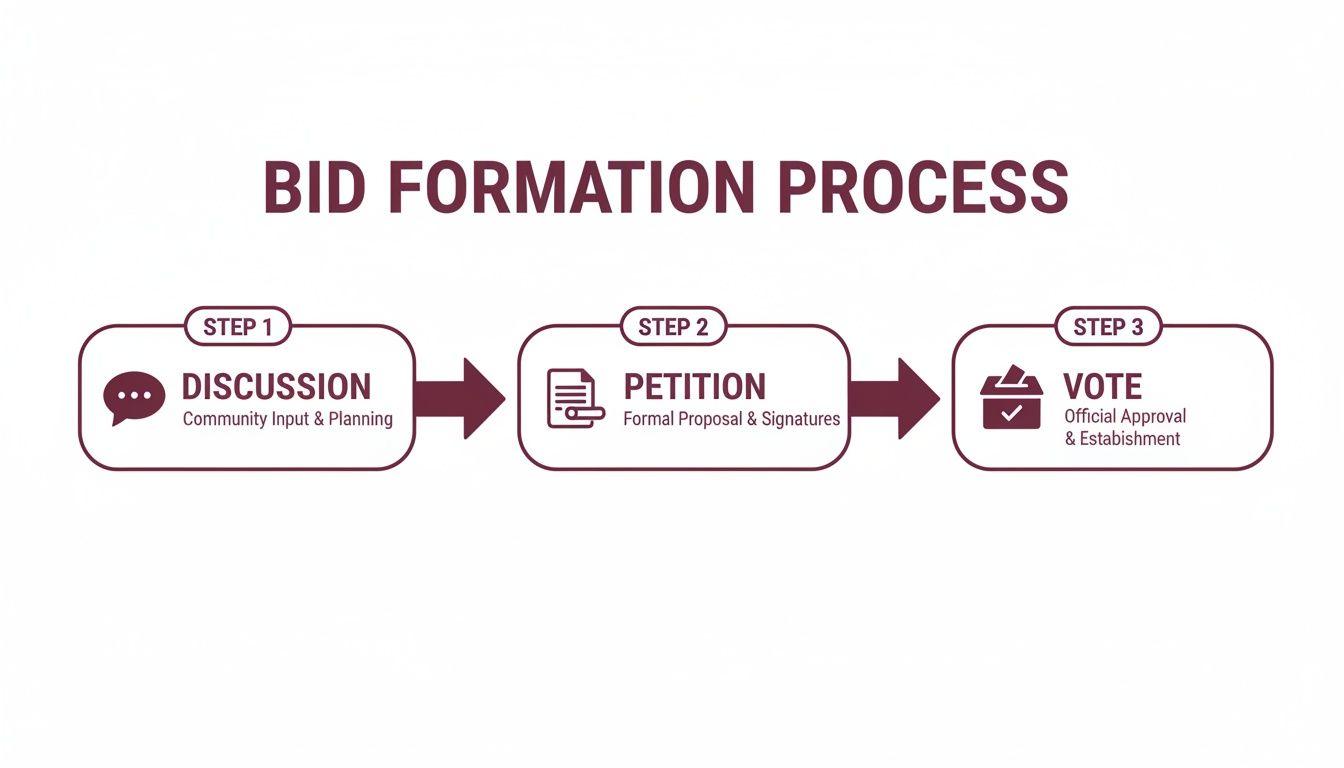
Forming a Steering Committee: A group of motivated local leaders comes together to hammer out a detailed improvement plan. This is the blueprint that defines the BID’s proposed boundaries, the specific services it will offer, how much it will cost, and the assessment formula for funding it.
Launching a Petition: With the plan in hand, the committee takes it to the streets, circulating a petition to every property owner within the proposed district. To move forward, they need a significant show of support—often a majority of owners who also represent a majority of the area's total assessed property value.
Holding a Public Hearing and Vote: If the petition succeeds, the plan goes before the local city government for a public hearing. After that, the final decision rests with the property owners themselves, who receive an official ballot in the mail to vote "yes" or "no."
This multi-step approval is at the very heart of what a BID is. It ensures a district is only created when there’s a clear, undeniable consensus from the community it’s meant to serve.
Who’s in Charge? Governance and Accountability
If the vote is a "yes," the BID is officially born as a private, non-profit organization. It's crucial to understand this: a BID is not another arm of the government. It’s an independent entity run by a board of directors, which is almost always made up of property owners, business tenants, and sometimes a representative from the city or a local resident.
This board steers the ship. They hire the staff, manage the budget, and make sure the BID delivers on the promises laid out in the original improvement plan. This structure ensures decisions are kept local, relevant, and responsive to the district’s needs.
Plus, BIDs aren't set in stone. They have a built-in expiration date, typically every three to five years, which triggers a mandatory renewal process. The BID has to go back to the property owners and earn their vote all over again. This democratic check-up keeps the organization sharp and accountable. And it works. The renewal success rate is incredibly high; a recent report on BIDs in the British Isles found that the average approval for a fifth-term renewal was a staggering 91.8%. You can read in the British BIDs Spring Report for more details on that.
How BIDs Are Funded and What They Do With the Money
Alright, so a neighborhood has decided it wants a Business Improvement District. The two big questions that always come up next are pretty straightforward: Where does the cash come from, and what do we actually get for it?
The engine that makes a BID run is something called a special assessment. This is the primary source of funding, and it's a mandatory fee paid by the property owners (and sometimes business tenants) within the district's borders. It's less of a tax and more like a collective investment—think of it as pooling resources with your neighbors to get things done that you couldn't afford on your own.
This assessment isn't just a random number. It's calculated using a specific formula that everyone agrees on during the BID's formation. Usually, it’s based on things like a property's assessed value, how much street frontage it has, or its total square footage. This keeps it fair and ensures contributions are proportional.
From Dollars to Doers: Putting the Funds to Work
Once the city collects these assessments (often right alongside property taxes), the money is handed over to the BID's nonprofit management team. This is where the plan turns into action. The BID's board, made up of local folks just like you, decides how to spend that budget to deliver services that go above and beyond what the city already does.
The beauty of a BID is that the services are custom-fit to the neighborhood's unique needs. Here’s a look at what that often includes:
Clean and Safe Programs: This is a big one. It's the nitty-gritty work that makes a huge difference, like hiring dedicated crews for sidewalk sweeping, getting rid of graffiti within 24 hours, and power washing grimy storefronts. Many BIDs also fund "ambassadors" who act as the eyes and ears of the district—they offer a friendly hello, give directions, and keep things feeling safe and welcoming.
Marketing and Promotion: A BID’s job is to put the district on the map. This means creating a strong brand, running social media that gets people excited, and hosting events that draw a crowd, like holiday festivals or art walks. For anyone tasked with planning these community gatherings, a solid guide to event production can be an invaluable resource.
Beautification and Physical Upgrades: This is all about improving the look and feel of the place. Think hanging flower baskets that add a pop of color, planting new trees, installing comfortable public benches, or even funding eye-catching murals and public art.
The whole process, from initial chats to a final vote, is designed to be democratic. It ensures the services and the funding model are exactly what the community wants and needs.
BIDs live by a simple but powerful mantra: supplement, don't supplant. They're not here to replace city services. They're here to add an extra layer of care and attention, filling in the gaps to make a good public space truly great.
While assessments are the main funding source, smart BIDs don't stop there. They often chase down other revenue streams to get more bang for their buck, like applying for grants, landing corporate sponsorships for events, or even selling branded merch. To get a feel for the broader funding landscape, check out our list of the 12 best resources for funding for community projects in 2025. This hustle helps them deliver even more value back to the businesses and residents they serve.
The Real-World Impact on Safety and Economic Vitality
The theory behind a Business Improvement District is one thing, but what really matters are the results you can see and feel on the street. When local businesses and property owners decide to pool their resources, that investment pays off in tangible ways—safer sidewalks, busier shops, and a local economy with a stronger pulse. This is where the assessment fee stops being an abstract line item and becomes a direct investment in a more secure and profitable future for everyone involved.
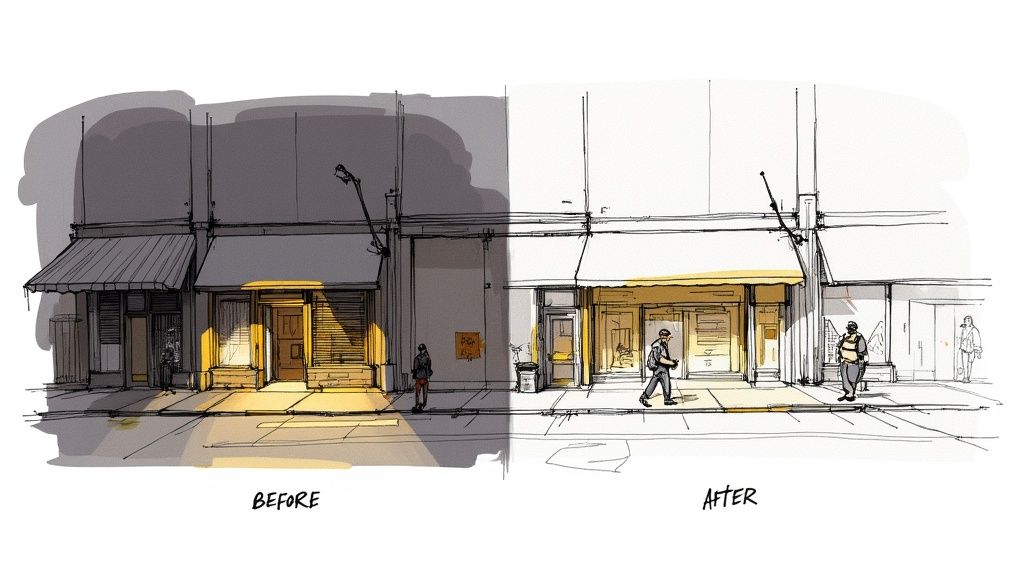
A well-run BID can completely change how people see and interact with a neighborhood. By focusing on the fundamentals, these organizations kickstart a positive cycle: safety improvements bring in more people, and more people make the area even more vibrant and secure.
Creating Safer, More Welcoming Spaces
One of the first things you’ll notice in a BID is an improved sense of security. And it’s not just a feeling—the data backs it up. Smart, proactive investments in things like brighter street lighting, visible security patrols, and quick graffiti removal make a place far less attractive to criminals and much more inviting to customers and residents.
A major analysis of Los Angeles BIDs really drove this point home. The study found that robberies inside these districts dropped by 7%, a steeper decline than in surrounding areas. Researchers pointed to beautification efforts as a key factor, concluding that they send a powerful signal that the neighborhood is cared for and actively watched. You can discover more insights about the BID-crime rate connection for a deeper look. This commitment to creating a secure atmosphere is truly at the heart of what a BID sets out to do.
By consistently keeping a place clean, well-maintained, and well-lit, a BID sends a clear message: this community cares. That attention to detail helps deter unwanted activity and creates a space where people feel comfortable sticking around and spending their money.
Boosting Economic Health and Property Values
Safety is just the beginning. BIDs are also serious engines for economic growth. Think about it: coordinated marketing campaigns, festive holiday decorations, and lively street festivals all work together to pull in customers and boost sales. This collective approach gives small, independent shops a marketing punch they could never land on their own.
The economic benefits then ripple out, building a much more resilient commercial center. The positive effects typically include:
Increased Sales and Foot Traffic: Targeted events and promotions directly drive business to local retailers and restaurants.
Lower Commercial Vacancy Rates: A vibrant, safe, and attractive district is a place where businesses want to be, making it much easier to fill empty storefronts.
Higher Property Values: As a district’s reputation and profitability climb, the value of the commercial properties within its boundaries tends to follow suit.
This kind of revitalization isn’t some far-off concept; it’s happening right here. You can see how downtown Jenks thrives with new businesses and revitalization efforts, putting these same principles of collective investment into action. For a wider view on urban development, you might find these Executive Insights on Modern Cityscapes interesting.
The Global Impact of Business Improvement Districts
The core idea behind a Business Improvement District—pooling resources for collective success—isn’t just for small-town main streets. It's a powerful strategy that scales up, driving the economies of the world's most competitive cities. On a global stage, this model helps major urban centers attract top-tier talent, leading companies, and international investment, proving the principles of local collaboration are truly universal.
When a BID operates on this massive scale, it's often called a Global Business District (GBD). Think of these as supercharged versions of a local BID. They are the economic hearts of major metropolises like New York, London, and Tokyo, acting as critical hubs for finance, innovation, and culture. While a local district might focus on street cleaning and holiday lights, a GBD tackles massive infrastructure projects and international marketing campaigns.
From Main Street to the World Stage
At the end of the day, the fundamental goal is the same: create a clean, safe, and dynamic environment where businesses can thrive. GBDs simply apply this concept to a much larger canvas. They are instrumental in maintaining a city's global brand and ensuring it remains an attractive place for multinational corporations to set up shop.
This isn't just a theoretical impact; the numbers are staggering.
Collectively, the world's leading GBDs generate USD 4.5 trillion in annual GDP, employ over 7 million people, and host 84 Fortune Global 500 headquarters.
This immense economic output shows just how foundational the BID model can be to national and even global economies. It's a testament to their resilience that 63% of stakeholders believe GBDs will be even more attractive in 2025 than they were before the pandemic. You can discover more insights about these global economic hubs and their post-pandemic rebound.
Here's a look at the heavy hitters—the GBDs that set the standard for urban economic power worldwide.
Top 5 Global Business Districts (GBDs) by Attractiveness
Rank | Global Business District | Country |
|---|---|---|
1 | The City of London | United Kingdom |
2 | New York Downtown | United States |
3 | Tokyo Marunouchi | Japan |
4 | Paris La Défense | France |
5 | Shanghai Lujiazui | China |
Seeing these names on the list really drives home the point. These aren't just business centers; they are globally recognized brands, and the GBD model is a key part of what keeps them competitive.
A Shared Strategy for Success
Whether in a bustling downtown like Jenks or a global financial capital, the strategy works because it’s adaptable. It empowers local stakeholders—the people who know the area best—to identify their unique challenges and implement tailored solutions.
The success of these global giants reinforces the value of community-led initiatives at every level. Just as GBDs focus on global competitiveness, they often use their resources to highlight unique cultural assets. This approach shares a common DNA with smaller-scale initiatives, something you can explore further in our guide to the impact and benefits of heritage tourism.
Ultimately, from a local shopping street to a sprawling city center, the lesson is clear: when a community invests in itself, the returns are powerful, creating vibrant places where people and businesses truly want to be.
Answering Your Questions About BIDs
When you start digging into how a Business Improvement District works, a lot of practical questions pop up for business owners, property managers, and residents alike. Let's clear the air and tackle some of the most common ones head-on.
Think of this as your quick-reference guide. We’ll get straight to the point on everything from how the assessment works to how you can get involved.
Is the BID Assessment Mandatory for Everyone in the District?
Yes. Once a BID is formed through a democratic vote by the property owners, the assessment becomes mandatory for every designated property within its legal boundaries. This is the cornerstone of the BID funding model, and frankly, it's what makes it work.
The logic is simple: the services—like extra cleaning crews, added security patrols, and district-wide marketing—benefit every single business and property in the area. Universal participation ensures the cost is shared fairly and prevents a "free-rider" situation where some get the perks without chipping in. This collective buy-in is what gives the BID a stable, predictable budget to get things done.
How Is a BID Different from the City Government or Chamber of Commerce?
This is a really important distinction, and it’s a question that comes up all the time. While all three are working to make the community better, they operate in completely different ways.
City Government: The city provides essential, baseline services across the entire city, funded by general taxes. Think police, fire departments, and basic street repairs. They handle the big picture.
Chamber of Commerce: This is a voluntary membership group. Businesses choose to join and pay dues to support the Chamber's work in networking and advocating for the broader business community.
Business Improvement District (BID): A BID is a very specific, geographically-defined area. It’s funded by a mandatory assessment to provide supplemental services—extra stuff—only within its boundaries. It’s managed by a private nonprofit made up of local stakeholders.
Essentially, a BID adds a concentrated layer of service right where it's needed most, making it a powerful tool for neighborhood-specific improvements.
"A BID isn’t here to replace the city; it’s here to enhance it. It's about neighbors pooling their resources to do the things for their specific street that a city-wide budget just can't cover."
Can Renters or Residents Get Involved in a BID?
Absolutely, and they should! While the property owners are usually the ones who vote to create the BID and pay the assessment, most BIDs know that renters and residents are the lifeblood of the district. The board of directors often has designated seats for business tenants, and sometimes even a resident representative.
Even if you don't have a formal vote, your voice is crucial. Here’s how you can get involved:
Attend Public Meetings: BID board meetings are almost always open to the public. It's the best way to stay in the loop and share your thoughts.
Join a Committee: BIDs often have committees for things like marketing, safety, or events. They’re usually looking for passionate volunteers from the community to lend their expertise.
Share Your Feedback: The people running the BID want to hear from you. Never hesitate to reach out with ideas, concerns, or even a compliment about their work.
An engaged community is a BID's greatest asset. Your input helps ensure the district’s priorities truly reflect what everyone who lives, works, and plays there actually needs. When everyone participates, the entire district gets stronger.
At The Ten District, we believe in the power of community-led growth to create a vibrant downtown. Discover what makes our neighborhood special by visiting us. Learn more about local events and businesses at https://www.thetendistrict.com.


Owner not Owbnrr !
Hi !
I manage a building in Conduit Street London W1 for the Freehold Owners, and have received a demand for a BID payment from City of Westminster. The property is 100% occupied by a tenant under a long lease.
Why does the Freehold Owbnrr have to pay this please ?