

What is heritage tourism: A guide to its impact and benefits
Let’s get one thing straight: heritage tourism isn’t just about visiting old buildings. It's the simple act of traveling to a place to truly experience it—the history, the people, the traditions, and the stories that make it unique. Think of it as stepping inside a living history book, where every landmark is a chapter and every local custom is part of the ongoing narrative.
What Exactly Is Heritage Tourism?

Unlike a typical beach vacation designed for pure relaxation, heritage tourism is all about connection and discovery. It elevates travel from a simple getaway into something deeper and more meaningful. It’s the difference between seeing a postcard of an ancient castle and actually walking through its stone halls, feeling the history in the air, and hearing the stories of those who came before.
This hunger for authentic connection is completely reshaping how we travel. Heritage tourism has exploded into one of the most significant parts of the global travel scene. The market was valued at a massive USD 709.29 billion and is expected to more than double, hitting USD 1,418.40 billion by 2034. That kind of growth sends a clear message: people are tired of generic experiences and are searching for something real. Read the full research about the heritage tourism market.
The Core Components of Heritage Tourism
At its heart, heritage tourism is driven by authenticity and powerful storytelling. The goal is to let visitors engage with a destination's unique identity—an identity often shaped by deliberate, community-led efforts.
When communities lean into their local history and culture, they create a distinct sense of place that you can't find anywhere else. This is what attracts travelers looking for genuine experiences. If you're curious about how communities build this kind of character, check out our guide on what placemaking is and how it transforms public spaces.
To really grasp what separates a regular trip from a true heritage experience, it helps to break down the key ingredients.
Core Components of Heritage Tourism at a Glance
This table simplifies the essential elements that define a heritage tourism experience, giving you a quick reference for what it's all about.
Component | Description | Example |
|---|---|---|
Authenticity | Experiences are genuine and reflect the true character and history of a place, free from commercial fabrication. | Visiting a family-owned olive grove in Greece that has used the same harvesting methods for generations. |
Preservation | Focuses on protecting and maintaining historical sites, natural landscapes, and cultural traditions for the future. | Revenue from park fees at Machu Picchu funding the conservation of the ancient Incan citadel. |
Education | Provides opportunities for learning about a location's history, culture, and people through interpretation and storytelling. | Taking a guided tour of the Freedom Trail in Boston to learn about the American Revolution. |
Connection | Encourages meaningful interactions between visitors and the local community, fostering mutual understanding and respect. | Participating in a traditional tea ceremony hosted by a local family in Kyoto, Japan. |
Ultimately, these components work together to create an experience that's not just memorable, but also enriches both the traveler and the destination. It's travel with purpose.
Exploring The Rich Diversity Of Heritage Travel
Heritage tourism isn't a single, one-size-fits-all experience. Far from it. Think of it less as a specific destination and more like a special lens you can use to see the world, whether you're halfway across the globe or right in your own neighborhood.
It’s a rich spectrum of travel that can be tailored to satisfy any curiosity. By understanding its different facets, you can figure out which kind of journey really speaks to you. At its core, we can break it down into three main pillars, though you'll find they often overlap to create unforgettable, layered experiences.
The Three Pillars Of Heritage Tourism
Getting a handle on these pillars helps you pinpoint what kind of traveler you are and what experiences will stick with you long after you've returned home.
Historical Heritage: This is the classic stuff. It’s all about getting your hands on tangible connections to the past. We're talking about exploring the physical remnants of history—the battlefields, ancient ruins, and architectural wonders that tell the epic stories of civilizations. It’s about walking the same ground as historical figures and touching the stones they laid. Think of trekking the ancient Inca Trail to Machu Picchu. That's historical heritage.
Cultural Heritage: This pillar dives straight into the living, breathing soul of a place. It’s about experiencing the traditions, arts, food, and festivals that give a community its unique identity. This could mean jumping into the vibrant chaos of the Holi festival in India, learning a traditional craft from a local artisan, or eating your way through a region's unique culinary scene. To truly get it, you have to appreciate the work that goes into preserving these stories, which is why things like cultural anthropology research are so vital.
Natural Heritage: Here’s where culture and history meet the great outdoors. This involves exploring landscapes that hold deep cultural or historical weight, like sacred mountains, ancient forests, or national parks with profound indigenous roots. A powerful example? A journey through the sacred landscapes of Uluru in Australia. It’s not just a rock; it’s a story embedded in the land itself.
Key Takeaway: The beauty of heritage tourism is its sheer variety. Whether you're drawn to ancient stones, living traditions, or sacred landscapes, there's a journey out there waiting to connect you with the world's most incredible stories.
Finding Heritage Close To Home
You don't need a passport to have a meaningful heritage experience. More often than not, some of the richest stories are waiting just around the corner. Your local museums, historical societies, and cultural centers are gateways to understanding the unique story of your own community.
For those of us in Oklahoma, we have a fantastic resource right at our fingertips. A great starting point is exploring Oklahoma’s rich history through the Oklahoma Historical Society’s exhibitions and museums. These local institutions take those big, global concepts of heritage and bring them right down to a personal, hometown level.
Once you start seeing these different types of heritage, you'll begin to see the world—and your own community—through a brand new, more connected lens.
The Real Impact of Supporting Heritage Destinations
When you decide to take a heritage trip, you’re doing a lot more than just booking a vacation. Your decision sends ripples out into the community, turning your travel budget into a powerful tool that helps preserve the very soul of a place. It’s a direct investment in the people and places that make a destination truly one-of-a-kind.
Every dollar you spend becomes a lifeline for historic sites that might otherwise crumble. The price of an admission ticket or a guided tour? That often goes straight into the upkeep of ancient monuments, the restoration of historic buildings, and the careful conservation of artifacts you can't find anywhere else. Without that steady flow of support, many of the world's most incredible landmarks would simply struggle to survive.
Fueling Local Economies and Keeping Traditions Alive
Beyond just preserving old buildings, heritage tourism builds a vibrant, sustainable local economy from the ground up. It creates good jobs that can’t be outsourced—for the local guide who knows every hidden story, the artisan practicing a craft passed down through generations, and the family running a small inn or restaurant.
This economic boost does more than just put money in people's pockets; it preserves the culture itself. When you buy handmade pottery or a locally woven textile, you’re giving that artist a real reason to keep their craft alive and teach it to the next generation. It’s a powerful way to ensure these invaluable traditions don't just fade into memory but remain a living, breathing part of the community’s identity.
By choosing authentic experiences, a traveler becomes a temporary custodian of a place's story, contributing to its ongoing narrative rather than just observing it from a distance.
A Story of Community Revival
Picture a small town whose unique identity was slowly being forgotten. The younger generation was leaving for jobs elsewhere, historic buildings sat empty, and local traditions were only remembered by a few elders. Then, the community decided to lean into its history and build a heritage tourism plan.
Travelers started coming to learn the town’s story, join in its festivals, and support its local businesses. That influx of interest and revenue sparked a renaissance. Old storefronts got a facelift, new energy buzzed in the town square, and young people suddenly saw a future for themselves right at home. The town didn't just survive; it started to thrive by celebrating its past.
We're seeing this same spirit of renewal in local projects aimed at creating vibrant downtowns, like the master plan that's driving the Jenks downtown and Riverwalk business boom.
Your trip is never just a trip. It's a vote for what you value, an investment in a community’s future, and a partnership in protecting our world's shared history.
A Global Snapshot of Heritage Tourism Hotspots
The urge to connect with the past isn't just a local trend; it's a full-blown global phenomenon. When you look at the heritage tourism market around the world, you start to see fascinating regional differences, each with its own unique flavor and story of growth. It’s not just about where people are traveling, but why.
Right now, Asia Pacific is the undisputed giant in the ring, commanding a massive 42% revenue share of the entire global market. This isn't too surprising when you think about the region's incredibly rich and diverse tapestry of ancient civilizations, spiritual traditions, and living cultural practices. Travelers are flocking to iconic, deeply significant sites, from the Great Wall of China to the temples of Angkor Wat.
Emerging Regions and Enduring Favorites
While Asia Pacific holds the top spot, other regions are quickly making a name for themselves. The Middle East & Africa is actually the fastest-growing region for heritage tourism, drawing visitors with its unbelievable archaeological wonders and layered history. At the same time, Europe remains an enduring powerhouse. Its classical ruins, medieval cities, and world-class museums have been the very bedrock of its tourism appeal for centuries.
It's easy to see how this kind of travel creates a positive loop. This infographic really breaks down how tourism supports preservation, creates local jobs, and helps keep traditions alive.
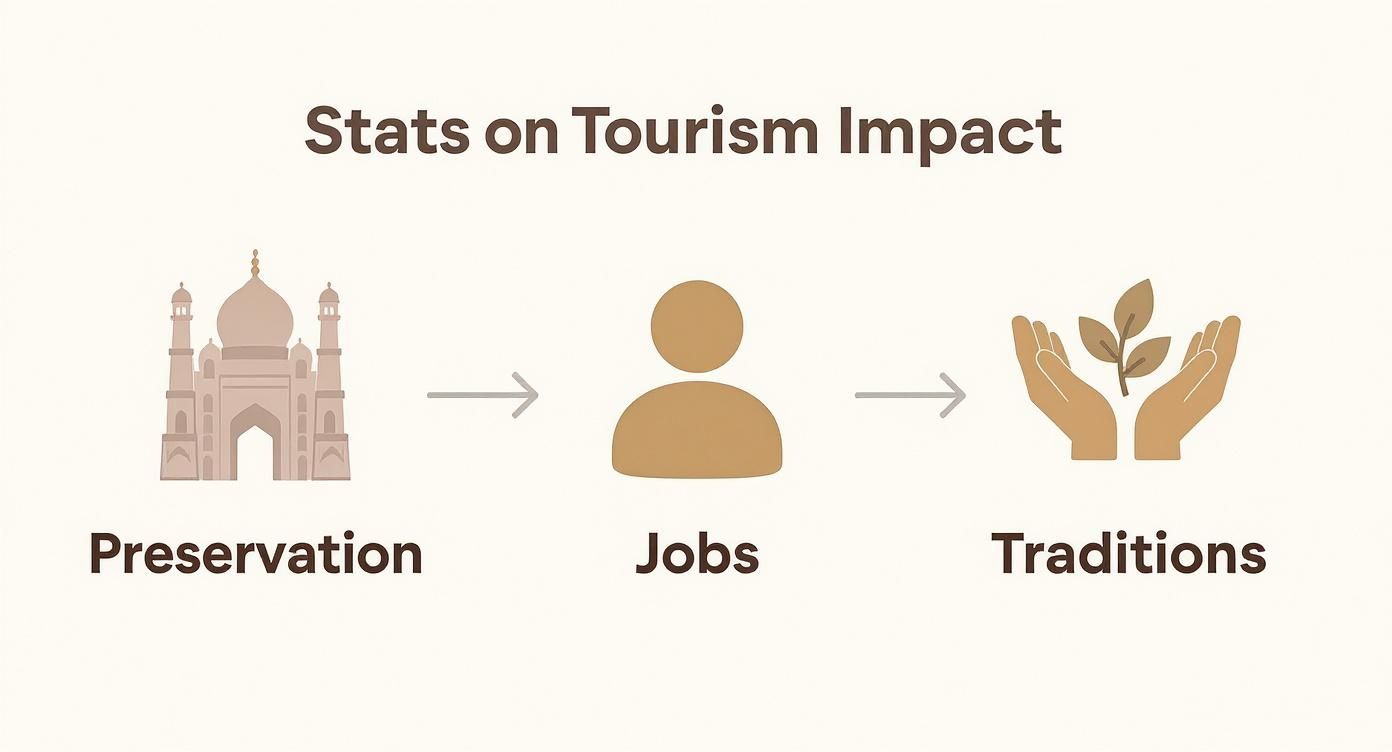
Essentially, every traveler's journey is a direct contribution to preserving a community's culture and history.
Across the Atlantic, the United States paints a different but equally compelling picture. The American cultural tourism market is largely powered by strong domestic demand, with travelers eager to explore the nation’s own complex history and diverse cultural landscapes. There's a real hunger for local cultural experiences, and the numbers back it up: this domestic interest is projected to surge from USD 455.0 billion to an incredible USD 955.0 billion by 2035.
Exploring Urban Heritage Hubs
Within these bigger global trends, major cities often act as concentrated hubs for history and culture. These urban centers give travelers a dense, accessible way to plug into a region's story. For example, anyone exploring Australia can find a ton of experiences through various Sydney city tours, which do a great job of showcasing the city's unique blend of colonial history, Indigenous heritage, and modern culture.
This global perspective shows us more than just amazing destinations. It shines a light on the economic and cultural forces shaping this vital industry. From ancient wonders to modern metropolises, the world's heritage is a shared treasure, just waiting to be explored with care and respect.
How to Be a Responsible Heritage Traveler
Exploring the world’s heritage sites is an incredible privilege. And being a great heritage tourist means being a conscious one. Responsible travel is more than just showing up; it’s about actively taking part in preserving a place for the next generation. It’s about leaving a destination just as good as you found it—or maybe even a little bit better.
Every choice you make, from where you grab lunch to the souvenirs you buy, has a ripple effect. When you’re mindful of that impact, you stop being just another visitor and become a partner in protecting these irreplaceable cultural and natural treasures.
Support the Local Economy Directly
One of the most powerful things you can do is make sure your travel dollars stay right in the community you’re visiting. This simple act is the lifeblood of sustainable heritage tourism and is absolutely essential for keeping small towns and historic districts vibrant.
Eat at Locally Owned Restaurants: Ditch the big chains and find a family-run cafe. You'll get a taste of authentic local flavor, and your money will go directly to the people who live there.
Buy from Local Artisans: Look for handmade goods and purchase them straight from the person who made them. This helps keep traditional crafts alive and ensures artisans are compensated fairly for their talent.
Hire Local Guides: A guide who grew up in the area will share stories and insights you'll never find in a book. Plus, you’re supporting a sustainable, local career.
These small decisions add up to a huge show of support. In fact, they’re the core principles you’ll find in any practical guide to small-town revitalization, because consumer choices truly can build a stronger community from the ground up.
Respect Cultural Norms and the Environment
Respect is everything when it comes to meaningful travel. When you show genuine regard for local customs and the environment, you’re paving the way for a positive experience for everyone involved—you and your hosts.
To travel responsibly is to understand that we are guests in someone else's home—a home rich with history, tradition, and life. Our goal should be to honor that, not alter it.
Before you even pack your bags, take a little time to learn about local etiquette, what’s considered appropriate to wear, and other social norms. It’s a small gesture, but it shows you care and can lead to much more genuine interactions.
Finally, always keep an eye on your environmental footprint. Stick to the marked trails, pack out what you pack in, and be mindful of resources like water and electricity. The preservation of natural heritage is just as critical as protecting historic buildings. By keeping these simple ideas in mind, you're doing your part to make sure these amazing places can inspire people for years to come.
The Future of Exploring Our Past
Heritage tourism isn't something stuck in a museum case; it's a living, breathing thing. It’s constantly changing, shaped by new technology and our own growing desire for deeper, more authentic ways to connect with history. The future of how we explore our past is at this really cool crossroads where digital tools meet a timeless human need for real experiences.
Imagine standing in front of the crumbling ruins of an ancient stadium. Now, picture holding up your phone and seeing those same ruins digitally rebuilt right before your eyes, complete with cheering crowds and roaring chariots. That’s the power of augmented reality (AR), a tool that will bring history to life in ways we’ve only dreamed of. It can layer stories and context onto a physical place without actually changing a thing.
Technology and Authenticity
But here's the interesting part. While technology opens up these amazing new doors, it also seems to amplify what travelers are truly looking for: authenticity. The more our world goes digital, the more we find ourselves craving real, unscripted human connections.
The future isn’t just about putting on a VR headset. It's also about those small-group tours led by a passionate local storyteller, or those unfiltered cultural moments that you can't script.
This creates a fascinating balancing act for the future of heritage tourism:
Smarter Tourism Management: We can finally use tech to help manage crowds and fight the "overtourism" that damages popular sites. Think timed entry systems and virtual queues that preserve fragile locations while making the visit better for everyone.
Discovering Hidden Gems: Digital platforms and smart marketing can shine a light on lesser-known heritage sites. This helps spread visitors out more evenly and funnels much-needed support into smaller communities.
The goal is to use technology not as a replacement for reality, but as a bridge to a deeper understanding of it. It’s about enhancing our connection to the stories and people behind the history.
The Role of Destination Marketing
Pulling off this balance between high-tech and high-touch is the next big challenge. It's up to communities and destinations to tell their unique stories in a way that attracts the right kind of visitor—the one who appreciates both. Understanding how to do that is everything, and you can learn more about what destination marketing is and how it works in our detailed guide.
Looking ahead, the heritage destinations that truly thrive will be the ones that masterfully blend the old with the new. They'll use modern tools to protect and share their history while, at the same time, creating opportunities for genuine, person-to-person cultural exchange.
This forward-thinking approach ensures that the stories of our past won't just survive—they'll continue to inspire and connect with generations to come. The future is all about making history more accessible, more meaningful, and more real than ever before.
Got Questions About Heritage Tourism? Let's Clear Things Up.
As you start thinking about your next trip, a few common questions usually pop up. Getting these details straight can make the difference between just seeing a place and truly connecting with it.
Cultural Versus Heritage Tourism
So, what’s the real difference between cultural and heritage tourism? It’s a common question, and the answer is simpler than you might think.
Imagine heritage tourism as a massive, sprawling library. This library holds the complete story of a place—every historical site, every significant landscape, every tradition passed down through generations. It's the whole collection.
Now, think of cultural tourism as pulling a specific, vibrant book off one of those shelves. It’s all about the living, breathing culture of a place right now—its art, its festivals, its food, and the daily rhythm of its people.
A great example? Visiting the ancient Acropolis in Athens is classic heritage tourism; you're stepping back into a monumental past. But then, walking over to the Plaka district for a Greek cooking class? That's cultural tourism. One is about the legacy left behind, and the other is about how that legacy lives on today.
Finding Authentic Experiences
In a world full of tourist traps, how do you find something real? The secret is to follow the money and the stories—look for experiences where the local community is both the guide and the beneficiary.
Dig into local tourism boards and hire independent guides who actually live there. They know the stories behind the stories.
Be intentional with your spending. Choose the family-owned restaurant over the big chain. Buy from the local artisan. Your dollars can either support a community or a corporation.
Follow travel bloggers who are focused on responsible travel. They’ve often done the hard work of finding those truly special, off-the-beaten-path spots.
An authentic experience isn’t about finding some "untouched" paradise. It's about showing up and engaging with a place on its own terms, where the local people are the ones telling their own stories and reaping the rewards.
Is It Only for History Buffs?
Not a chance! While anyone who loves a good historical rabbit hole will feel right at home, heritage tourism is really for anyone who's curious.
It’s about more than just dates and battles. It’s the intangible stuff, like listening to local music, tasting recipes passed down for centuries, or hearing folklore that has shaped a community's identity. It’s also about natural heritage—like exploring a national park that holds deep spiritual meaning for an indigenous group. It’s about getting the full picture.
Here at The Ten District, we believe the best stories are the ones right outside your door. Come discover the rich history and vibrant culture of Jenks, where every storefront and local gathering is a part of our story. Start planning your visit at https://www.thetendistrict.com.


Comments