

Understanding Commercial Property Vacancy Rates A Practical Guide
Walk down any Main Street, and you can get a feel for the local economy just by looking around. Are the storefronts full and bustling? Or are there "For Lease" signs dotting the windows? This simple observation is the heart of a crucial economic indicator: the commercial property vacancy rate.
Think of it as the community's economic pulse. A low rate suggests strong demand, business confidence, and healthy growth. A high rate, on the other hand, often points to underlying economic struggles. For anyone involved in shaping a community's future, from entrepreneurs to city planners, this number is where the story begins.
What Commercial Property Vacancy Rates Really Mean
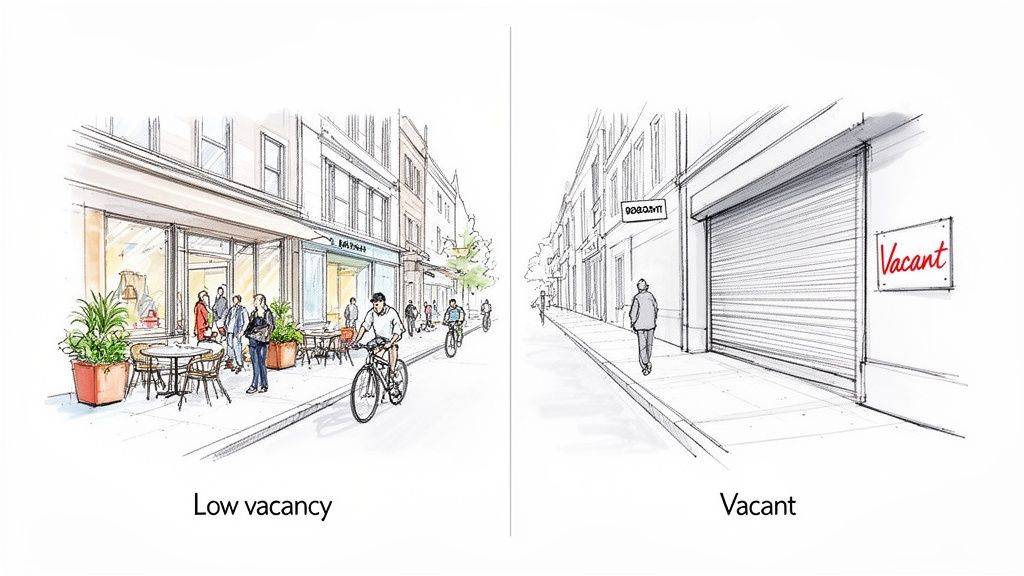
Picture a vibrant downtown hub like Jenks' Ten District. When you see restaurants with full patios, boutiques with steady foot traffic, and active offices, you're looking at a low vacancy rate in the flesh. It’s a tangible sign that businesses feel confident enough to put down roots, invest in the community, and hire local talent. This creates a powerful ripple effect—more businesses draw in more people, which helps everyone thrive and encourages new ventures to open up shop.
Now, flip that image. A street lined with empty storefronts tells a very different tale. High commercial property vacancy rates are a clear signal of economic headwinds. Maybe consumer spending has tightened, local businesses are struggling, or bigger trends—like the shift to remote work—are reshaping the demand for brick-and-mortar space. This isn't just a statistic on a spreadsheet; it's a real-time narrative of a community's challenges and its potential for renewal.
More Than Just Empty Buildings
So, what counts as "vacant"? In simple terms, it's any commercial property that's unoccupied and on the market for lease or sale. It's not generating rent; it's just sitting there. The concept is straightforward, but the implications run deep.
A consistently low vacancy rate is the gold standard for a healthy market. It usually points to:
Strong Business Confidence: Companies are signing long-term leases, betting on a stable and profitable future.
Robust Consumer Demand: Packed retail centers mean people are out spending money, supporting a diverse ecosystem of shops and services.
A Positive Economic Outlook: The overall financial health of the area is solid, making it attractive for both existing businesses and newcomers.
A high vacancy rate isn't just a landlord's problem—it affects everyone. It can drag down property values, shrink the tax base that funds local services like schools and fire departments, and chip away at a neighborhood's sense of energy and safety.
Reading Between the Lines
Of course, not all vacancies are created equal. An empty shop on a prime downtown corner sends a much different signal than an available office on the fifth floor of a corporate park. The type of lease structure also changes the game for a property owner. For instance, knowing the ins and outs of a triple net lease reveals how risk and responsibilities are shared, which can soften the financial blow of a vacancy for a landlord.
This single metric is a critical piece of the puzzle for anyone with a stake in their community. Understanding how to read and interpret these numbers empowers people to make smarter decisions. To see how this fits into the bigger picture, you can dive deeper into the core principles of economic development. Whether you’re an entrepreneur hunting for the perfect location or a community leader driving a revitalization effort, vacancy rates are the essential starting point for building a stronger local economy.
Alright, let's move past the theory. Understanding what vacancy rate is gets you in the door, but knowing how to calculate it yourself—and where the pros get their numbers—is where the real power lies.
And don't worry, you don't need a finance degree for this. The math is surprisingly simple. It all comes down to a basic formula that pits empty space against the total amount of space available, giving you a crystal-clear percentage that tells a story about a building, a block, or an entire town.
The Basic Vacancy Rate Formula
To figure out the vacancy rate, you only need two numbers: the total empty square footage and the total potential square footage.
The formula looks like this: (Total Vacant Square Footage / Total Gross Leasable Area) x 100 = Vacancy Rate %
Let’s put it into action. Picture a small downtown block with ten identical storefronts, each one about 2,000 square feet. That gives you a Total Gross Leasable Area of 20,000 square feet.
Now, say two of those storefronts are sitting empty. That’s 4,000 square feet of vacant space.
Plug it into the formula: (4,000 / 20,000) x 100 = a 20% Vacancy Rate. Just like that, you have a hard number that gives you an immediate snapshot of that specific block's economic pulse.
Where to Find Reliable Vacancy Data
While you can easily run the numbers for a building you own or are looking at, getting a bead on an entire district or city means tapping into professional-grade resources. National averages paint a broad picture, but the real, actionable insights are found much closer to home, from sources that get the unique rhythm of your community.
Here’s where the experts go to find solid commercial real estate data:
Commercial Real Estate Brokerages: Big players like CBRE, JLL, and Cushman & Wakefield are constantly publishing quarterly market reports. These are often free and packed with detailed analysis on vacancy, rental trends, and new construction in specific metro areas.
Municipal and County Websites: Your local government’s economic development department is a goldmine. They track this stuff obsessively to attract new businesses and often post reports or interactive dashboards on their websites to brag about the area's economic health.
Business Journals and Publications: Local business journals live and breathe the regional economy. They’re constantly reporting on commercial real estate trends, big lease signings, and shifts in vacancy rates, offering the kind of timely, on-the-ground info you can't get anywhere else.
It's so important to look past the headline number. A city's overall vacancy rate might look grim because of a glut of empty office towers, while its retail and industrial markets are actually booming. Always hunt down data broken out by property type—office, retail, industrial—to get the real story.
Getting a handle on the numbers is the first step to making smarter decisions. For a deeper look at the financial side of things, our guide on how to evaluate commercial property for maximum ROI can help fill in the gaps. When you combine simple math with sharp, local data, you can stop just guessing and start taking informed action, spotting the real opportunities hiding in your own backyard.
How National Real Estate Trends Affect Your Local Community
It’s tempting to scroll past national real estate headlines and assume they have nothing to do with your town. But big economic shifts are a lot like weather systems—they might form hundreds of miles away, but eventually, they bring either rain or sunshine right to your doorstep.
Think of it this way: the national economy is the ocean, and your local community is a coastal town. When a huge wave, like the massive shift to hybrid work, forms out at sea, it doesn't just stay there. It travels, eventually reaching your local shores and reshaping the demand for commercial space on your own Main Street.
The Great Office Space Recalibration
The single biggest national trend rocking commercial property vacancy rates today is the fundamental change in how and where we work. The pandemic didn't just introduce remote work; it supercharged a move toward hybrid schedules that has left a tidal wave of empty office space all across the country.
This isn’t just a temporary dip. It’s a complete structural shift. In early 2025, the U.S. office property vacancy rate soared to a record high of 19.6%. At the same time, demand for traditional office space was stuck at about 30% below pre-pandemic levels. The engine behind this change was the widespread adoption of hybrid models, which slashed the average square footage needed per employee by a staggering 23% since 2019. You can see all the details in these commercial real estate statistics on KaplanCollectionAgency.com.
But here’s the critical part: this challenge is also an incredible local opportunity.
While demand for massive corporate headquarters is drying up, the desire for vibrant, community-focused experiences is exploding. People might not need to drive to a downtown high-rise five days a week, but they absolutely still crave connection, entertainment, and unique local spots. This is exactly where districts like The Ten District in Jenks can shine. By creating a place people want to be—full of unique shops, great food, and community events—these areas can turn the challenge of empty offices into their biggest advantage.
To get a handle on this, you first need to measure it. The formula for vacancy rates is simple but powerful.
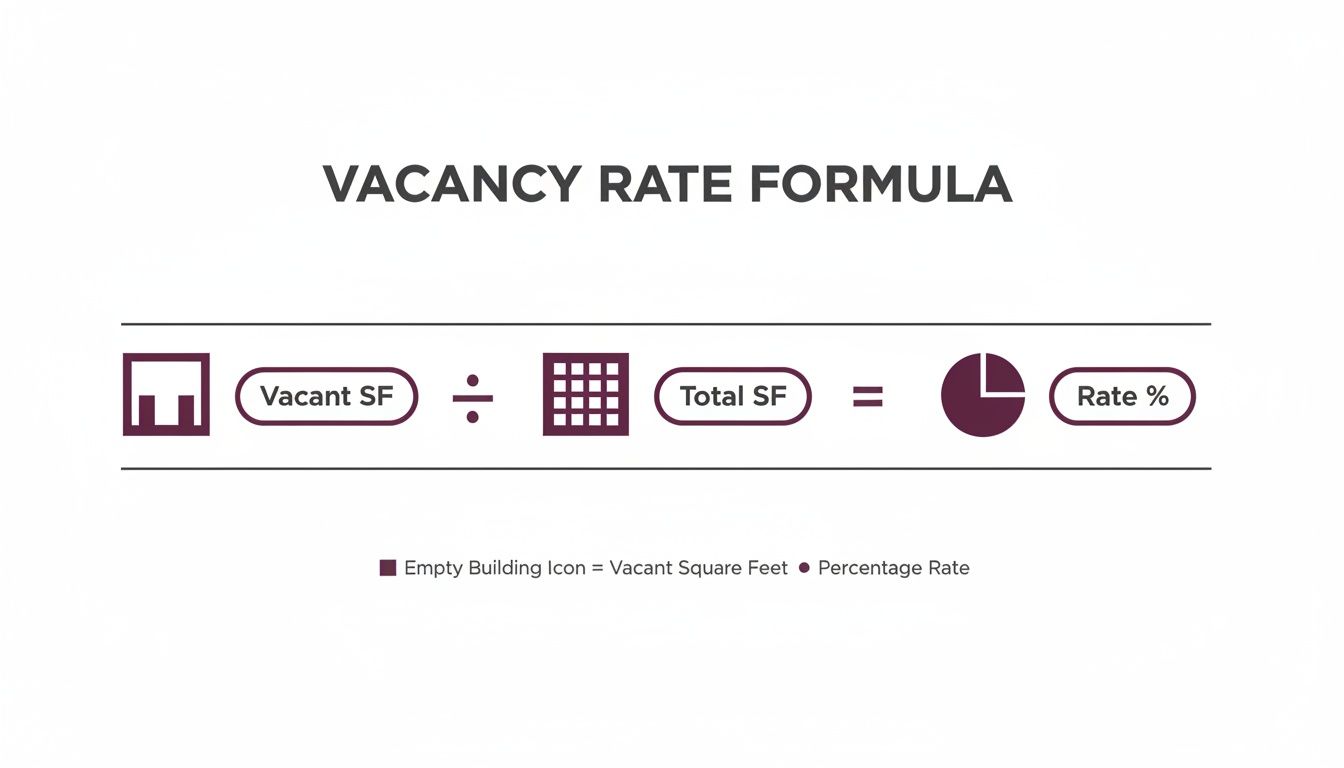
This calculation is the first step in translating those big, national trends into concrete, measurable data for your own community.
Turning National Headwinds into Local Tailwinds
While giant urban cores are struggling with cavernous, empty office towers, smaller and more agile districts have the flexibility to adapt. They can take underused spaces and transform them into something new and exciting. This evolution—from a classic 9-to-5 business district into a lively 18-hour destination—is the secret to modern economic resilience.
The table below breaks down how these national shifts can actually benefit a district that’s ready to innovate.
National vs Local Commercial Real Estate Trends
National Trend | Impact on Large Urban Cores | Opportunity for Districts like The Ten District |
|---|---|---|
Hybrid & Remote Work | Massive office vacancies, decreased foot traffic during weekdays, struggling legacy businesses. | Increased demand for flexible workspaces, "third places," and community hubs closer to home. |
Rise of E-Commerce | Closure of big-box retailers, leaving large, hard-to-fill commercial vacancies. | Thriving "experiential retail"—boutiques, galleries, and hands-on workshops that offer more than just a product. |
Quest for Authenticity | Homogenized downtowns struggle to attract visitors seeking unique experiences. | Fostering a unique local identity with independent shops, pop-ups, and creator-driven businesses. |
In short, the very trends hurting traditional business centers are creating the perfect conditions for community-focused districts to flourish.
Here’s how those national trends create specific local opportunities:
The Rise of Experiential Retail: With online shopping handling the basics, brick-and-mortar stores have to offer an experience. This means more unique boutiques, art galleries, and interactive workshops that you just can't get on a website.
The Demand for "Third Places": People are actively looking for places to connect that aren't home or the office. This is fueling a boom in cozy coffee shops, local breweries, and welcoming public spaces where a community can actually come together.
The Growth of the Local Creator Economy: Entrepreneurs can now test their ideas with less risk through pop-up shops and market stalls. These ventures can fill vacant storefronts, even temporarily, and add a dynamic, ever-changing energy to the district.
The new economic reality isn't about forcing workers back to their old desks. It's about creating places people want to be, regardless of their work schedule. The focus has shifted from corporate necessity to human desire.
By understanding these dynamics, local leaders and entrepreneurs can start reading between the lines of the national news. They can see a headline about declining office demand not as a threat, but as a clear signal to double down on what makes their community special. For those looking to see how this plays out on the ground, this piece on unpacking Oklahoma’s economy and its future outlook offers great local context.
This community-first focus builds a tough, resilient economy that isn't dependent on a single industry or work model, ensuring the town's vitality for years to come.
The Ripple Effect of Vacant Storefronts
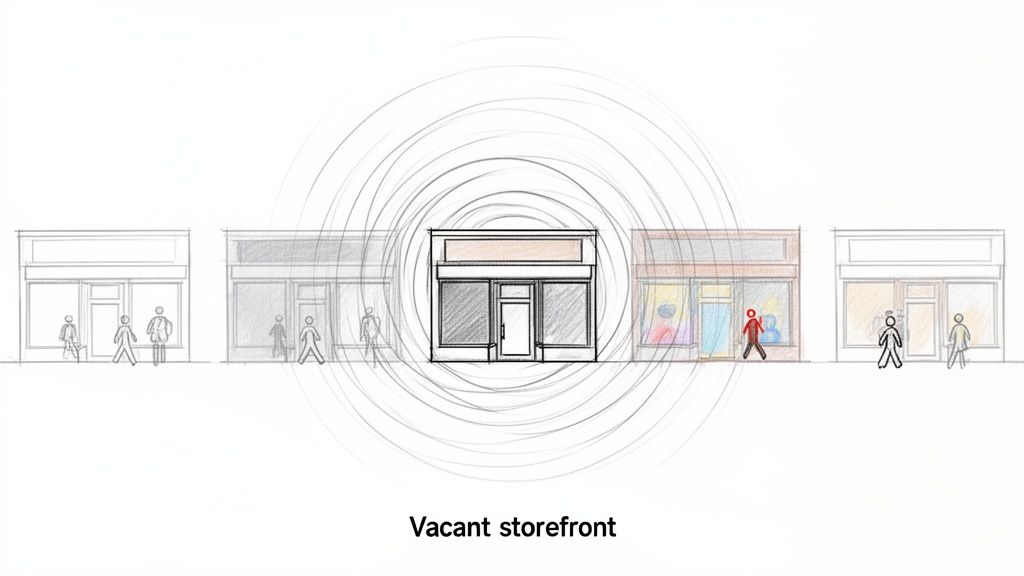
An empty storefront is never just an empty building. It's more like a dead battery in a string of Christmas lights—its darkness doesn't just create a single gap but can dim the entire block. This is the real-world impact of high commercial property vacancy rates: one empty space sending waves of consequence through the whole community.
It all starts subtly. The first casualty is foot traffic. A vibrant downtown relies on a steady stream of interesting shops and eateries to pull people along the sidewalk. A vacancy breaks that chain. A potential customer might walk past the dark windows, lose their momentum, and decide to turn around before they ever reach the thriving boutique or busy cafe just two doors down.
That initial dip in foot traffic is just the first domino to fall.
The Economic Cascade of Emptiness
When the businesses next door see fewer people walking by, they naturally see a drop in sales. The coffee shop that depended on impulse buys from shoppers at the now-empty retailer suddenly finds its afternoon rush thinning out. That’s a real problem. Over time, a sustained drop in revenue can put a serious strain on even the most beloved local spots, making it harder for them to grow, hire, or even cover their own rent.
This pressure builds and expands, kicking off a chain reaction:
Decreased Property Values: A block with a few "For Lease" signs starts to look less desirable. This can drag down the value of surrounding commercial properties, making it tougher for existing owners to sell or refinance.
Discouraged New Investment: Entrepreneurs are smart. When they scout locations, empty storefronts act like warning signs, suggesting the area might not have the customer base to support a new venture.
Lost Tax Revenue: Every vacant property is a direct hit to the city's wallet. It means no sales tax from a business that isn't there and, eventually, lower property tax assessments. That’s money that would have gone to parks, libraries, and public safety.
A high vacancy rate creates a perception of decline that can quickly become a self-fulfilling prophecy. What might start as a simple market shift can, if ignored, eat away at the economic foundation of an entire district.
The Social and Community Impact
But the ripple effect isn't just about dollars and cents. The soul of a community is woven together in its shared spaces, and a downtown district is chief among them. When storefronts go dark, the social damage can be just as severe as the financial fallout.
A street with unlit, empty windows can feel less safe after dark, discouraging people from taking an evening stroll or visiting restaurants and bars. This erodes the sense of connection that makes a downtown feel less like a commercial zone and more like a neighborhood’s living room.
Those vacancies also represent lost opportunities. A former retail space could have become a new art gallery, a yoga studio, or a family-friendly restaurant—places where people meet, connect, and build relationships. Each empty unit is a missed chance to strengthen the community’s social fabric. This is why a community's proactive vision is so critical. Understanding and getting behind the revitalization of downtown blocks is a collective effort, as seen in the inspiring work happening in Jenks. You can learn more about how small wins contribute to a big vision in local renewal.
Ultimately, tackling high commercial property vacancy rates is about so much more than filling buildings. It’s about protecting the entire ecosystem that makes a community resilient, vibrant, and a place where people actually want to be.
Turning Vacancies Into Vibrancy: A Playbook for Action
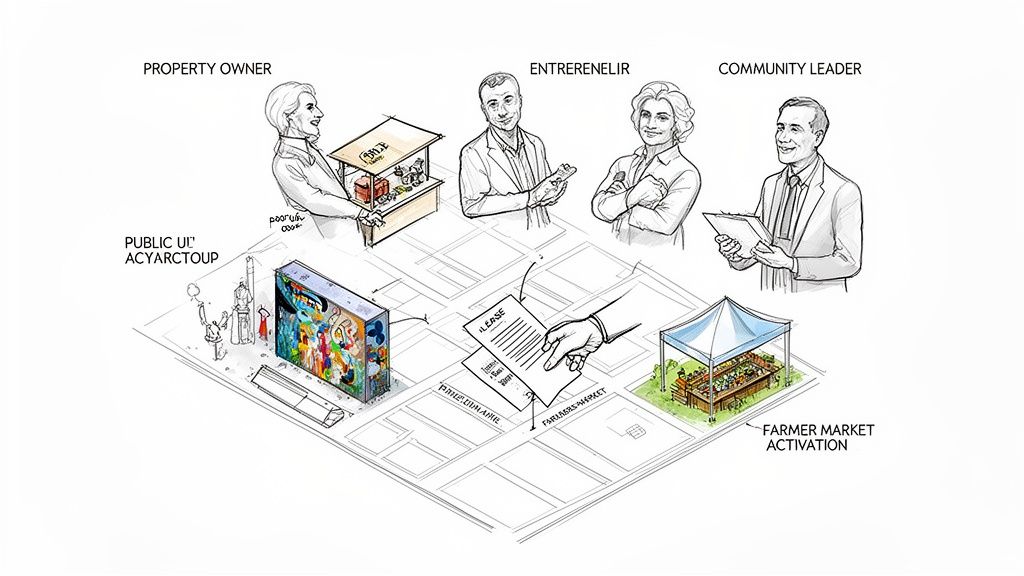
Knowing the numbers behind commercial property vacancy rates is a solid start, but the real win is turning that data into visible, on-the-ground change. A street full of empty storefronts feels like a complex problem, but it’s one we can absolutely solve with a dose of creativity, collaboration, and the right moves.
This isn’t just a landlord’s problem to fix—it’s a shared mission. Real, lasting progress kicks in when property owners, entrepreneurs, and community leaders all get in the game, each playing a crucial, interconnected part. Let’s break down the playbook.
For Property Owners: Rethink and Revitalize Your Space
As a property owner, an empty building isn't just lost rent; it's a missed opportunity. In today’s market, the old "wait-and-see" approach for a long-term tenant just doesn't cut it anymore. It's time to get flexible, creative, and proactive to make your property a place businesses are lining up for.
One of the biggest game-changers is moving to flexible leasing. Instead of holding out for that single, ten-year lease, think about lowering the barrier to entry. Consider a percentage rent agreement, where a tenant pays a lower base rent plus a piece of their sales. When they win, you win.
Other smart moves include:
Pop-Up and Short-Term Leases: Offer up your space for a few weeks or months. This lets new ideas get tested, creates buzz, and keeps your storefront from going dark.
Tenant Improvement (TI) Allowances: A little investment goes a long way. Offer to help tenants with build-out costs. A sharp-looking interior can be the final nudge they need to sign the lease.
Property Enhancements: Don’t underestimate the power of curb appeal. A fresh coat of paint, modern signage, better lighting, or restoring a historic facade can completely change how your building is perceived.
A vacant property is a passive liability. By investing in flexible leasing and strategic upgrades, you transform it into an active asset that generates interest, foot traffic, and ultimately, income.
Thinking outside the box with concepts like food halls can be transformative. These hubs are fantastic for enhancing asset value through new concepts by creating a destination that draws consistent crowds and supports multiple small businesses under one roof.
For Entrepreneurs: Seize the Moment
High vacancy rates can look like bad news, but for a sharp entrepreneur, they signal opportunity. When landlords have more spaces than tenants, the power shifts. This gives you the leverage to negotiate great terms and launch your dream with a lot less risk.
First, do your homework. Use the data sources we've talked about to find districts with higher vacancies but strong potential. Then, walk in with a solid business plan and be ready to negotiate for more than just a lower rent. Ask for things like a few months rent-free to get started or a cap on future rent hikes.
Here are a few tactical approaches:
Launch a Pop-Up Shop: This is the ultimate low-risk market test. You can validate your product, build a customer base, and prove your idea works before you even think about a long-term lease.
Collaborate on a Shared Space: Why go it alone? Team up with a business that complements yours. A clothing boutique and a local jeweler, for instance, can share costs while creating a more compelling shopping destination together.
Propose a Percentage Rent Deal: If you’re confident in your business but wary of high fixed costs, this is a great pitch. It shows the landlord you’re invested in success and aligns your goals from day one.
For Community Organizers: Build a Destination
Community leaders and local groups are the glue that holds a district together. Your job is all about "placemaking"—the art of creating an environment that people just want to be in. That means organizing events that bring in foot traffic, forging a unique identity, and making the entire area a place where people love to spend their time and money.
A fantastic tool for this is a Business Improvement District (BID). BIDs are funded by local property owners to collectively market the district, keep public spaces beautiful, and recruit the right mix of businesses. For a deeper dive, check out this guide on what a Business Improvement District is and how it drives local renewal.
Proven placemaking initiatives include:
Organizing Regular Events: Farmers' markets, art walks, holiday festivals, and outdoor music create a steady drumbeat of activity and give people a reason to keep coming back.
Investing in Public Art: Murals and sculptures can turn a bland wall or an empty corner into a landmark, sparking local pride and tons of social media love.
Enhancing the Streetscape: Simple things like benches, planters, good lighting, and clean sidewalks make a district feel safe, welcoming, and walkable.
When these three groups work in tandem, they create a powerful cycle of revitalization. Property owners offer the canvas, entrepreneurs bring the color and energy, and community organizers build the frame that makes the whole picture a masterpiece.
Answering Your Questions About Vacancy Rates
Alright, we’ve covered a lot of ground—from defining vacancy rates to exploring trends and strategies. But often, the real understanding comes from tackling those specific, practical questions that pop up.
Think of this section as our final sit-down, a chance to clarify the common queries we hear from property owners, entrepreneurs, and community members. Let's make sure you walk away from this with the confidence to put this knowledge to work.
What’s a "Healthy" Commercial Vacancy Rate, Anyway?
Figuring out a "healthy" commercial vacancy rate is less about a magic number and more about a balancing act. For a buzzing retail or mixed-use area, a rate somewhere between 5% and 10% is often the sweet spot.
Why? That range signals a strong market where most spaces are filled, but it still leaves a little room on the dance floor for new businesses to move in without a brutal fight for space or insane rent prices.
If the rate drops below 5%, it might seem like a great problem to have, but it's often a sign of an overheated market. This is where you see aggressive rent hikes that can push out local startups and independent shops, the very businesses that give a district its character.
On the flip side, a rate that creeps above 10% and stays there is usually a red flag. It points to deeper issues—maybe a mismatch between the type of space available and what businesses actually need, a drop in local spending, or just broader economic headwinds.
Honestly, the trend is more important than the number itself. A stable 8% vacancy rate tells a much healthier story than one that just jumped from 4% to 8% in a single quarter. Stability means predictability, and that’s what builds a sustainable market.
It's all about equilibrium. A balanced market creates healthy competition and lets a district grow organically, giving both established players and new ventures a real shot at success.
How Can Small Businesses Actually Use This Data?
If you’re a small business owner or an aspiring entrepreneur, vacancy rate data isn’t just some dry economic metric. It's your secret weapon for making smart decisions and, just as importantly, for negotiating your lease.
When you see high or rising vacancy rates in a neighborhood, the negotiating power starts to shift your way. Landlords with too many empty storefronts are far more motivated to make a deal. This is your chance to ask for things like:
Lower Base Rent: The most obvious win, directly cutting your monthly overhead.
Tenant Improvement (TI) Allowances: Get the landlord to chip in for the cost of building out your space—think new floors, lighting, or custom fixtures.
Rent Abatement Periods: Negotiate for a few rent-free months at the start of your lease. That's crucial cash flow when you're just getting off the ground.
But it goes beyond just the negotiation. Look at what kind of properties are sitting empty. Is office vacancy high but retail space is tight? That could be a golden opportunity for a new coffee shop, a quick-service lunch spot, or a happy hour bar to serve all those office workers. This data helps you see the real health of a location before you commit to a long-term lease.
What's the City’s Role in All This?
Local governments and community organizations are absolutely crucial players in the fight against empty storefronts. While property owners and entrepreneurs are on the front lines, it's the city and groups like Business Improvement Districts (BIDs) that create the environment where businesses can actually win.
They focus on making a district more attractive, accessible, and economically sound.
Key Government Initiatives:
Financial Carrots: This looks like façade improvement grants to boost curb appeal, tax breaks for new businesses, or low-interest loans for property upgrades.
Cutting Red Tape: Simplifying and speeding up the permitting process for business licenses and construction is a game-changer. It removes a massive headache for new tenants.
Public Investment: Putting money into better sidewalks, public parking, parks, and clean streets makes the whole area more appealing to everyone—businesses and customers alike.
Community groups and BIDs, on the other hand, are masters of "placemaking." They're the ones building the district's identity and creating a constant buzz that drives foot traffic. They market the area as a destination, organize events like farmers' markets or holiday festivals, and actively recruit businesses that fit the neighborhood's vibe. They give people a reason to show up, turning a collection of shops into a genuine community hub.
Are you ready to experience a downtown that gets it right? At The Ten District, we're building a vibrant community where businesses thrive and people love to gather. Discover your next opportunity at https://www.thetendistrict.com.


Comments