

Your Guide to the Perfect Event Sponsorship Proposal Template
An effective event sponsorship proposal is more than just a document asking for money. It’s a sales pitch, a conversation starter, and the foundation of a potentially powerful partnership between your event and a sponsor. It's your chance to clearly lay out the value you're offering—from audience reach to brand alignment—making it one of the most critical tools for getting the resources you need.
Why Your Sponsorship Proposal Needs to Stand Out
Let's be honest: in a world overflowing with marketing noise, a generic sponsorship proposal is heading straight for the trash folder. Decision-makers are buried in requests. Only the most personalized, compelling, and value-packed pitches will even get a second glance.
A proposal that cuts through the clutter isn't just asking for a check; it's building a business case for a partnership where everyone wins.
This guide gives you the complete framework—and a downloadable template—to ditch the robotic requests for good. We’ll use The Ten District, a buzzing community hub here in Jenks, as our real-world example. You'll see exactly how strategic, well-crafted proposals can attract high-value local and regional partners. This is your roadmap to creating a pitch that tells your event's story and proves an undeniable return on investment (ROI).
The Shift from Donations to Partnerships
The sponsorship game has changed. What used to feel like corporate charity is now a sharp, strategic part of a brand's marketing plan. Today’s sponsors are looking for way more than just their logo slapped on a banner. They want measurable results that hit their business goals.
A winning proposal reframes sponsorship as a smart investment, not a handout. It shows you’ve done your homework on the sponsor's brand, their target audience, and their marketing objectives, positioning your event as the perfect vehicle to get them where they want to go.
Your entire proposal needs to answer the one question every marketing manager is asking: "What's in it for us?" A killer proposal will spell out the value exchange, showing how a partnership will help the sponsor:
Reach a specific demographic they’re struggling to connect with.
Generate qualified leads for their sales team.
Boost their brand image and build goodwill in the community.
Drive product trials or even direct sales.
The Growing Market for Strategic Sponsorships
The appetite for well-planned event partnerships is stronger than it's ever been. Just look at the numbers. The global sports sponsorship market alone was recently valued at a staggering USD 106.44 billion, with projections to hit USD 195.50 billion by 2032. That explosive growth is all about data-driven strategies that help brands connect with passionate, engaged communities.
For places like The Ten District, these figures confirm what we already know: there’s immense value in crafting tailored proposals that speak directly to what a sponsor actually needs.
This trend hammers home the importance of a professional, strategic approach. By focusing on building real community partnerships and showing clear value, you can tap into this massive market and land the funding your event truly deserves.
Anatomy of a Winning Sponsorship Proposal
Let's be honest, a sponsorship proposal isn't just an ask for money. It’s a business case. You're not just requesting funds; you're offering a strategic partnership that delivers real value. When you get this right, every section builds on the last, leading a potential sponsor from a casual glance to a confident "yes."
We're going to break down the essential pieces of a proposal that actually gets funded. Think of it like a roadmap, and we'll use a couple of hypothetical Ten District events—like a community 'Summer Art Walk' or a bustling 'Holiday Market'—to show you how it's done.
The Cover Letter: Your First Impression is Everything
Your cover letter is your digital handshake. It’s the very first thing a sponsor sees, so a generic "To Whom It May Concern" is the fastest way to get your email deleted. This is your chance to prove you’ve done your homework.
Instead of a boilerplate intro, get personal. Mention a recent campaign they ran, a local initiative they championed, or how their company values line up perfectly with what your event is all about.
For instance, if you're pitching the 'Summer Art Walk' to a local Jenks bank, try something like this:
"We were so inspired by [Bank Name]'s recent 'Support Local Artists' grant program. It’s clear you share our passion for fostering creativity right here in our community, which is why we believe a partnership for our upcoming Summer Art Walk would be a perfect fit for your community engagement goals."
That one paragraph does so much work. It shows you're paying attention and you see a genuine alignment, making the sponsor feel like a valued partner, not just another name on a spreadsheet. Keep it short, state your purpose, and create a hook that makes them want to keep reading.
The Event Overview: Sell the Vibe, Not Just the Details
This is where you paint a picture and bring your event to life. Don't just list the date, time, and address. You need to sell the experience. What will people see? What will they do? What's the energy going to be like? Why is this the one event our community can't miss?
Use descriptive language that puts them right there on Main Street. For a 'Holiday Market' at The Ten District, you could describe:
The buzz on the street with twinkling lights and festive music.
The smell of hot cocoa and roasted nuts from local vendor stalls.
Families making memories at the outdoor ice rink and kids lining up to meet Santa.
Over 50 local artisans showcasing unique, handcrafted goods that draw shoppers from all over the Tulsa area.
This kind of storytelling helps a sponsor visualize their brand right in the middle of the action, making the partnership feel tangible and exciting. Once you've set the scene, you can follow up with the key logistics in a clean, easy-to-read format.
Before we dive deeper, it's helpful to see how all these pieces fit together. Think of your proposal as having five core building blocks.
Key Components of Your Sponsorship Proposal
Here’s a quick rundown of the essential sections every powerful sponsorship proposal needs. Each one serves a specific purpose, guiding your potential partner through your value proposition logically and persuasively.
Section Component | Purpose | Key Information to Include |
|---|---|---|
Cover Letter | To grab attention and establish a personal connection. | Personalized greeting, mention of sponsor's activities, and a clear statement of purpose. |
Event Overview | To sell the vision and energy of the event. | Event story, date, time, location, key activities, and expected attendance. |
Audience Demographics | To prove your event delivers the sponsor's target market. | Age, income, location, interests, and psychographic data of your attendees. |
Sponsorship Tiers | To present clear, value-packed partnership options. | Tier names, pricing, and a detailed list of benefits for each level. |
Call to Action | To guide the sponsor on what to do next. | Clear next steps, contact information, and a deadline for response. |
Having these components clearly defined ensures you're not just asking for support, but demonstrating a clear return on their investment.
Audience Demographics: The Proof Is in the Numbers
You’ve sold the dream, now it’s time to back it up with data. Your audience demographics section is arguably the most important part of your event sponsorship proposal template. This is where you prove your attendees are the exact people the sponsor is trying to reach.
Vague claims like "we attract a diverse crowd" won't cut it. You need concrete numbers.
Age Distribution: 65% of our attendees are between 25-45.
Geographic Reach: 70% live within a 15-mile radius of Jenks, with 30% traveling from the greater Tulsa metro.
Household Income: Our average attendee household income is $85,000, showing real purchasing power.
Interests: Post-event surveys show our audience is highly interested in local dining, boutique shopping, and family-friendly activities.
If you’re planning a first-time event, don't worry. You can pull data from similar community events or use demographic info for The Ten District's typical foot traffic. This data-driven approach transforms your ask from a donation request into a strategic marketing opportunity.
Sponsorship Tiers: Create Packages They Can't Refuse
This is the "what's in it for me?" section. Your job is to design tiered packages that offer increasing value and work for different budgets. Get creative with the names! Instead of the stale "Gold, Silver, Bronze," tie them to your event's theme. For the 'Summer Art Walk,' you could offer levels like 'The Muralist,' 'The Gallery Patron,' and 'The Art Enthusiast.'
Be specific about the benefits. "Logo placement" is weak. "Logo on 10,000 event flyers, main stage banner, and all social media posts" is strong.
Pro Tip: Always include an "In-Kind Sponsorship" option. Some businesses would rather provide goods or services (like printing, beverages, or equipment) than cash. This can be just as crucial for your bottom line. Make sure you've mapped out your needs by checking out our guide on how to build your Jenks, Oklahoma: Your Essential Event Budget Planning Template.
The Call to Action: Tell Them Exactly What's Next
You've made your case, so don't leave them hanging. Every great proposal ends with a clear, direct call to action (CTA). Make it incredibly easy for them to say yes or take the next step.
Don't be shy. A confident CTA looks something like this:
"We are confident that a partnership with [Sponsor's Company] for the Holiday Market will deliver exceptional brand visibility and community goodwill. We would love to schedule a brief 15-minute call next week to discuss this opportunity further. Please let us know what time works best for you."
Be sure to include your name, title, email, and phone number. Sometimes, adding a little urgency helps. A simple line like, "Sponsorship opportunities for this tier are limited and will be confirmed by [Date]," can encourage a quicker response. This professional close leaves a great final impression and sets you up for a successful partnership.
Designing Sponsorship Tiers That Actually Sell
Let's be honest, the days of just slapping "Gold, Silver, Bronze" on your sponsorship packages and calling it a day are long gone. Sponsors are smarter and more selective than ever, which means your sponsorship tiers need to work a lot harder. They have to be creative, compelling, and packed with undeniable value.
Think of your tiers less as price points and more as genuine invitations to a partnership. For an event in The Ten District, say a local music festival, you could ditch the generic labels for names that really connect with our community's spirit.
Main Street Headliner
Community Amplifier
Jenks Supporter
See the difference? These names tell a story. They give sponsors a sense of identity and place within your event, transforming a simple request for money into a chance to collaborate. It’s a small shift that makes your proposal feel custom right from the start.
Building Value Beyond Just a Logo
A sponsor's logo on a banner is the absolute bare minimum. Real value comes from tangible, measurable benefits that line up with what a sponsor is actually trying to achieve with their marketing dollars. Your proposal needs to spell out exactly what they get for their investment, focusing on exposure, engagement, and exclusivity.
This diagram shows how your tiers should fit into the bigger picture of your proposal. You’re building a case, not just listing prices.
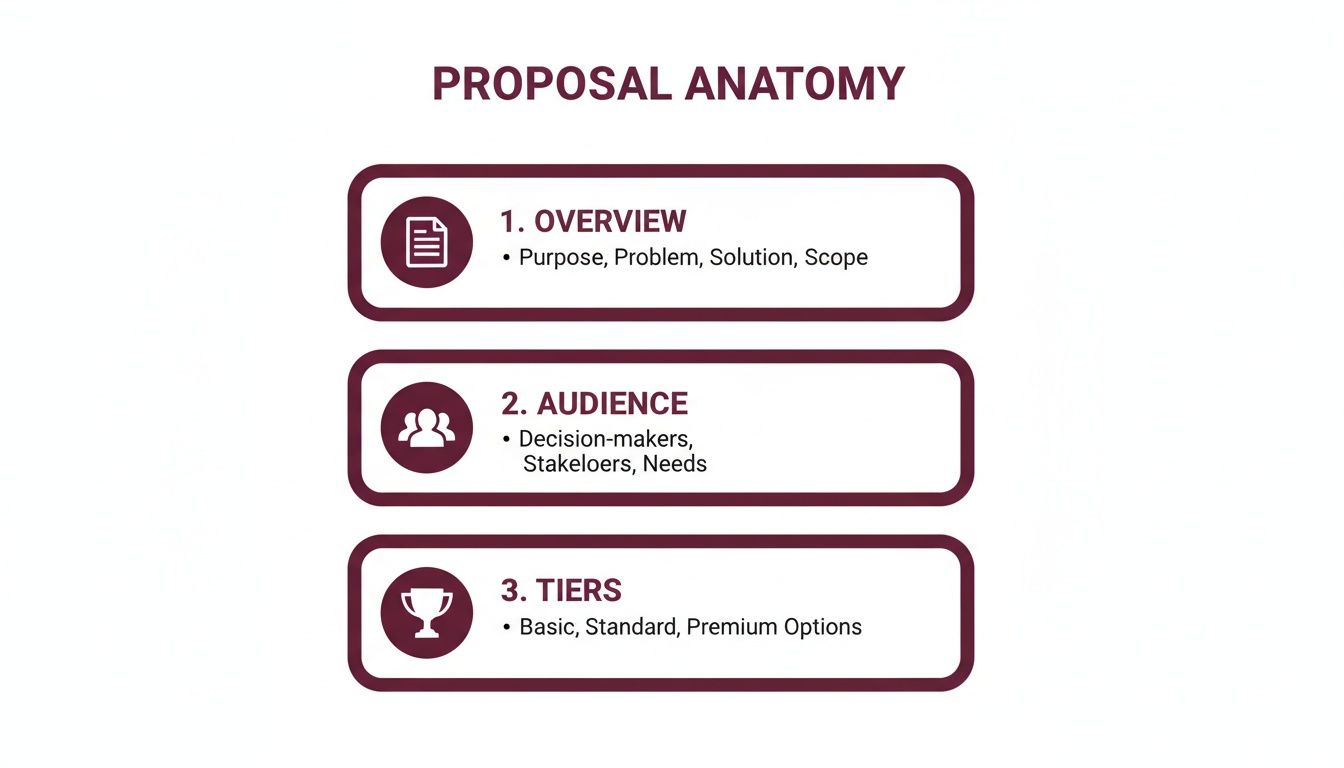
By structuring your proposal this way, you first establish the event's vision and prove your audience's value. When you finally present the sponsorship packages, they feel like a logical and exciting next step.
The best packages I've seen always mix different types of benefits to appeal to a wider range of goals. Try to include a blend of these:
Digital Promotion: Give sponsors features in your email newsletters, dedicated shout-outs on social media, and a spot on your event website.
On-Site Branding: Think bigger than a banner. Offer prominent signage, a branded lounge area, or even naming rights for a stage or activity.
Speaking Opportunities: Let a key partner join a panel or give a brief welcome address. It positions them as a thought leader.
Exclusive Access: Provide VIP tickets for their clients, a private networking happy hour, or meet-and-greet opportunities with performers or speakers.
When you're putting your tiers together, make sure to highlight opportunities for partners to hand out some of the best giveaways for trade shows. This can drive a ton of foot traffic to their booth or activation space.
Pricing Your Tiers for a Clear ROI
Pricing can feel like the hardest part, but it doesn't have to be. It should be a pretty straightforward calculation based on the value you're providing and the costs you need to cover. First, tally up all your event expenses. Your total sponsorship goal should aim to cover a good chunk of these costs.
Next, assign a fair market value to every single benefit you offer. For instance, a dedicated email blast to 5,000 subscribers could be valued at $500, while a main stage banner might be worth $1,500. Add up the total value of the benefits in each package. The asking price should be slightly less than this total, making it an obvious deal for the sponsor.
This strategy completely changes the conversation from "How much does this cost?" to "Look at all the value we're getting for this price." This is a huge deal, because today, 74% of brands are focused on 'fewer, bigger, better' deals that promise a 12% ROI boost. Plus, sponsorships tied to social impact are exploding, generating 33% higher engagement. For events right here in The Ten District, your proposal has to show data-driven ROI and a real path to community connection.
Your pricing shouldn't just cover your costs; it needs to scream about the marketing value a sponsor gets. When they see a package valued at $10,000 offered for a $7,500 investment, the ROI is crystal clear.
Sample Sponsorship Tiers for a Community Festival
To bring it all together, let’s imagine what this could look like for a "Jenks Founder's Day" festival hosted in The Ten District. This table gives a clear comparison of benefits that you can easily adapt for your own event.
This table provides a great starting point for building out your own sponsorship packages.
Tier Level | Example Price | Key Benefits |
|---|---|---|
Presenting Partner | $10,000 | - "Jenks Founder's Day Presented by [Sponsor Name]" title rights- Main stage naming rights- 5-minute welcome address on stage- 10 dedicated social media posts- Premium logo placement on all marketing materials |
Main Street Partner | $5,000 | - Naming rights for a key activity area (e.g., "Kids' Zone")- 5 dedicated social media posts- Logo on event t-shirts and flyers- Booth space in a high-traffic location- Recognition in all press releases |
Community Supporter | $2,500 | - Logo on sponsor banner at event entrance- 2 shared social media mentions- Logo inclusion on the event website- Standard booth space |
In-Kind Partner | (Goods/Services) | - Benefits tailored to the value of the contribution (e.g., providing printing services in exchange for "Community Supporter" level benefits). |
This kind of structured approach makes it incredibly easy for potential sponsors to see their options and pick the level that fits their budget and marketing goals.
By offering creative, value-packed packages, you’re not just asking for money—you’re building partnerships that last. For even more inspiration on securing funding, check out these 8 Jenks downtown fundraising ideas for a vibrant 2025.
Nailing Your Outreach and Follow-Up
Look, even the most stunning proposal is just a pretty document if it never lands in front of the right person. A great sponsorship strategy is just as much about your outreach and follow-up game as it is about the proposal itself. This is where your homework, hustle, and professional touch really shine.
Your outreach should never, ever feel like a generic email blast. The real goal here is to kick off a genuine conversation. That starts by finding companies whose values and marketing goals actually line up with your event's mission. If there's a disconnect, you're just wasting everyone's time.
Think about the businesses that are already active in the community. For an event in The Ten District, that could mean local banks, real estate agents, or family-owned restaurants that have a real stake in seeing downtown Jenks thrive.
Finding the Right Person to Talk To
Once you've got a list of potential sponsors, the next hurdle is getting past the gatekeeper. Firing off your pitch to a generic "info@" email is the fastest way to get deleted. Don't do it.
Instead, jump on a tool like LinkedIn to track down the actual decision-maker.
You're typically looking for titles like:
Marketing Manager or Director
Community Relations Manager
Brand Partnerships Coordinator
Local Store Manager or Owner (for smaller businesses)
Taking a few extra minutes to find a specific name shows you’ve put in the work. It flips your cold outreach into a warm introduction and makes it way more likely you'll get a reply.
Writing That First Email
That first email is your digital handshake. It needs to be short, personal, and laser-focused on the value you're offering. Decision-makers are busy people, so cut to the chase while still making a connection.
Here’s a simple, effective script you can adapt:
Subject: Partnership Idea | [Your Event Name] & [Sponsor's Company Name]
Hi [Contact Name], My name is [Your Name], and I’m organizing [Your Event Name], a [brief, exciting event description] happening in The Ten District on [Date]. I've been following [Sponsor's Company Name]'s work in the community, especially your recent [mention a specific project or campaign], and was really impressed. It’s obvious you share our passion for [shared value, e.g., supporting local artists, building community spirit]. We're expecting over [Number] attendees and think a partnership would be an amazing way for you to connect with a super-engaged local crowd. I’ve attached a quick proposal that outlines a few ways we could work together. Would you be open to a quick 15-minute chat next week to see if this is a good fit? Best, [Your Name] [Your Title] [Link to Event Website]
This email just works. It's personal, it quickly explains why you're reaching out to them, and it ends with a simple, low-pressure ask. You aren't asking for a "yes" on the spot—you're just asking for a conversation.
The Art of the Polite Nudge
Radio silence doesn't always mean "no." More often than not, it just means you caught them at a bad time. A polite, professional follow-up is absolutely essential. In fact, one study found that email sequences with four to seven messages get 3x more replies than those with only one to three.
Give it about a week after your first email. Your follow-up should be even shorter and act as a friendly reminder.
Here’s a quick script for that:
Subject: Re: Partnership Idea | [Your Event Name]
Hi [Contact Name], Just wanted to quickly follow up on my email from last week about a potential partnership for [Your Event Name]. We’re finalizing our top-tier partners by [Date] and would love to figure out how we could feature [Sponsor's Company Name] at the event. Let me know if you have any questions. Thanks, [Your Name]
This approach is friendly and creates a little urgency without being annoying. It makes it easy for them to hit reply. Remember, building relationships with local businesses is key. To get a head start, you might want to connect with the top 7 local business networking groups in Jenks, OK. This is how your amazing event sponsorship proposal template turns into signed deals instead of just sitting in your sent folder.
Proving Value After the Deal Is Signed
Getting that signature on your sponsorship proposal feels like crossing the finish line, but really, it's just the starting gun. Now the real work begins. Anyone can secure a one-time deal; the goal is to build a partnership that lasts.
Your focus has to shift immediately from pitching value to delivering it. This is the phase that separates one-off sponsors from loyal partners who come back every year, often with a bigger check.
Fulfilling Your Promises with Precision
First things first: create a master checklist of every single thing you promised in that agreement. This isn't just a to-do list; it’s your roadmap for execution.
Assign each deliverable to a specific team member and give them a hard deadline. It doesn't matter if it's a social media shout-out, logo placement on a flyer, or a fully branded activation space—every detail matters. Flawless, proactive execution tells sponsors they made a smart investment in a professional team. For more on keeping these relationships solid, check out our guide on 9 vendor management best practices for 2025 success.
Tracking the Metrics That Actually Matter
To prove ROI, you need cold, hard data. Don't wait until the event is over to start thinking about this. You should be tracking key performance indicators (KPIs) from the second the partnership kicks off.
Here’s what you should be monitoring:
Digital Engagement: Use unique tracking links (like UTMs) for each sponsor’s website to see exactly how much traffic you’re sending their way. Track the reach, likes, shares, and comments on every social post that mentions them.
On-Site Interactions: Document everything. Take great photos of their booth, their branding around the venue, and people actually engaging with their setup. If you can, use QR codes or simple lead capture forms to track direct leads generated right there at the event.
Audience Data: Send out a post-event survey and ask attendees which sponsors they remember most. Go a step further and ask about their perception of those brands after seeing them at your event.
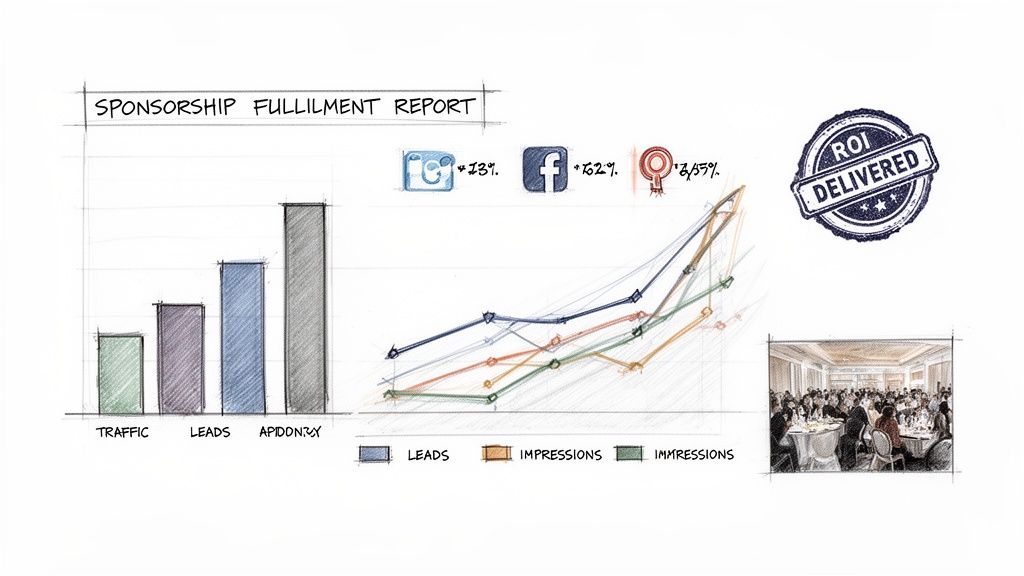
A great sponsorship fulfillment report doesn't just list what you did. It tells a story with data, connecting the dots between a sponsor’s investment and real outcomes like brand lift, new leads, and community goodwill.
Crafting a Compelling Sponsorship Fulfillment Report
Give it about a week after the event, then it’s time to pull all that data into a professional sponsorship fulfillment report. This is your final, most powerful piece of communication. It’s your proof.
Make the report visual, concise, and packed with numbers. Include your best photos, screenshots of social media posts showing the engagement metrics, and simple charts visualizing website traffic or survey results. Most importantly, frame all the results around the sponsor’s original goals to explicitly show how you helped them win.
The global events industry is projected to hit $1,346.92 billion soon. While live events still dominate, the surge in hybrid formats means sponsors demand crystal-clear ROI on both their physical and digital activations. Your fulfillment report is how you deliver those hard metrics and prove your worth.
When you deliver on every promise and prove the value with a killer report, you do more than just keep a sponsor happy. You make them feel like a genuine partner—and get them excited to sign on for your next event before you even have to ask.
Got questions about sponsorship proposals? Good. It means you're thinking through the details. Even with the best template, you're going to hit a few snags. It’s part of the process.
Let's walk through some of the most common questions I hear from event organizers. Think of this as a quick-reference guide for those moments you feel stuck. These insights will help you navigate the real-world conversations you're about to have with potential partners.
How Far in Advance Should I Send My Sponsorship Proposal?
Timing is everything. For a major community event, you need to start your outreach 6 to 12 months ahead of schedule. I know that sounds like a lifetime away, but there's a good reason for it.
Many of the larger corporations and companies finalize their marketing and sponsorship budgets for the next year sometime in the fall. If you send your proposal before they've locked in their spending, you stand a much better chance of getting a piece of that pie. Wait too long, and those funds are already spoken for.
Now, if you're targeting smaller, local businesses, they often have more flexible timelines. A 3-to-4-month window can work. But the golden rule here is simple: earlier is always better. It gives you more breathing room for follow-ups and negotiations without the stress of a looming event date.
What's the Biggest Mistake to Avoid?
I see it all the time: sending a generic, one-size-fits-all proposal. It's the single biggest—and most common—mistake you can make.
Sponsors get dozens of these requests. They can spot a copy-paste job from a mile away, and it immediately tells them you haven't bothered to learn anything about their business. It's a fast track to the "no" pile.
Failing to customize your proposal to reflect their brand, their marketing goals, and who they are trying to reach is a huge misstep. Your pitch has to answer one critical question from their perspective: "Why us?"
Do your homework. Always research the sponsor and tailor your pitch to solve their specific challenges. Show them you’re thinking about a true partnership, not just asking for a check. A customized proposal shows you’re serious, and that alone will make you stand out.
Should I Include a Contract in the Initial Proposal?
Absolutely not. Never, ever attach a legally binding contract or formal agreement to your initial proposal. It’s way too soon and can come across as aggressive or intimidating, especially to a potential partner who's just learning about your event for the first time.
Think of the proposal as a marketing tool, not a legal document. Its only job is to get them interested and start a conversation. You're there to showcase the value and get them excited about what you could do together.
Once a sponsor has verbally agreed to the key terms and is ready to move forward, that's when you send over a formal sponsorship agreement for their team to review. Keep the early stages focused on building a relationship, not on legal paperwork.
Ready to create a vibrant event that attracts top-tier sponsors? At The Ten District, we provide the perfect backdrop for unforgettable community experiences. Learn more about hosting your next event with us.


Comments