

Monthly Celebrations in Jenks: 10 Local Ideas
The global events market was about $1.35 trillion in 2025 and is projected to reach $2.1 trillion by 2032, but Jenks doesn't need giant productions every month to benefit from that demand. The strongest monthly celebrations for Jenks are recurring, locally anchored events that give families, businesses, artists, and neighbors a dependable reason to return to The Ten District throughout the year.
The practical opportunity is a familiar rhythm rather than a packed calendar for its own sake. The United Nations observance calendar includes recurring days and weeks such as World Water Day, World Environment Day, World Teachers' Day, and World Food Day, showing how annual moments can organize public attention across communities. The UN's international observance calendar offers plenty of inspiration, but local organizers still need to choose themes that fit Jenks, Oklahoma weather, downtown businesses, and the way families spend a Saturday.
A workable Jenks calendar could pair a First Friday art walk with a seasonal farmers market, a small-business coffee, outdoor movies, cleanup mornings, author readings, cultural potlucks, wellness gatherings, vintage markets, and live music. Each idea below separates family-friendly adaptations from business promotion and operational cautions. The basic planning rule is simple: assign every event a repeatable date, anchor partners, a weather backup, and a modest promotional cycle.
That approach fits The Ten District, the downtown Jenks district stretching west from the Arkansas River toward the historic Midland Valley railroad tracks. Organizers can use the downtown Jenks guide for local context and the The Ten District event hub to keep recurring activities visible. A useful companion is this community festival planning guide, especially when a small monthly gathering starts attracting several partners.
Table of Contents
1. First Friday Art Walk and Gallery Nights - Keep the route dependable
2. Seasonal Main Street Farmers Market - Build the vendor mix before promoting the date
3. Monthly Small Business Spotlight and Networking Coffee - Make attendance easy for working owners
4. Monthly Outdoor Movie Night - Treat weather and licensing as part of the program
5. Monthly Community Clean-Up and Beautification Day - Give volunteers a job and a finish line
6. Monthly Author Readings and Local Storytelling - Make the gathering feel hosted
7. Monthly Community Potluck and Cultural Celebration - Start with a trusted co-host
8. Monthly Fitness and Wellness Gathering - Make the activity welcoming rather than competitive
9. Monthly Vintage Market and Antique Collective Pop-Up - Protect the market's character
10. Monthly Live Music and Local Performance Series - Give performers a fair, clear arrangement
Turn Ten Ideas Into One Jenks Calendar - Choose a manageable starting mix - Use a 90-day setup sequence - Design for Oklahoma conditions - Measure what matters locally
1. First Friday Art Walk and Gallery Nights
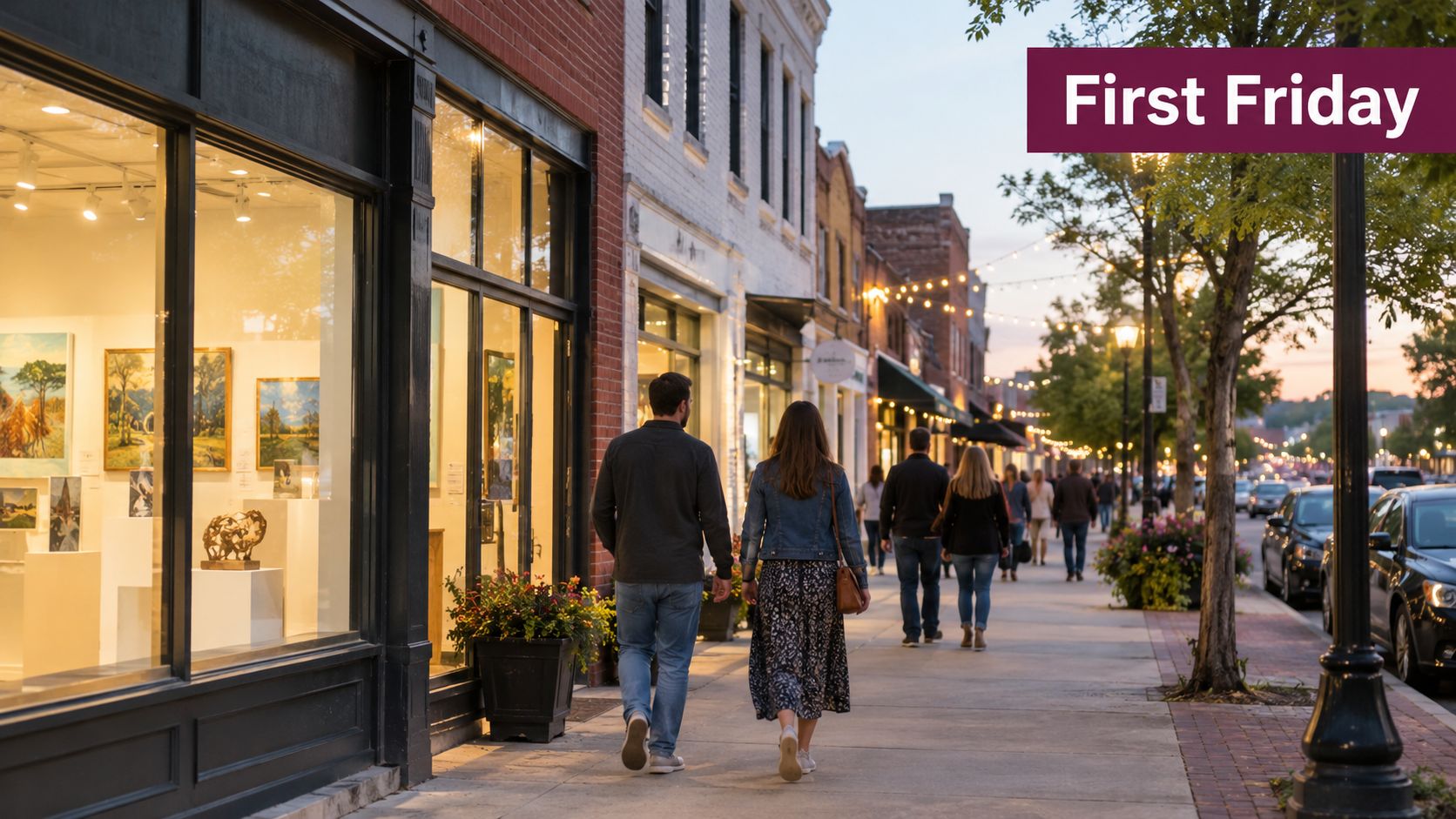
A First Friday art walk gives downtown Jenks a reliable evening appointment. Galleries, independent shops, restaurants, and studios can extend their hours, display local work, and create a walkable route along Main Street without carrying the cost of a major annual festival.
The format works best when the event feels consistent but not identical every month. One month might feature a local painter, another a student exhibition, and another live acoustic music beside a retail storefront. The public art spaces in Jenks can help visitors understand that the district's creative identity extends beyond one room or one business.
Keep the route dependable
Start with three or four anchor venues that commit to participating every month. Other businesses can join when they have the staff and a fitting display, but the core route should remain dependable. Visitors need to know that at least a few places will be open and active when they arrive.
A printed calendar at participating businesses can sit alongside a simple digital event listing. Marking parking areas clearly matters, especially for visitors approaching downtown from the Arkansas River side. Temporary wayfinding signs should be reviewed with the city rather than placed casually in travel lanes or on private property.
Families need an easy entry point. Add a small art activity, a kid-friendly demonstration, or a short scavenger route that doesn't require children to stay inside a gallery for long. Restaurants can offer an early dinner option, while artists receive a recurring place to meet potential buyers and neighbors.
Practical rule: Build the monthly habit around the event's date and route, then change the featured art. Constantly changing the basic logistics makes repeat attendance harder.
Tulsa's Philbrook area, Cherry Street, and Oklahoma City's Paseo Arts District show how recurring openings can keep attention on local artists. Those examples are useful models, but Jenks should keep its own scale and Main Street geography at the center.
2. Seasonal Main Street Farmers Market
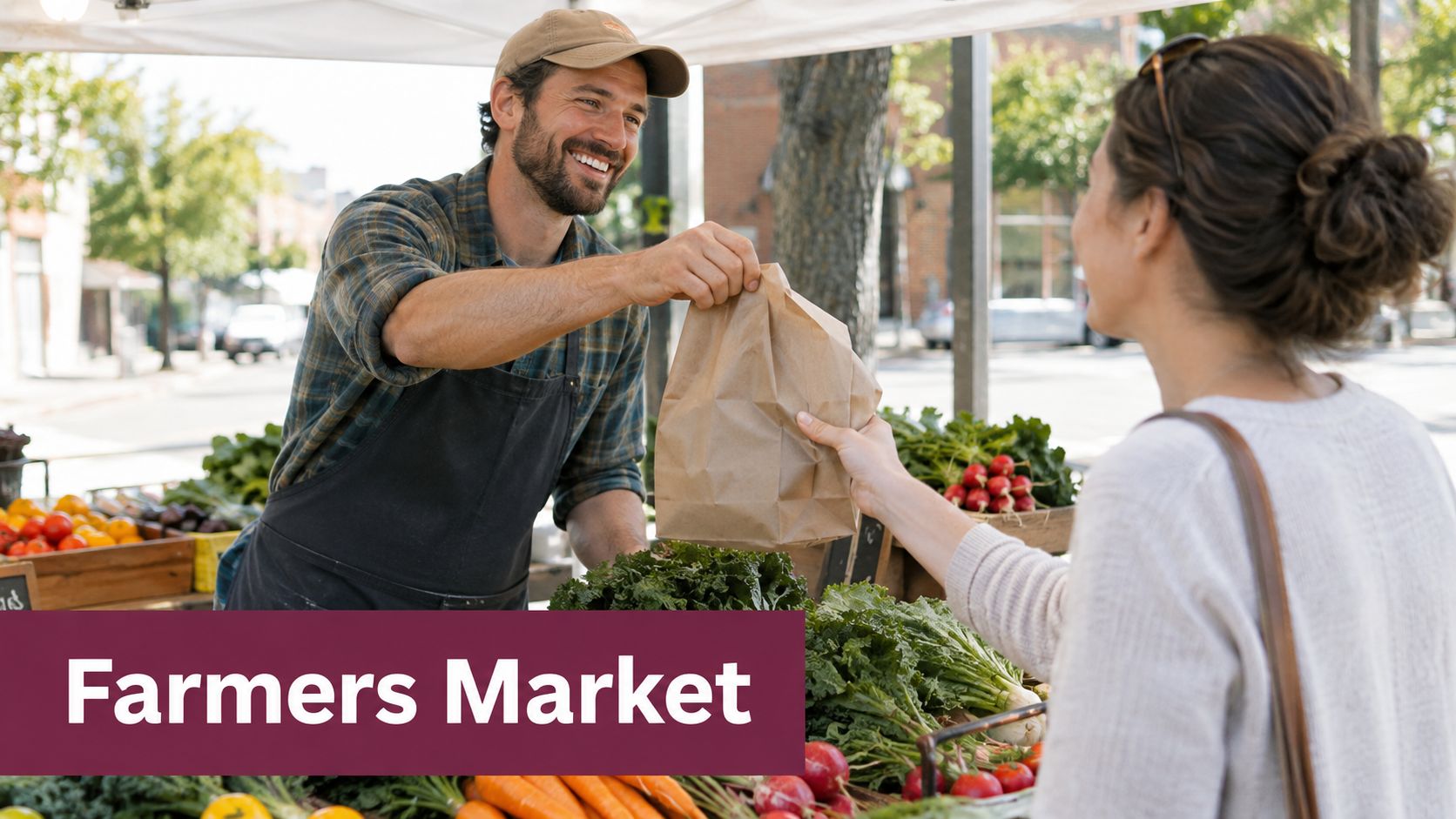
A seasonal farmers market can become one of the clearest reasons to visit downtown Jenks on a Saturday morning. The strongest version isn't just a row of vendors. It creates a short, pleasant route through Main Street where shoppers can buy produce, baked goods, honey, flowers, prepared food, and small crafts before visiting nearby businesses.
Oklahoma's growing season, heat, wind, and sudden storms make a seasonal schedule more practical than pretending the market should operate unchanged all year. A Saturday morning window from 8 a.m. to noon gives families time to arrive early, while a summer weekday evening could test a second rhythm without committing the district to a permanent expansion.
Build the vendor mix before promoting the date
Recruit eight to twelve anchor vendors before launch, with enough variety that shoppers have a reason to return. Produce alone may not carry the market every month. A bakery, honey producer, flower seller, prepared-food vendor, and craft maker can give the route more texture while regional growers provide the seasonal backbone.
Use chalk, planters, or temporary barriers to define vendor areas and keep pedestrian movement clear. Nearby businesses can offer an early-bird special, a breakfast pairing, or a place for shoppers to cool down. Organizers should ask vendors each month about spacing, timing, customer questions, and which categories are missing.
The Jenks farmers market perspective can support local storytelling, while an Oklahoma Farmers Market Association listing and Jenks or Tulsa food publications can help reach shoppers who already plan their weekends around fresh food. A useful companion for seasonal planning is this eat fresh all year guide.
Families benefit from a simple activity, such as a produce coloring station or a short demonstration, but the market shouldn't become so programmed that vendors disappear behind entertainment. The event's value is the shopping experience itself.
Jenks already has a strong local precedent for recurring downtown events. The city identifies the 30th annual Herb and Plant Festival in 2026, and the festival takes place on Main Street. The Jenks city calendar confirms the durability of that spring tradition.
3. Monthly Small Business Spotlight and Networking Coffee
A business coffee works because it respects the morning. Set it on the same weekday and at the same time, such as the first Tuesday from 8 to 9:30 a.m., then keep the formal program shorter than the gathering. A rotating downtown coffee shop or restaurant can host a featured owner, followed by informal conversation among independent retailers, service providers, nonprofit leaders, and residents interested in Jenks commerce.
The featured business owner shouldn't deliver a polished sales presentation. A brief conversation about opening the business, solving a difficult problem, serving local customers, or adapting to seasonal traffic will be more useful. The organizer can prepare three or four open questions and let the guest speak in a natural voice.
Make attendance easy for working owners
Keep the program to 60 minutes or less. Owners can't spare a full morning every month, and a gathering that runs long will gradually lose the people it was meant to serve. Send a short reminder two days beforehand with the host location, time, and guest name.
A rotating host should be confirmed several months ahead so the calendar doesn't depend on a last-minute volunteer. The Jenks Chamber of Commerce can help promote the meeting or participate when the subject fits its members. Tulsa's ServiceSource and chamber breakfast formats provide useful examples of structured networking, but a downtown Jenks coffee should feel more conversational than formal.
For residents and families, the event can include a short public-facing question such as “What should visitors know about shopping downtown?” That keeps the gathering from becoming closed business networking. The independent shops around Jenks give the event a natural local cast of speakers.
The main caution is overprogramming. Don't add a panel, sponsor pitch, lengthy announcements, and multiple presentations to a simple coffee. One owner, one host, and a clear reason to talk is enough.
4. Monthly Outdoor Movie Night
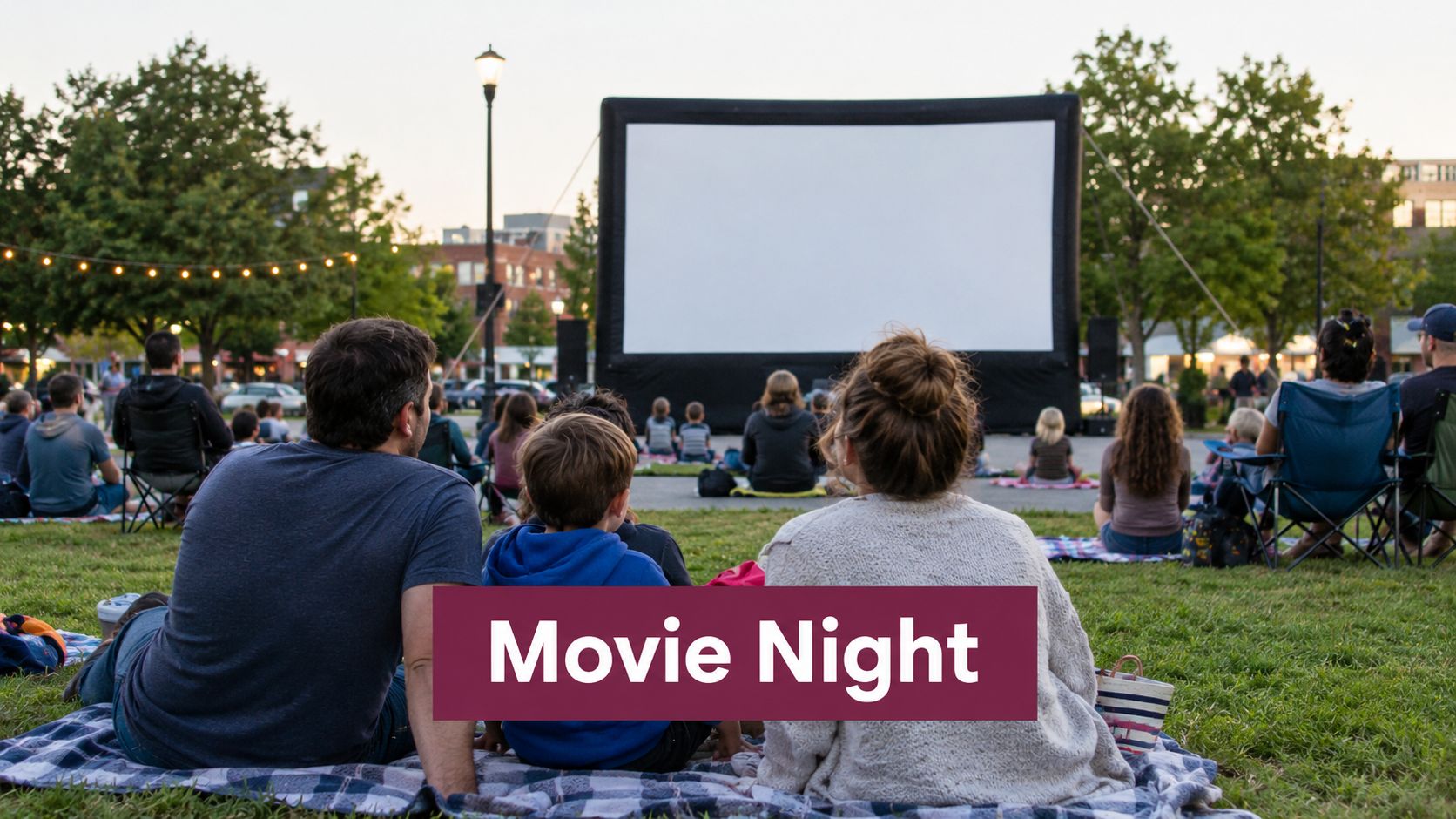
Outdoor movies suit the warmer part of the Jenks calendar, from late spring into early fall. A monthly showing from May through September could use a portable screen in a downtown location arranged with Jenks Parks and Recreation, such as a suitable park area or a nearby lot approved for public use.
The family experience should be uncomplicated. People bring blankets and chairs, restaurants sell food nearby, and children have enough room to settle without a formal stage program taking over the evening. Choose films with broad family appeal, including animated stories, adventure, comedy, and other G or PG selections. A niche film may attract a devoted audience but won't necessarily serve the district's broader monthly purpose.
Treat weather and licensing as part of the program
Set the same evening each month, such as the third Friday, and publish the lineup by April 1 if possible. That gives families a chance to plan around school, sports, and summer travel. The organizer also needs a rain location or a clear cancellation policy, because Oklahoma weather can change quickly.
Jenks Parks and Recreation should be involved before the first public announcement. Venue approval, equipment, liability coverage, restroom access, electrical needs, and crowd movement all need a responsible owner. Film licensing must also be checked. A public screening isn't automatically covered by a personal streaming subscription, and the organizer should verify the applicable rights rather than assume nonprofit status solves the issue.
Allowing blankets, outside snacks, and nonalcoholic beverages can reduce pressure on concessions. A downtown restaurant or caterer may still operate a small stand, but food service shouldn't become the bottleneck. The family-friendly things to do in Jenks can help position the movie as one part of an evening downtown rather than an isolated screening.
Tulsa's Guthrie Green, Broken Arrow parks, and Oklahoma City parks offer useful examples of repeatable outdoor cinema. Jenks can borrow the dependable scheduling without trying to copy the scale of those venues.
5. Monthly Community Clean-Up and Beautification Day
A clean-up morning may not look like a conventional celebration, but it gives residents a visible way to care for downtown. On a consistent Saturday, volunteers can work on planters, sidewalks, benches, murals, and public areas in The Ten District and near the Riverwalk.
Choose three or four priority projects before volunteers arrive. A vague request to “help beautify downtown” leaves people standing around while organizers search for tools. A short list such as planter maintenance, sidewalk washing, bench work, or approved mural touch-ups makes the morning manageable.
Give volunteers a job and a finish line
A window from 8 a.m. to noon is practical for avoiding the worst heat during warmer months. The same second Saturday each month can become a recognizable civic routine, but the work should change with the season. Spring planting, summer litter removal, fall maintenance, and winter inspection each require different materials and permissions.
The Jenks Parks and Recreation department can help clarify which public projects are approved, what tools are available, and how liability should be handled. A local hardware or landscaping business may donate supplies, while coffee, doughnuts, and water give volunteers a small welcome when they arrive.
The street activation ideas for Jenks offer a useful way to connect maintenance with public life. Take before-and-after photographs, but don't turn the morning into a photo opportunity at the expense of the work.
People come back when they can see what changed and know exactly where their effort went.
Families can participate through supervised litter walks, planting, or a simple public-art maintenance activity approved by the responsible owner. Avoid assigning children hazardous work or using paint and tools without adult supervision. Organizers should also publish a sign-up form roughly two weeks ahead so they can match the project list to the number of volunteers.
The best outcome is not a one-time transformation. It's a district where residents recognize that public spaces receive regular care from people who live, work, and spend time there.
6. Monthly Author Readings and Local Storytelling
A literary evening gives downtown Jenks a quieter kind of monthly celebration. A bookstore, library space, or cultural venue can host a local or regional author for a short reading, conversation, and questions. The format suits adults, older students, teachers, and families looking for a cultural outing that doesn't depend on loud entertainment.
A third Thursday at 6:30 p.m. provides a useful habit, though the venue's schedule should determine the final time. Invite several authors ahead of time, including novelists, memoir writers, historians, essayists, and emerging Oklahoma writers. A local story doesn't need to be about Jenks to be relevant. The conversation can explore place, memory, family, work, and the way Oklahoma communities change.
Make the gathering feel hosted
Keep the event to 45 to 60 minutes, including reading and questions. A moderator should introduce the author, explain how questions will work, and protect the final portion for audience participation. Without that structure, readings can run long and leave no time for the discussion people came to hear.
Partner with the Jenks Library system, an existing bookstore, Oklahoma writers' organizations, or regional university creative-writing programs. Those partners can help identify speakers and promote the series to readers beyond downtown. A simple email sequence sent three weeks, two weeks, and one week before the event is enough if the message includes the author, subject, location, and accessibility information.
Nearby restaurants can offer a post-reading meeting place, but the literary event shouldn't require attendees to buy dinner. Families may appreciate a children's author, a short youth writing activity, or a Saturday version during school breaks. Adults may prefer memoir, local history, or a craft conversation.
The caution is authenticity. Don't present an author as a representative of a culture or community without their agreement and proper context. Let writers describe their own work, and compensate them or support their books when the budget allows.
7. Monthly Community Potluck and Cultural Celebration
A community potluck can bring people together around food, stories, music, and traditions, but it needs more care than a generic “international night.” A rotating host organization should help shape each gathering so the featured culture isn't reduced to decorations or a menu label.
One month might focus on Mexican foodways, another on Vietnamese family traditions, another on Native American heritage, and another on Southern Oklahoma cooking. The point isn't to assign a single identity to a broad population. The point is to invite people to share what they know and to let cultural partners set the tone.
Start with a trusted co-host
Work with a cultural organization, community group, or knowledgeable local host before announcing a theme. That partner can advise on food, music, language, stories, and what should not be treated as entertainment. Native American communities in Oklahoma have their own traditions and protocols, so organizers should seek direct guidance rather than improvising a presentation.
A consistent evening schedule helps, but the location needs enough seating, handwashing access, shade or indoor backup, and a clear plan for food safety. Ask guests to RSVP through a simple form so organizers can estimate participation. Provide staple items such as rice, bread, drinks, or a main dish so the event doesn't depend entirely on attendees bringing something.
Dish cards should list ingredients and identify the cultural origin in the contributor's own words. That supports guests with allergies and encourages conversation. Live music, storytelling, dance, or craft-making can work when the people leading those activities want to participate.
Families can bring children, but the program should offer more than a meal. A short story, demonstration, or table activity gives children a respectful way to learn. Avoid turning cultural knowledge into a costume theme or asking one guest to explain an entire community.
The Ten District's downtown setting can make the potluck a welcoming shared table, but the gathering should remain community-led. Promotion needs to name the host, explain the purpose, and avoid exaggerated claims about representation.
8. Monthly Fitness and Wellness Gathering
A wellness gathering can connect The Ten District with the Arkansas River and the Riverwalk without requiring a large race or complicated equipment. A guided walk, outdoor yoga class, tai chi session, or gentle movement meetup gives residents a reason to start the day downtown and continue with coffee or breakfast afterward.
The simplest first version is a 30-minute guided walk beginning at an agreed downtown meeting point and following an accessible route near Main Street and the Riverwalk. A local trainer or instructor can lead stretching or movement, while Jenks Parks and Recreation helps clarify route, facility, and liability requirements.
Make the activity welcoming rather than competitive
A first-Saturday 8 a.m. gathering can work during cooler months, while early evening may be more comfortable during summer. Publish the route length, terrain, pace, footwear suggestions, and weather policy in every listing. Participants shouldn't have to guess whether the event is a workout, a stroll, or a class.
Partner with a local fitness studio or qualified instructor. The organizer needs to understand insurance, waivers, emergency contacts, and what the leader is qualified to teach. A small stipend or referral arrangement can recognize the instructor's time, but the event should not promise medical advice or a level of training it can't provide.
Tulsa's Philbrook, Broken Arrow Parks and Recreation, and Oklahoma City park programs offer examples of outdoor wellness formats. Jenks can make its version more local by pointing out public art, downtown history, river views, and nearby businesses along the route.
Families may prefer a walk with observation prompts, while older adults may need benches, shade, and a slower pace. Don't combine a fast fitness group and a casual community stroll without separate leaders. Afterward, a nearby coffee shop can welcome participants, but no purchase should be required to join the walk.
The most sustainable wellness event is one people can attend in ordinary clothes, at an ordinary pace, without feeling tested.
9. Monthly Vintage Market and Antique Collective Pop-Up
A vintage market can fill a different part of the downtown calendar than a farmers market. Antique dealers, vintage clothing sellers, used-book vendors, record collectors, and upcyclers bring objects with stories, and shoppers often browse longer when booths are arranged as a route rather than a single crowded cluster.
Start with eight to twelve vendors and recruit a dependable core before expanding. Quality matters more than filling every available space. A market with too many near-identical booths can frustrate shoppers and make small sellers compete directly with one another.
A third-Saturday window from 8 a.m. to 2 p.m. would give the event a recognizable place in the month, but organizers should test whether downtown businesses and vendors prefer morning, afternoon, or a full-day setup. A linear arrangement along an approved Main Street section could guide visitors between the market and nearby shops, though street closures, loading, parking, and pedestrian safety must be resolved before promotion.
Protect the market's character
Create a vendor application that asks what each seller brings, how much space they need, whether they require electricity, and how they handle payment. A modest booth fee may cover coordination and basic materials, but it should be set only after organizers understand actual costs. Don't promise a guaranteed customer volume.
Promote three or four weeks ahead in local vintage, antique, book, and collector groups. Nearby restaurants can offer an early-bird breakfast or a market-day special, but the promotion should remain clear about what the vendor fee does and doesn't include.
Families can enjoy a discovery table, a repair demonstration, or a children's book section without turning the event into a general carnival. The market should preserve room for careful browsing. Tulsa's Cherry Street area, Oklahoma City's Paseo District, and Fort Worth's Stockyards provide useful examples of recurring vintage and flea-market energy, but Jenks should select vendors that fit its own downtown identity.
10. Monthly Live Music and Local Performance Series
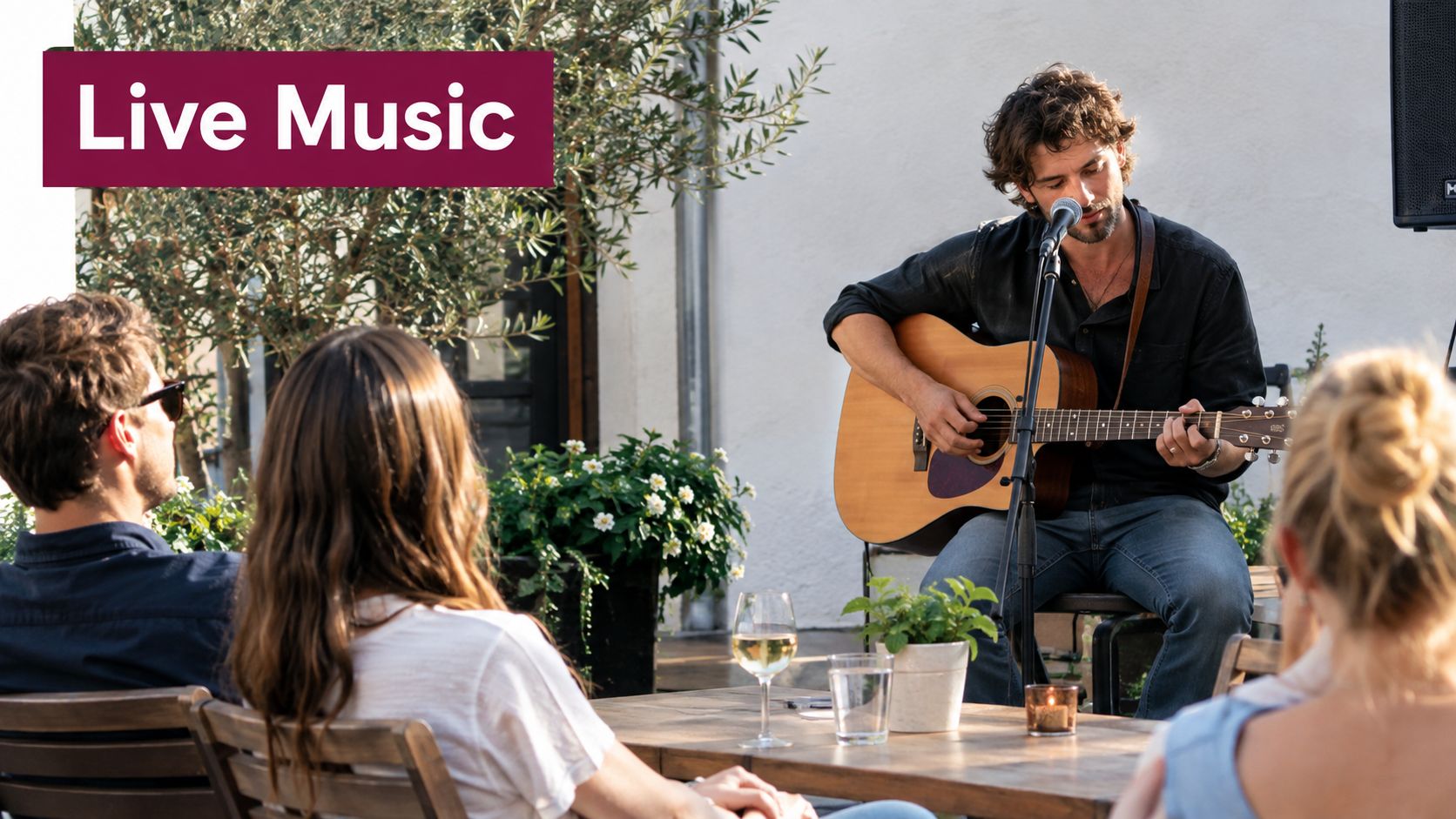
Live music can become the evening thread that ties several downtown businesses together. A rotating restaurant patio, gallery, plaza, or approved outdoor venue can host local musicians and performers for a short set, giving visitors a reason to stay for dinner, browse before the show, or visit another business afterward.
A consistent slot, such as the third Friday from 6 to 8 p.m., is more valuable than a random string of announcements. An early Sunday afternoon version could work for families and acoustic performers. Rotate genres carefully, including folk, Americana, jazz, bluegrass, and contemporary music, while making sure the venue's size and sound limits fit the performer.
Give performers a fair, clear arrangement
Recruit musicians through local music schools, university programs, Oklahoma music organizations, and existing venue networks. Confirm arrival time, set length, equipment, weather policy, payment, promotion, and whether the performer may sell merchandise. A 60 to 90 minute program usually gives the audience a complete experience without creating a difficult late-night loadout.
Fair compensation matters. The proposed budget range of $50 to $150 per performance can be a starting point for organizers, but the final amount should reflect the act, equipment, travel, and event budget. Never describe a performance as “exposure” when the organizer expects a professional commitment.
Tulsa's Cain's Ballroom and the Woody Guthrie Center demonstrate the region's connection to live music, while regular programming in Broken Arrow and Fort Worth shows how a series can contribute to place identity. Jenks doesn't need a concert-scale production. A good singer on a restaurant patio can be enough when the sound is clear and the audience knows what to expect.
Promote the performer three or four weeks ahead through local event calendars, music groups, restaurants, and The Ten District's channels. Keep announcements honest about start time, seating, weather, and whether food or drinks are available. Nearby businesses benefit when the event gives visitors a reason to move through downtown instead of keeping everyone in one fenced area.
Monthly Celebrations: 10-Item Comparison
Event | Implementation complexity | Resource requirements | Expected outcomes | Ideal use cases | Key advantages |
|---|---|---|---|---|---|
First Friday Art Walk & Gallery Nights | Low–Medium: monthly coordination among businesses | Event coordinator, marketing, extended hours, minimal equipment | Predictable weeknight foot traffic; recurring artist exposure | Galleries, restaurants, boutiques building repeat visitors | Low cost; leverages existing retail; builds community habit |
Seasonal Main Street Farmers Market | Medium: weekly logistics and vendor recruitment | Vendor management, stalls/tables, permits, volunteers, parking plan | Strong weekend morning draw; supports local producers; family visits | Local farmers, food retailers, family-oriented activity | Authentic local products; boosts producer margins; anchors weekends |
Monthly Small Business Spotlight & Networking Coffee | Low: single-venue, simple scheduling | Host venue, organizer, basic promotion, rotating speakers | Peer networking; increased visibility for featured businesses | Entrepreneurs, small business owners, local service providers | Minimal cost; fosters merchant cohesion and knowledge sharing |
Monthly Outdoor Movie Night (Seasonal) | Medium: technical setup and licensing needs | Screen, projector, sound, power, permits, film licensing, venue | Family evening draw; extended dining and retail visits in summer | Families, restaurants seeking dinner crowd, community gatherings | High attendance potential; family-friendly; longer dwell time |
Monthly Community Clean-Up & Beautification Day | Low–Medium: volunteer coordination and planning | Tools, supplies, volunteer coordinator, liability coverage | Improved curb appeal; civic pride; positive local media stories | Volunteer groups, service organizations, beautification priorities | Tangible public improvements; low cost; builds neighborhood ownership |
Monthly Author Readings & Local Storytelling Series | Low: venue partnership and curation | Bookstore/library venue, curator/moderator, promotion | Attracts cultural audiences; deepens district's cultural profile | Readers, writers, cultural organizations, students | Positions district as cultural destination; low cost; niche draw |
Monthly Community Potluck & Cultural Celebration | Low–Medium: outreach to cultural partners | Public space or venue, organizers, cultural partners, basic supplies | Cross-cultural engagement; family participation; inclusive reputation | Multicultural outreach, community-building, heritage education | Low cost; fosters inclusion; strong word-of-mouth |
Monthly Fitness & Wellness Gathering | Low: instructor scheduling and liability management | Fitness instructor, liability waivers/insurance, promotion, minimal gear | Regular health-focused visitors; post-activity café/retail traffic | Wellness communities, active residents, Riverwalk users | Builds lifestyle identity; attracts repeat higher-spend visitors |
Monthly Vintage Market & Antique Collective Pop-Up | Medium: vendor curation and street logistics | Vendor management, permits, booth rental system, street setup | Draws collectors and regional shoppers; vendor revenue opportunities | Vintage dealers, thrifters, antique collectors, weekend browsers | Curated unique goods; creates urgency; booth fees offset costs |
Monthly Live Music & Local Performance Series | Musicians, PA/sound, venue partners, permits, promotion, modest honoraria | Evening audience growth; increased food & beverage sales | Music fans, restaurants, cultural event attendees | Differentiates district culturally; supports local musicians; social buzz |
Turn Ten Ideas Into One Jenks Calendar
Ten event concepts can create a strong downtown rhythm, but launching all ten at once would stretch volunteers, businesses, civic partners, and the audience. A better approach is to assign each idea a dependable place in the calendar, then start with a small mix that tests different kinds of participation.
Jenks already has a recurring local event cycle. The Jenks Chamber identifies the Herb and Plant Festival in April, the Jenks America Food Truck Festival in May, and Lights On! in November as part of the downtown rhythm. The Ten District's Main Street events overview gives organizers a useful starting point for avoiding conflicts with established celebrations.
The Herb and Plant Festival is held each April and features over 100 booths, according to this TulsaKids profile of Jenks America. That scale matters. A new farmers market or vintage market shouldn't try to compete with an established spring event. It can complement it by serving a different month, audience, or time of day.
Lights On is also more than a retail promotion. It serves as the annual holiday kickoff on Main Street, with a ceremonial lighting and family activities. The related downtown overview describes 100% community participation in homes and businesses, which makes the event a community-wide tradition rather than an ordinary shopping night. The Ten District's downtown Jenks guide provides that broader context.
Choose a manageable starting mix
Begin with one event from each of four categories:
Family: Outdoor movie night or a family-friendly live performance.
Arts and culture: First Friday art walk or author readings.
Market: Seasonal farmers market or vintage collective.
Civic and wellness: Clean-up day, walking group, or movement class.
This mix gives organizers different signals. A market tests daytime shopping and vendor coordination. An art or author event tests cultural participation. A movie tests family scheduling and outdoor logistics. A cleanup or wellness gathering tests resident involvement without requiring a sales transaction.
Use a 90-day setup sequence
The first month should focus on responsibility, not promotion. Confirm the venue, civic partners, business hosts, and any organizations that will share the work. Establish who handles weather decisions, accessibility questions, volunteer communication, vendor payments, and emergency contacts.
The second month is for participants. Recruit anchor businesses, artists, vendors, instructors, musicians, authors, and volunteers. Confirm the date and backup plan in writing. Review parking, accessible routes, restrooms, loading, electrical needs, shade, seating, and pedestrian movement. Verify permits, insurance, food requirements, and music or film licensing where relevant.
The final month is for public communication. Create a reusable event page and flyer that preserve the recurring date while allowing the monthly feature to change. Promote each gathering three to four weeks ahead, then repeat the key details closer to the date. Use plain language. Tell visitors where to start, what to bring, what happens if it rains, and which businesses are participating.
Design for Oklahoma conditions
Heat, wind, storms, cold snaps, and short daylight changes can affect every outdoor plan. A summer walking event may need an early start. A winter author reading may need an indoor location. A market needs shade and a wind plan. A movie needs a rain decision that families can find quickly.
Attendance also requires realistic planning. Industry event guidance reports typical in-person show-up rates around 51% to 52%, while community and meetup-style events often reach 55% to 65% attendance, according to this community event planning analysis. Those figures are planning benchmarks, not promises for Jenks. They do show why organizers shouldn't order supplies, hire staff, or close space based only on RSVPs.
The same source describes flexible staffing, walk-up capacity, and sensible overbooking as ways to manage no-shows. For a downtown event, that can mean keeping a few open vendor spaces, avoiding fragile food quantities, and designing a layout that works if attendance is smaller than expected.
Measure what matters locally
Don't judge every celebration by the same standard. A cleanup day should track volunteer participation and completed projects. A market should gather vendor feedback and note whether visitors moved into nearby businesses. An author reading should record questions, repeat attendance, and audience fit. A family event should ask whether the timing, parking, shade, seating, and program worked for parents.
The broader events economy suggests real potential for local economic development. Independent event reporting says more than half of organizers reported increased attendance in 2025, while roughly 80% of eventgoers said they planned to attend the same number of events or more. The same reporting says about 30% of attendees travel from outside the county, with non-local visitors spending an average of $60.57 per person on dining, lodging, and other local businesses. The event industry statistics report supports treating recurring celebrations as potential regional draw, not just entertainment.
That opportunity comes with a caution. Monthly celebrations should not make every business stay open late, donate supplies, or provide staff without a clear reason. Rotate hosts, publish expectations, share promotion, and give businesses permission to participate at the level they can sustain.
The Ten District's strength won't come just from having an event every month. It will come from giving Jenks residents a familiar reason to return downtown, with enough consistency to build habit and enough local character to make each visit feel worth making.
The Ten District brings together independent shops, dining, galleries, public art, entertainment, and recurring Main Street gatherings in downtown Jenks. Visit The Ten District to find upcoming events, plan a family outing, and discover a local reason to return throughout the year.


Comments