

Downtown Street Festival in Jenks What to Expect on Main
Title tag: Jenks Main Street Street Festivals Explained
Meta description: What a downtown street festival feels like in Jenks, where Main Street closes, how to park, and what to expect on foot in The Ten District.
If you're looking at a Jenks festival date and wondering whether Main Street will be easy to walk, where to park, and what the street turns into once the cars are gone, the short answer is simple. A downtown street festival in Jenks means Main Street stops acting like a through street for a while and starts acting like our town square.
In The Ten District, those festival days feel different the minute you step out of your car. Storefronts matter more. Sidewalks fill up. Kids slow down to look at booths. Grownups start saying, "Let's walk one more block," and usually do. That's the shift. The street quits being something you pass through and becomes the place you're there to enjoy.
Our downtown is built for that kind of day. The Ten District stretches across ten blocks west of the Arkansas River to the historic Midland Valley tracks, and that layout makes Main Street festivals feel close together without feeling cramped when they're planned well. If you've ever walked the Herb and Plant Festival, Lights On!, or a food truck event downtown, you already know the rhythm. You park a little off the main drag, you drift toward the crowd, and before long you're visiting a shop you didn't mean to stop in.
This guide is for both sides of the curb. If you're coming as a visitor, it helps to know what you'll find on foot and how locals move through it. If you're thinking like an organizer, merchant, or sponsor, it helps to understand why some festival setups feel easy and welcoming while others create bottlenecks. For current downtown dates and public happenings, the best local starting point is the Main Street events page in The Ten District.
Table of Contents
Introduction What a Downtown Street Festival Feels Like in Jenks - It feels more like a long front porch than a fairground - Why this matters in Jenks specifically
How a Downtown Street Festival Actually Works - The street closes before the festival feels open - How it's different from a market or venue event
What You Will Find on Main Street Vendors Stages and Street Setup - The pieces most people notice first - The details that make a festival feel easy
Why Street Festivals Matter for Jenks Businesses and Neighbors - What that means on a Jenks block - The hidden costs neighbors notice first
How to Do a Jenks Street Festival Like a Local - Where to park and how to walk in - What families and first-timers should watch for
How to Stage a Street Festival in The Ten District - Start with the footprint and the curb edges - Program for movement, not just attraction - Don't treat cleanup as the last line item
Introduction What a Downtown Street Festival Feels Like in Jenks
Walk down Main on a festival day and you'll notice the first change before you see any stage or tent. The traffic noise drops, the street opens up, and people start walking in the middle where cars usually are. That's the feeling most folks mean when they talk about a downtown street festival in Jenks.
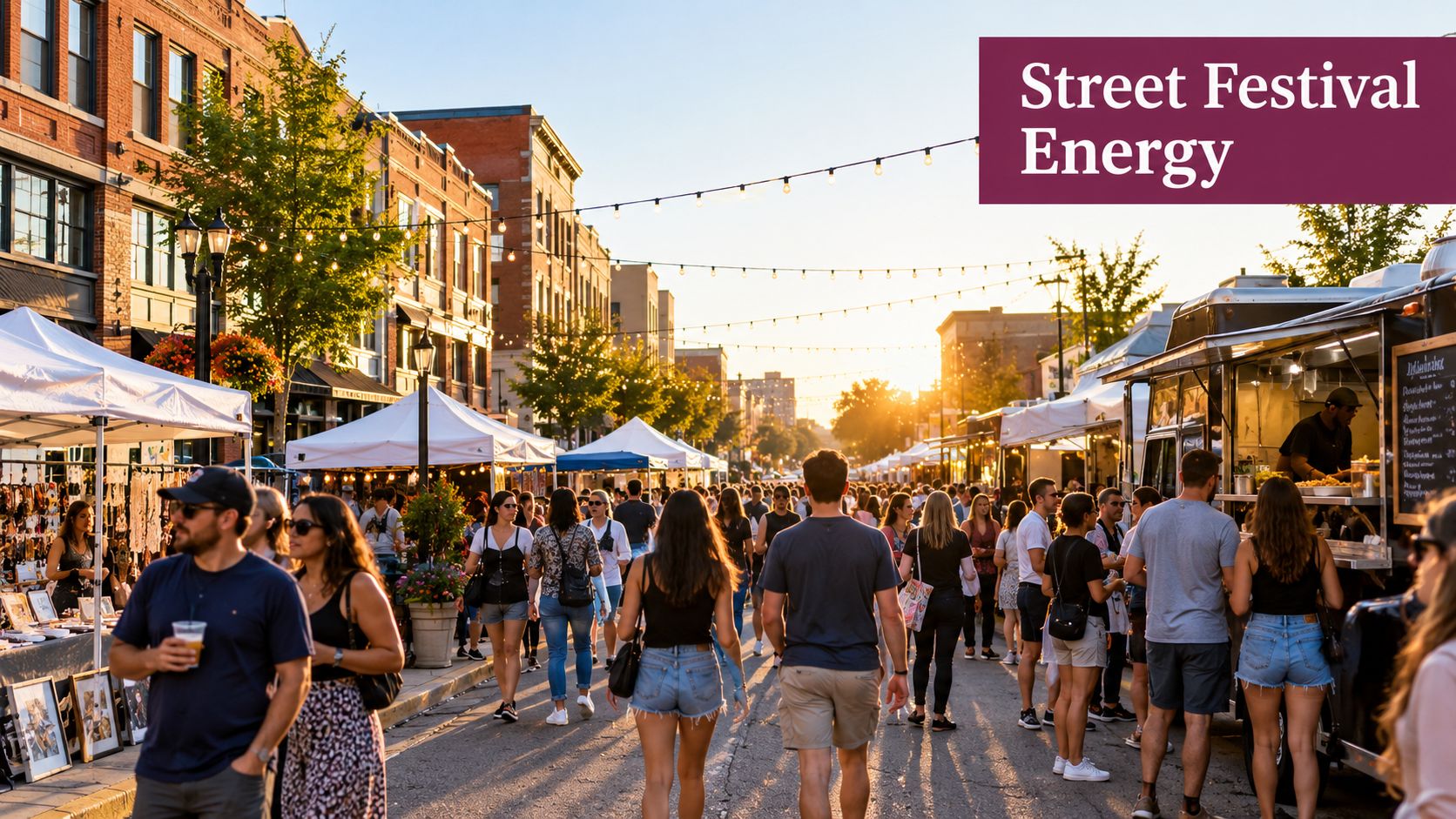
The best local example is the Herb and Plant Festival. The City of Jenks calendar identifies the 30th annual Jenks Herb and Plant Festival as taking place on Main Street, which gives us a real, hometown example of what this kind of event looks like in The Ten District, not some generic downtown somewhere else. You can see that listing on the City of Jenks Herb and Plant Festival calendar page.
It feels more like a long front porch than a fairground
Jenks festivals on Main usually don't feel like you're entering a sealed-off venue. They feel like the downtown blocks themselves are hosting. That matters because our historic storefronts, cross streets, and sidewalks are part of the event, not just the backdrop.
A lot of readers get tripped up on the term itself. A downtown street festival isn't just "an event downtown." It's an event that uses the street as the main public space. The pavement becomes walking room. The curb line becomes the edge of activity. The shops and restaurants become part of the experience.
A good Main Street festival doesn't pull you away from downtown businesses. It gives you reasons to notice them.
Why this matters in Jenks specifically
Jenks isn't trying to imitate a giant entertainment district. Our strength is that Main Street can still feel personal. You can park nearby, walk a few blocks, and understand the whole footprint without needing a map every few minutes.
That makes these festivals easier for families, grandparents, shoppers, and first-time visitors than people sometimes expect. It also means small choices matter a lot, like which block gets music, where a food line forms, and whether a side street stays easy to cross.
How a Downtown Street Festival Actually Works
Think of Main Street like your living room moved outdoors for the day. The furniture changes, the guests show up, and somebody has to make sure everyone can still move around without bumping into each other. That's really what a downtown street festival is. It's a temporary pedestrian district created by closing part of the public right-of-way and programming it for people instead of vehicles.
In Jenks, that isn't abstract. We can see the mechanics in a real closure notice from the Herb and Plant Festival. A 2023 City of Jenks calendar notice for the Herb and Plant Festival says closures began Friday, April 21 at 7 p.m., roads reopened by 6 p.m. on April 22, and the blocked streets included Main Street between Birch Street and 4th Street plus 1st, 2nd, and 3rd Streets around Aquarium Place and A Street. That's a useful local picture of how these events come together and then come back down.
The street closes before the festival feels open
A lot of folks assume the event starts when vendors arrive. In practice, the work starts when the street has to stop functioning like a street. Barricades go out first. Then booths, stages, food trucks, signs, restrooms, and power needs get placed inside that footprint.
That early closure window is what gives crews time to turn ordinary blocks into a safe walking environment. By the time attendees show up, what they see is the finished version. What organizers see is a sequence.
Close the route: Cars get rerouted so setup crews can work.
Build the footprint: Vendors, entertainment, and support pieces get placed.
Operate the event: The street works as a pedestrian space for several hours.
Tear down and reopen: Downtown shifts back to normal traffic as fast as possible.
How it's different from a market or venue event
Not every event with booths is a street festival. Some are better thought of as markets, and some are venue-based events that happen to be near Main Street.
Here's a simple comparison:
Event type | What defines it | What it feels like in Jenks |
|---|---|---|
Street festival | The street itself is closed and becomes the main event space | You walk where cars usually drive |
Market | Booths or sellers gather, but the street may not be the central feature | More shop-and-stroll, less full-street takeover |
Venue event | Activity happens mainly inside one property or fenced site | You arrive at a destination rather than roam blocks |
For food vendors especially, setup details matter more than people realize. If you're organizing a Jenks event with prepared food, packaging choices affect trash volume, carry comfort, and cleanup speed. A practical reference like this microwavable food container guide can help vendors think through what works for street service before festival day.
For local planners, a working checklist helps because these events involve more moving parts than they appear to from the sidewalk. The Jenks event planning checklist is a useful local planning reference for that reason.
What You Will Find on Main Street Vendors Stages and Street Setup
Once you're inside the festival footprint, the street usually breaks into a few clear zones even if nobody labels them that way. One stretch leans shopping. Another pulls people toward food. Somewhere there will be music, a photo moment, or a reason for families to stop instead of keep walking.
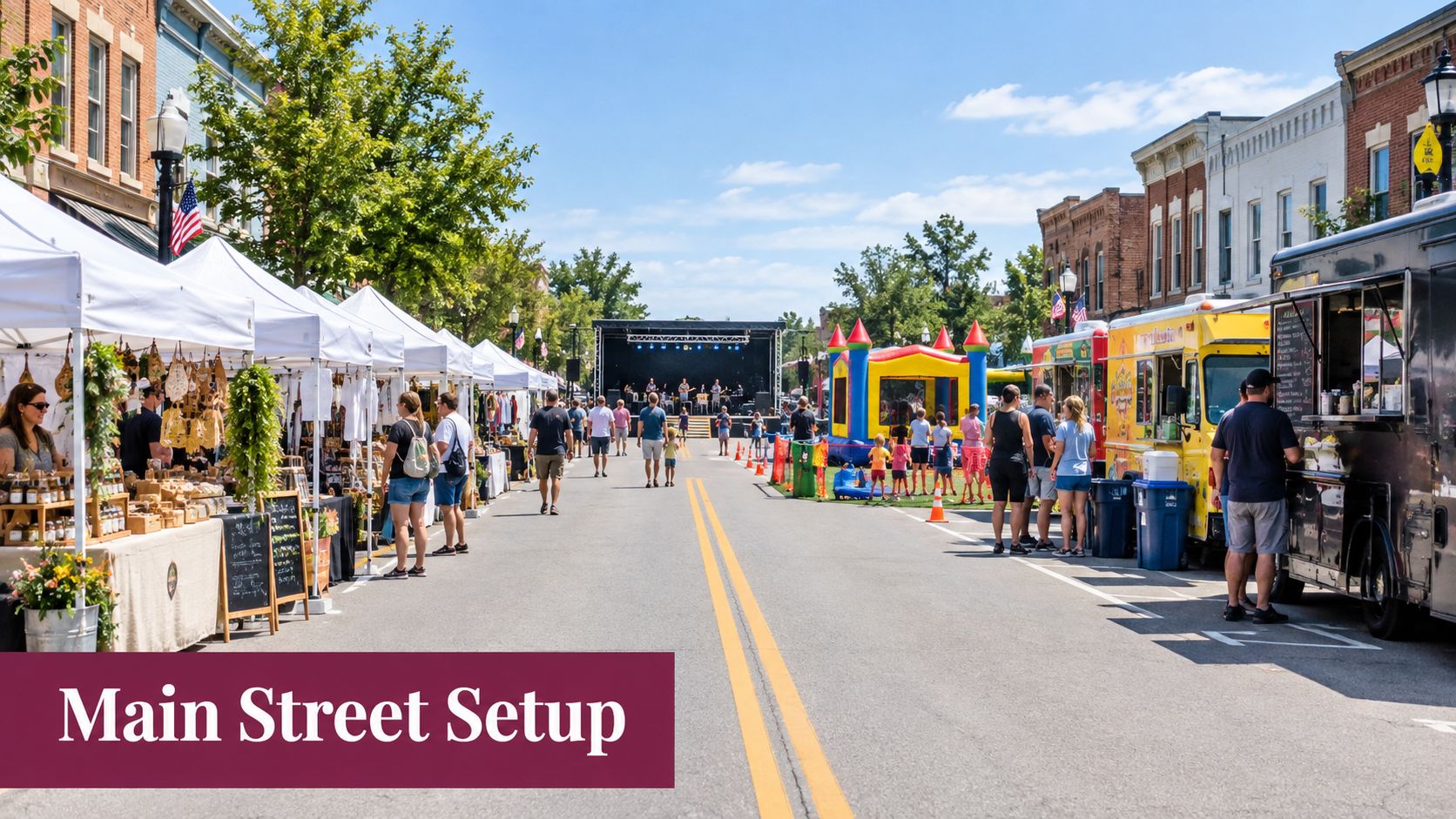
That layout isn't accidental. A downtown street festival works best when people can circulate without getting trapped at one busy corner. A Washington State Main Street review estimated that attendee dining and shopping spending produced a collective direct economic impact of $102.0 million between 2011 and 2019, and the practical lesson for districts like ours is that vendor mix and movement matter because the goal is to spread spending across the district instead of bunching it at a single anchor. That finding appears in the Washington State Main Streets impact review.
The pieces most people notice first
Most Main Street attendees notice the visible pieces before they notice the planning logic.
Vendor rows: These create the browse-and-pause rhythm. They work best when booths leave enough room for strollers, wheelchairs, and folks carrying food to keep moving.
Food trucks and food booths: These draw lines, so placement matters. Put them wrong and one line can block half a block.
Stage or music area: This gives the festival a center of gravity, but it shouldn't pin the whole crowd in place.
Storefront spillout: Sidewalk racks, specials, and open doors connect the event to brick-and-mortar businesses.
Restrooms and support areas: Not glamorous, but everyone notices when they're missing or hard to find.
The details that make a festival feel easy
Operational guidance for city-street festivals recommends perimeter-first crowd management, often using building fronts and existing urban edges as control lines, plus detour signage and updates to mapping apps so traffic doesn't snarl nearby streets. It also recommends orienting sound systems downward or toward the crowd and checking volume at the perimeter with decibel meters so nearby residents and businesses don't take the full hit of the speakers. That's all laid out in this inner-city festival operations guide.
Practical rule: If a setup makes it hard to tell where to walk, where to line up, or where to rest, the problem isn't the crowd. It's the layout.
Accessibility belongs in that same category. Recent public event guidance expects organizers to plan physical vehicle barriers, ADA-compliant paths, and accessible toilets, with one guide requiring 20% of portable restrooms to be ADA compliant and at least one accessible unit per location. That's one reason experienced attendees look for clear restroom signs, level routes, and posted rules on prohibited items before settling in for a few hours. You can see that expectation in this public event logistics guide.
If you're planning a kid-friendly craft or take-home activity near the vendor zone, something simple and low-mess tends to work better than anything precious. This coloring tote bags guide is a decent example of the kind of easy booth activity that fits a walkable street event.
For locals trying to decide whether an event will feel more like shopping, browsing, or hanging out, the quickest clue is usually the vendor map and block mix. That's why we keep an eye on pages like outdoor markets this weekend in Jenks before heading downtown.
Why Street Festivals Matter for Jenks Businesses and Neighbors
Street festivals matter here because they change how people use downtown. On an ordinary day, some people come to Main Street for one errand or one meal. On a festival day, they wander. That wandering is where local businesses get discovered.
The broad pattern isn't unique to Jenks. A major Canadian municipal festival strategy found that 28% of festivals take place on a street, sidewalk, or other public right-of-way, which tells us street-based festivals are a substantial part of the event scene rather than a novelty. The same study reported an average of 145,084 visitors per festival, a median of 38,218, noted that 25% of festivals drew under 10,000 visits, and 30.5% drew between 10,000 and 70,000 visits. It also found that 61% of surveyed business owners said festivals and large-scale events in their neighbourhoods had a positive economic impact on their businesses. Those figures come from the City of Toronto festival strategy background report.
What that means on a Jenks block
Those numbers matter less as bragging rights and more as perspective. They show that a downtown street festival can be small and local or large and regional. Jenks doesn't need every event to be huge for Main Street merchants to benefit.
What helps most is the pattern of movement. Somebody comes for plants, then grabs lunch. Somebody else comes for music, then notices a shop window. A family arrives for one booth and leaves having spent part of the afternoon downtown.
A Washington State Main Street impact study adds another useful point. It found that Main Street communities organized and hosted approximately 14 events annually in each district, totaling nearly 500 events and festivals across the state in 2019 alone. Those events attracted more than 1 million visitors and attendees, with each Main Street community receiving nearly 29,500 annual visitors to its downtown districts during event periods. The report also estimated that almost 40% of visitors came from outside the local municipality, calculated an average attendee spending estimate of about $35, and reported $102.0 million in collective direct economic impact from dining and shopping between 2011 and 2019, along with more than 5.8 million attendees during that period. Those findings appear in the National Endowment for the Arts summary referencing the Washington Main Street study.
When a festival brings in people from outside town, downtown businesses don't just get more transactions. They get introductions.
The hidden costs neighbors notice first
The flip side is that goodwill depends on execution. If trash piles up, restroom lines get silly, or teardown drags late into the evening, neighbors remember that too.
A recent festival-management example makes that clear. One public-realm event year was reported at more than 1,000,000 attendees, while another large downtown deployment involved over 1,000 compostable, chemical-free, and waterless toilets, around 200 staff, 30 refuse vehicles, and an estimated 300 tonnes of waste. That's a strong reminder that sanitation, waste, and public safety often determine whether a street festival feels worth repeating. Those examples are described in this festival operations news report.
If you're a downtown merchant or organizer wanting a plain-language outside perspective on risk and event controls, this GM GROUP Services festival advice is a useful supplementary read.
For Jenks merchants, the bigger question isn't just "Will people come?" It's whether the event setup helps them convert foot traffic into real visits. That's where district-level thinking matters, and it's part of the local discussion around business retention strategies in Jenks.
How to Do a Jenks Street Festival Like a Local
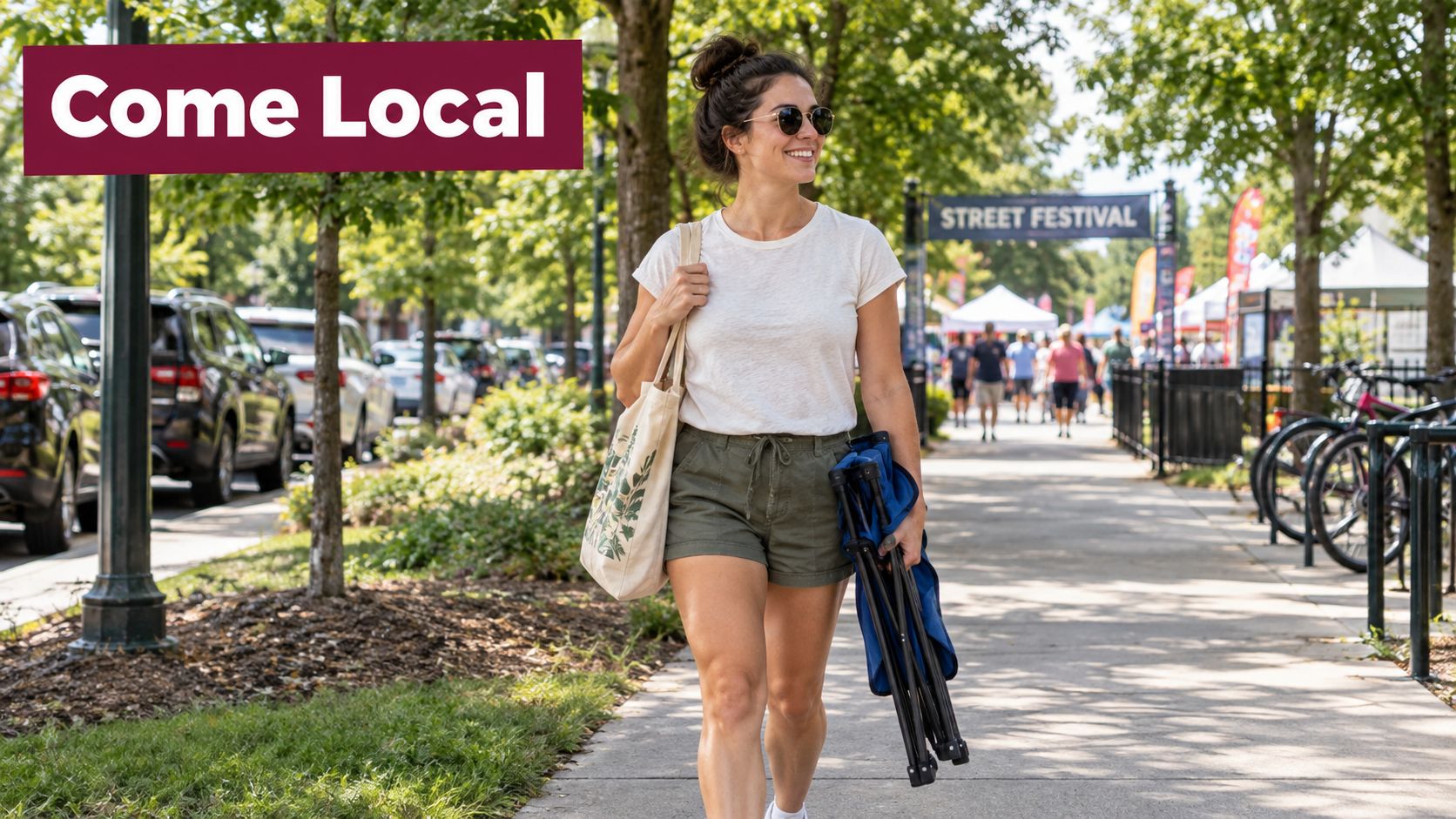
Locals usually don't overcomplicate a Main Street festival. We park a little outside the thick of it, walk in from the edge, and avoid trying to treat the nearest block like a front-row parking lot. That one habit makes the whole day easier.
The good news is that Jenks Main Street events often lean public and walkable rather than heavily gated. TravelOK identifies the Jenks America Food Truck Festival as a Main Street event in Jenks with free admission, which is a strong sign of the local norm. You can see that on the TravelOK listing for the Jenks America Food Truck Festival. The Jenks Chamber's annual Lights On! holiday kickoff is also tied to downtown Jenks Main Street, is free and open to the public, and includes caroling, Santa, a ceremonial lighting, live entertainment, food trucks, and merchant specials on the Lights On! Jenks event listing.
Where to park and how to walk in
If Main Street is closed, don't fight that fact. Use the surrounding blocks and expect a short walk. In Jenks, that's usually the better trade anyway because you enter from the side streets and get your bearings before you're in the busiest stretch.
A few local habits help:
Arrive before the biggest crowd window: Earlier feels calmer, especially if you're pushing a stroller or meeting older relatives.
Start at one end and work one side first: That's the easiest way to avoid backtracking.
Cross the street when it opens up: Don't wait until you're stuck behind a food line and a wagon.
Carry light: A small bag, water, and maybe a folding chair if the event format suits it.
What families and first-timers should watch for
Families usually want the same three things. Shade when they can find it, bathrooms they can locate quickly, and enough space to pause without blocking traffic.
If you're coming with grandparents or anyone who tires easily, pick a meeting spot before you split up. "Near the stage" sounds clear until everyone learns there are speakers, tents, and a dozen people waiting for corn dogs.
If a Jenks festival is free and spread across Main Street, treat it like a walk, not a sprint. You'll enjoy more and miss less.
For a broader feel for what to pair with a festival walk, our downtown Jenks guide is the natural next stop.
How to Stage a Street Festival in The Ten District
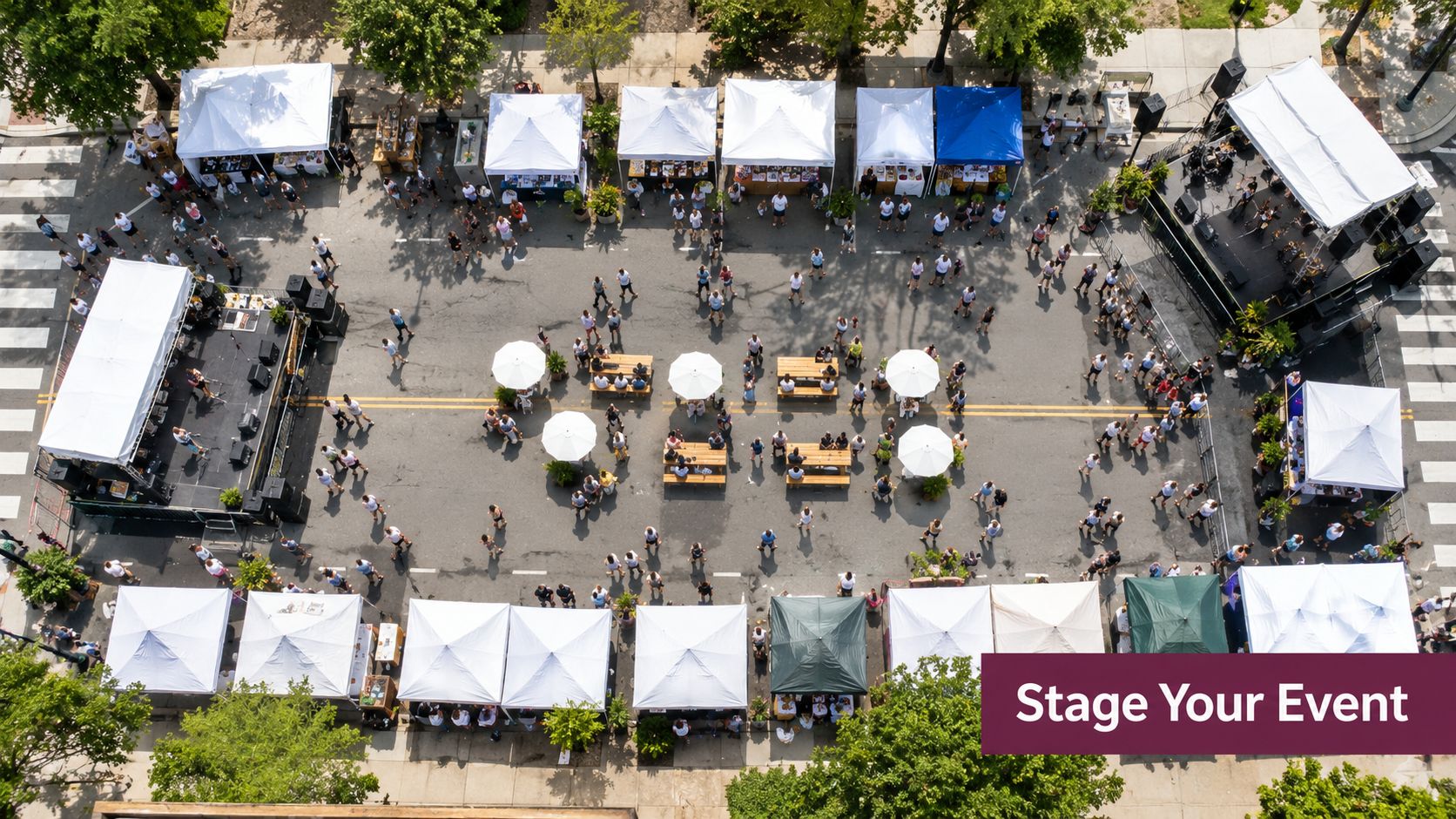
Planning a street festival in The Ten District starts with one basic truth. You're not booking a room. You're temporarily reshaping a public street network that still has to work for merchants, visitors, emergency access, and reopening crews.
Start with the footprint and the curb edges
On Main Street, the first planning question isn't entertainment. It's geometry. Which blocks close, where people enter, where food lines will form, and how emergency access stays readable all come first.
A useful mental model is perimeter-first planning. Building fronts, corners, and existing hard edges do part of the crowd-control work for you if you respect them. If you ignore them, you'll spend the whole event correcting choke points.
Here are the decisions that deserve attention early:
Closure logic: Use blocks that create a readable walking route rather than a confusing patchwork.
Entry points: Make arrivals obvious so people don't drift into setup zones or vendor backsides.
Cross-street treatment: Decide which side streets stay passable, which become activity nodes, and which need stronger controls.
Reopening plan: Build teardown with the end in mind so downtown can return to normal quickly.
Program for movement, not just attraction
A lot of first-time organizers overbuild one hot spot. They put the main attraction in a single place and accidentally starve the rest of downtown. Better festival footprints create several reasons to keep walking.
That means balancing food, shopping, and entertainment instead of stacking everything at one end. It also means giving brick-and-mortar businesses a role so the event doesn't feel detached from the district around it.
A practical setup often includes:
Planning focus | Why it matters in The Ten District |
|---|---|
Vendor mix | Helps spread interest across blocks |
Sound placement | Keeps energy up without overwhelming nearby storefronts |
Wayfinding | Reduces milling around at intersections |
Accessible routes | Makes the event usable for more residents and visitors |
Waste and restroom planning | Protects the post-event reputation of the district |
Don't treat cleanup as the last line item
Cleanup is part of the event, not what happens after the event. Restroom placement, trash flow, servicing schedules, and street-sweep timing all shape how merchants and neighbors remember the day.
If you're building a promotion plan alongside logistics, one local resource in that process is the Jenks festival marketing strategy guide. The Ten District also provides local event-calendar context and district-level visibility, which can help organizers align timing and messaging with other Main Street activity.
The festival people praise on Saturday is often the one that leaves the lightest mess by Sunday morning.
Bringing It Together for Your Next Main Street Day
A downtown street festival in Jenks isn't complicated once you've seen it clearly. Main Street closes to cars for a while, opens to people, and turns into a walkable strip of vendors, storefront activity, food, music, and neighbor-to-neighbor conversation.
What makes it work here is the scale of The Ten District. Our downtown is big enough to hold real activity and small enough to learn on foot. You don't need a shuttle map and a full-day strategy just to enjoy yourself. You need comfortable shoes, a little patience at the busiest corners, and a willingness to keep walking past the first thing that catches your eye.
For attendees, the practical stuff matters most. Park just outside the core, arrive with some margin, and treat the event like a stroll through several connected blocks instead of one stop. For organizers, the make-or-break details sit in the street itself. Closures, access, sound, restrooms, traffic detours, cleanup, and the way spending gets distributed across downtown all matter more than flashy promotion on its own.
Jenks already has strong examples to learn from on Main Street, from the Herb and Plant Festival to Lights On! and food-truck-centered gatherings. If you want the next date to circle or the next district page to check before heading out, start with the city calendar and your usual downtown habits. Then walk Main and let the street tell you what kind of day it has become.
If you want more local context before your next festival day, The Ten District is where you'll find the downtown Jenks perspective that national event guides miss. We keep the focus on Main Street itself, what happens block by block, and what locals need to know before they head our way.


Comments