

Building City of Jenks Oklahoma Partnerships: Strategies for Success
Ever feel like you're just spinning your wheels with community outreach? You send emails, make calls, but nothing quite sticks. More often than not, the problem isn’t your effort—it’s the lack of a solid game plan before you even start.
Building real, lasting partnerships in The Ten District and in the City of Jenks Oklahoma isn't about just asking for help. It’s about creating collaborations that are so mutually beneficial they practically run themselves. And that magic starts with some serious internal groundwork.
Laying the Groundwork for Successful Collaborations In The City of Jenks Oklahoma
Before you pick up the phone or draft that first email, the most important work happens right inside your own organization. This is where you lay the foundation for partnerships that truly mean something. Forget theory; we're talking about the practical, nitty-gritty steps of figuring out what you actually need and, just as importantly, what you bring to the table.
Great partnerships don’t just happen by accident. They’re the result of careful, deliberate planning. Too many people jump straight to outreach, excited by the idea of collaboration, only to find their efforts fizzle out. Without a clear vision of what success looks like for both sides, you’re just hoping for the best. Let’s get strategic instead.
This is the fundamental flow—from that initial spark of an idea to a signed agreement.
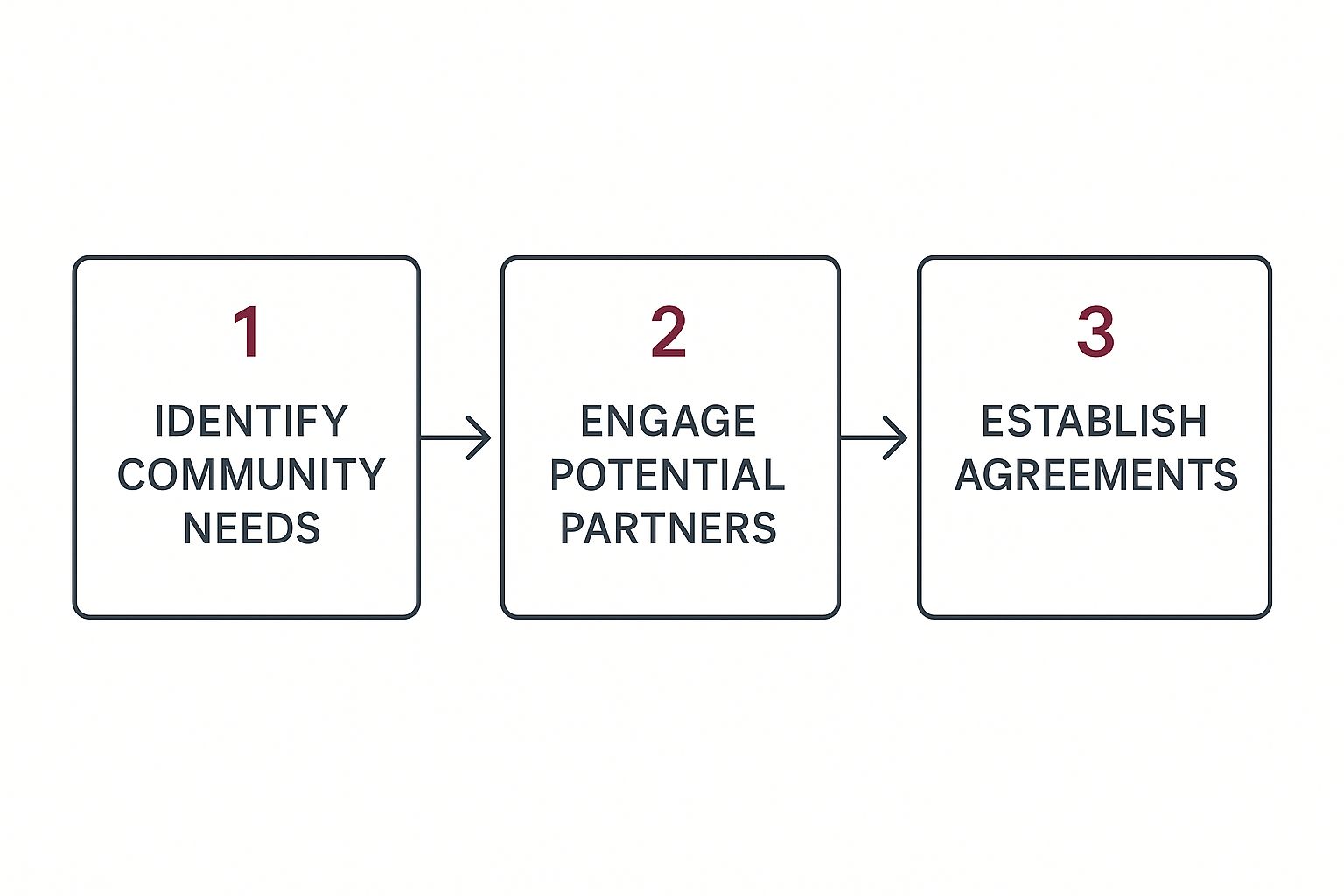
As you can see, it all starts with understanding what the community actually needs. That insight is what shapes every conversation and every agreement you make.
Start With a Reality Check: Your Needs Assessment
First things first, you have to look inward and outward. What does your organization need to hit its goals? And, maybe more importantly, what does the community you serve really want or need? A partnership built to solve a problem nobody actually has is dead on arrival.
Kick things off by asking some honest questions:
Where are the gaps in our programs or day-to-day operations?
Are we missing key resources, like a good event space, reliable volunteers, or specific tech skills?
What are our customers, clients, or community members telling us in their feedback?
What big community issues align with our mission but are just too massive to tackle alone?
This is all about listening. For instance, a community-academic partnership in Milwaukee didn't just guess what people needed. They went out and engaged 165 residents, who came up with 71 unique ideas for improving local health. Those ideas were then sorted into concrete action areas. This resident-first approach meant their efforts were spot-on and genuinely valued.
A partnership built on assumptions is a partnership built to fail. True collaboration starts with listening to your community to understand their genuine needs, ensuring your efforts are wanted and impactful from day one.
Getting a handle on what your community truly values is essential. For a deeper look at how to do this effectively, check out our guide on community engagement best practices for a vibrant 2025.
Create Your "Perfect Partner" Profile
Once you know what you need, you can start defining who you’re looking for. Think of this as creating a dating profile, but for professional collaboration. An "ideal partner profile" saves you from wasting time on mismatched connections and helps you pinpoint the businesses, nonprofits, or cultural groups in The Ten District that are a natural fit.
This profile is your filter. It should clearly outline the traits of a fantastic partner. Consider these points:
Shared Values: Do their mission and public identity vibe with yours? A youth-focused nonprofit and a family-friendly local cafe are already speaking the same language.
Complementary Resources: This is the classic "you scratch my back, I'll scratch yours." Do they have something you need, and can you offer them something in return? A local tech firm could provide web support for an arts organization, which then offers creative team-building workshops for the firm's employees.
Actionable Goals: What can you actually accomplish together? Ditch the vague "let's work together sometime" and aim for something concrete, like "co-host a community cleanup day this spring."
To get really clear on this, a simple matrix can be a game-changer. It forces you to think through the practicalities of a potential partnership before you get emotionally invested.
Potential Partner Alignment Matrix
This framework helps you evaluate and prioritize potential partners by scoring them on what truly matters: shared goals, compatible resources, and aligned values.
Partner Type | Potential Shared Goals | Key Resources Offered | Value Alignment Score (1-5) |
|---|---|---|---|
Local Restaurant | Increase foot traffic, host family events, support local causes. | Event space, food/drink catering, promotional reach to customers. | 4 |
Tech Startup | Employee engagement, community goodwill, brand visibility. | Tech skills, volunteer hours, potential sponsorship. | 5 |
Arts Nonprofit | Audience growth, secure funding, access new venues. | Creative talent, unique events, cultural credibility. | 5 |
Fitness Studio | Attract new members, promote wellness, community involvement. | Health expertise, free classes, access to a health-conscious audience. | 3 |
By taking the time to map this out, you're not just guessing anymore. You’re approaching potential partners with a clear, well-researched vision for how you can both win. This strategic approach changes the entire conversation—from a generic ask to an exciting, co-created plan for success.
Identifying and Connecting With the Right Partners
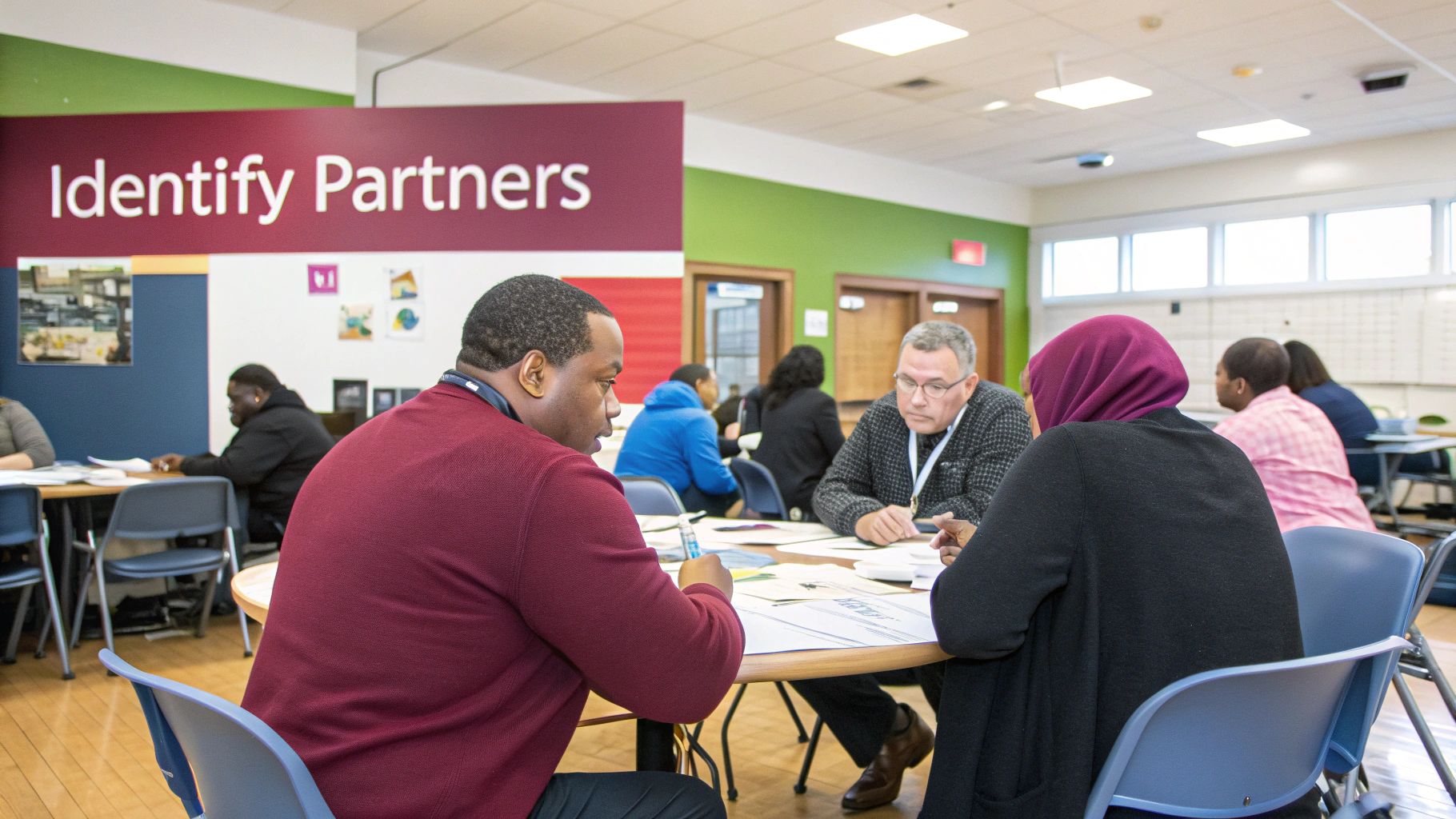
Okay, you’ve got your internal strategy dialed in. Now it’s time to look outward. Building strong community partnerships isn't about blasting emails to every business in town and hoping something sticks. That's a waste of everyone's time.
The real magic happens when you find organizations that are genuinely on the same wavelength. It’s about being smart, targeted, and authentic in your search for collaborators. People can spot a copy-and-paste job a mile away, so this is where the real work—and the real reward—of relationship-building begins.
Smart Prospecting in the City of Jenks Oklahoma
Finding the right fit requires a little bit of detective work. It’s about digging into the local fabric of our community, because your next great partner is probably right around the corner, waiting for the right opportunity to jump in.
Here’s where I always start my search:
Local Hubs: The Jenks Chamber of Commerce in the City of Jenks Oklahoma is more than just a name; their member directory is a goldmine of active, engaged local businesses.
Community Hotspots: Don't just show up to events like the Herb & Plant Festival—be present. These gatherings are the best places to meet business owners and nonprofit leaders in a natural, low-pressure way.
Your Inner Circle: Think about who you already know. Ask your board members, your most dedicated volunteers, or even your key suppliers for introductions. A warm referral from a trusted connection is priceless.
This groundwork is absolutely essential. You're not just building a list; you're creating a shortlist of high-potential partners whose values and audience seem to mirror your own. Getting this right is a cornerstone of the growth we’re aiming for, an idea central to the downtown Jenks master plan.
Mastering the Art of the First Message
With a solid list in hand, it’s time to make your move. That first email or LinkedIn message sets the entire tone. It has to be personal, respectful of their time, and immediately show them what’s in it for them.
The trick is to prove you've done your homework. Mention something specific—a project they just completed, a value they champion on their website, or their involvement in a local initiative. This instantly shows you're not just another generic request filling their inbox.
Your first outreach shouldn’t read like a request. It should feel like an invitation to a conversation about a shared opportunity. Focus on mutual benefit, not just your own needs. That’s what makes an offer compelling and hard to ignore.
A great first message is short, powerful, and makes it incredibly easy for a busy person to say, "Yes, I'm open to a chat."
What to Say and What to Avoid
Crafting that perfect outreach message is a delicate dance. You need to be professional but not stiff, clear but not demanding. The language you choose can make or break the whole thing before you even get a reply.
Just look at the difference in these two approaches:
What to Avoid (Generic & Self-Focused) | What to Say (Personalized & Mutual) |
|---|---|
"I'm writing to see if your company would be interested in sponsoring our upcoming event." | "I was so impressed by your company's involvement in the Main Street cleanup last month. It aligns perfectly with our mission..." |
"We are looking for partners to help us achieve our goals." | "I noticed you serve a similar audience to ours. I have an idea for how we could collaborate to offer them even more value." |
"Attached is our sponsorship package. Please let me know if you are interested." | "Would you be open to a brief 15-minute call next week to explore how we might work together? " |
See the shift? The "What to Say" examples are all about them—their work, their values, and a potential shared future. When you show genuine interest and respect, you’re not making a transaction; you’re starting a relationship. This is how you get your message read and, more importantly, land that crucial first conversation.
Crafting a Proposal That Inspires Action

You’ve made the connection. The initial conversation went well, and there’s a spark of a great idea. So, what’s next? It's time to take that energy and put it on paper, transforming a promising chat into a real, tangible plan.
A great partnership proposal is so much more than a dry, formal document. Think of it as a story about a shared future. It should feel less like a contract and more like a co-authored vision that gets both of you genuinely excited to move forward. This is your chance to show you’re serious, professional, and have thought through the details, giving them a clear blueprint for success.
The Anatomy of a Winning Proposal
Your proposal needs to be structured, scannable, and above all, persuasive. Forget the dense paragraphs and corporate jargon. People are busy. You need to organize your ideas into clear, distinct sections that answer their most pressing questions right away. A well-organized document respects their time and makes it easy for them to become your champion inside their organization.
Here are the key pieces you absolutely have to include:
The Shared Vision: Start strong. Kick things off with a brief, powerful summary of the opportunity. Remind them of the common ground you found in your first talk and paint a picture of what you can accomplish together.
Clear Project Scope: Define the boundaries of the project. Is this a one-time event, an ongoing program, or a joint marketing campaign? Be specific here to avoid any "I thought you were handling that" moments later on.
Defined Roles & Responsibilities: This is crucial. Who is doing what? Clearly outline the tasks, deliverables, and who owns each part of the plan. This clarity builds a ton of confidence.
Resource Commitments: Detail what each side is bringing to the table. This isn't just about money. Be sure to list in-kind contributions like staff time, marketing muscle, venue access, or technical know-how.
Metrics for Success: How will you know if this thing is actually working? Agree on simple, measurable goals. This could be anything from event attendance numbers and social media engagement to new leads generated for both of you.
When you present these things clearly, you're showing professional respect. Think about it: when someone makes things easy for you, is clear, and is organized, you automatically trust them more. Organizing your proposal this way can genuinely increase your chances of getting that "yes."
Framing the Undeniable Win-Win
Here’s the heart of your proposal: framing the collaboration as a clear victory for both sides. Your passion for your own mission is a given, but your potential partner needs to see exactly how this venture helps them hit their goals. This is where your homework on their business really pays off.
For instance, instead of just saying, "We need a sponsor for our community art festival," try this on for size: "By becoming the headline sponsor for The Ten District Arts Festival, your business will get direct exposure to over 5,000 local residents and be featured in all our media outreach, cementing your brand as a pillar of the community." See the difference?
A proposal that only focuses on your needs is an ask. A proposal that demonstrates mutual benefit is an opportunity. Shift your language from "we need" to "we can achieve together."
This approach is the foundation for building community partnerships that actually last. It changes the entire dynamic from a one-sided request to a balanced, collaborative effort.
Negotiation and Co-Creation
Let's be real: a proposal is rarely the final word. It's a starting point for a deeper conversation. You have to go into this process ready—and genuinely open—to getting feedback and making adjustments.
True partnership is about co-creation, not dictation. If a potential partner suggests changes, take it as a great sign! It means they're engaged, invested, and already thinking like a partner.
A few tips for navigating this stage gracefully:
Listen More Than You Talk: When they give feedback, listen to understand the why behind it. Are they dealing with budget constraints, timeline issues, or internal policies you don't know about?
Be Flexible: Know your absolute non-negotiables, but be ready to bend on other points. Maybe they can't swing a financial sponsorship but can offer a huge in-kind contribution of staff volunteers and marketing support. That could be just as valuable.
Frame it as Problem-Solving: If you hit a roadblock, tackle it together. Use phrases like, "That's a great point. How can we work together to find a solution that works for both of us?"
By embracing feedback and working together to shape the plan, you build a much stronger foundation of trust and shared ownership. The process itself becomes the first official act of your new partnership, ensuring everyone is genuinely on board to bring your shared vision to life.
How to Formalize and Launch Your Partnership
The handshake was firm, the conversation was great, and the energy is electric. So, what’s next? This is the critical moment where you turn that fantastic verbal agreement into a real, official collaboration. It’s where many promising partnerships unfortunately lose steam, but it’s also your biggest opportunity to set your joint initiative up for long-term success.
Getting from a casual understanding to a formal launch takes some thoughtful planning and clear documentation. It’s the best way to make sure everyone is on the same page, which prevents a world of headaches down the road and provides a solid foundation for building community partnerships that truly last. Think of it as protecting your new relationship and creating a shared roadmap.
From Handshake to Signed Agreement
Now, I'm not saying you need a 50-page legal contract drafted by a team of lawyers. But a simple written agreement? That’s non-negotiable. This document, often called a Memorandum of Understanding (MOU), is less about legal threats and more about creating clarity and mutual accountability.
An MOU shouldn't be filled with dense legal jargon. It needs to be a straightforward document that anyone can pick up and understand. Its main job is to get all those key details out of your heads and onto paper, making sure nothing is left up to guesswork.
A partnership without a written agreement is just a conversation. An MOU transforms goodwill into a concrete plan, giving both partners the confidence and clarity to move forward together.
This document becomes your guidepost. When questions pop up weeks or even months later, you can both go back to it as your single source of truth.
Key Clauses for Your Partnership Agreement
To make your MOU truly effective, there are a few essential pieces you absolutely have to include. These are the pillars that will hold up your entire collaboration.
Goals and Purpose: Start by writing down exactly what you want to achieve together. What is the shared "why" driving this partnership?
Roles and Responsibilities: Get specific. Who is doing what? This simple step avoids so much confusion and ensures important tasks don't fall through the cracks.
Timeline and Duration: Define the start and end dates for the project or the collaboration itself. Is this a one-time event or an ongoing relationship?
Communication Plan: How often will you check in? Who are the main points of contact? Set a regular meeting schedule, even if it's just a quick 15-minute call every other week.
Conflict Resolution: Agree on a simple way to handle disagreements. It might sound overly formal, but it’s a healthy practice that keeps small issues from blowing up.
Working on this document together is really your first official act as partners. It solidifies your shared commitment and gets you ready for a powerful launch.
Planning a Launch That Creates Buzz
With the agreement signed, it’s time to celebrate and tell The Ten District—and the world—about your new collaboration. A well-planned launch isn't just a party; it's your first chance to show the community the real value you're bringing together.
The goal here is to generate genuine excitement. This could be a co-hosted event, a joint press release, or a coordinated campaign on social media. We've seen local educational partnerships do incredible things by extending learning beyond the classroom walls through collaborations with local businesses and community groups. These efforts enrich everyone and make our community stronger.
If you need a little help getting started, our guide on how to organize a community event is a fantastic resource with a start-to-finish checklist perfect for anyone in The Ten District.
The most important thing is to make the launch feel authentic. It should reflect the spirit of your partnership and give people a taste of the great things to come. By formalizing your agreement and launching with real intention, you set the stage for a collaboration that doesn't just start strong but keeps delivering value for years.
Sustaining and Growing Your Partnership Over Time
Pulling off a great launch event is a huge win, but it’s really just the starting line. The true, lasting impact of any collaboration unfolds in the weeks and months that follow, long after the initial buzz has faded. This is where you transition from a one-off project into a resilient, long-term alliance that keeps giving back—to your organization, your partner, and the entire Ten District community.
Sustaining a partnership isn't about grand, sweeping gestures. It's about the small, consistent, and intentional habits you build together. The goal is to nurture the relationship so it can breathe, adapt, and grab new opportunities as they pop up. This forward-thinking approach is what separates a fleeting project from a partnership with genuine staying power.
Find Your Communication Rhythm
If there’s one thing that can sink a partnership, it’s a breakdown in communication. When the conversation stops, so does the collaboration. To keep that from happening, you need to lock in a clear and consistent rhythm for checking in from the very beginning.
This doesn't mean your calendar has to be clogged with hour-long meetings. A simple, predictable schedule is all it takes to keep everyone on the same page and accountable.
Weekly or Bi-Weekly Check-ins: A quick 15-minute call or a shared project update via email is often plenty to keep the gears turning.
Monthly Review Meetings: Use this time to measure your progress against the goals you laid out in your initial agreement.
Quarterly Strategy Sessions: This is your chance to pull back from the day-to-day grind and think bigger. What’s working? What’s not? What new ideas could you explore together?
When you establish this rhythm on day one, communication becomes a habit, not a chore. It ensures tiny issues get sorted out before they snowball into major problems and keeps the momentum alive.
Celebrate Wins and Tackle Challenges as a Team
Every partnership will see its share of highs and lows. The real test of a lasting collaboration is how you handle both. Celebrating the small victories is every bit as important as navigating the inevitable bumps in the road.
When you hit a milestone—maybe you exceeded your event attendance goal, got some positive press, or wrapped up a project phase—make a point to celebrate it. A simple shout-out in a newsletter or a thank-you lunch can do wonders for morale and reinforces the value of working together.
A partnership is like any relationship—it needs consistent care and attention to thrive. Acknowledging small wins builds positive momentum, while facing challenges with transparency and a united front builds the trust needed for long-term success.
On the flip side, when you hit a snag, don't try to hide it. Be transparent with your partner. Frame it as a shared puzzle to solve together. This approach builds a much deeper level of trust and turns obstacles into opportunities to make your collaboration even stronger.
Evolve and Expand Your Collaboration
The most powerful partnerships are never static; they grow and change over time. As you work together, you’ll start to see new avenues for collaboration you couldn't have predicted at the outset. You have to stay open to these new possibilities.
Use those quarterly strategy sessions to really brainstorm. Could that successful joint event become an annual tradition? Could a simple social media cross-promotion evolve into a fully integrated campaign? For example, a partnership that starts with a single event could grow into one of the many community art project ideas that can revitalize The Ten District, creating a permanent landmark for everyone to enjoy.
Looking at global examples can also spark local inspiration. Take the Global Partnership for Sustainable Development Data. They've supported over 400 proposals across 190 countries by connecting local efforts with powerful data analytics to solve huge challenges. Their model shows just how much can be achieved when partners pool their unique strengths for a bigger purpose. You can learn more about their incredible work and how they leverage data for the public good.
By staying open to new ideas and actively looking for ways to grow your work together, you turn a simple partnership into a genuine force for good in the community. That commitment to growth is what makes a partnership truly great.
Navigating the Bumps in the Road
Even with the best intentions, building strong local partnerships isn't always a straight line. Questions pop up. Tough situations arise. From my own experience working to build up The Ten District, anticipating these common hurdles is what separates partnerships that fizzle out from those that truly thrive.
Let's dive into some of the most frequent questions I hear and tackle them with practical, real-world advice.
How Do We Measure the ROI of a Non-Financial Partnership?
This is a huge one, especially when you can't just point to a direct dollar amount. The secret is to stop thinking about Return on Investment (ROI) and start focusing on Return on Value (ROV). Success isn't always on the balance sheet; it's measured in the tangible and intangible wins that push your mission forward.
You need to track value-based metrics. These Key Performance Indicators (KPIs) tell the real story of your partnership's impact.
Increased Awareness: Did your social media mentions tick up? Did a local news outlet cover your event? Track those numbers.
Community Sentiment: Use simple surveys or even just listen to the buzz on the street. Has the public's perception of what you do improved?
Audience Growth: How many new faces did you see at your event? How many new volunteers signed up because of this specific collaboration?
Don't forget to assign a fair market value to any in-kind contributions. If a partner donates their event space, figure out what it would have cost you to rent it. If their team volunteers for a day, track those hours and multiply them by a reasonable hourly rate. Documenting this stuff proves the partnership’s worth to your board and stakeholders, even when no cash changes hands.
What’s the Best Way to Handle an Unresponsive Partner?
It’s incredibly frustrating. You spend hours crafting the perfect proposal, send it off, and then... crickets. The key here is what I call professional persistence, but you also have to know when it's time to walk away.
I usually give it about a week before sending a polite follow-up email. If that doesn't get a response, maybe try a different angle, like a friendly message on LinkedIn. It shows you’re serious but not desperate.
If you still get radio silence after that second attempt, take it as a clear signal. It likely means they just don't have the bandwidth or the interest right now. Your time and energy are your most valuable resources—spend them on prospects who are just as excited to work with you as you are with them.
It's so much better to build relationships with people who are ready and willing to meet you halfway. A partnership should be a two-way street, not a constant chase.
How Can a Small Organization Attract a Larger Partner?
It’s easy to feel intimidated when you’re a small nonprofit or a new business approaching a big, established company. But here’s the thing: you have something they desperately need and often can't build themselves.
Lead with your unique strengths: deep community trust, authentic grassroots connections, and the ability to be nimble and quick. Big corporations often struggle to create that kind of genuine local presence. Frame your proposal around the real, on-the-ground access and credibility you can offer them.
Instead of starting with a big ask for cash—which can be a nightmare of red tape for them—propose a direct, hands-on collaboration.
Suggest co-hosting an event that puts their brand right in front of your loyal, engaged audience.
Propose a skills-based volunteer project where their employees can get out of the office and see their impact firsthand.
Show them exactly how a partnership with you helps them hit their Corporate Social Responsibility (CSR) goals in a way that feels meaningful, not manufactured.
When you highlight your unique value, you shift the whole conversation. You’re no longer a small organization asking for a handout; you’re a strategic partner offering an opportunity they can't get anywhere else.
What Should a Basic Memorandum of Understanding Include?
A Memorandum of Understanding (MOU) sounds formal, but it doesn't need to be a dense, 20-page legal document. Its main job is just to make sure everyone is on the same page. Think of it as a written handshake that solidifies good intentions.
Plus, if you're looking for funding for a joint project, a clear MOU shows potential donors that you're serious. For anyone working to improve our own downtown, having these agreements in place is crucial for attracting support—it's a core principle behind many successful Jenks downtown fundraising ideas.
A solid, simple MOU should just clearly state:
The names of the partner organizations.
The shared purpose or goal of the partnership.
The specific roles and responsibilities for each partner.
The timeline or duration of the collaboration.
Who the key point of contact is for each organization.
A simple sentence on how you'll handle any disagreements.
Signatures from someone authorized to represent each partner.
That’s it. This simple document provides critical clarity and turns a good idea into a committed plan everyone can get behind.
At The Ten District, we see every day how strong community partnerships are the very foundation of a thriving downtown. From our local shops and amazing restaurants to our cultural events, every single collaboration makes Jenks stronger. Come explore what makes our district special and see these partnerships in action for yourself. Discover more at https://www.thetendistrict.com.


Comments