

Jenks Oklahoma This is Your Essential Event Budget Planning Template
- Jul 24, 2025
- 14 min read
Updated: Jul 26, 2025
Jenks Oklahoma - Let's be honest, an event budget is a lot more than just a spreadsheet of numbers. It's the strategic blueprint for your entire event. Think of it as your financial command center, giving you the clarity to make smart decisions, put resources where they count, and ultimately, deliver an unforgettable experience here in The Ten District.
Why a Solid Event Budget Is Your Strategic Blueprint

When you’re juggling vendors, venues, and visions, a solid budget is what keeps everything grounded. It’s not about pinching pennies; it’s about empowering you to make informed, strategic moves right from the get-go. A well-built budget isn't just accounting—it's a dynamic tool that helps you hit your goals.
For any event, from a huge community festival to an intimate corporate mixer, tight financial control is the bedrock of success. It gives you the confidence to justify every dollar to stakeholders, pivot when the unexpected (inevitably) happens, and ensure your money is creating a high-impact experience. This is strategic spending, plain and simple.
More Than Just a Balance Sheet
A detailed template forces you to map out the entire financial landscape of your event. By breaking down expenses and projecting your income, you can see exactly where the money is flowing and spot opportunities to be smarter with your spending. This clarity is everything when it comes to staying profitable and proving your event's return on investment (ROI).
And let's face it, expectations are higher than ever. Recent studies show that 67% of event professionals in Jenks Oklahoma expect their budgets to grow, a clear sign that the industry is investing more in creating top-notch experiences. A lot of that cash is going toward the complex tech and setups needed to pull off engaging hybrid events.
Your Blueprint for Success in The Ten District
Planning an event in a vibrant, growing area like The Ten District means your financial strategy has to be on point to capitalize on everything the community has to offer. Your budget is your guide, helping you funnel funds into the key areas that make a local event truly shine.
When you have a budget you can trust, you can:
Secure the Best Vendors: You'll know exactly what you can afford for venues, catering, and entertainment without guessing.
Allocate Marketing Spend Wisely: A clear budget helps you justify the promotional dollars needed to attract the right crowd.
Plan for Contingencies: Setting aside a fund for surprises isn't optional—it's essential for a smooth event.
Measure True ROI: Track revenue against every single expense to clearly demonstrate financial success.
A well-structured budget is the key to unlocking these opportunities. To help you visualize this, here's a breakdown of the core components every effective template should have.
Core Components of an Effective Event Budget Template
Budget Category | What to Include | Why It's Critical |
|---|---|---|
Venue & Location | Rental fees, permits, insurance, security, and cleaning costs. | This is often your single largest expense and sets the tone for the entire event. |
Food & Beverage | Catering per person, bar service, taxes, and gratuity. | A major factor in attendee satisfaction. Under-budgeting here is a common mistake. |
Marketing & Promotion | Digital ads, social media, print materials, PR, and signage. | You can host the best event in the world, but it doesn't matter if no one knows about it. |
A/V & Technology | Sound systems, projectors, lighting, Wi-Fi, and live-streaming gear. | Crucial for creating an immersive and professional atmosphere. |
Staff & Labor | Event planners, on-site staff, volunteers, and security personnel. | The people running your event are key to a smooth and positive experience. |
Contingency Fund | A reserve of 10-15% of your total budget. | Your safety net for unexpected costs, vendor issues, or last-minute changes. |
Having these categories laid out from the start prevents costly oversights and keeps you in control.
A great event budget doesn’t restrict you; it liberates you. It provides the confidence to invest in what matters most, ensuring you can deliver a memorable experience that aligns with your strategic objectives and delights your attendees.
This structured approach is what separates a good event from a truly great one. Whether you're organizing a small gathering on Main Street or a major public function like the one detailed in the Jenks State of the City 2024 overview, your budget is the single most important document you will create. It's your roadmap to success.
Building Your Event Budget From The Ground Up
Let’s be honest, building an event budget isn't about becoming a master accountant overnight. It's really about smart, realistic forecasting. I’ve seen too many great event ideas crumble because the numbers weren't handled properly from the get-go. The secret is to start by splitting your financial world into two simple buckets: money coming in (revenue) and money going out (expenses).
First up, let’s talk revenue. Ticket sales are the obvious one, but don't just stop there. You need to think like an entrepreneur. What are all the potential income streams for your event? In The Ten District, this could mean sponsorships from thriving local businesses, or if you're planning something like a trade show, charging for exhibitor booths. You could even sell branded merch. A corporate conference might build tiered sponsorship packages, while a community arts festival might lean heavily on concession sales and donations. Get creative here.
With a good idea of potential income, it's time to face the other side of the coin: expenses. This is where things can get messy if you aren't careful. The best way I’ve found to keep it all straight is to break your costs down into two types: fixed and variable.
Differentiating Fixed and Variable Costs
Fixed costs are your non-negotiables. These are the expenses that won’t change, whether you have 50 guests or 500. Think of them as the foundation of your event—they get locked in early.
Venue Rental: The fee for locking down your spot in The Ten District.
Permits and Insurance: You can’t skip these. They’re essential for legal and safety compliance.
Speaker Fees: The agreed-upon rate for your keynote speaker or special guests.
Entertainment: What you’re paying the band or DJ, no matter the crowd size.
Core Technology: This could be your event management software or the cost of a dedicated event app.
Variable costs, on the other hand, are directly tied to your attendance numbers. These are the per-person costs that are critical for figuring out your break-even point and profitability.
Food and Beverage: Catering is almost always priced per head. More people means a bigger catering bill.
Swag and Materials: The cost for welcome bags, lanyards, or printed programs will scale with every new attendee.
Staffing: A bigger crowd might require more security, check-in staff, or servers.
This image really breaks down how these different pieces come together to form the backbone of a solid event budget.
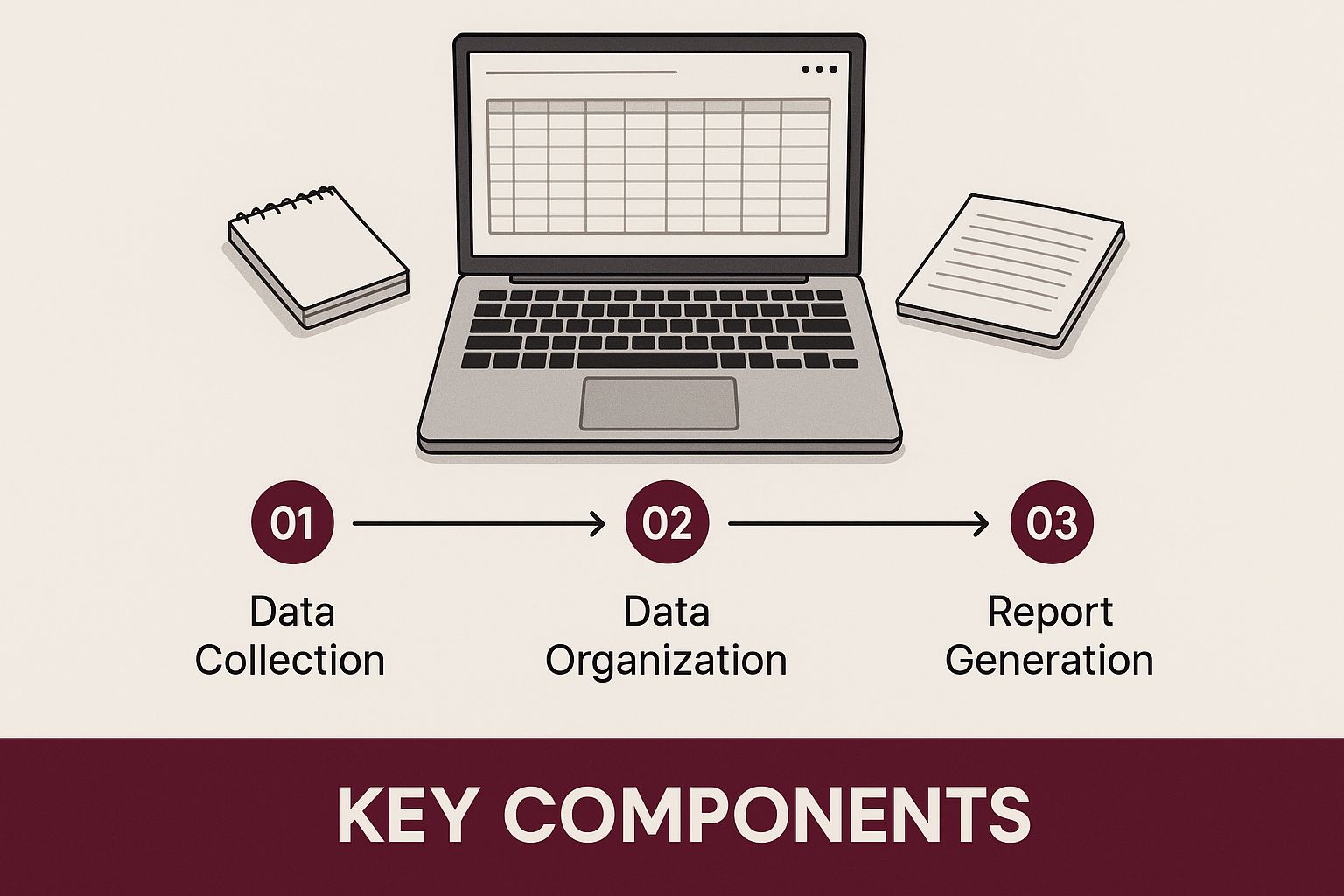
As you can see, it's about mapping out both your income streams and your categorized expenses to create a truly functional plan.
Accurately Estimating Your Event Costs
Once you have your categories, the real work begins: putting realistic numbers next to each line item. Guesswork is the enemy of a successful event. If you’ve run this event before, pull up that historical data. If it’s a brand-new event, it's time to hit the phones and get some quotes.
Pro Tip: I always tell my clients to get at least three quotes for any major expense—think venues, catering, and A/V rentals. It’s not just about finding the best price; it gives you a real feel for the going market rates here in The Ten District.
The details really matter. For instance, planning a corporate conference with a hybrid component means your tech costs will be a huge line item. Live-streaming A/V is a world away from a simple mic and projector. On the flip side, a community festival’s budget will probably pour more money into security, waste management, and marketing to draw a big local crowd.
Your event budget planning template isn't a "set it and forget it" document. It’s a living, breathing tool that will change as you lock in vendors and finalize details. This initial groundwork, though, gives you the financial framework you need to make smart decisions every step of the way.
It’s a classic event planning nightmare. The venue is booked, the caterer is paid, and everything seems on track. Then, the little expenses start trickling in. A permit fee here, a processing fee there. Suddenly, your carefully planned budget is starting to unravel.
The real danger to your event’s financial health isn’t the big, obvious line items. It's the slow, silent creep of small, forgotten costs that can completely dismantle your plans. A truly effective event budget planning template has to be built to catch these details before they become problems.
I've seen it happen time and time again—planners get blindsided by expenses they simply forgot to factor in. These "minor" costs add up with alarming speed, turning what should have been a profitable event into a last-minute financial scramble. It’s why so many of us in the industry feel the pressure.
Recent data shows that 32% of US event organizers named 'insufficient budget' as their single biggest challenge. That’s a massive number, and it highlights just how critical detailed financial foresight is. A solid budget isn't just a spreadsheet; it's the tool that helps you make smart decisions on everything from ticket prices to vendor selection.
Costs Hiding in Plain Sight
So where do these budget-killers lurk? They're almost always tucked away in the operational details that seem insignificant at first but are absolutely essential for a smooth-running event.
Here are some of the most common culprits I always tell people to watch out for:
Payment Processing Fees: That 2-3% fee on ticket sales might not sound like much, but when you're dealing with thousands of dollars in revenue, it becomes a major expense.
Permits and Licenses: Especially for events in The Ten District, you might need permits for everything from noise and food service to public assembly. Each one comes with an application fee.
Insurance Policies: You've got your general liability, of course, but what about cancellation insurance? Or extra coverage for a high-risk activity you've planned?
Taxes and Gratuities: That initial quote from your caterer probably looks great. But wait for the final invoice, where the 20-25% in taxes and service fees suddenly appears. Always ask for the "all-in" price.
The most important line item on any budget is the one you didn’t know you needed. A good template forces you to anticipate these costs, turning potential surprises into planned expenses.
The Non-Negotiable Contingency Fund
This brings me to what is, without a doubt, the most critical part of any event budget: the contingency fund. So many planners either skip this or treat it like "extra" money for fun upgrades. That’s a huge mistake. This is your safety net for the real, unexpected problems that will pop up.
Rising operational costs are a constant battle. A key vendor might hit you with a last-minute price hike, or a larger-than-expected crowd means you need to hire more security. Without a buffer, these situations force you to make painful cuts somewhere else, often compromising the attendee experience.
My rule of thumb is to allocate 10-15% of your total estimated expenses to this fund. If you're planning an outdoor festival or a first-time event with more unknowns, pushing that to 20% is even smarter. This is the money that lets you handle challenges with grace. It's also where having fantastic vendor relationships can save the day. For more on that, check out our guide on vendor management best practices for 2025 success to keep those partnerships rock-solid.
Using Technology for Smarter Budget Management
While a spreadsheet is a solid start, relying on one exclusively is a bit like navigating The Ten District with an old paper map. It gets the job done, but you're missing out on a much faster, smarter way to manage your event's finances. Let's talk about leveling up your toolkit.
Modern tech offers a powerful upgrade, bringing more accuracy and way less manual work to your budget. Event Management Systems (EMS) and dedicated budgeting software are built to handle the kind of complexity that makes a simple spreadsheet buckle. These tools don't just hold numbers; they help you manage them with real-time expense tracking, automated financial reports, and seamless integration with your registration platform. That means you get a live, instant picture of your revenue.
Beyond the Basic Spreadsheet
The real advantage of these systems is the complete, 360-degree view they provide of your event's financial health. You can see in an instant how a spike in ticket sales boosts your bottom line or how an unexpected vendor cost chips away at your profit margin. This is the kind of control you need to make quick, data-driven decisions when things change on the fly.
The point of technology isn't just to track where the money went. It’s to give you the clarity to make smarter financial moves. An event budget planning template backed by the right software puts you in total control, from the first ticket sold to the final invoice paid.
Deciding on the Right Tool: Spreadsheet vs. Software
So, when does it make sense to stick with a spreadsheet, and when should you invest in specialized software? It really comes down to the scale and complexity of your event. A simple spreadsheet might be perfect for a small community gathering, but a multi-day festival in The Ten District demands something more robust.
Here’s a quick comparison to help you decide.
Spreadsheet vs Budgeting Software
Feature | Spreadsheet (e.g., Excel, Google Sheets) | Dedicated Budgeting Software |
|---|---|---|
Cost | Low to free. | Monthly or annual subscription fee. |
Learning Curve | Minimal if you know the basics. | Can require some initial training. |
Collaboration | Good, especially with cloud-based versions. | Excellent, with user roles and permissions. |
Real-Time Data | Manual updates required. | Often automated through integrations. |
Reporting | Manual creation of reports and charts. | Automated, professional-looking reports. |
Integrations | Limited; may require third-party add-ons. | Seamless integration with ticketing, etc. |
Ultimately, dedicated software is about saving time and reducing human error. The investment often pays for itself by preventing costly mistakes and providing insights that a spreadsheet just can't deliver.
Key Features to Look For
When you're exploring technology, don't get distracted by flashy features you'll never use. Focus on tools that solve real problems. You'll want a platform that offers:
Real-Time Expense Tracking: The power to log an expense on your phone the second you make it. No more lost receipts or forgotten costs.
Automated Reporting: The ability to generate a profit and loss statement or a budget vs. actual report without wrestling with formulas for hours.
Registration Integration: A direct link between your budget and ticket sales for a live, up-to-the-minute revenue count.
This isn't just a niche strategy anymore. Industry data reveals that 79% of event professionals now use an EMS, and most of these systems include strong financial management tools. It’s a clear sign that the pros see technology and solid budgets as non-negotiable for financial success.
For any event happening in The Ten District, where drawing a large crowd is often the name of the game, this financial precision is vital. It guarantees you can manage your resources effectively for everything from paying vendors to ensuring public safety. In fact, a clear budget is a cornerstone of our expert event crowd management tips, because it lets you properly fund essential security and staffing.
Making Your Live Event Budget Work for You
Once your event budget template is in place, the real fun begins. A template is your map, but these are the pro tips that act as your compass, guiding you through the messy, real-world landscape of event spending. This is where we move beyond just plugging in numbers and start strategically making every dollar count.
The most powerful tool you have? Negotiation. Seriously, never take the first quote you get from a vendor. Come to the conversation prepared. Know what their competitors are charging and, more importantly, what you can offer in return. This isn't about trying to lowball anyone; it's about finding a win-win. Can you offer them a multi-event contract? What about prominent logo placement or a series of dedicated social media shout-outs? These aren't cash, but they have real value and can get you a much better price.
Keep a Running Tally: Budgeted vs. Actual Costs
Your budget is a living, breathing document, not something you set and forget. The second you start spending money, you need to track your "actuals" against your "projected" costs. Trying to figure it all out after the event is a recipe for disaster.
In your template, you should have columns for Projected Cost, Actual Cost, and Difference. Update them religiously. Did the venue just spring a surprise security fee on you? Log it. Did you find a cheaper printer than you expected? Update that line item and enjoy the small victory. This real-time tracking gives you a live look at your event's financial health, so you can make smart adjustments on the fly.
An event budget isn't a final exam where you see how you did at the end. It's a daily health check. Consistent tracking allows you to spot a financial fever before it turns into a full-blown illness, giving you time to react and find a cure.
How to Make Smart Cuts Without Ruining the Vibe
Costs will creep up. It’s inevitable. The trick is to make cuts without anyone in your audience noticing a thing. It's all about thinking strategically—knowing where to save and where it's worth it to splurge.
Splurge Here: Pour your resources into the high-impact areas that directly shape the attendee experience. Think excellent food and drinks, a seamless check-in process, and top-notch A/V for your speakers. People remember and talk about these things.
Save Here: Find your savings behind the scenes. Can you ditch the fancy printed programs for a well-designed event app? Could you use creative lighting to transform a standard room instead of paying for expensive physical decorations? These cuts trim the fat without hurting the perceived value.
A well-run event in our community knows this balance well. For instance, our comprehensive **Jenks community events planning guide** emphasizes how focusing on these core experiential elements is what makes local events truly successful.
Your Safety Net and Post-Event Wrap-Up
That contingency fund—the 10-20% of your total budget you set aside—is your ultimate safety net. It's not there for last-minute "nice-to-haves." It's for true emergencies. You need to set clear rules for when you can dip into it. A good example: covering an unexpected jump in catering costs because of a surge in last-minute sign-ups. A bad example: deciding you want a more expensive centerpiece at the last minute.
Finally, the job isn't done when the last guest walks out the door. Within a week, you need to conduct a thorough post-event financial review. Compare every single final cost against what you initially projected. Where were you on the money? Where did you completely miss the mark? This deep dive is gold. It gives you the historical data you need to make your next event budget even sharper and more profitable.
Common Questions About Event Budgeting
Even with the best planning template in hand, tough questions always come up. It's completely natural to feel a little bit of pressure when you're locking in the numbers. Let's walk through some of the most common issues I see event planners run into, so you can move forward with confidence.
These are the tricky situations that can make or break your budget. Having clear answers ahead of time is the key to keeping your event financially sound.
How Much Should I Set Aside for a Contingency Fund?
The standard rule of thumb is to set aside 10-15% of your total estimated expenses for contingency. This isn't just "extra" money for last-minute upgrades—think of it as a critical safety net for your event.
For events with more variables, like an outdoor festival in The Ten District or a brand-new conference without any historical data to lean on, pushing that number closer to 20% is a smart move. It’s your insurance policy against genuine, unforeseen costs. I'm talking about things like a sudden vendor price hike, needing to rent emergency equipment, or covering unexpected staffing needs.
What Are the Most Common Hidden Costs in Event Planning?
From my experience, the sneakiest costs are always hiding in the fine print. You absolutely have to watch out for these budget-killers before they become a real problem.
Payment Processing Fees: These can easily skim 2-3% off every single ticket sale, which adds up faster than you'd think.
Taxes and Service Fees: Venue and catering quotes often leave these out. When they show up on the final bill, they can inflate your costs by 20-30%.
Insurance, Licenses, and Permits: All those essential policies and local permits come with their own price tags.
The most dangerous expenses are the ones you forget to plan for. A great template forces you to account for post-event costs too, like video editing for on-demand content or thank-you gifts for speakers.
I’ve seen these small, overlooked items derail otherwise perfectly planned events. By identifying them early, you can turn potential surprises into manageable line items in your budget. If you want to dive deeper into creating positive community experiences that still honor your budget, you can learn a lot by celebrating TulsaPeople and the heartbeat of Jenks through the stories of local leaders.
How Can I Reduce Costs Without Hurting the Attendee Experience?
This is all about strategic savings, not just thoughtless cuts. You want to trim the fat, not the muscle.
Start by negotiating with your vendors. You can offer them valuable non-cash benefits, like a multi-event contract or better brand exposure during the event, in exchange for a better rate.
Choosing an off-peak day or season can dramatically lower your venue costs. You could also swap expensive printed materials for a functional mobile event app. For décor, focus your budget on high-impact lighting and one or two "wow" features instead of trying to decorate every single surface.
Finally, look for sponsors to cover specific, tangible items like the event Wi-Fi or a coffee bar. This is a win-win: it directly benefits your attendees while taking a line item completely off your budget.
At The Ten District, we believe a well-planned event is the cornerstone of a vibrant community. Start building your next successful event with the resources and inspiration found right here in the heart of Jenks. Learn more at https://www.thetendistrict.com.


Comments