

What is creative placemaking: Transforming Communities with Arts & Culture
You hear the term "creative placemaking" thrown around a lot these days, but what does it actually mean? At its heart, it’s about strategically weaving arts and culture into the very fabric of a community to boost its identity, economy, and social vibe.
It's a hands-on process where artists, residents, and local businesses roll up their sleeves together to shape the look and feel of their neighborhood.
What is Creative Placemaking, Really?
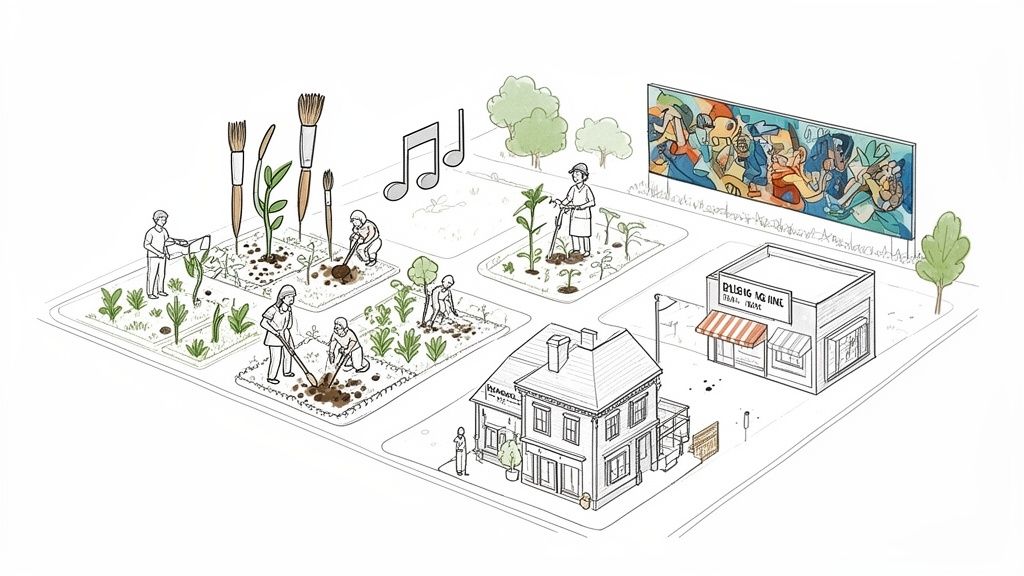
Think of it like tending to a community garden. But instead of planting flowers and vegetables, you’re planting art, local stories, and cultural events. When you do it right, these “seeds” grow into lively, shared spaces that truly reflect the people who call that place home.
This goes way beyond just plopping a statue in a park or slapping a mural on a wall. It’s a much deeper, more intentional practice than that.
Creative placemaking is, first and foremost, a partnership. It’s a dynamic collaboration that brings artists to the table not just to create pretty things, but as genuine problem-solvers and community organizers. They team up with residents, small business owners, and city leaders to reimagine public spaces, tackle local challenges, and build a stronger sense of connection among neighbors.
Weaving Art into the Community Fabric
The whole thing kicks off by looking at what a community already has going for it—its history, its people, its unique cultural identity. From there, projects are built with the community, not just dropped on top of it. This is key to making sure the results feel authentic and are built to last.
Successful creative placemaking can look like a lot of different things:
Interactive public art installations that actually invite you to touch, play, and participate.
Pop-up markets and festivals that put local artisans and musicians front and center.
Forgotten alleyways and vacant lots transformed into cool community hangouts.
Cultural hubs offering everything from workshops and performances to shared creative spaces.
The real goal here is to turn everyday places into meaningful destinations. It’s about creating an environment where people feel a genuine sense of belonging and pride, which naturally fuels a healthier local economy and a happier community.
The Power of Working Together
This approach absolutely depends on active participation from everyone. It’s built on the simple idea that every single resident has a stake in their neighborhood’s future. By building those connections, creative placemaking can help bridge divides and strengthen the social glue that holds a community together. A great starting point for any project is exploring effective community engagement strategies you should know.
When it's all said and done, creative placemaking is about tapping into a community's creative spirit to build a more vibrant, connected, and interesting place to live, work, and visit. It’s how neighborhoods get to tell their own stories, solve their own problems, and shape their own futures.
The Core Principles of Effective Placemaking
For creative placemaking to really work, it needs more than just a few good ideas. It runs on a set of core principles that make sure every project is authentic, sustainable, and actually connected to the community it's supposed to serve. Think of these as less of a rigid rulebook and more like the essential ingredients for turning a spark of an idea into a lasting part of our town.
At its very heart, effective placemaking is always community-led. This means projects start by listening—truly listening—to the people who live and work in a place every single day. Their knowledge, their history, and what they hope for the future are the most valuable assets we have. It’s a complete flip from the old top-down approach where a handful of experts decide what a neighborhood needs. Instead, it’s a collaborative process built with residents, not for them.
This spirit of collaboration is what sparks genuine ownership and pride. When the community is in the driver's seat from the very beginning, the projects feel like they belong to everyone. This kind of active involvement is a cornerstone of strong civic engagement, which you can dive into deeper in our guide to making an impact in your community.
Artist-Driven and Context-Sensitive
Another huge piece of the puzzle is being artist-driven. We're not just talking about hiring artists to paint a mural on a wall after all the decisions are made. Here, artists are at the table from the start as problem-solvers, community organizers, and storytellers. They bring a unique way of seeing the world that can unlock creative solutions to local challenges, whether it's reimagining a forgotten alleyway or finding new ways to celebrate our local heritage. Their real job is to help the community see its own potential.
Just as important is being context-sensitive. A project that was a huge hit in another town can't just be copied and pasted here. It has to honor the specific history, culture, and feel of our streets.
This means starting with what’s already there—the unique architecture, the local stories, the businesses that have been here for years—and building on those strengths to create something new that feels like it’s always belonged.
The idea of creative placemaking really started gaining steam in the early 2010s, though it was built on decades of community development research. It was a 2010 white paper that blew the doors open, showing how weaving arts into community planning could bring new life to cities and small towns everywhere, from Providence to Los Angeles. You can read the full research about how this strategy transforms spaces.
Building for the Long Term
Finally, truly successful creative placemaking is sustainable. It has to look beyond a single festival or a one-off art installation and think about the long-term social, physical, and economic health of the community. This means planning for how things will be maintained, creating flexible spaces that can change as needs evolve, and making sure every project contributes to a stronger local economy and a more connected community for years to come.
The Tangible Benefits for Communities and Businesses
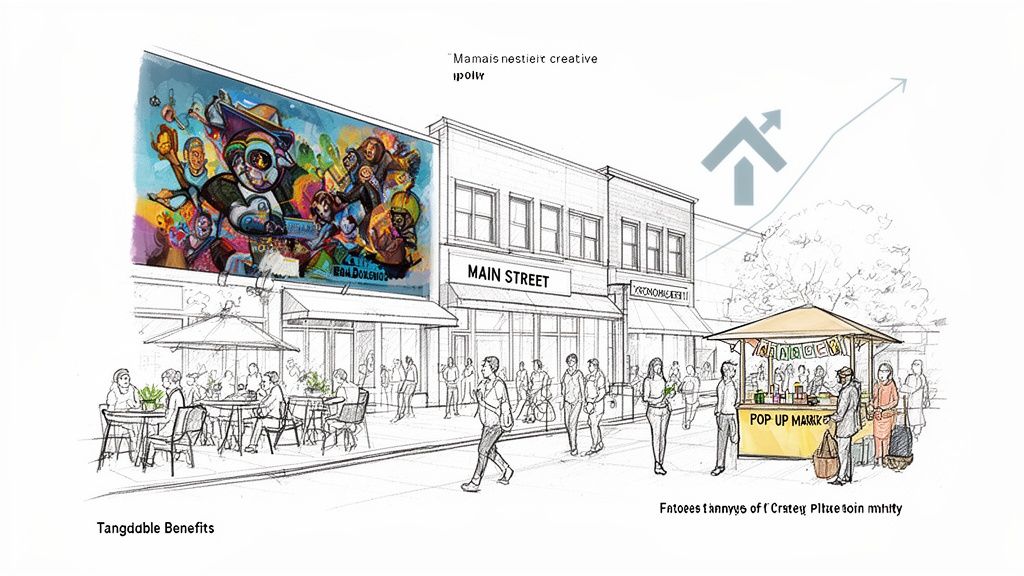
While the big ideas behind creative placemaking are inspiring, the real magic is what you can actually see and measure on the ground. This is where art and culture stop being a "nice-to-have" and become powerful drivers for a town's bottom line and its overall vibe.
These benefits ripple out to touch everyone, from the local shop owner who sees more people walking through the door to the family that now has a vibrant park to enjoy on a Saturday afternoon.
For local businesses, the payoff can be immediate. Think about it: a mural festival, a string of pop-up markets, or a cool interactive sculpture can completely change the flow of a street. Suddenly, you have new visitors exploring the area and locals rediscovering their own neighborhood. Those casual passersby quickly turn into paying customers.
This jolt of energy breathes life back into commercial districts. When streets feel more alive and interesting, those once-empty storefronts start looking like prime real estate for new boutiques, cafes, and galleries. It kicks off a positive cycle of growth that strengthens the whole local economy.
Boosting the Local Economy
Creative placemaking isn't just about making a place prettier; it's about building a stronger, more resilient economic foundation. It creates jobs—and not just for artists. Event planners, construction crews, and local suppliers all get a piece of the action.
The economic punch of the arts sector is huge, contributing $804 billion (or 4.3%) to the U.S. GDP back in 2016. That number shows just how powerful these initiatives can be. In some downtowns, creative placemaking has sparked investment pipelines of over $2 billion, promising thousands of new jobs. You can dig deeper into the economic power of creative placemaking here.
Fostering a Stronger Community
Beyond the dollars and cents, the social benefits are just as important. These projects forge a powerful sense of place and shared identity. People simply feel more connected to their town and to each other.
The true value of creative placemaking is its ability to build social capital. When neighbors come together to create something beautiful or meaningful, they form lasting bonds that strengthen the entire community fabric.
This collaborative spirit creates a genuine sense of ownership and pride. When people see their own stories and culture reflected in the streets they walk every day, they become more invested in their neighborhood's success. Major developments can fuel a boom, like the Tulsa Premium Outlets' impact on Jenks, and these community-first projects amplify that energy.
When done right, creative placemaking delivers a dual return. It pumps measurable economic value into local businesses while creating a richer quality of life for everyone who calls the community home.
Inspiring Examples of Creative Placemaking in Action
Talk is cheap. It’s one thing to discuss creative placemaking in theory, but it’s another thing entirely to see it breathe life back into a community. This is where the real magic happens—watching forgotten spaces transform before your eyes.
These projects aren’t one-size-fits-all. They range from massive, district-wide overhauls to small, scrappy efforts that activate a single park or intersection. But by looking at what’s worked elsewhere, we get a blueprint for what’s possible right here when a community decides to invest in its own story.
Barcelona’s 22@ Innovation District
If you want to see a grand slam, look at the 22@Barcelona district in Spain. This area was once a crumbling, forgotten industrial zone—the kind of place you’d just drive past. But a deliberate, long-term creative placemaking strategy flipped the script entirely.
Today, it’s a global hub for innovation. By 2019, the project had attracted over 1,000 tech and knowledge-based companies, created more than 50,000 jobs, and jacked up property values by as much as 30% in the surrounding neighborhoods. This wasn't a fluke; a 2019 report showed that over 2,400 similar events happened in 330 cities around the globe, proving this model has legs. You can dive deeper into this global creative placemaking movement to see just how widespread it is.
From Vacant Lots to Vibrant Hubs
You don’t need a Barcelona-sized budget to make a real impact. Some of the most inspiring stories come from smaller, local projects that took what they had and made something incredible.
Project Row Houses (Houston, Texas): This started with seven local artists and a block of rundown shotgun houses. Instead of tearing them down, they turned them into a thriving arts and community campus. It’s now grown to cover five city blocks, complete with artist studios, affordable housing, and youth programs. It’s a perfect example of how preserving a neighborhood’s character can be the very thing that drives its revival.
Lower Town Artist Relocation Program (Paducah, Kentucky): Paducah was a town on the ropes, facing serious economic decline. Their big idea? Offer vacant, historic properties to artists for as little as a single dollar. It was a bold move, and it worked. The city attracted over 75 artists who restored the buildings, opened galleries, and built a creative community from the ground up that is now a major destination.
Whether it’s a big city or a small town, these projects show how flexible this approach is. It’s about more than just painting a mural. It’s about activating Main Streets with farmers' markets, reimagining public squares as concert venues, and celebrating local history through art.
You can see how these same ideas are already taking shape in our own backyard by exploring these 7 public art examples redefining communities in 2025. The best projects always feel authentic because they’re built by the people who call that place home.
A Practical Roadmap for Your Community
So, you're fired up and ready to bring this kind of energy to your own neighborhood. Good. Moving from idea to action is totally doable, but it’s not a solo mission. It needs a collaborative spirit and a clear game plan.
And it doesn't start with some grand, top-down vision. It starts with conversations. Real, honest-to-goodness talks that get the right people around the same table.
Success really boils down to getting a diverse group of stakeholders to buy in. We’re talking about passionate residents, local artists and musicians, small business owners, property developers, and city leaders. Each one brings a totally different perspective—and crucial resources—to the mission, turning a bunch of individual ideas into a shared goal the whole community can get behind.
Assembling Your Creative Team
First things first: you need to identify these key players and just invite them to talk. Think of it like forming a neighborhood task force, one dedicated to sparking some serious creativity.
Local Artists and Creators: These are your visionaries. They’re the ones who can take the abstract idea of "community identity" and turn it into something you can see, hear, and feel.
Business Owners: They’ve got their finger on the pulse of the local economy. They can offer up spaces, sponsorships, and the kind of commercial insights you just can't get anywhere else.
Residents and Community Leaders: They are the heart and soul of the neighborhood. Their input is what makes a project feel authentic and ensures it’s actually something people want and need.
City Officials and Planners: Getting them involved early is critical. They're your guides for navigating the world of permits, zoning, and tapping into public resources.
Once you have your crew, the real work starts: brainstorming. This stage is all about asking questions. What empty lot has potential? What stories in our town aren't being told? What tiny pilot project could we launch just to get the ball rolling? There are a ton of practical community engagement strategies out there to get these conversations flowing.
From Idea to Pilot Project
With a team and a few ideas brewing, it’s time to start small. Pilot projects are your best friend here. They’re low-risk, they build confidence when they succeed, and they show the rest of the community that this isn’t just talk.
Maybe it's a weekend pop-up market in an underused parking lot. Or commissioning a single, powerful mural on a highly visible wall. It could even be a series of free outdoor concerts in the local park.
This step-by-step approach is how you build the trust and partnerships needed for the bigger stuff down the road. It’s a process that mirrors huge success stories, like the transformation of Barcelona's 22@ district from a forgotten industrial zone into a buzzing innovation hub.
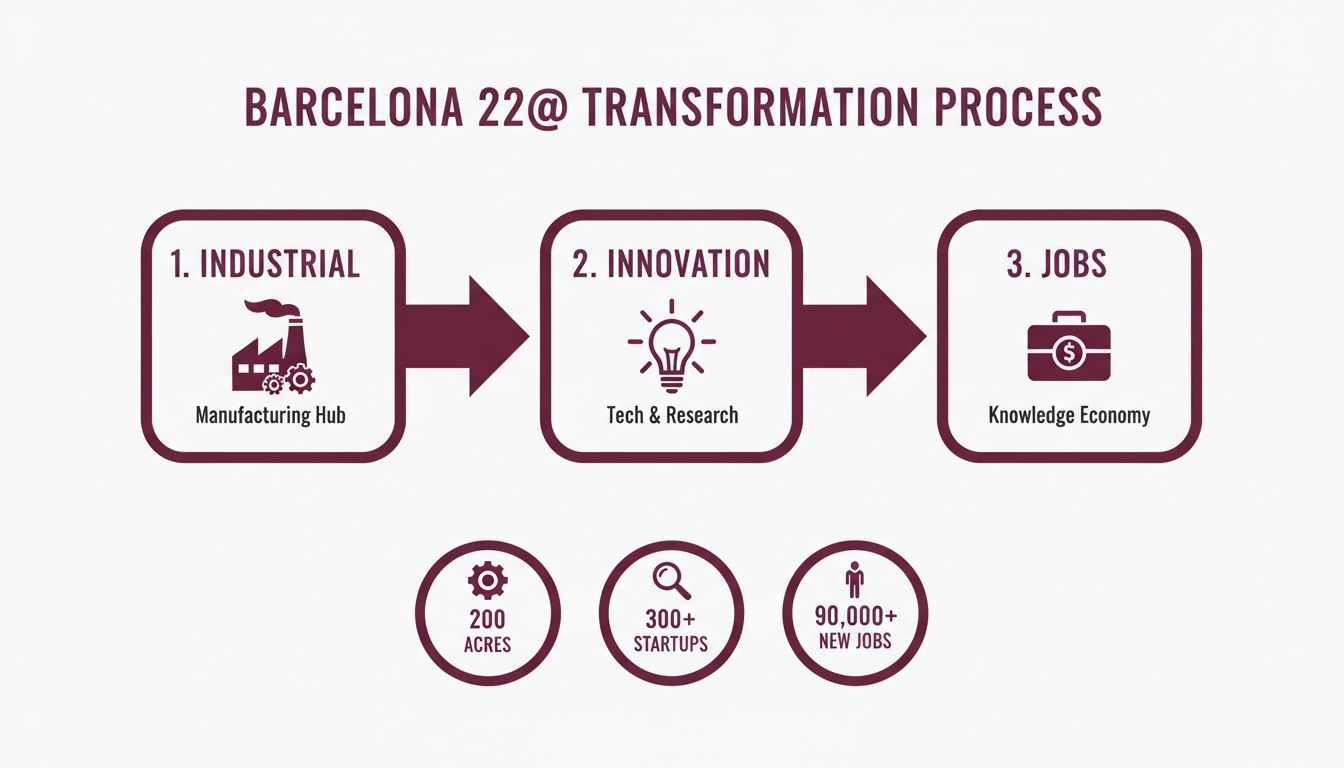
This visual really captures how a focused, creative effort can completely shift a district’s identity, moving from old-school manufacturing to a modern knowledge economy that opens up all sorts of new doors.
Developers are catching on, too. They're seeing real, tangible benefits from weaving arts and culture into their plans. One $250 million mixed-use development that baked in artist studios and a community center from the get-go saw faster lease-ups and quicker project approvals, all because they had earned strong community support.
The journey begins with a single step. By fostering collaboration and starting with manageable projects, any community can begin to unlock its creative potential and build a more vibrant future, block by block.
These early wins lay the groundwork for more ambitious plans, a lot like the ones being mapped out right here in our own backyard. To see how these ideas can take root locally, you should definitely check out what's happening by exploring the Jenks Downtown Master Plan and its vision for our community's future.
How to Measure the Impact of Your Project
So, how do you know if a creative placemaking project is actually working? What does success really look like on the ground? It's about more than just looking at the final budget. True success means digging into both the hard numbers and the harder-to-measure stuff—the genuine community vibe.
To really get the full picture, you have to blend both.
The Numbers Game: Quantitative Metrics
Let's start with the easy part: the numbers. Quantitative metrics are the things you can count, track, and stick on a spreadsheet. Think about a 15% bump in foot traffic for local shops during a festival, the total ticket sales from a concert series, or the number of new businesses that popped up on a street after a revitalization effort.
These figures are absolutely essential. They’re what you bring to city council meetings or potential funders to prove that your project is delivering real economic value.
The Heart of the Matter: Qualitative Metrics
But let's be honest, the real soul of creative placemaking lives in the things you can't easily count. This is the qualitative side of the story. It's that growing sense of local pride you can feel in the air, or seeing more neighbors stopping to chat by a new mural. It’s the positive stories that start showing up in the local paper.
These are the indicators that tell you a project isn't just changing a place; it's changing how people feel about their place.
Seeing the Whole Picture
To tie it all together, it helps to use a framework like a logic model for program evaluation. This is just a straightforward way to connect your actions—like installing new public art—directly to your goals, whether they're economic, social, or cultural. It helps you tell a clear story.
Measuring success means capturing the full story. It’s about tracking the tangible economic boosts while also listening to the community’s voice to understand how a project has strengthened social connections and instilled a deeper sense of belonging.
When you combine both types of measurement, you create a narrative that’s impossible to ignore. You can show that a mural festival didn't just generate $50,000 in local spending, but that it also led to 80% of residents saying they feel more connected to their neighborhood.
That balanced approach gives you a clear, defensible, and inspiring story about your project’s real value.
Measuring the Impact of Creative Placemaking
To put it all into practice, you need to look at both sides of the coin. Here’s a breakdown of the different ways you can measure success, from hard data to community feedback.
Metric Type | What It Measures | Example |
|---|---|---|
Economic | Financial and commercial activity generated by the project. | A 10% increase in sales tax revenue for the district; 5 new businesses opened within a year. |
Social | Changes in community connection, engagement, and well-being. | Survey results showing 75% of residents feel safer walking at night; higher attendance at community meetings. |
Physical | Improvements to the built environment and public spaces. | A 20% decrease in vacant storefronts; increased use of a public park after an art installation. |
Cultural | Shifts in local identity, creative expression, and civic pride. | More local artists participating in events; positive mentions of the district on social media. |
Ultimately, a mix of these metrics will give you the most honest and complete assessment of your work, showing stakeholders and the community alike that creative placemaking is an investment that pays off in more ways than one.
Common Questions About Creative Placemaking
When you start talking about changing the feel of a community, a few practical questions always pop up. Whether you're a long-time resident, a small business owner, or an artist looking to contribute, getting straight answers is the first step to getting involved.
Who's Actually Footing the Bill for All This?
It’s almost never just one person or group. Successful projects are usually a creative blend of funding streams, pieced together from a few different places:
Public Funds: This can come from city budgets, grants from arts councils like the National Endowment for the Arts, or special community development funds.
Private Investment: Think sponsorships from local businesses that want to see the area thrive, contributions from developers, and donations from foundations that believe in the vision.
Earned Income: Sometimes, the projects help pay for themselves. Revenue from things like ticket sales, vendor fees at a pop-up market, or even merchandise can help keep things running for the long haul.
Isn't This Just a Fancy Term for Public Art?
That’s a great question, and the answer is no—though you can see why people make the connection. Public art is often a part of creative placemaking, but it’s not the whole story.
Think of it this way: a mural or a sculpture is an outcome. Creative placemaking is the community-driven process that gets you there.
It’s the difference between hiring an artist to paint a mural and organizing a neighborhood project where residents help design and paint it together. One gives you a nice wall; the other builds connections, pride, and a real sense of ownership.
How Can I Get Involved in What's Happening Here?
Getting your hands dirty is easier than you might think. A great starting point is to connect with your local Main Street association, the chamber of commerce, or a local arts council. Showing up to public city planning meetings is another powerful way to make your voice and ideas heard.
Honestly, one of the best first steps is to simply support what’s already happening. Go to the local art walks, shop at the pop-up markets, and tell your friends about the cool events going on. When you show up, you send a clear message that there's a real demand for more of these kinds of activities in our community.
Ready to see these ideas in action? At The Ten District, we’re all-in on building a community that buzzes with art, culture, and thriving local businesses. Check out what's coming up and see for yourself what makes our district the place to be at https://www.thetendistrict.com.


Comments