

What is civic engagement? A Guide to Impact
Let’s cut through the jargon. At its core, civic engagement is simply the act of showing up for your community. It's about being an active player, not just a spectator, in the life of your town—working alongside your neighbors to tackle challenges and build a better future together.
Understanding What Civic Engagement Really Means
Forget the dry, academic definitions for a minute. Think of civic engagement as the bridge connecting your personal actions to the health of the entire community. It’s the sum of all those small (and large) efforts that make a place better, from a single neighborhood block all the way up to the national level.
This is so much bigger than just politics. It’s any action you take to improve the quality of life for the people around you. Every single one of us—students, business owners, parents, retirees—has a part to play. If you're looking for a good primer on the basics, this guide on What is Civic Engagement? is a fantastic place to start.
The Core Idea of Participation
The whole idea is built on a simple but powerful belief: your voice and actions actually matter. A healthy community isn't a passive one; it needs its members to get involved. That involvement can look like a thousand different things.
A thriving community is not a spectator sport. It requires each of us to step onto the field, contribute our skills, and work together toward a shared goal. True engagement turns passive residents into active citizens.
When we all pitch in, we create a sense of shared ownership and build the kind of social fabric that holds a town together through thick and thin.
To give you a clearer picture, here's a quick breakdown of what civic engagement looks like on the ground.
The Core Pillars of Civic Engagement
Pillar | Core Activity | Real-World Example |
|---|---|---|
Electoral Participation | Voting, staying informed on candidates | Casting your ballot in the local Jenks school board election. |
Community Service | Volunteering time and skills | Helping out at the Jenks Community Food Bank on a Saturday. |
Community Organizing | Mobilizing neighbors around a shared issue | Starting a petition to get a new crosswalk near Jenks High School. |
Advocacy & Activism | Voicing opinions to elected officials | Speaking up about zoning changes at a Jenks City Council meeting. |
Public Deliberation | Participating in forums and town halls | Attending a public workshop to discuss the future of Main Street. |
These pillars aren't mutually exclusive; in fact, they often overlap and support one another, creating a strong foundation for a vibrant community.
Why It Matters Here and Now
In today's world, it’s easier than ever to see the real-world impact of getting involved. Organizing a neighborhood cleanup or showing up to a planning meeting creates ripples that make our community stronger and more connected.
Take Jenks, for example. When you look into best practices for community engagement, you can see how intentional participation leads directly to a more responsive and dynamic local government. It’s not just theory; it’s happening right here.
Ultimately, understanding civic engagement is about recognizing your own power to make a difference. It’s about taking ownership of the place you call home and being part of the solution. It all starts with that first step, and every single contribution helps build the future we all want to see.
Exploring the Spectrum of Civic Participation
Think of civic engagement less as a single, grand action and more like a community toolkit. Inside, you'll find a whole range of tools for different jobs. You just have to pick the one that fits your skills, your schedule, and what you’re passionate about.
The real key is understanding that you don't have to do it all. Finding your place on this spectrum is what makes participation meaningful. For some, that means diving into local politics. For others, it’s about rolling up their sleeves and getting their hands dirty with direct community service.
From the Ballot Box to the Block Party
One of the first things that comes to mind for many is political participation. This is so much more than just showing up for the big presidential elections. It’s about staying plugged into local issues, showing up at town halls, and really getting how decisions are made in our city.
When local elections for school bonds or city council seats pop up, casting an informed vote is one of the most direct ways to shape the future of Jenks. It’s a powerful tool. You can see just how important this is by learning more about how Oklahomans head to the polls for crucial local races and the impact it has.
But politics is just one piece of the puzzle. Community service is where you can get hands-on and see an immediate impact. The options here are huge:
Volunteering: Giving your time to a local food bank, an animal shelter, or an after-school program.
Mentoring: Sharing what you know with local kids to help them find their footing, both personally and professionally.
Neighborhood Improvement: Getting a community garden started, organizing a park clean-up, or joining a neighborhood watch.
These acts are the glue that holds a community together. They build connections and solve immediate problems, strengthening the fabric of our town one project at a time.
Organizing and Advocating for Change
As we move along the spectrum, we get to community organizing. This is what happens when neighbors spot a shared problem—maybe an unsafe intersection or the lack of a good park—and decide to tackle it together. It’s all about building power from the ground up to get the attention of decision-makers.
Right alongside organizing is advocacy, which is simply using your voice for a cause you believe in. This could be as simple as writing letters to elected officials, signing petitions, or firing up social media to spread the word about an important issue. It’s about making sure community values are heard loud and clear.
Civic engagement is fundamentally about connection—to our neighbors, to our shared challenges, and to the democratic process itself. By participating, we are actively weaving ourselves into the story of our community.
This whole idea of citizens getting directly involved is catching on everywhere. Between 1979 and 2023, there were 716 recorded cases of these kinds of deliberative processes across 28 OECD countries, pulling in over 80,000 citizens. What's really telling is that a massive 70% of these happened at the local or regional level. It just proves that real, meaningful change almost always starts right here in our own backyards.
Ultimately, the world of civic participation is wide open. Whether you’ve got one hour a month or a few hours every week, there’s a spot for you. From voting to volunteering to advocating, every single action helps build a more vibrant, responsive, and connected Jenks.
Why Your Engagement Strengthens Our Democracy
When you decide to get involved in what’s happening around you, you're doing something much bigger than just showing up. You’re casting a vote for a healthier, more responsive democracy.
Think of it like a conversation. If only a few people are talking, it’s easy for decision-makers to miss what the community truly needs. But when more voices join in—at town halls, through petitions, or by volunteering—that conversation gets louder and clearer. It becomes impossible to ignore.
Each action, no matter how small it seems, sends a clear signal that residents are paying attention. That fundamentally changes how leaders and institutions operate.
This map shows how different kinds of engagement—political, community, and advocacy—all work together to build a strong foundation for our community.
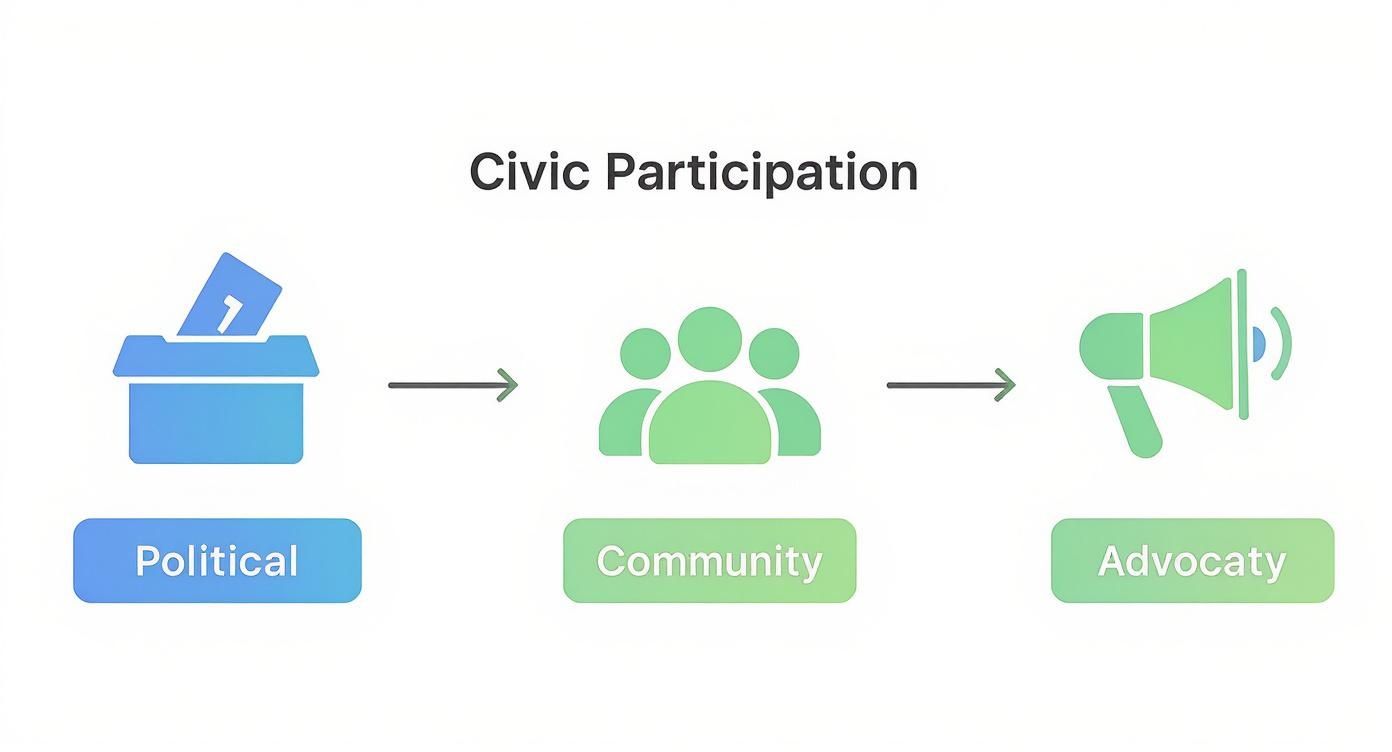
As you can see, these pillars aren't separate. They feed into each other, creating a cycle of positive community involvement that keeps getting stronger.
Building Accountability and Trust
One of the most immediate results of civic engagement is increased government accountability. When residents are actively following local issues, leaders are far more likely to act in the public's best interest. It’s that simple.
This builds a bedrock of trust between the community and its institutions, creating a more cooperative and effective environment for everyone. Even just attending a city council meeting sends a powerful message that people care and expect transparency.
If you’re curious about how this works on the ground, a great starting point is understanding the structure and function of the Jenks City Council and seeing how resident participation fits directly into the process.
When we engage, we are not just citizens; we are co-creators of our community. We shift from being passive consumers of services to active partners in governance, ensuring our institutions truly reflect our collective values.
This partnership is what leads to real-world results—policies and projects that better reflect what our community actually wants and needs, from safer streets to better parks.
A Bulwark Against Democratic Decline
The need for active participation isn't just a local issue; it’s a global one. A startling 2024 report revealed that 94 countries have seen a decline in at least one key measure of democratic performance over the last five years.
Areas like Credible Elections and Effective Parliament saw the most significant drops, impacting dozens of nations. This global trend underscores just how urgent it is for us to get involved right here at home to protect and strengthen our own democratic resilience.
By getting involved right here in The Ten District, you are doing your part to push back against this trend. Active, engaged communities are the strongest defense against apathy and institutional decay. Your participation shores up the very foundations of our democratic society, ensuring it remains vibrant, responsive, and resilient for years to come.
How Technology Is Redefining Civic Action
Not too long ago, making your voice heard meant showing up in person at a town hall or knocking on doors with a petition. Today, the game has completely changed. Technology has blown the doors wide open for civic engagement, making it easier and faster for everyday people to connect, organize, and demand action.
That screen in your pocket? It's now one of the most powerful tools for building a better community.
From social media campaigns that put a spotlight on local issues to online forums where neighbors brainstorm solutions, digital tools have seriously lowered the barrier to entry. This shift means more people can get involved on their own terms, fitting engagement into their already packed lives instead of having to clear their schedules for a physical meeting.
The Rise of Digital Engagement Platforms
Digital platforms have fundamentally rewired how we interact with our communities and even our local government. These tools are giving citizens the power to take action in ways that would have been unimaginable just a decade ago.
Think about the real-world impact of these modern methods:
Online Petitions: A single, powerful idea can now collect thousands of signatures in just a few days, proving widespread support for an issue and forcing decision-makers to pay attention.
Social Media Campaigns: A simple hashtag can unite an entire community around a cause, spreading information like wildfire and mobilizing people for events or advocacy efforts.
Community Forums: Websites and apps are creating digital town squares where residents can talk through local challenges—from traffic headaches to dreams for a new park—and solve problems together.
Crowdfunding for Projects: Neighbors can pool their money to directly fund local initiatives, whether it's a new playground or a public art project, giving them direct ownership over neighborhood improvements.
And it’s not just for grassroots movements. Local governments are getting in on the act, too. For example, you can now sign up for alerts with the City of Jenks to get instant updates on everything from road closures to community events, keeping you in the loop.
"In the digital age, a single, well-crafted post can ignite a community conversation, and a thoughtfully designed app can make government more accessible than ever before. Technology gives every citizen a megaphone."
But this evolution isn't a perfect science just yet. Research points to a gap between what these tools could do and how they're actually being used. One recent study found that while many government agencies have engagement initiatives, only 56% see relationship-building as a core goal. With most people under 40 getting their information from their smartphones, a mobile-first approach is crucial for building trust and making sure everyone has a seat at the table. You can check out more of these civic communication benchmarks for 2025 to see where things are headed.
Bridging the Digital Divide
For technology to really supercharge civic engagement, it has to be for everyone. The digital divide—the gap between folks who have easy access to the internet and those who don’t—is still a major hurdle.
Making sure that our older residents, low-income families, and people in more rural areas aren't left out of the conversation is absolutely critical. If participation isn't equitable, it isn't truly progress.
At the end of the day, technology is a powerful amplifier for civic action. When we use it thoughtfully and inclusively, it helps build a more informed, connected, and engaged community where every single person has a chance to shape the future of their hometown.
Finding Your Place in Community Life
Knowing you should get involved is one thing. Figuring out how to actually start is something else entirely. It’s easy to get overwhelmed by the options, but trust me, finding your spot in community life doesn’t require some grand plan or a massive time commitment.
It all begins with a single, manageable step that fits into your life right now.
Think of it like picking up a new hobby. You wouldn't try to master the entire craft on day one. You’d pick one simple skill and practice it. Civic engagement is the exact same. The goal is to find an entry point that feels right for you, whether you’ve got one hour a month or a few hours a week to spare.
The real key is connecting your personal interests with the needs of the community. Do you love to garden? Joining a local community garden could be your perfect first move. Are you a wizard with social media? A local nonprofit would probably love your help managing their online presence.
Simple First Steps Anyone Can Take
Let's be honest, just getting started is often the hardest part. The good news? The first few steps can be incredibly simple and still make a real difference. You don’t need to run for office to be civically engaged; you just have to show up in a way that works for you.
Here are a few low-commitment ideas to get the ball rolling:
Stay Informed Locally: Spend just 15 minutes a week reading news from a local Jenks source. Knowing what's happening is the foundation for everything else.
Attend One Meeting (From Your Couch): Many city council or school board meetings are now streamed online. Simply listening in is a powerful way to understand how local decisions get made.
Follow and Share: Follow local community groups or city departments on social media. A simple share helps spread important information to your neighbors.
These small acts build momentum and a sense of connection, making it much easier to take bigger steps down the road. For anyone looking for more structured ideas, exploring effective community engagement strategies can open up a world of possibilities.
Your Guide to Getting Involved
Feeling unsure where to start? This table breaks down different activities by time commitment and potential impact to help you find your perfect starting point.
Activity | Time Commitment | Impact Area | Great For... |
|---|---|---|---|
Local News Follower | 15-30 minutes/week | Awareness | People with very limited time who want to stay informed. |
Social Media Amplifier | 1-2 hours/month | Information Sharing | Anyone active online who can share posts from local groups. |
Attend a Public Meeting | 1-2 hours/month | Local Governance | Residents wanting to understand how decisions are made. |
Volunteer at an Event | 3-4 hours (one-time) | Community Spirit | People who want a hands-on but low-commitment experience. |
Join a Committee | 2-5 hours/month | Policy & Planning | Individuals ready for a deeper, more consistent contribution. |
Community Organizing | 5+ hours/week | Systemic Change | Passionate residents dedicated to mobilizing neighbors for a cause. |
Whether you have 15 minutes or 5 hours, there's a role for you. The most important thing is simply to begin.
Matching Your Skills to Community Needs
Once you feel ready to dive a little deeper, start thinking about what you’re good at and what you genuinely enjoy doing. Your unique skills are valuable assets that local organizations desperately need. The idea is to find an opportunity that doesn't feel like a chore but like a fulfilling extension of who you already are.
True civic engagement happens when you align your personal passions with a public purpose. It’s the sweet spot where what you love to do meets what your community needs.
Take a moment to consider how your professional or personal skills could be put to good use. Are you a fantastic organizer? Help plan a neighborhood block party. Are you a skilled writer? Offer to help a local cause draft its newsletter.
By finding a role that fits you, you’re far more likely to stick with it and see the long-term impact of your contributions. If you're looking for more inspiration, our guide on 9 community engagement strategies you should know offers concrete examples to help you find that perfect fit right here in Jenks.
Ultimately, finding your place is a personal journey of discovering how your unique talents can help build a stronger community for everyone.
Common Questions About Getting Involved
Taking that first step into civic life can feel like a big deal, and it’s perfectly normal to have questions. So many people want to get involved but get stuck on the "how" or the "what if." Let's clear up some of the most common hurdles and show you that getting involved is for everyone.
First, let's bust the biggest myth out there: you don't need to be some kind of expert to make a difference. Far from it. Your lived experience as a member of this community is actually your greatest asset.
Do I Need to Be a Political Expert to Participate?
Not even close. Think of civic engagement less like a political science class and more like caring about your own backyard. It’s about wanting safer streets for your kids to ride their bikes, better local parks, or seeing the small businesses on Main Street succeed.
Your perspective is what matters. You don't need a fancy degree to spot a problem or dream up a solution. Most local groups are thrilled to welcome passionate residents, not just policy wonks. They'll give you the info you need as you go.
How Can I Make a Difference with Very Little Time?
This is the big one, isn't it? Life is packed, and it's easy to feel like you don't have a spare minute to contribute. But real impact doesn't always demand a massive time commitment. Small, steady actions build up to create huge change.
Try weaving engagement into the things you already do:
Got a lunch break? You have time to sign an online petition for a local cause.
Scrolling social media anyway? Share good information from a community group to keep your neighbors in the loop.
Have one free afternoon a month? That's all it takes to volunteer for a one-off event like a community cleanup.
The trick is finding something that fits your life right now. It's about being consistent, not being available 24/7.
Meaningful participation isn’t measured in hours spent, but in the intention behind the action. Every email sent, every meeting attended, and every informed conversation contributes to a collective voice that is impossible to ignore.
That collective voice is built one small action at a time. Never, ever underestimate the power of your contribution, no matter how small it feels.
What If I Feel Like My Efforts Are Not Working?
Feeling discouraged when you don't see instant results is completely normal. Real, lasting change is a marathon, not a sprint. It’s a slow burn. Just remember that every single thing you do is a piece of a much larger puzzle.
When you show up to a meeting, shoot an email to a city official, or even just talk to a neighbor about an issue, you're sending a signal that people are paying attention. You’re building connections and laying the foundation for what comes next. Even when the wins feel small or take forever, your presence keeps the momentum going.
Where Can I Find Trustworthy Local Groups to Join?
Finding the right group can make all the difference. A great place to start is often your city's official website or the local library—they usually have lists of community partners and volunteer gigs.
Online tools like VolunteerMatch can also point you toward nonprofits based on your interests. But honestly, don't overlook the power of just talking to people. Ask your neighbors, local shop owners, and community leaders which organizations they trust. A personal recommendation is often the best way to find a group where you'll feel right at home.
At The Ten District, we know a strong community is built by the people who show up for it. We hope you'll explore the many ways to get involved right here in Jenks. Discover local events, connect with your neighbors, and be part of what makes our district truly special. Learn more at The Ten District.


Comments