

Temporary Public Art Installations in Jenks
A temporary sculpture beside Main Street can change how we move through downtown Jenks. The opportunity is real, but the artwork has to survive Oklahoma weather, fit the city's approval process, and give people a reason to stop at a nearby shop or restaurant.
Table of Contents
What Makes The Ten District Ready for Temporary Art - Temporary and permanent serve different purposes
Understanding Temporary Public Art Installations - What makes the category useful - The structure behind the experience
Economic and Community Benefits for Downtown Jenks - Measure the Jenks version of success - Participation needs design, not just an invitation
Planning Your Installation and Partnerships - Build the approval file early - Treat agreements as part of the artwork
Materials and Durability for Outdoor Installations - Choose for the actual site - Plan what happens underneath
Examples and Best Practices for The Ten District - What works in a local setting
Getting Started and Next Steps for Local Artists and Organizers - A practical starting sequence - Start where the district already gathers
What Makes The Ten District Ready for Temporary Art
On a festival day, the walk from the Arkansas River toward the Midland Valley railroad tracks already feels like a sequence of small public rooms. Families move between storefronts, food stops, event areas, and the riverfront, while temporary displays help mark where one activity begins and another ends. That existing rhythm makes downtown Jenks a natural setting for temporary public art installations, especially pieces designed to be discovered on foot rather than viewed from one fixed point.
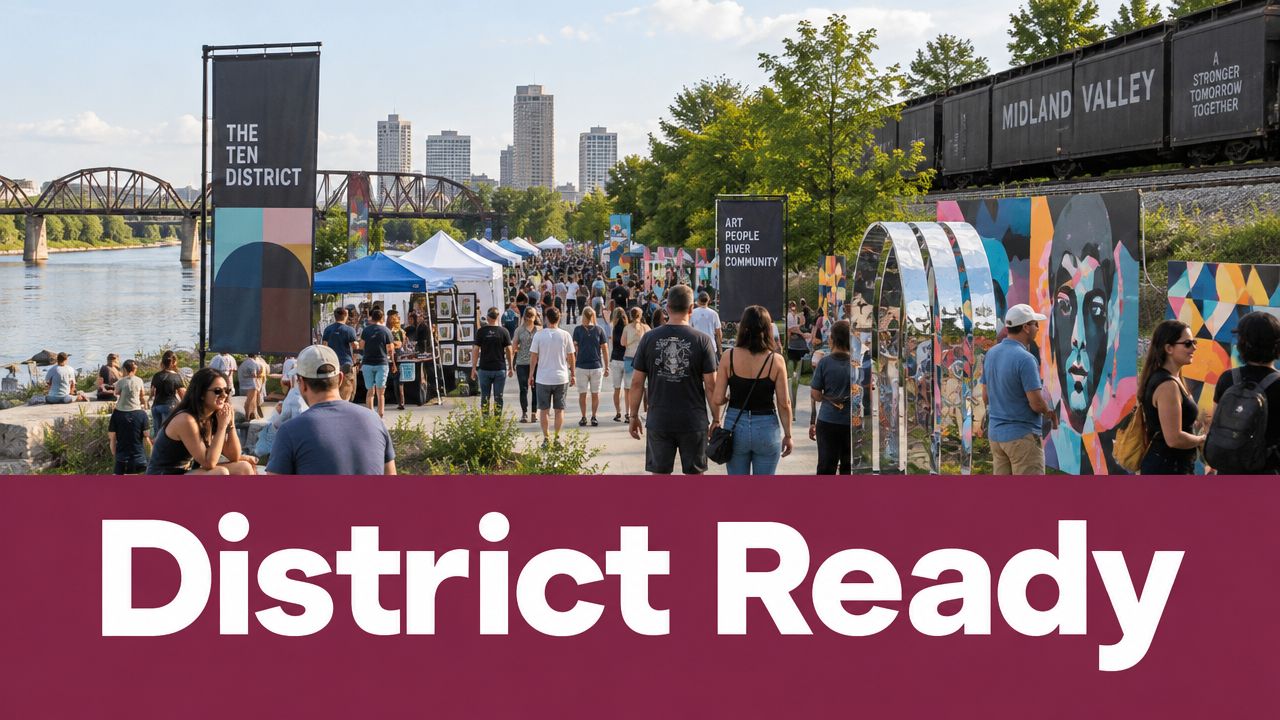
The Ten District stretches roughly ten blocks west from the Arkansas River to the historic tracks. That compact scale matters. A visitor can encounter an installation, continue toward independent retailers, pause for food, and still remain within the same downtown walk. A project doesn't need to cover every block to feel connected to the district. It needs a clear route, visible entry points, and enough nearby activity to make lingering comfortable.
The district also has something a vacant lot or isolated park may not have, an established pattern of gatherings. Festivals, outdoor markets, and other civic activities give artists a built-in audience, while businesses can help explain the work and direct visitors toward adjacent parts of downtown. The Jenks public art spaces guide offers a useful starting point for thinking about how those spaces can work together.
Temporary and permanent serve different purposes
A permanent sculpture becomes part of the city's long-term visual identity. A temporary piece can test an idea, respond to a season, highlight local history, or invite residents to shape the meaning while the work is on display. It can also move when a street, event layout, or public need changes.
That flexibility comes with responsibility. Organizers must plan installation, inspection, maintenance, removal, and surface restoration from the beginning. The strongest projects feel easy to encounter because the difficult work happened before the first visitor arrived.
Local test: If residents can't understand where to find the work, how long it will remain, or what surrounds it, the installation is still a concept, not a finished downtown experience.
Understanding Temporary Public Art Installations
Temporary public art installations are artworks created for a defined display period rather than indefinite placement. In practice, the category can cover a few months through five years or less, although local rules vary. Raleigh's public art process, for example, treats temporary work as short-duration art and asks applicants to provide an installation and de-installation timeline, a maintenance plan, and, where necessary, structural drawings and liability insurance (Raleigh's public art process).
For Jenks, the simplest comparison is a pop-up shop. A pop-up has a planned opening, a limited run, a location chosen for foot traffic, and a closing process. A temporary artwork follows the same basic logic, but its success may depend less on transactions and more on conversation, participation, interpretation, or the way it changes a familiar route through The Ten District.
What makes the category useful
The artwork's limited life is part of its meaning. A sculpture trail can tell a local story during a particular season. An interactive piece can gather feedback before a city commits to a permanent feature. A group exhibition can give Oklahoma artists public visibility without requiring the district to make a long-term physical commitment.
The interactive public art installations page is relevant to this distinction because interaction changes the practical brief. Visitors may touch, enter, photograph, or gather around a work. That means the artist and site owner must consider circulation, supervision, accessibility, cleaning, and the possibility of unintended use.
The structure behind the experience
A temporary installation still needs a complete life cycle:
Defined dates: The agreement should state when installation begins, when public display starts, and when removal must finish.
Clear ownership: Partners should document who owns the artwork, who controls the site, and who carries responsibility for repairs.
Maintenance planning: Someone must inspect the work during the display period, respond to damage, and keep surrounding areas usable.
Removal and restoration: The end of the project should include safe dismantling and repair of any disturbed surface.
Public purpose: The concept should connect to a place, audience, or civic question rather than occupy empty space.
Temporary structures can also support the practical side of an event or exhibition. Organizers researching short-term facilities may find mobile office solutions from Pacific Mobile useful when a project needs a temporary administrative, ticketing, or coordination space separate from the artwork itself.
Economic and Community Benefits for Downtown Jenks
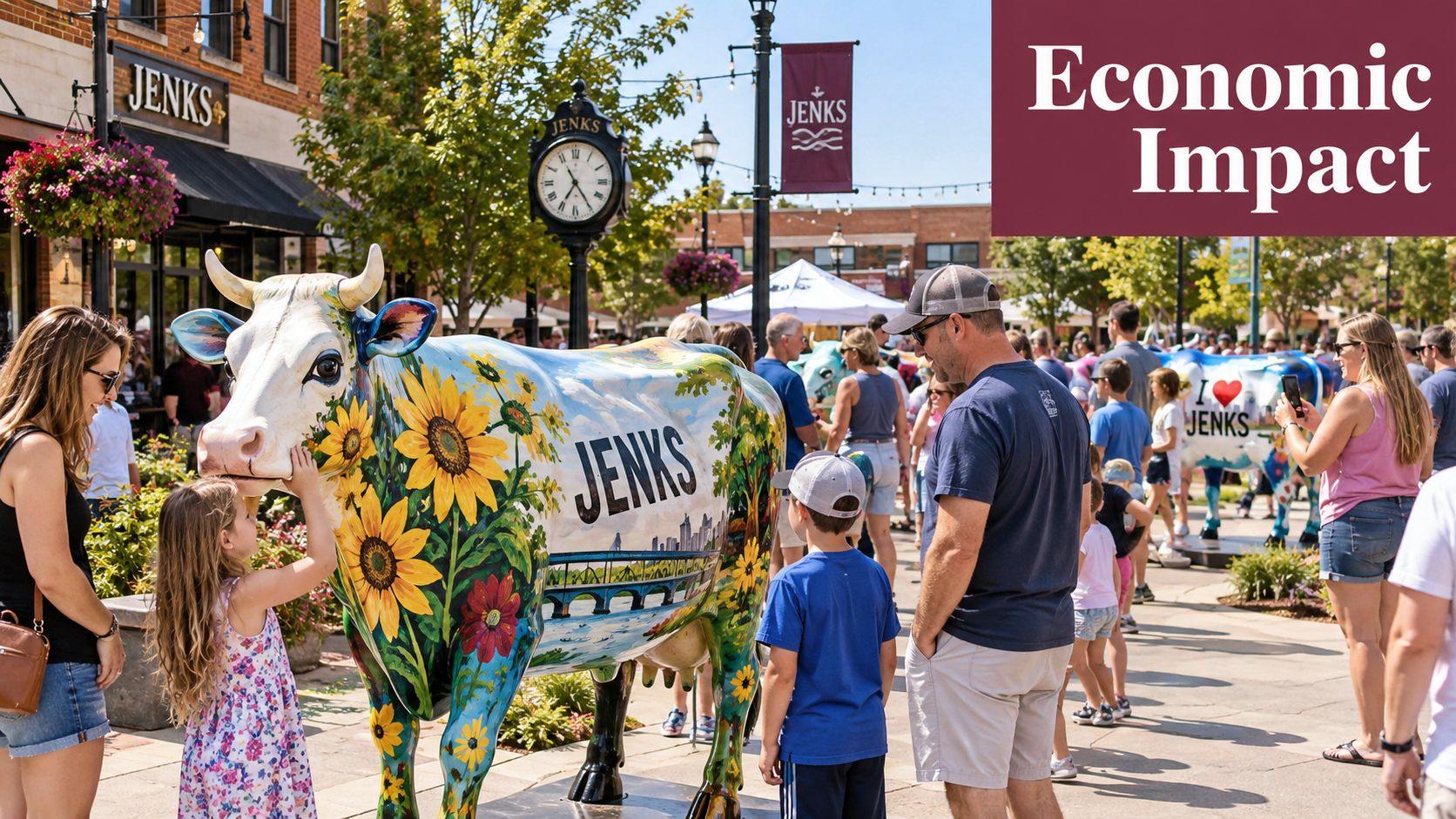
On a busy day in downtown Jenks, a temporary artwork can change a short errand into a longer visit. Someone stops to look, takes a photograph, walks toward another storefront, and decides to stay for food or an event. That sequence matters more than attention alone. For The Ten District, the practical measure is whether the installation connects foot traffic with local businesses and shared public space.
Large projects show what temporary art can achieve, though they do not predict results for Jenks. Chicago's Cows on Parade reportedly brought about 2 million additional visitors during its three-month run, with approximately $500 million spent on hotels, food, and sightseeing. New York City's Cow Parade reportedly drew 3 to 4 million extra visitors and generated about $1 billion in revenue for local businesses (Project for Public Spaces on art and city economics). These were citywide activations. A district project in Jenks operates at a smaller scale, but the same principle applies: a well-placed installation can support nearby commerce when its route, timing, and partnerships are planned together.
Measure the Jenks version of success
Local organizers should track signals that businesses, artists, and civic partners can review:
Dwell time: Observe whether visitors stay longer than they would for a quick pass-through.
Business activity: Ask participating businesses whether people mention the installation or enter because of it.
Route movement: Record which blocks receive attention and which remain disconnected.
Participation: Count school groups, families, artists, and residents who contribute feedback or content.
Repeat visits: Use a short survey or event follow-up to learn whether visitors plan to return.
A project can also create value through sponsorships, memorabilia, auctions, parking, and visitor spending. Research on temporary sculpture trails cites one trail with a £123 million boost and 1.18 million visitors, while other examples produced more modest gains such as £0.5 million (research on temporary public art and local economic effects). Jenks organizers should compare the project's cost with the spending and participation it can reasonably influence, rather than borrow a headline result from a much larger city.
Participation needs design, not just an invitation
Public value depends on who helps shape the work. Residents may disagree about imagery, placement, safety, ownership, or whether an installation serves existing businesses and neighbors. Recent research connects temporary public art with local knowledge and civic engagement, while noting that participation can remain uneven and short-lived (research on temporary public art and civic engagement).
For The Ten District, organizers should invite input before the design is fixed, offer several ways to respond, and report which decisions changed because of feedback. The community value of public art in Jenks depends on that visible process. A temporary installation can strengthen local identity when people recognize their concerns, places, and stories in both the planning and the finished work.
Planning Your Installation and Partnerships
A sound proposal for downtown Jenks starts with the site, not the object. Sketch the route people will take, identify nearby property owners, note pedestrian clearances, and decide whether the installation sits on city property, private property, or a combination of both. That decision affects which approvals and agreements you'll need.
Build the approval file early
Applicants should expect to assemble a practical package rather than rely on a compelling concept alone:
Site map and placement drawings: Show the exact footprint, access path, nearby utilities, pedestrian movement, and installation equipment.
Dates and removal plan: State the display period and how the team will dismantle the work without leaving damage behind.
Insurance documentation: Confirm coverage before public access begins, not after the artwork arrives.
Structural information: Provide stamped engineer drawings when the scale, anchoring, height, or public contact makes them appropriate.
Maintenance responsibilities: Name the person or organization responsible for inspections, cleaning, repairs, and emergency response.
Permission from property owners: Secure written consent where the project uses private frontage, walls, parking areas, or business premises.
Local rules elsewhere show why assumptions are risky. Los Angeles defines temporary public art as an installation period between 12 months and five years and requires proof of insurance, a site map, and required permits before issuing a right-of-entry permit (Los Angeles temporary public art policy). Richmond, Virginia requires review by its Public Art Commission, City Planning Commission, and relevant departments, with an approved duration no longer than 12 months (Richmond temporary art application).
Treat agreements as part of the artwork
Sacramento generally limits temporary public art to five years or less, with case-by-case exceptions. Its policy also requires a license agreement for city-property projects that spells out maintenance duties and removal at the agreed end (Sacramento Temporary Public Art Policy).
For a Jenks proposal, begin conversations with the appropriate City of Jenks staff and property owners, then coordinate with The Ten District organization, nearby businesses, Jenks Public Schools arts contacts, and regional arts groups. Use the downtown Jenks event-planning checklist to align the installation with existing event logistics instead of creating a parallel process.
Seattle's rules provide another operational warning. Seattle Parks allows temporary art for up to three months, and insurance must cover the full installation period (Seattle temporary art installation requirements). Coverage dates are a scheduling constraint, not paperwork to finish at the end.
Materials and Durability for Outdoor Installations
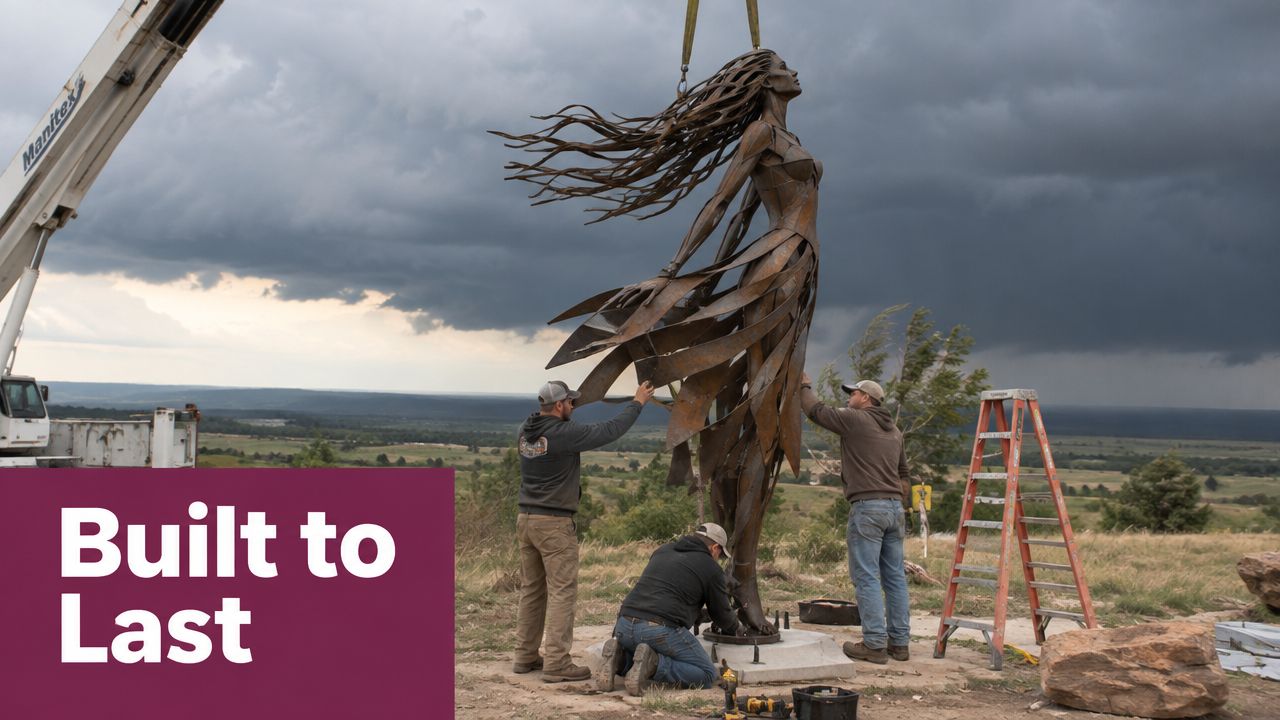
Jenks artists have to design for exposure, not just presentation. Heat, wind, rain, public contact, vandalism, and rapid temperature changes can affect a piece before its planned closing date. Materials that look sound in a studio may behave differently beside an open riverfront or on a sun-heated paved surface.
Choose for the actual site
Lightweight vinyl and fabric can make a project easier to transport and install, but they need careful tensioning, UV protection, drainage, and anchoring. Metal and composite materials can provide stronger visual presence and better resistance to ordinary wear, yet they add weight, corrosion concerns, sharper failure points, and more demanding foundation work.
The right choice depends on the location and the way people encounter it. A banner suspended above a controlled walkway has different requirements from a sculpture that children can approach from every side. A work near the Arkansas River may face different moisture and wind exposure from one placed against a protected storefront.
Practical rule: Temporary doesn't mean lightly built. Engineer the work for every condition the public and the site can impose.
Guidance from Public Art for Public Spaces emphasizes wind, rain, vandalism, expansion from heat and cold, and public contact. It also points to durable outdoor materials, safe edges, structural soundness, documented removal, and site restoration. Those details belong in the initial design review, not in a last-minute installation checklist.
Plan what happens underneath
Anchoring deserves particular attention. A proposal should show how the work resists movement, how installers will access the site, and what happens if severe weather requires temporary closure or removal. The team should also document the condition of pavement, grass, curbs, walls, and irrigation before work begins.
Maintenance can be simple, but it can't be absent. Assign inspection responsibility, establish a response process for damage, and keep public contact surfaces clean. The historic district guidelines for Jenks can help organizers think through how a new installation should relate to existing downtown character and building conditions.
Examples and Best Practices for The Ten District
The most useful models for Jenks aren't necessarily the largest projects. A district can learn from a small sculpture route, a series of artist-designed storefront elements, a participatory installation tied to local history, or a seasonal work that gives visitors a reason to explore beyond one event area.
A strong project usually has a clear route. Visitors know where the first piece is, how the works connect, and what they can do along the way. That route might move from the river toward Main Street, connect several businesses, or create a loop around a festival footprint. The artwork should add to the walk rather than force people into unsafe crossings or confusing dead ends.
What works in a local setting
Artist selection should balance quality with relevance. A call for proposals can invite Oklahoma artists to respond to Jenks history, the Arkansas River, local commerce, or the relationship between old rail infrastructure and present-day downtown life. A review group should include artistic knowledge, practical site experience, business perspective, and community representation.
Public input works best when it has a defined role. Residents might suggest themes, identify stories, test an interactive element, or review a shortlist. They shouldn't be asked to approve a vague idea without enough information to respond meaningfully.
Timing also matters. Installing immediately before a downtown festival can create visibility, but it can overwhelm crews, parking, and business access. A quieter setup window may produce a smoother launch, followed by a public unveiling when foot traffic is already expected.
For organizers preparing a branded temporary display, Exhibition Stand Design from UCON Exhibitions offers a useful reference for thinking about visitor flow, sightlines, modular components, and how people move through a designed environment. The same principles can improve an outdoor art route, even when the final work looks nothing like a trade-show stand.
A workable downtown brief: one clear theme, one walkable route, one named maintenance lead, and one removal date everyone has approved.
Measure more than attendance. Record business feedback, resident participation, accessibility issues, weather interruptions, and which parts of the route people primarily use. That record will make the next Jenks installation more precise.
Getting Started and Next Steps for Local Artists and Organizers
Start with a modest proposal that can be explained in one page. Name the site, describe the artwork, identify the public purpose, state the display period, and show how people will encounter it. A smaller installation with reliable maintenance will do more for trust than an ambitious project that arrives late, blocks access, or deteriorates in public view.
A practical starting sequence
Define the local question: Decide what the piece should help people notice about Jenks, from river access and local history to downtown renewal.
Walk the route: Visit the proposed location at different times, observe shade, traffic, parking pressure, pedestrian behavior, and nearby business activity.
Find partners: Speak with property owners, The Ten District organization, arts educators, local businesses, and relevant city contacts before finalizing the design.
Prepare the documents: Assemble the site map, structural information, insurance proof, maintenance plan, installation schedule, and removal method.
Set the measurement plan: Choose a few practical indicators, such as participation, business observations, route use, and repeat interest.
Plan for the ending: Put removal, storage, surface repair, and public communication in the agreement from the start.
Rapid prototyping can help artists test scale, attachment points, sightlines, and visitor interaction before committing to a full build. Resources on rapid prototyping for inventors from American Additive Manufacturing may be useful when a concept includes custom forms or components that need physical testing.
Start where the district already gathers
An existing event calendar can provide a practical first audience, but the artwork shouldn't become disposable event dressing. Give it enough time for residents to encounter it outside the launch day. Invite businesses to share observations, ask schools or arts groups to contribute age-appropriate interpretation, and make the closing date visible so removal feels like part of the story rather than a disappearance.
Temporary public art can help Jenks test ideas before making permanent investments. It can reveal which locations encourage conversation, which themes bring people together, and which operational details need revision. It can also expose tensions around representation, access, and downtown change. That information is valuable only when organizers listen and document what they learn.
A thoughtful project adds another reason to walk Main Street, but it should respect the businesses, residents, historic character, and everyday routines that make the district work. The strongest installation won't compete with downtown Jenks. It will help people pay closer attention to the place we already share.
The Ten District offers a walkable setting where local art, independent businesses, outdoor events, and riverfront visits can meet in one downtown experience. Visit The Ten District to explore Jenks Main Street and consider where a temporary public art installation could give your next visit a little more to discover.


Comments