

Jenks Brand Identity Development Playbook
A visitor can recognize downtown Jenks before seeing a logo. They find free street parking, walk toward Main Street, pass familiar storefronts beneath glowing lights, and decide within minutes whether the district feels easy to explore and worth discovering. That lived experience is the starting point for brand identity development in Jenks, not an afterthought added to a style guide.
For The Ten District, identity has to work on sidewalks, storefronts, wayfinding signs, event materials, websites, and in the way people are welcomed through a business door. A polished mark helps, but a coherent district brand depends on the many small decisions that make downtown feel like one connected place.
Table of Contents
Walking the District to Define Our Identity
Start on the sidewalk, not in a design program. Walk Main Street slowly and pay attention to what a first-time visitor can see, hear, and understand without local knowledge.
The Jenks Chamber describes downtown as stretching from First Street to Fifth Street, with glowing lights overhead and mature trees lining the sidewalk. Those details already establish a tone. The overhead lights create continuity after sunset, while the trees soften the corridor and make the walk feel more human than a strip of disconnected storefronts. Our identity should build from those existing cues instead of replacing them with a generic “downtown” look.
Parking belongs in that audit, too. The city identifies free street parking in the official downtown district, along with additional parking at Jenks Commons Park at 220 E. A Street. A visitor's experience begins when they leave the car, so the route from parking to Main Street deserves the same attention as a logo or social post.
What we observe before we design
We look for practical signals:
Arrival: Can someone tell where the Main Street core begins?
Orientation: Do signs, storefronts, and public spaces help visitors choose a direction?
Recognition: Can people distinguish district information from an individual business promotion?
Welcome: Do facades, windows, seating areas, and entrances feel open and understandable?
Memory: What would a visitor describe to a friend after leaving?
Public art is part of that memory. A useful local reference point is Jenks public art and community spaces, because those places show how identity can live in shared environments rather than only in commercial marks.
A practical overview of the design fundamentals is Data Hunters Agency's brand identity guide. For our purposes, its value is the reminder that identity includes connected visual and verbal choices. In Jenks, those choices must survive sunlight, brick, pavement, temporary signs, and the varied character of independent businesses.
Practical rule: If the identity looks good on a screen but fails when someone is trying to find parking, read a sign, or locate an event entrance, the work isn't finished.
Researching Our Local Heritage and New Growth
A district identity becomes credible when it reflects both memory and change. Downtown Jenks can't be reduced to its newest opening, but it also can't remain frozen in an earlier version of Main Street.
TravelOK identifies Jenks Restaurant at 215 E. Main as a Main Street mainstay that has operated for more than five decades. That kind of continuity matters because long-running businesses carry stories that visitors and residents can recognize. They give the district a sense of belonging that a newly printed logo can't manufacture.
New businesses add a different kind of information. A local recap documented Jenks Coffee Co. at 103 E. Main St., Pure Kitchen and Market at 102 E. Main St., and Slim Chickens at 418 W. Main St. These openings show how the corridor can welcome different routines and audiences while remaining tied to the same walkable geography.
Mapping the moments people remember
Research should follow an actual visit from beginning to end. We can map a Saturday morning coffee trip, a meal with visiting family, or an evening that combines shopping and an event. At each point, we record the emotional high, the friction, and the question a visitor may have next.
Visit moment | What to examine | Identity implication |
|---|---|---|
Arrival | Parking, entrances, first visible sign | Make the district easy to enter |
First walk | Facades, trees, lights, public art | Reinforce a recognizable Main Street character |
Business choice | Menus, windows, shared district cues | Support individuality without visual confusion |
Event transition | Temporary signs, booths, crossings | Keep the experience legible during change |
Departure | What visitors photograph or mention | Identify the memories worth reinforcing |
The research should include conversations with shop owners, residents, families, property owners, and event organizers. Each group sees a different part of the journey. A merchant notices window visibility, a parent notices crossing and seating, and an event organizer notices where temporary signs create confusion.
Our historic district guidelines for Jenks can help protect the physical character that gives this research meaning. The aim isn't to make every building look alike. It's to identify the shared qualities that allow different businesses to feel connected.
Designing Visuals for a Walkable Main Street
A visitor may first see a district marker from a car, then follow a wayfinding sign on foot, notice a window decal across the street, and find the same identity on an event map that evening. The visual system must work through that entire route, not only on a logo sheet.
Start with a core mark that stays recognizable in one color, at small size, on dark surfaces, and against the textures found along Main Street. Build supporting choices for typography, color, patterns, icons, and photography. These elements should give merchants practical options while allowing each storefront to retain its own voice.
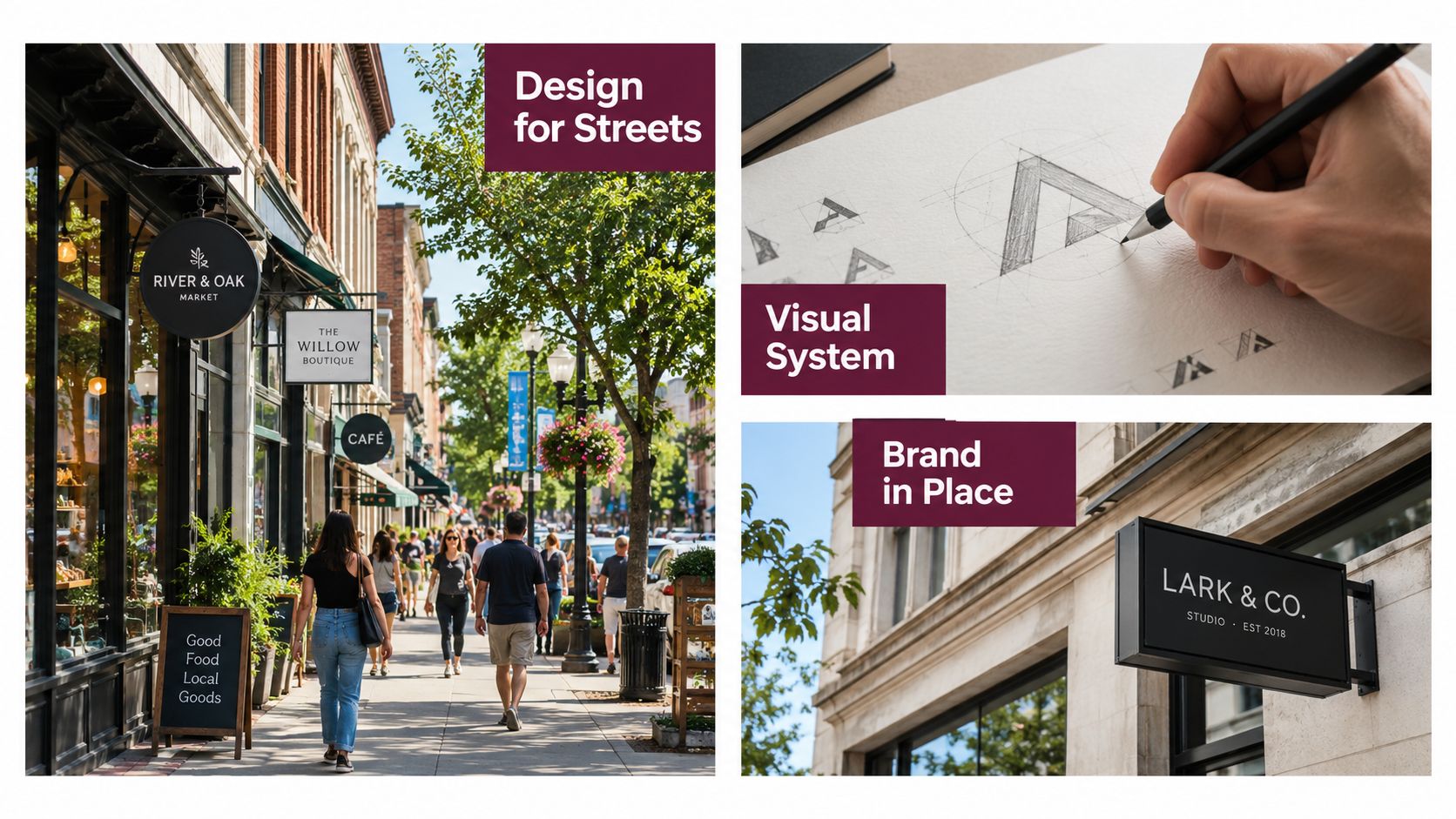
Jenks' official downtown district is centered on Main Street. Visitors can use free street parking and additional parking at Jenks Commons Park at 220 E. A Street, so wayfinding should connect the park to the Main Street corridor without filling every view with signs.
Build the system around the moments people experience:
Recognition: Set the district mark, primary colors, and type choices.
Movement: Standardize arrows, destination names, parking references, and distance language.
Storefront use: Provide window decals, door notices, and co-branded materials that support individual merchants.
Event use: Prepare adaptable formats for posters, banners, vendor information, maps, and social posts.
Local conditions: Document adjustments for historic facades, temporary installations, small print, and accessibility needs.
A restaurant, gallery, boutique, and service business will apply the identity differently. Giving each one the same storefront template would erase useful distinctions. Clear boundaries work better: shared recognition for the district, flexible applications for the business. Guidance that helps merchants inspire better loyalty card designs can extend that identity to customer-facing materials.
The same standard should shape ground-floor retail in downtown Jenks. Signs, windows, entrances, and event materials need to make the corridor active and easy to understand while leaving the distinct businesses visible. A living identity succeeds when people can recognize the district, find their way, and still remember which local business they visited.
Operationalizing the Brand Across Every Touchpoint
A visitor should recognize downtown Jenks before reaching a storefront, then receive the same clear cues at the entrance, during an event, and while asking for directions. That requires an operating system, not a logo file. The identity must guide physical wayfinding, merchant materials, public spaces, and community events without making every business look identical.
Start with a short set of decisions people can apply under real Main Street conditions. Define who maintains current files, answers merchant questions, reviews vendor materials, and approves temporary uses. Assigning those responsibilities keeps the system usable when a street closure, seasonal event, or new storefront changes the district.
Build the tools around actual work:
Wayfinding: Use consistent destination names, arrows, parking references, and distance language so visitors can move through the walkable district.
Merchant materials: Offer window decals, door notices, and co-branded formats that identify the district while preserving each business's character.
Event operations: Prepare adaptable templates for posters, banners, maps, schedules, vendor information, and digital announcements.
Asset control: Keep one current library of logos, type choices, templates, photography guidance, and approved descriptions.
Local adjustments: Document how the identity works on historic facades, temporary installations, small print, and accessible signs.
A restaurant, gallery, boutique, and service business will use these materials differently. Shared recognition should connect them, while flexible applications protect useful distinctions. Guidance on brand storytelling for Jenks should also connect district history, merchants, public art, and everyday visitor behavior to the places people see.
Service language should support judgment rather than produce a script. Staff need a clear answer to “Where can we park?” and useful directions when someone asks, “What's nearby?” Event vendors need the same practical clarity at booths, entrances, and information tables.
Review storefronts, signs, event materials, and digital listings on a regular cycle. Revisit the system when the district offer changes, the audience shifts, or a new event reveals a gap. A living identity succeeds when people recognize the district, find their way, and remember the local business they visited.
Engaging Local Businesses in the Rollout
A visitor turns from Main Street toward a storefront, checks an event map, then asks a merchant what else is nearby. Those moments are where a district identity proves its value. Local businesses need tools that support this movement through downtown Jenks, not a logo package that sits in a folder.
The brand belongs to the people who open their doors every morning. Jenks Coffee Co. at 103 E. Main St., Pure Kitchen and Market at 102 E. Main St., and Slim Chickens at 418 W. Main St. serve different customers and have different visual instincts. The rollout should connect them as part of one walkable district while preserving each business's character.
Start with listening sessions. Ask merchants where visitors get confused, which local stories feel accurate, what materials they already maintain, and what they can realistically add. Property owners and civic leaders should join these discussions because facade choices, event requirements, and public improvements affect the whole block.
Then give each business a short, usable onboarding kit. It should include current logos, files, colors, type choices, templates, and approved district descriptions, with examples for storefront windows, menus, event booths, websites, social posts, and printed handouts. The guidance should also state what stays personal: the business name, interior character, product photography, menu voice, and individual promotions. A named contact or clear approval process prevents small questions from delaying participation.
Co-marketing should follow how people move through the district. One merchant can recommend a nearby shop, an event organizer can feature several storefronts, and a district post can show how multiple stops fit into one visit. This makes the identity useful in daily operations and community events, rather than repeating the same slogan everywhere.
Resident feedback belongs in the rollout too. Families, older residents, downtown workers, and regional visitors may notice different barriers. Their observations can improve signs, event maps, and public-space communication before a minor problem becomes part of the district's reputation. Review what businesses and visitors report, then adjust the system while leaving room for each storefront to remain recognizably its own.
Measuring Success Beyond Social Media Metrics
A strong brand can earn attention online and still fail on Main Street. Followers and likes may indicate interest, but they don't tell us whether visitors recognize the district, find their way from parking, understand what's happening, or return to independent businesses.
Brand consistency research cited by Lucidpress reported that companies with consistent branding saw about a 23% revenue increase in 2016, while a 2019 update raised the estimate as high as 33%. The same research stream was later summarized as showing that 68% of organizations credited brand consistency with at least 10% revenue growth, while only 30% reported widespread use of brand guidelines across their organizations. These figures help explain why identity work should be managed as business infrastructure, not just visual decoration. Lucidpress brand consistency statistics
A separate summary associates consistent brand presentation with 10% to 20% average revenue growth in one study set and up to 33% in a later update. TurnMe Digital's brand identity and business growth guide The figures aren't a substitute for local measurement, but they support a clear operating principle: track what consistency changes in the actual experience.
Use a district scorecard
Useful measures for The Ten District include:
Visual consistency score: Review signs, storefront materials, event assets, and digital listings against agreed standards.
Message alignment rate: Check whether public descriptions accurately communicate the district's character and practical information.
Voice consistency index: Compare event copy, merchant-facing language, and district communications for tone and clarity.
Customer recognition rate: Ask visitors what they remember about downtown Jenks and whether they recognize the district identity.
Employee brand knowledge: Test whether staff can explain parking, nearby destinations, events, and the district's basic story.
Local business indicators: Compare merchant feedback, visitor patterns, and locally reported revenue movement without treating any single measure as proof.
Operational reviews matter because fragmented execution can become expensive. A summary from Shoutout Studio reports that 52% of senior professionals at mid-sized and large firms say poor brand consistency costs more than $6 million annually in lost revenue. Shoutout Studio's analysis of brand consistency Jenks isn't a national corporation, but the lesson still applies: unmanaged inconsistency creates avoidable work and weakens recognition.
Use foot-traffic analysis for downtown Jenks alongside merchant conversations and quarterly audits. Update the identity when the district's businesses, audience, events, or physical environment changes. The strongest system can flex for new neighbors while preserving the cues that make Main Street unmistakably ours.
The Ten District brings together independent shops, dining, galleries, entertainment, public art, and community events around Jenks Main Street. Visit The Ten District on your next downtown walk, notice how each business contributes to the shared identity, and support the places that keep the district connected.


Comments