

9 Crowd Management Strategies for The Jenks Ten District in 2025
From bustling street fairs in the Artisan Quarter to sold-out concerts at the Grand Meridian Arena, the success of any event in The Jenks Ten District hinges on more than just the main attraction. It depends on the unseen, yet critical, art and science of crowd management. When handled effectively, it creates a seamless, safe, and enjoyable experience for everyone. When overlooked, it can lead to frustration, logistical chaos, and significant safety risks. The difference between a memorable event and a hazardous one often comes down to proactive planning and the implementation of effective crowd management strategies.
This guide moves beyond generic advice to provide a comprehensive deep-dive into practical, actionable techniques tailored for the unique venues and vibrant communities of The Ten District. Whether you are an event planner, a small business owner hosting a pop-up, or a community organizer, you will find detailed insights into managing attendee flow, preventing dangerous overcrowding, and ensuring swift responses in emergencies.
We will explore a range of essential topics, from foundational pre-event risk assessments to the sophisticated use of behavioral psychology and real-time analytics. You will learn how to:
Design intelligent queuing systems and physical layouts.
Deploy trained staff for maximum impact.
Leverage technology for better communication and monitoring.
Implement robust emergency and evacuation protocols.
By understanding and applying these proven strategies, you can elevate the safety and success of your events, ensuring every attendee’s experience in The Ten District is positive from start to finish. Let's explore the essential techniques for navigating the crowds.
1. Pre-Event Risk Assessment and Planning
Effective crowd management doesn’t start when the gates open; it begins months, sometimes even a year, in advance with a meticulous risk assessment. This proactive approach is a cornerstone of modern event safety, shifting the focus from reactive crowd control to preventive crowd management. Pioneered by experts like G. Keith Still, this strategy involves a systematic analysis of your event space and anticipated audience to identify potential hazards before they can escalate into incidents.
This foundational step is crucial for any event in The Ten District, from a packed concert at the Jenks Amphitheater to a bustling street fair in the Rose District. By thoroughly evaluating the venue, modeling crowd flow, and planning for emergencies, you create a safer, more enjoyable experience for everyone. The success of large-scale events like the London Olympics and the Hajj pilgrimage heavily relies on this type of detailed, proactive analysis.
How It Works: A Proactive Framework
Pre-event planning is a comprehensive process that turns abstract risks into concrete operational plans. The goal is to understand the relationship between your space, the people in it, and the activities they will perform.
Venue Analysis: This involves more than just checking fire exits. Planners analyze entry and exit points, internal pathways, potential choke points, and sightlines.
Crowd Flow Modeling: Using software or manual calculations, you can predict how crowds will move through the space, helping identify areas prone to dangerous overcrowding.
Stakeholder Coordination: This strategy emphasizes bringing local police, fire departments, and medical services into the planning phase. Their input is invaluable for creating realistic emergency response protocols.
The following infographic illustrates a simplified workflow for assessing your venue's capacity and flow.
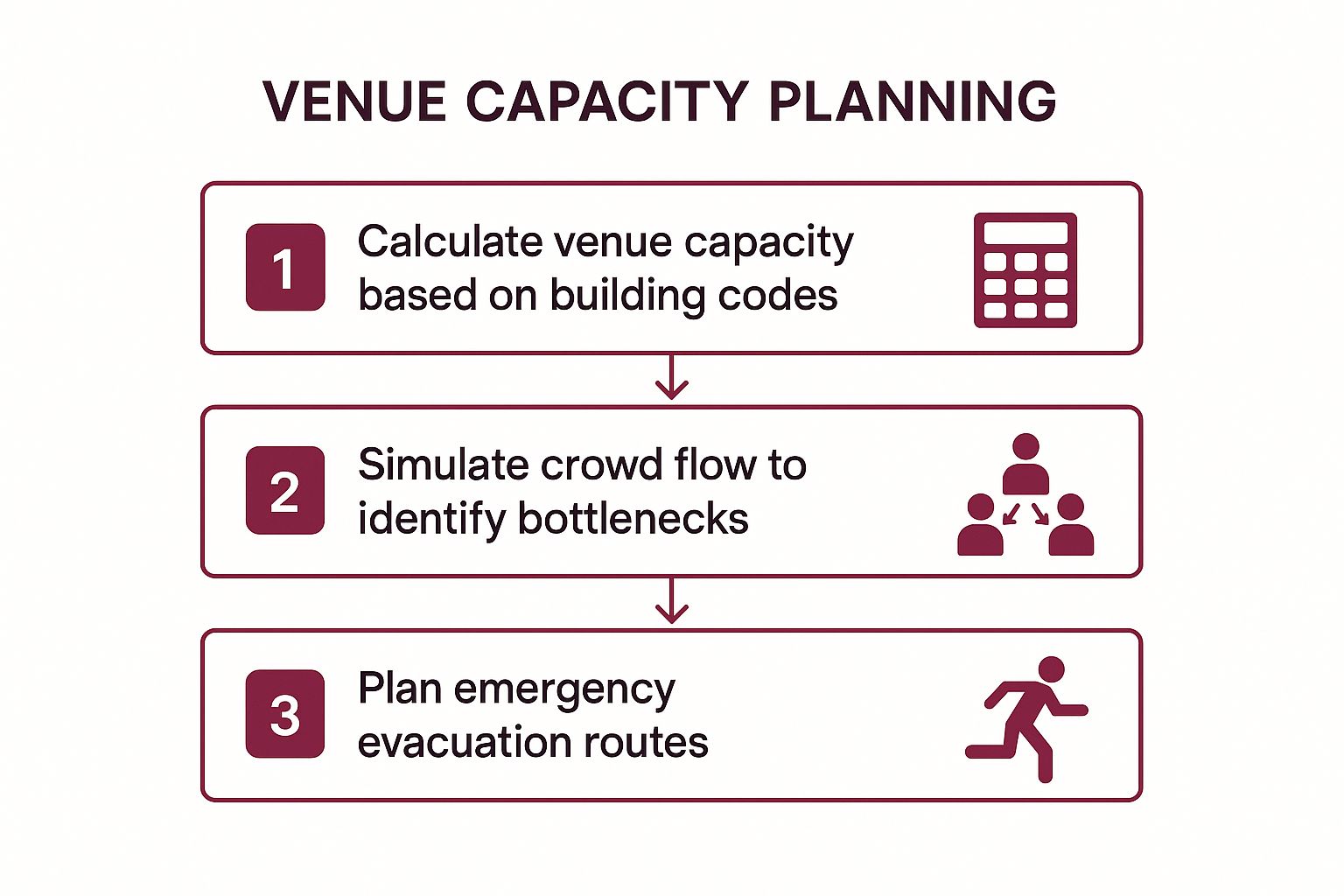
This structured process ensures that your operational capacity is based on safety data, not just guesswork, directly influencing staffing levels and resource placement. For a deeper look into the pre-planning phase, you can review our ultimate festival planning checklist. This proactive thinking is one of the most essential crowd management strategies you can deploy.
2. Dynamic Crowd Monitoring and Real-Time Analytics
While pre-event planning sets the stage, effective crowd management strategies must also be dynamic, adapting to the live, unpredictable nature of a crowd. This is where dynamic crowd monitoring and real-time analytics come into play, moving beyond static plans to a live, data-driven approach. This strategy uses technology like CCTV with AI, sensors, and even aggregated mobile data to provide a real-time view of crowd density, flow, and sentiment.
This level of technological oversight is no longer just for massive global events; it's becoming a crucial tool for ensuring safety at any significant gathering, from a weekend art festival in the Blue Dome District to a holiday market in The Gathering Place. By transforming raw video feeds and data points into actionable intelligence, event managers can spot potential issues like dangerous overcrowding or unusual behavior long before they escalate. Success stories from Disney World's MagicBand system to Singapore's Smart Nation initiatives prove the immense value of this proactive, real-time approach.
How It Works: A Live-Data Framework
Dynamic monitoring provides an operational dashboard for your event, allowing you to see and respond to situations as they unfold. The goal is to move from guessing to knowing, using technology to understand crowd behavior in the moment.
Real-Time Data Collection: High-definition cameras, LiDAR sensors, and Wi-Fi tracking points collect anonymous data on crowd movement and density. This information is processed instantly by AI analytics platforms from companies like Crowd Vision or Axis Communications.
Predictive Alerts: The system isn't just watching; it's analyzing. It can identify patterns that precede problems, such as a sudden surge toward an exit or a rapid increase in density in a small area, and trigger alerts for staff.
Informed Decision-Making: This real-time data allows command center staff to make immediate, informed decisions, such as redirecting foot traffic, opening additional service lines, or dispatching security personnel to a specific location.
The following video from Crowd Vision demonstrates how their analytics platform visualizes crowd data to improve safety and operational efficiency.
This technological layer provides the critical data needed to manage a live environment effectively. By integrating these systems, you ensure your team is responding to actual conditions on the ground, making your crowd management strategies smarter and safer.
3. Strategic Physical Barrier and Queue Management
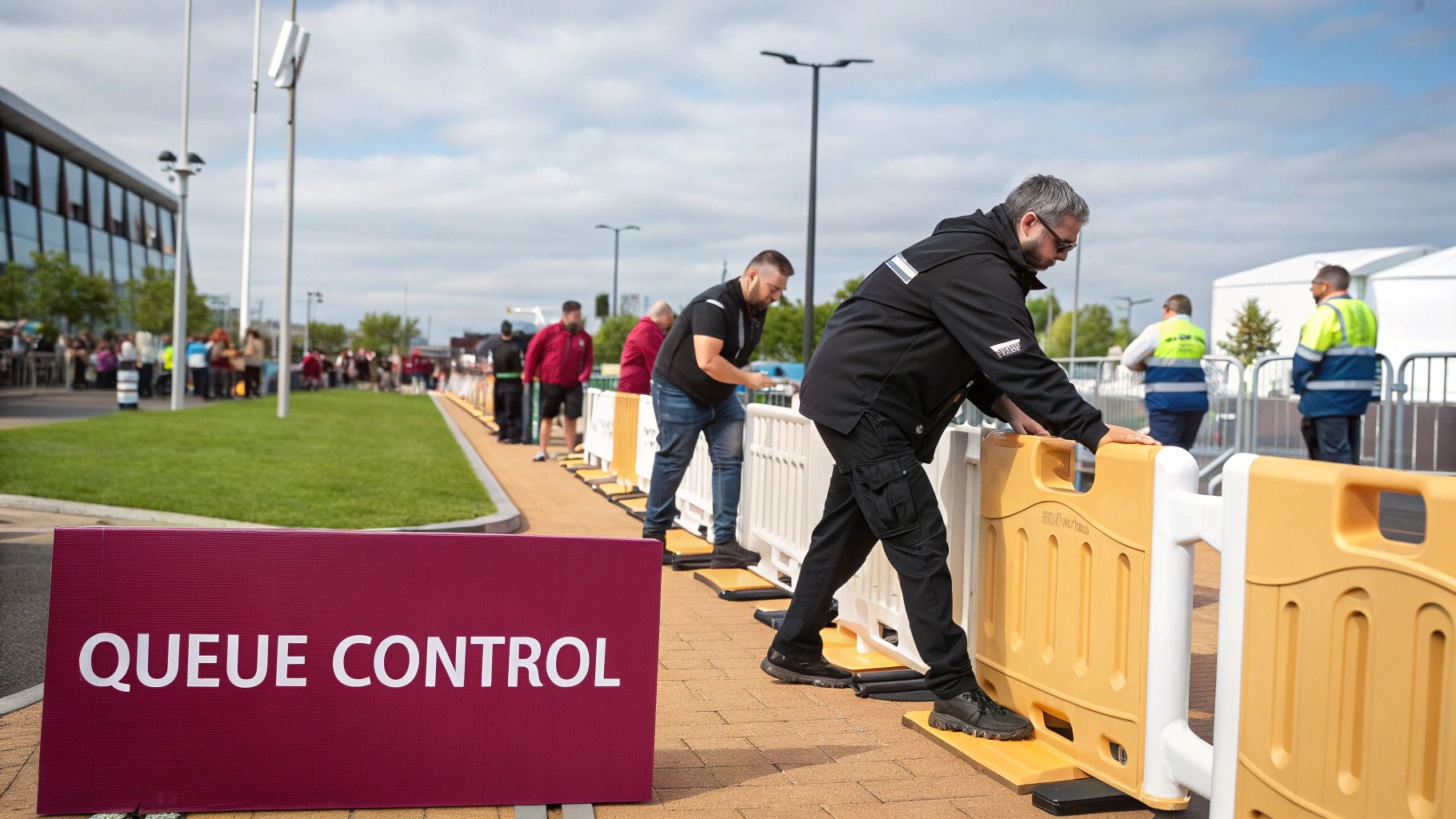
Beyond planning, the physical environment itself is one of the most powerful tools in your arsenal of crowd management strategies. Strategic barrier placement and well-designed queue systems are not about trapping people; they are about guiding them intuitively and safely. This approach involves the deliberate use of physical infrastructure, both temporary and permanent, to direct crowd flow, prevent dangerous density levels, and create an orderly, stress-free experience for attendees.
This principle is visible everywhere, from the meticulously designed queues at Disneyland that make waiting feel like part of the attraction, to the robust Mojo Barriers that create a safe zone for both performers and fans at concerts. For events in The Ten District, like the annual Jenks Herb & Plant Festival, smart use of barriers can turn a potentially chaotic street into an organized, browsable marketplace, enhancing safety and commerce simultaneously.
How It Works: Guiding Flow and Behavior
Effective barrier and queue management is a science that combines engineering with human psychology. The objective is to make the safe path the easiest and most obvious path for attendees to follow, reducing the need for constant verbal instruction from staff.
Queue Design: Systems like the serpentine queue, championed by companies like Tensator, keep lines compact and moving. Curved lines are psychologically more calming and physically more efficient than straight ones with sharp, 90-degree turns which can create friction points.
Barrier Functionality: Barriers serve multiple purposes. Low-level guidance barriers define walkways, while high-strength stage barriers are engineered to withstand immense crowd pressure. The key is using the right tool for the job to manage different levels of crowd energy.
Signage Integration: Barriers are most effective when paired with clear, concise signage. Signs placed at eye level before, during, and at the end of a queue help manage expectations and reduce frustration.
The successful implementation of such infrastructure can be seen in large-scale urban developments. You can explore how improved pedestrian flow and public space management are being integrated into local infrastructure by reviewing the Jenks Main Street Project update. This focus on physical design is a critical component of proactive crowd management.
4. Trained Personnel Deployment and Communication Systems
Sophisticated plans are only as effective as the people who execute them. This is where strategic personnel deployment and robust communication systems come into play. This human-centered approach relies on highly trained staff who act as the eyes, ears, and voice of your event's safety plan. It moves beyond simply having bodies in vests to creating a network of skilled observers who can interpret crowd dynamics, de-escalate potential issues, and guide attendees effectively.
This strategy is vital for dynamic environments in The Ten District, whether it’s managing the flow of attendees at a Bixby food truck festival or ensuring safety at a high-energy concert at the Jenks Amphitheater. Major events like the UEFA European Championships and the London Marathon build their safety frameworks around this principle, using trained stewards and marshals who are well-versed in crowd psychology and emergency procedures. Their presence provides both real-time intelligence and a visible assurance of safety for guests.
How It Works: A Human-Centric Network
Effective personnel deployment involves placing the right people in the right places with the right tools. The goal is to create a responsive and cohesive team that can manage everything from simple directional questions to complex emergency responses.
Behavioral Training: Staff are trained not just in rules and procedures, but in reading crowd behavior. This includes identifying signs of distress, agitation, or dangerously high density, allowing for preemptive action.
Clear Command Structure: A defined hierarchy ensures information flows efficiently. Supervisors are positioned with an overview of multiple zones, enabling them to coordinate responses and redeploy resources as crowd conditions change.
Integrated Communication: Reliable communication is non-negotiable. This often includes a multi-layered system of radios for instant team-wide alerts, supported by standardized hand signals for loud environments where verbal commands are impossible.
This focus on skilled personnel ensures your team can adapt to the fluid nature of live events. Just as you carefully manage your event vendors, investing in your crowd management staff is crucial for operational excellence. For further insights on team coordination, you can explore our guide on vendor management best practices. This investment in human capital is one of the most impactful crowd management strategies available.
5. Controlled Entry and Ticketing Systems
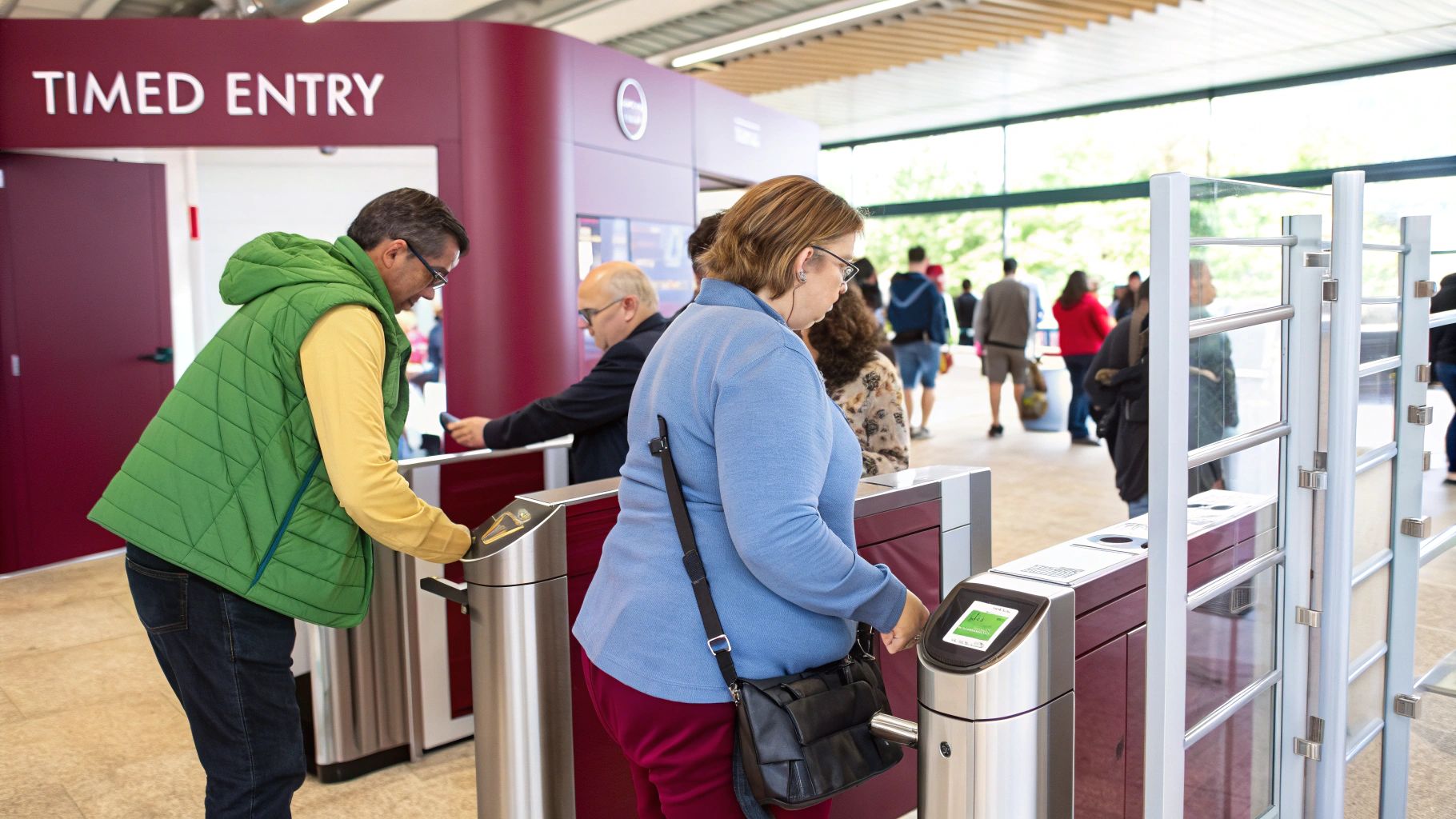
One of the most effective crowd management strategies is controlling who enters your venue and when. A systematic approach to entry management, using tools like advance ticketing and timed entry slots, shifts control from the crowd to the organizer. This method is all about regulating the inflow of guests to prevent dangerous surges at gates and ensure the internal venue population never exceeds its safe operational capacity.
This strategy prevents the chaotic "first come, first served" rush that can lead to crushing at entrances and overwhelming internal facilities. From the timed ticketing at the Anne Frank House in Amsterdam to the reservation system for Yosemite National Park, controlled entry is a proven method for creating a safer and more pleasant visitor experience. For venues in The Ten District, like a special exhibit at the Philbrook Museum of Art or a seasonal event at the Gathering Place, this approach is essential for managing expectations and maintaining safety.
How It Works: Regulating Arrival Flow
Controlled entry transforms arrivals from a potential bottleneck into a predictable, managed process. Instead of a single massive opening time, you create staggered arrival windows, which disperses the entry demand over several hours. This is heavily reliant on clear communication and robust technology popularized by platforms like Eventbrite and Ticketmaster.
Advance and Timed Ticketing: Selling tickets exclusively online for specific time slots allows you to cap the number of arrivals per hour. This smooths out the entry curve and gives staff better control.
Capacity Monitoring: Digital ticketing systems provide real-time data on how many people have entered, allowing you to hold or adjust entry if internal capacity limits are approached.
Clear Communication: Success depends on clearly communicating the entry process to attendees well before the event. Instructions should be included on tickets, websites, and social media.
This proactive regulation of guest arrival is a powerful tool. By implementing these systems, you not only improve safety but also enhance the overall guest experience by minimizing wait times and reducing the stress associated with gaining entry to a popular event.
6. Emergency Response and Evacuation Protocols
While proactive planning aims to prevent incidents, a robust emergency response plan is a non-negotiable component of any event. This strategy involves creating comprehensive systems and procedures for rapidly and safely evacuating crowds during a crisis. It goes beyond simply marking exits; it’s a dynamic plan that accounts for human behavior under stress and ensures seamless coordination with first responders. This is one of the most critical crowd management strategies for protecting lives when the unexpected occurs.
Developed and standardized by organizations like the National Fire Protection Association (NFPA) and FEMA, these protocols are essential for any venue in The Ten District. Whether it's a medical emergency at a packed Jenks High School football game or an unexpected severe weather alert during an outdoor festival, a well-rehearsed plan can prevent panic and ensure a controlled, orderly evacuation. Lessons learned from tragedies like the Manchester Arena bombing and the Las Vegas shooting underscore the absolute necessity of having detailed, actionable emergency procedures.
How It Works: A System for Safe Evacuation
An effective emergency protocol is a pre-scripted, drilled system that activates the moment a crisis is confirmed. The primary goal is to move people away from a threat efficiently while minimizing confusion and secondary risks.
Pre-Planned Routes: This includes identifying primary, secondary, and tertiary evacuation paths that are always kept clear of obstructions. These routes must be well-lit and clearly marked with universally understood signage.
Multi-Channel Communication: In an emergency, relying on a single communication method is a critical failure point. A strong plan uses multiple systems simultaneously, such as PA announcements, digital screen displays, and staff with megaphones, to deliver clear, calm, and consistent instructions.
Agency Coordination: Your plan must be integrated with local emergency services. This involves establishing a clear chain of command and pre-determined staging areas for police, fire, and medical teams, ensuring they can operate effectively upon arrival. The heroic efforts of our local first responders show how vital this coordination is. Read about how Jenks heroes saved a passenger from a fiery van to see this coordination in action.
Training is what turns a plan on paper into an effective response. All staff, from security to vendors, must be drilled on their specific roles during different emergency scenarios, empowering them to guide the public with confidence and authority.
7. Behavioral Psychology and Crowd Influence Techniques
One of the most sophisticated crowd management strategies involves shaping behavior without issuing a single command. This approach leverages principles from behavioral psychology and economics, pioneered by figures like Dr. Robert Cialdini and Dr. Richard Thaler, to "nudge" people towards safer, more orderly actions. Instead of relying on overt control, it uses subtle environmental and social cues to influence choices positively.
This method is incredibly effective because it works with, not against, human nature. It’s about making the desired behavior the easiest and most natural option. For an event like the Tulsa Tough cycling race in the Blue Dome District, this could mean designing queueing systems that feel intuitive or using signage that frames safety precautions as a collective, community effort. This is crowd management at its most intelligent, fostering cooperation by design.
How It Works: A Framework for Nudging
Implementing behavioral psychology is about subtly engineering the environment to guide crowd actions. The goal is to make compliance feel like a personal choice rather than a rule being enforced. This is achieved by understanding and applying key psychological triggers.
Environmental Design: The physical layout of a space can have a profound impact on behavior. A famous example is the fly etched into urinals at Amsterdam's Schiphol Airport, which dramatically improved cleanliness by giving people a target. Similarly, using calming colors in potentially high-stress areas like entry security can reduce anxiety.
Social Proof: Humans are social creatures who often look to others to determine how to act. You can use this by displaying messages like, "95% of attendees use the designated walkways." This creates a powerful norm that encourages others to follow suit, a technique used by the UK's Behavioural Insights Team to increase tax compliance.
Behavioral Nudges: These are small interventions that guide choices. For instance, theme parks use in-queue entertainment and distance markers to reduce the perceived wait time, minimizing frustration. At a local Jenks event, this could be as simple as painting footsteps on the ground leading to hand sanitizing stations.
These psychological techniques are powerful crowd management strategies because they are often low-cost and high-impact, promoting a sense of shared responsibility and improving the overall guest experience. By understanding how people think and react, you can build a safer, more harmonious event from the ground up.
8. Multi-Zone Management and Crowd Distribution
One of the most effective crowd management strategies for large-scale events or venues is to stop thinking of the crowd as a single entity. Multi-zone management is the practice of dividing a large event space into smaller, distinct, and independently managed zones. This approach fundamentally changes crowd dynamics by decentralizing density and preventing the dangerous buildup of pressure in any single area. It's a key principle used by global event producers like Live Nation and AEG Live to manage massive festivals.
This strategy is particularly relevant for sprawling events in The Ten District, such as a multi-stage music festival at the Riverwalk or a large-scale art fair spanning several blocks in the Blue Dome District. By creating separate zones, each with its own capacity, attractions, and amenities, you encourage a more even distribution of attendees. This proactive method prevents dangerous bottlenecks and allows for more targeted monitoring and response, enhancing both safety and the overall guest experience.
How It Works: A Divide and Conquer Approach
Multi-zone management transforms a vast, potentially chaotic space into a network of smaller, more controllable environments. The goal is to give attendees reasons to spread out, thereby reducing the risk of a single point of failure.
Strategic Segmentation: Divide the venue based on logical boundaries like different stages, themed areas, or existing architecture. For example, a food festival might have a "culinary demo" zone, a "food truck alley," and a "beer garden," each managed separately.
Decentralized Resources: Each zone should have its own dedicated resources, including security staff, first aid stations, restrooms, and concessions. This reduces cross-venue traffic for basic needs and ensures faster response times.
Capacity Monitoring: Each zone has its own capacity limit, which is monitored in real-time. If one zone, like the area around a main stage, reaches capacity, staff can temporarily restrict entry and guide people toward less crowded zones with other attractions.
This structured approach is a core component of the UK's renowned "Purple Guide" for event safety. By implementing these crowd management strategies, you create a more resilient event layout that can absorb fluctuations in crowd movement without compromising safety.
9. Technology-Enhanced Communication and Information Systems
In an increasingly connected world, leveraging technology for communication is one of the most powerful crowd management strategies available. This approach moves beyond simple PA announcements, using digital platforms to deliver real-time, personalized information directly to attendees. By empowering the crowd with knowledge, you enable them to make smarter decisions, which helps distribute density, reduce frustration, and enhance overall safety.
This strategy is particularly effective for multi-stage festivals or large, sprawling venues like the Oklahoma Aquarium or the Riverwalk in Jenks, where conditions can change rapidly. The core principle is transparency: informed attendees are calmer and more cooperative. Global leaders in experience management, like Disney Parks and Transport for London, have demonstrated that providing live data on wait times, route changes, and capacity levels directly to guests' phones can dramatically improve flow and satisfaction.
How It Works: A Digital Framework
Technology-enhanced communication integrates various digital tools into a cohesive information ecosystem. The objective is to push timely, relevant updates to attendees through the channels they already use, turning their personal devices into crowd management assets.
Dedicated Event Apps: A centralized mobile app can provide maps, schedules, push notifications for emergency alerts, and real-time wait times for attractions, food vendors, or restrooms.
Digital Signage and Displays: Strategically placed screens can display dynamic information, such as directing people to less crowded exits or updating them on weather changes. This visual reinforcement is crucial for capturing attention.
Mass Notification Systems: In case of an emergency or a necessary schedule change, systems that send mass SMS texts or push alerts are invaluable. They ensure critical information reaches the widest possible audience instantly.
These systems work together to create a feedback loop where event organizers can guide crowd behavior proactively. For more localized information, you can explore options like the official alert system for the City of Jenks. Adopting these digital communication tools is a key component of modern, effective crowd management.
Crowd Management Strategies Comparison
Strategy / Aspect | Implementation Complexity 🔄 | Resource Requirements ⚡ | Expected Outcomes 📊 | Ideal Use Cases 💡 | Key Advantages ⭐ |
|---|---|---|---|---|---|
Pre-Event Risk Assessment and Planning | High - requires specialized expertise and time | High - skilled personnel, software, and coordination | Proactive incident prevention, optimized resource use | Large-scale events needing detailed risk management | Prevents incidents; ensures compliance; improves planning |
Dynamic Crowd Monitoring and Real-Time Analytics | High - advanced tech setup and operation | High - sensors, AI systems, reliable connectivity | Immediate response, objective data-driven decisions | Events requiring continuous crowd behavior monitoring | Real-time alerts; predictive insights; reduces human error |
Strategic Physical Barrier and Queue Management | Moderate - physical setup and maintenance | Moderate - barriers, signage, storage | Controlled crowd flow, reduced staff load | Venues needing visible, straightforward crowd control | Low cost; quick adjustment; clear crowd guidance |
Trained Personnel Deployment and Communication Systems | Moderate to High - intensive training and staffing | High - trained personnel, communication equipment | Flexible crowd management, immediate on-site decisions | All event sizes requiring human judgment and interaction | Human adaptability; relationship building; quick response |
Controlled Entry and Ticketing Systems | Moderate - tech infrastructure and staff training | Moderate to High - ticketing systems, entry hardware | Prevents overcrowding, predictable attendance | Events with ticketed admission and capacity limits | Controls entry flow; improves experience; revenue predictability |
Emergency Response and Evacuation Protocols | High - detailed planning and multi-agency training | High - training, drills, communication systems | Saves lives, reduces panic, regulatory compliance | All venues with emergency safety requirements | Life-saving; clear communication; boosts confidence |
Behavioral Psychology and Crowd Influence Techniques | Low to Moderate - design and messaging integration | Low - mostly design and signage costs | Subconscious behavior influence, improved attendee mood | Events focusing on crowd cooperation without restrictions | Non-restrictive; cost-effective; culturally adaptable |
Multi-Zone Management and Crowd Distribution | Moderate to High - zoning, coordination complexity | Moderate to High - staffing, barriers, signage | Even crowd distribution, targeted management | Large, multi-activity events or venues | Prevents crowding; easier emergency response; tailored management |
Technology-Enhanced Communication and Information Systems | Moderate to High - app and signage development | Moderate to High - apps, digital signage, connectivity | Informed crowds, reduced anxiety, improved flow | Events leveraging mobile tech and digital communication | Empowers attendees; rapid updates; data collection |
Fostering a Safer, Smarter Future for Events in The Ten District
As we've explored, the art and science of crowd management are far more than just setting up barriers and hiring security. True mastery lies in a proactive, integrated, and human-centric approach. From the meticulous groundwork of Pre-Event Risk Assessment to the sophisticated application of Behavioral Psychology, each strategy we've discussed is a vital thread in the fabric of a safe and successful event. The days of reactive crowd control are over; the future is about proactive crowd collaboration.
The core takeaway is this: effective crowd management is not a single action but a continuous cycle. It begins long before the first guest arrives and extends well after the last one departs. It’s a dynamic process that demands constant learning, adaptation, and a deep understanding of human behavior. Merely implementing one or two of these strategies in isolation is insufficient. The real power emerges when they are woven together into a cohesive, comprehensive safety ecosystem.
Synthesizing the Strategies for Maximum Impact
Think of these nine pillars not as a checklist to be completed, but as a framework for building a robust safety culture. The most effective event organizers in The Ten District will see the powerful connections between these elements.
Technology as an Enabler: Dynamic Crowd Monitoring and Technology-Enhanced Communication Systems are not standalone solutions. They are the nervous system that empowers your on-the-ground teams, feeding real-time data into your Trained Personnel Deployment and allowing for swift adjustments to your Multi-Zone Management plan.
Planning Meets Reality: Your initial Risk Assessment and Planning is your blueprint. However, it must be flexible enough to adapt based on live feedback. This is where Controlled Entry Systems provide crucial data on ingress flow, helping you prevent bottlenecks before they form, a practical application of your initial planning.
The Human Element: Ultimately, crowds are composed of people. Behavioral Psychology techniques are most effective when supported by clear communication and well-designed physical environments. Strategic use of Physical Barriers and Queue Management can subconsciously guide attendees, reducing stress and creating a more pleasant experience that complements your communication efforts.
Your Actionable Path Forward
Moving from theory to practice is the most critical step. As an event planner, business owner, or community organizer in The Ten District, your journey toward mastering crowd management starts now. Don't feel overwhelmed by the breadth of these strategies; instead, focus on incremental, impactful improvements.
Conduct a Post-Event Audit: After your next event, gather your team and review what worked and what didn't. Did you experience unexpected congestion? Were there communication gaps? Use the strategies in this article as a lens to analyze your performance and identify one or two key areas for improvement.
Invest in Training: Your staff are your most valuable asset. Invest in training that goes beyond basic security procedures. Focus on communication, de-escalation, and understanding crowd dynamics. A well-trained team can be the difference between a minor issue and a major incident.
Embrace a Pilot Program: You don't need to implement a full suite of analytics or a complex multi-zone system overnight. Start small. Test a new queuing technique at one entrance or pilot a new communication app with a specific team. Measure the results, gather feedback, and scale what works.
By embracing these advanced crowd management strategies, you are not just ticking a box for safety; you are actively enhancing the attendee experience. You are building a reputation for professionalism, safety, and operational excellence that will attract more visitors and larger events to our vibrant community. This commitment transforms our public spaces from simple venues into thriving, secure, and unforgettable destinations.
Ready to experience brilliantly managed events firsthand? Explore the upcoming calendar at The Ten District, where cutting-edge planning and a commitment to safety create unforgettable experiences for everyone. Discover your next adventure at The Ten District.


Comments