

Public Relations Basics for Local Businesses & Organizers
A customer can walk past a Ten District storefront, glance at the window, and keep going, even when the products are excellent. A restaurant can serve a memorable meal while nearby residents remain unaware that it exists. An event organizer can plan a useful gathering, then struggle to fill the seats because the announcement never reaches the right people.
That gap between doing good work and being understood by the community is where public relations begins. For a local business or organizer, PR isn't a corporate press office. It's the practical work of building trust, sharing useful stories, listening to residents, and helping the right people notice what's happening in the ten-block downtown district.
What Public Relations Actually Means for a Local Business
Jenks boutique owner Jenks has a simple problem. Her shop carries distinctive gifts, clothing, and locally made goods, but the parking lot still looks quiet. She could buy an advertisement, yet she also needs to understand why people aren't stopping. Do they know the store is open? Are visitors looking for a certain product? Does the neighborhood see the business as part of the district, or merely another storefront?
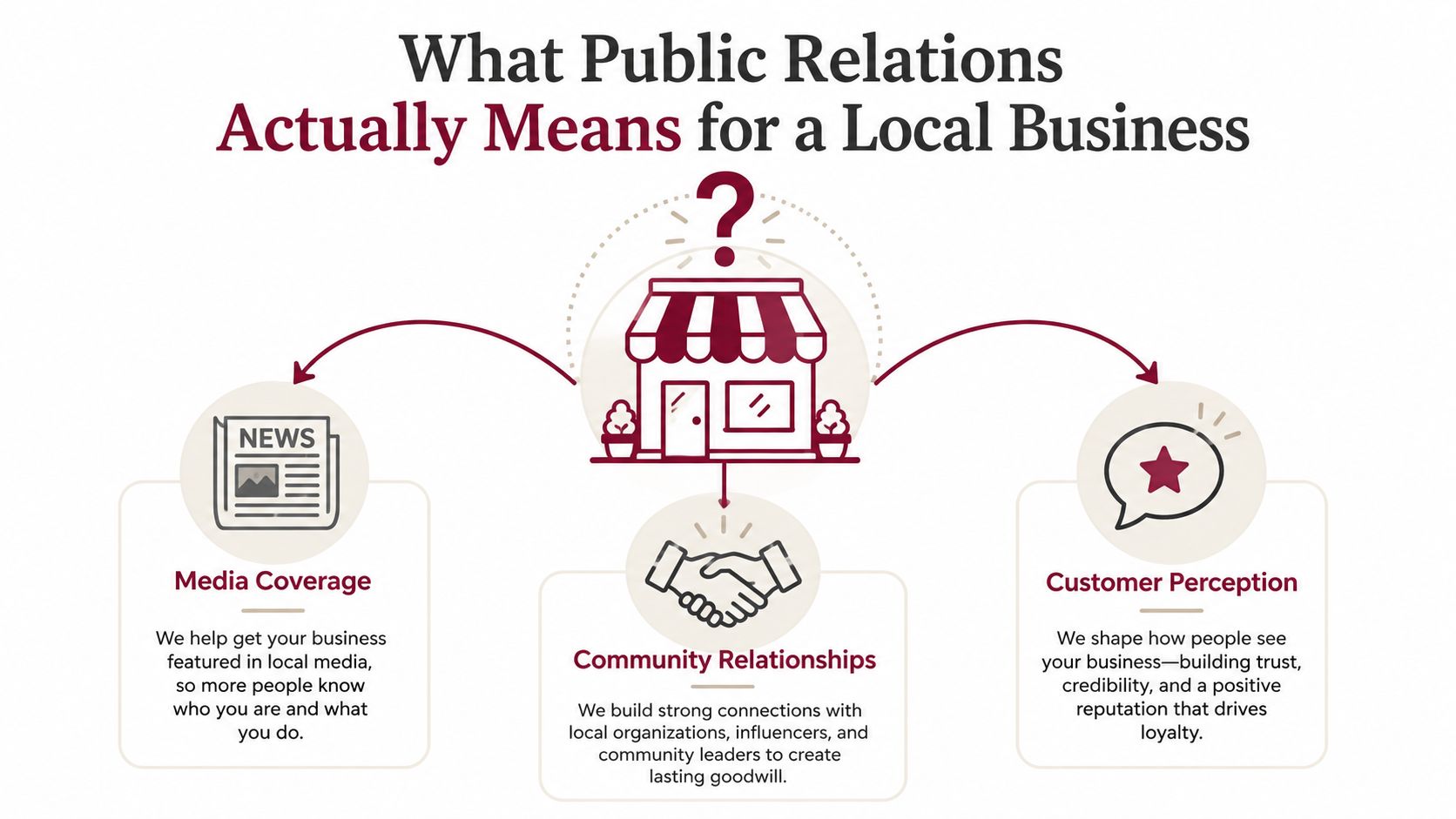
Public relations is the relationship-building work that helps an organization earn attention and shape trust through communication. The relationship runs in both directions. A business shares its story, but it also listens to questions, concerns, and suggestions from customers, neighbors, journalists, and partners.
Edward L. Bernays's 1923 book Crystallizing Public Opinion is a foundational milestone in PR history. The Museum of Public Relations describes the book as introducing a “two-way-street” relationship between an organization and the public, a concept that treats communication as a feedback loop rather than one-way promotion. This overview of PR history and market development places that idea in a longer professional context.
PR and advertising solve different problems
Advertising lets you pay for a controlled message and a selected placement. PR helps other people find a reason to talk about, recommend, attend, or trust your organization. A TulsaPeople feature, a story in the Jenks Trojan Torch, a neighborhood newsletter mention, or a customer's recommendation can introduce a business through a community voice rather than a paid sales message.
For Jenks, a useful PR question isn't only, “How do I get more customers?” It's also, “What does this district need, and how does my business contribute?” A seasonal workshop with a nearby gallery, a local maker showcase, or a donation drive with a restaurant partner gives people a reason to care beyond a product discount.
Practical rule: Start with a story that helps the community understand your value. Promotion becomes more credible when it follows a genuine contribution.
A clear brand story can help you explain that contribution consistently. The Ten District's brand storytelling resource can help a local owner turn history, place, people, and purpose into a message others can remember. If criticism or a serious mistake threatens trust, a resource on how to handle a reputation crisis can help you think through acknowledgment, response, and recovery.
Why PR Has a History Worth Knowing
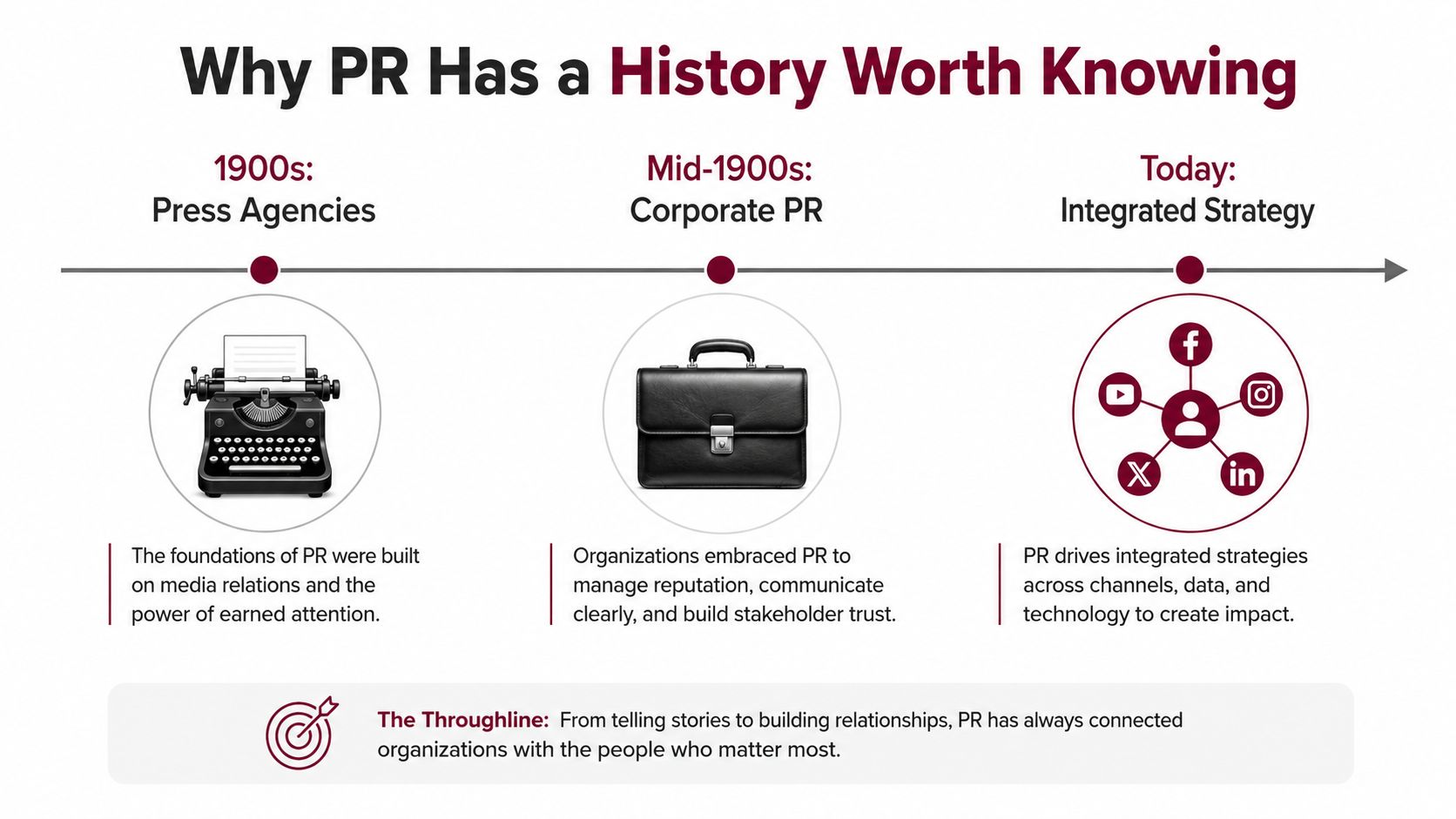
Public relations existed long before social platforms, email newsletters, and online reviews. Krupp created a news bureau in Germany in 1893, Marconi sent its first news release in the United Kingdom in 1910, and the International Public Relations Association was founded in 1955. These milestones appear in the historical timeline cited by Business Research Insights, which describes PR's development from press distribution into an organized professional discipline.
That history matters because it corrects a common misunderstanding. PR isn't just posting more often or trying to make a business go viral. It brings together media relations, reputation management, stakeholder engagement, and coordinated communication. Social media is one channel within that wider practice.
The local version of a long-standing discipline
A Jenks coffee shop uses the same basic logic as a much larger organization, even though the scale is different. The owner identifies a relevant story, prepares accurate information, contacts appropriate media, responds to questions, and maintains relationships after the story appears.
For a Ten District business, the audience may include residents, families, visitors from Tulsa, Bixby, Sapulpa, and Broken Arrow, nearby merchants, city stakeholders, and community groups. Each audience has different interests. A new menu may interest food writers, while a public art project may interest local reporters, families, and neighborhood organizations.
The professional history also explains why repeatable practices matter. A press release should contain useful facts. A media pitch should respect a journalist's subject area. A crisis response should be coordinated rather than improvised. A community announcement should tell people what's happening, why it matters, and how they can participate.
This foundation makes PR more approachable. You don't need a national campaign to practice sound public relations. You need a clear message, a real community connection, reliable information, and the discipline to follow up thoughtfully.
Five Core PR Tactics You Can Use This Month
Local PR works best as a connected system. One story can become a press release, a personal media pitch, a district social post, an event announcement, and a conversation with a partner. The tactics below reinforce one another, so choose the starting point that matches your available time and the news you have.
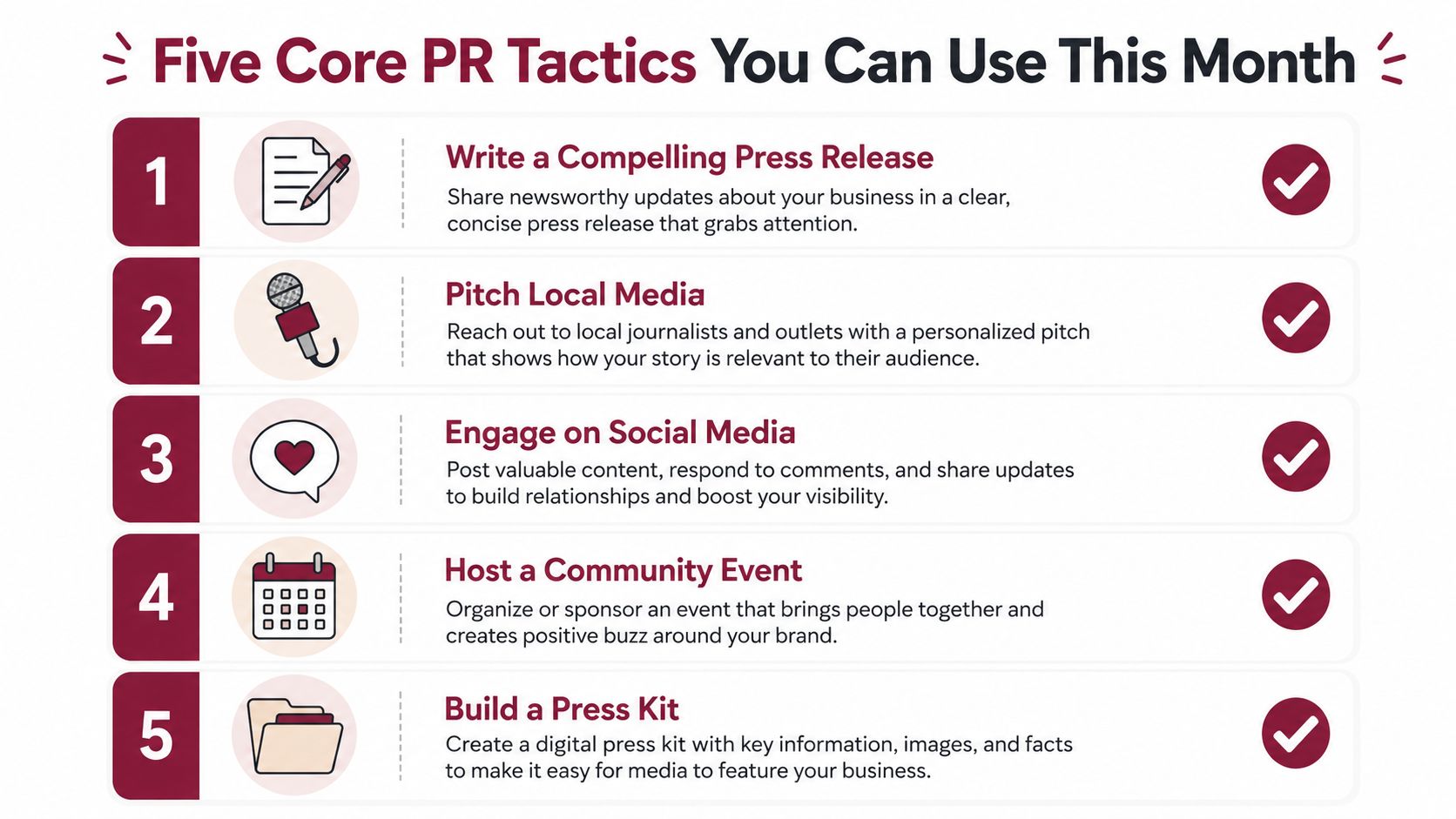
1. Write a useful press release
A press release should announce something with public interest, not repeat a sales slogan. A new restaurant opening, a significant anniversary, a pop-up market, a charitable collaboration, or a public program can provide a legitimate news angle.
Include the essential details near the top:
News point: State what is happening and why it matters.
Local relevance: Explain the connection to Jenks or The Ten District.
Practical details: Add dates, location, hours, registration information, and contact details.
Human voice: Provide a concise comment from the owner, organizer, or partner.
2. Pitch local media with care
Build relationships with the TulsaPeople editorial team, the Jenks Trojan Torch, neighborhood newsletters, and local bloggers before you need coverage. Read what each outlet publishes, identify the appropriate contact, and personalize your message.
A pitch might explain why a Ten District outdoor market gives families a useful weekend activity, or why a local retailer's maker collaboration reflects the district's character. Avoid sending the same announcement to every contact. These event promotion strategies can help organizers shape a timely story instead of distributing a generic notice.
3. Extend the story through social channels
Owned social channels give you control, while district accounts and partner accounts can add trusted local context. Share the announcement, introduce the people involved, show preparation, answer questions, and remind followers of practical details.
A press release can also become several short posts, but review every draft for accuracy and tone. If you want help turning a release into social content, explore automated social posts from press releases as a workflow option, then edit the output so it sounds like your business.
4. Host a community event
Events create a physical reason for people to visit and a visual reason for media to pay attention. A boutique might host a styling workshop, a gallery might lead a local art walk, or several restaurants might coordinate a district tasting experience.
Make the event easy to understand. Give it a clear purpose, a named host, a simple schedule, and a way for attendees to participate or share feedback.
5. Build partnerships and a small press kit
A partner can add credibility, reach, resources, or a new audience. Retailers, galleries, restaurants, entertainment venues, and community organizations can combine their strengths without pretending to be the same kind of business.
Keep a simple press kit in a shared folder. Include a short business description, approved photographs, a logo, contact information, event details, and brief background notes. That preparation helps a journalist, event partner, or district organizer move quickly when an opportunity appears.
Your 30-Day Starter Action Plan
A solo owner or volunteer organizer can begin with a small, repeatable routine. Reserve a focused block of time each week rather than waiting for a quiet month that may never arrive. The local marketing guidance for small businesses can complement this PR routine with broader promotional work.
Week one, choose the message
Write one sentence that explains what you want people to understand. “We sell gifts” is too broad. “We connect visitors with Oklahoma-made gifts in a welcoming downtown shop” gives your communication a clearer direction.
Then choose one primary audience. You might focus on nearby families, weekend visitors, local food enthusiasts, or people planning a district event. List the questions that audience may ask, and use those questions to refine your message.
Week two, map relationships
Create a short list of relevant media contacts, neighborhood newsletters, community organizations, and complementary businesses across The Ten District's ten blocks. For each contact, record the subject they cover, the best way to reach them, and one reason your work might be relevant to their audience.
Use this week to introduce yourself without demanding coverage. Follow an outlet's work, share a relevant story, or send a brief note of appreciation that shows you understand its local focus.
Week three, publish one story
Choose one real announcement. Draft a press release or event notice, prepare a small set of photographs, and send a personalized pitch to the most relevant contacts. Publish the same core facts on your website or social channel so interested people have a reliable place to learn more.
Don't overload the message with every detail about your organization. One strong story is easier for people to understand and easier for partners to repeat.
Week four, review and adjust
Record who responded, where the story appeared, what questions people asked, and whether you noticed changes in visits, inquiries, registrations, or email signups. Keep the notes in a simple spreadsheet.
At the end of the month, decide what to repeat, what to revise, and what to stop. PR becomes manageable when each month produces a small lesson instead of a demand for a perfect campaign.
Measuring What Matters Without Drowning in Numbers
A Ten District outdoor market gives an organizer a useful measurement challenge. The team wants attendance, but attendance alone won't explain which communication helped people decide to come or whether the event supported participating businesses.
Start with a baseline and benchmark. Compare current performance with your own prior data and with selected peers or comparable local activities. The PR measurement guidance from REQ's benchmarking framework recommends separating activity from impact by tracking outputs such as media mentions, releases distributed, interviews, website traffic spikes, and social engagement.
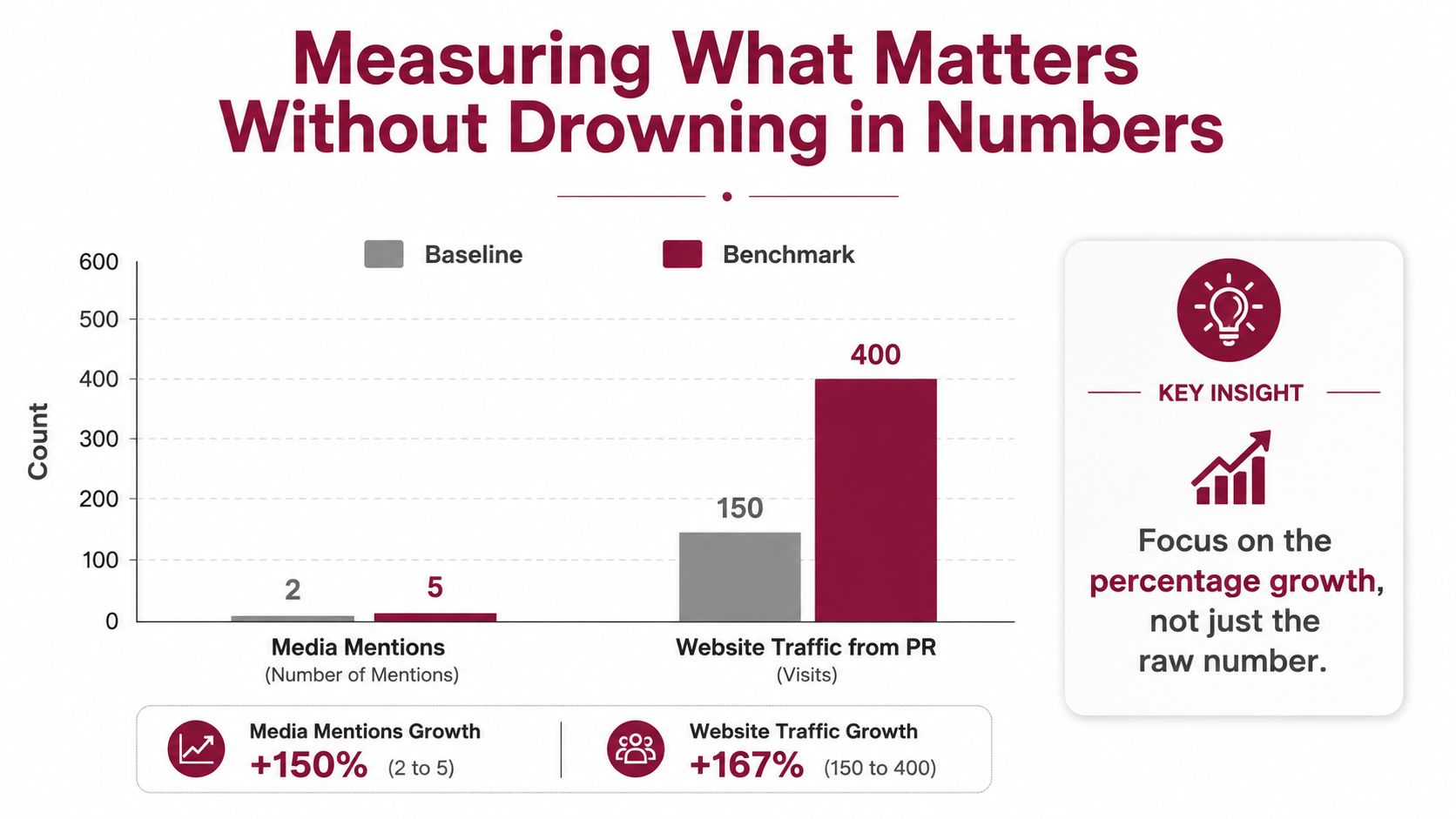
The market story before and after
Before the market, the organizer records the usual website traffic pattern, event registrations, email list activity, and participating businesses. During promotion, the team logs media mentions, partner shares, direct inquiries, and registrations by source when possible.
Afterward, the team asks attendees how they heard about the market. A short response option such as “friend,” “social media,” “local news,” “district website,” or “partner business” gives more useful information than a vague impression of reach.
The organizer then compares:
Activity measures | Business and community outcomes |
|---|---|
Releases distributed | Event registrations |
Media mentions | Foot traffic reported by participating businesses |
Social shares and comments | Email signups |
Interviews completed | Repeat attendance or future inquiries |
Website visits from coverage | Partner participation in the next event |
A single popular post may create attention without creating visits, signups, or sales. Conversely, a modest local story may reach people who are highly relevant to the district. Track both sides so you can see whether communication created activity and whether that activity supported a meaningful result.
A simple weekly review can take place in one shared sheet. Record the date, communication, outlet or partner, response, and observed outcome. Over time, those notes become a practical record of what works for your audience.
PR Is Not Advertising and Other Misconceptions
The phrase “free advertising” makes PR sound simpler than it is. Advertising buys placement and gives the advertiser control over the message, timing, and audience selection. PR seeks attention and trust through relationships, relevance, and public interest, so the organization cannot guarantee that a journalist will publish a story or that readers will respond as hoped.
A TulsaPeople feature, a Jenks Trojan Torch story, or a word-of-mouth recommendation is earned media. A sponsored social post or billboard is paid media. A newsletter, website article, or Instagram account is owned media.
Three channels, three jobs
Earned media: Another person or outlet chooses to discuss your organization. It can provide third-party credibility, but you don't control the final editorial treatment.
Paid media: You pay for distribution and can control the message and placement more closely. It works well when you need predictable exposure for a specific offer or deadline.
Owned media: You publish through channels you control. It gives you a dependable home for details, updates, and follow-up content.
These channels work better together than in competition. A local story can send interested readers to your website. Your owned channel can provide the event schedule. A paid reminder can reach people who saw the story but haven't acted.
A small PR budget still benefits from a clear story, accurate information, and thoughtful outreach. Pay for advertising when you need guaranteed placement. Use PR when your strongest asset is a meaningful local development, a useful community contribution, or a relationship that deserves attention.
Proving PR Value When Nobody Else Speaks the Language
Owners, accountants, sponsors, and city stakeholders rarely want a list of posts without a connection to business or community results. They want to know whether communication supported revenue, attendance, participation, reputation, or another agreed objective.
That translation remains difficult across the profession. A 2025 communications report found that 44% of communicators struggle to align PR metrics with revenue or other business KPIs, and it identified measurement as the second-biggest challenge after being too reactive. Cision's report on PR measurement challenges provides that finding.
Use lightweight attribution
Small organizations don't need a complex analytics department to make PR more credible. They need consistent questions and labels.
Ask new customers: Add “How did you hear about us?” to checkout conversations, registration forms, or email signup forms.
Tag campaign links: Use a distinct landing page or campaign label for an event, partnership, or media announcement.
Compare periods carefully: Review changes in inquiries, foot traffic, registrations, sales, or signups against your own earlier baseline.
Record context: Note weather, holidays, competing events, construction, and other conditions that may affect results.
Attribution won't prove that one article caused every purchase. It can show patterns and help you avoid unsupported conclusions. A report might say, “The event announcement generated media mentions, partner referrals, and registrations reported through the campaign form,” rather than claiming that every attendee came from PR.
That level of honesty builds trust with decision-makers. It also improves your next campaign because the team learns which messages and relationships produce meaningful responses.
Putting It All Together for The Ten District
Public relations basics become practical when you reduce them to a working checklist:
Define the relationship: Decide which community you serve and what you want people to understand.
Choose one story: Focus on a local event, collaboration, contribution, opening, or useful development.
Select the right channel: Pitch relevant media, use owned channels, involve partners, and add paid promotion when predictable reach matters.
Prepare for questions: Keep accurate details, contact information, photographs, and a coordinated response ready.
Measure outcomes: Track activity, then connect it with visits, registrations, inquiries, signups, participation, or another business KPI.
Repeat with learning: Keep the parts that helped and revise the parts that didn't.
Questions local organizers often ask
How quickly should a business respond during a crisis? Timing affects reputational outcomes. Research on crisis disclosure timing indicates that when an organization discloses a crisis can change the effectiveness of its response strategy, so teams should prioritize rapid acknowledgment, message control, and coordinated disclosure planning. This research summary on crisis disclosure timing offers background for building a response process before a problem occurs.
How often should I send a press release? Send one when you have a legitimate, relevant announcement. A smaller number of well-targeted releases is more useful than a steady stream of routine promotions that gives journalists no clear reason to respond.
Can a small business compete with attention from Tulsa or Broken Arrow? It can compete by being specific. A district event, local partnership, Oklahoma-made product, neighborhood improvement, or human story gives regional audiences a reason to pay attention. Relevance often matters more than trying to sound like a larger organization.
Choose one story this week, identify one partner who can strengthen it, and select one outcome to track. The Ten District's community involvement programs can help you identify ways to connect business activity with the wider life of the district.
The Ten District offers a setting where independent shops, restaurants, galleries, venues, and organizers can turn local relationships into practical PR opportunities. Visit The Ten District to find district businesses, community activities, and upcoming ways to participate, then choose one collaboration or event to share with your audience this week.


Comments