

The Jenks Fire Explained A Community Crisis
This wasn't your typical wildfire. The Jenks fire was a massive, deep-burning mulch fire that quickly grew into a major emergency. It smoldered intensely inside a 30-foot-high pile of organic material, a unique situation that completely overwhelmed normal firefighting methods and pushed the City of Jenks to declare a state of emergency.
Understanding the Jenks Fire Emergency
Back in March 2025, Jenks, Oklahoma, was up against a challenge unlike any other. The emergency started with a huge mulch fire at Gem Dirt, a local soil supplier right near West 101st Street and Highway 75. This wasn't a fast-moving grass fire that could be contained quickly; it was a stubborn, deep-seated blaze that ended up burning for over a week and required a multi-state response to finally put out.
Things escalated to the point where the city had to declare a local state of emergency. At first, the Jenks Fire Department thought about letting the fire burn itself out—which is often the go-to strategy for these kinds of incidents. But it didn't take long to realize this fire was different.
Officials quickly changed tactics, bringing in specialized crews and technology from as far away as Florida and Louisiana to help local responders. News on 6 provided ongoing reports that captured the full scale of the challenges crews were facing.
The Scale of the Problem
So, what made this event so tough to handle? Imagine a charcoal briquette, but the size of a building. That’s essentially what firefighters were up against.
Instead of burning with big, open flames, the fire was smoldering deep inside the massive mulch pile. This internal combustion generated incredible heat and thick, unending smoke that created a whole new set of problems for the community.
Here's a quick look at the key details of the event.
Jenks Fire At a Glance
Key Detail | Description |
|---|---|
Location | Gem Dirt, near West 101st Street and Highway 75 in Jenks, OK |
Start Date | March 2025 |
Duration | Burned for over a week |
Fire Type | Deep-seated mulch fire in a 30-foot-high pile |
Initial Response | Jenks Fire Department |
Escalation | City of Jenks declared a state of emergency |
Expanded Response | Specialized crews from Florida and Louisiana were called in |
Primary Challenge | Ineffectiveness of traditional surface-level water application |
This summary really highlights how unusual and difficult the situation was for everyone involved.
The core issue was just how deep the fire was burning. Water sprayed on the surface would often just evaporate before it could ever reach the heart of the blaze. It made traditional firefighting techniques almost useless against such a large, insulated heat source.
This challenging situation brought a new kind of environmental risk to the forefront for our growing suburban area. For residents, the fire was much more than just a story on the local news; it became a direct threat to air quality and daily life. You can learn more about what makes our town special in our guide to life in Jenks, Oklahoma.
Tracing the Fire and the Official Response
It all started with the first calls reporting a fire at the Gem Dirt facility. When the Jenks Fire Department rolled up, they weren't met with the roaring flames of a typical building fire. This was something different, something trickier. They were facing a deep-seated thermal event, a fire smoldering inside a massive, 30-foot-high pile of mulch.
Faced with this unusual blaze, the initial call was a tough one. The crew believed the fire was buried too deep for surface water to do any good, so the first strategy was to let it burn itself out. This is actually a standard playbook move for some industrial fires where just containing the problem is more practical than trying to extinguish it right away.
That plan didn't last long. As the days dragged on, the sheer volume of smoke choking the community became unbearable. The "let it burn" strategy was officially off the table, and it was time to get aggressive. This pivot marked a major turning point in the crisis.
The infographic below offers a glimpse into the history of the Jenks Fire Department, showing just how far it's come over the last century.
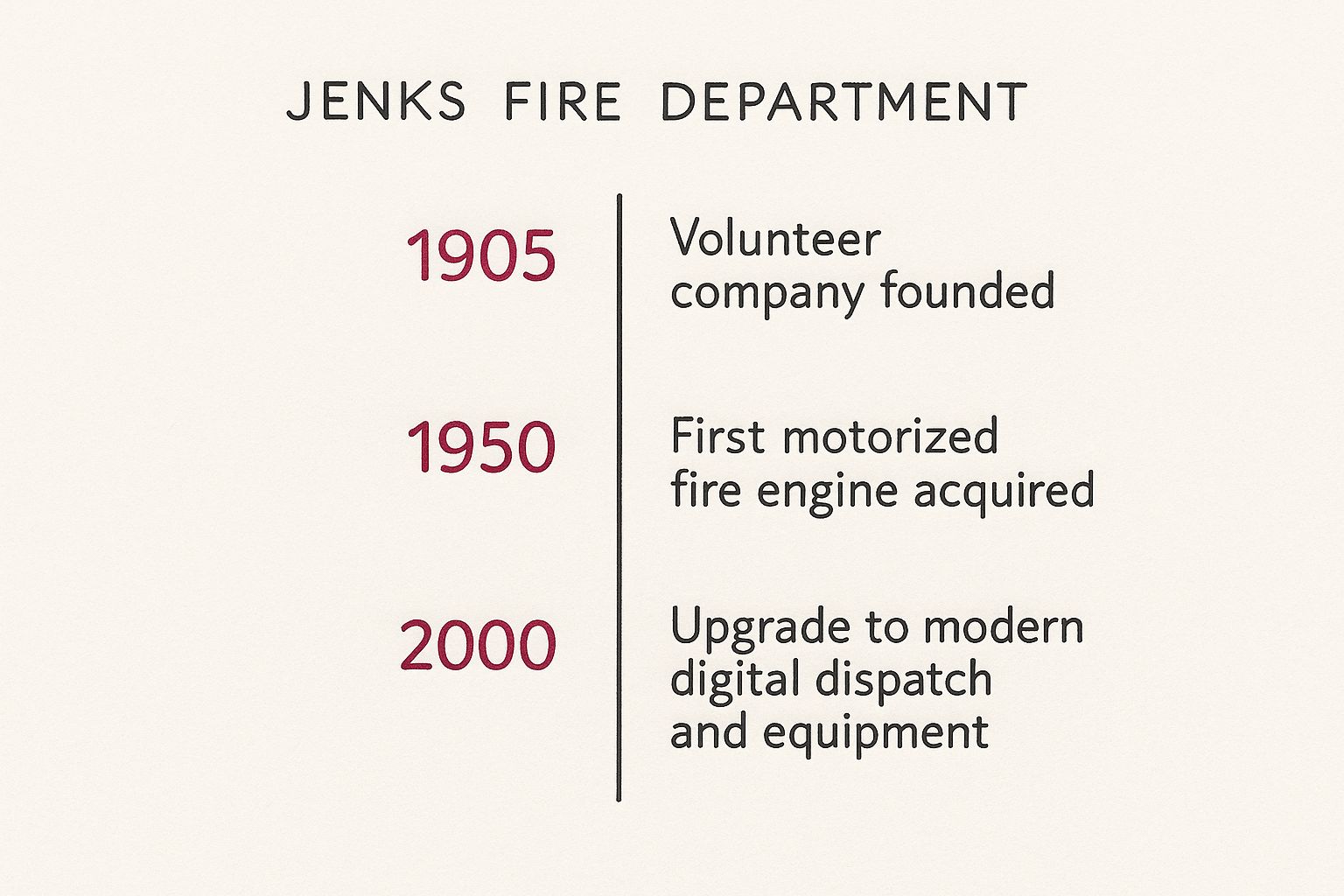
This timeline gives you a sense of the department's evolution from a small volunteer group to the modern force it is today, providing important context for the resources they could bring to the 2025 incident.
Escalation and Emergency Declaration
As the situation intensified, it became painfully clear that local resources were stretched to the breaking point. The fire just wouldn't quit, and with public health concerns mounting from the relentless smoke, city officials had to make a big move.
The City of Jenks officially declared a local state of emergency. This wasn't just paperwork; it was the key that unlocked access to critical state and federal resources. It was a formal admission that the Jenks fire had snowballed into a crisis too big for local responders to handle alone.
This declaration was the signal that a multi-agency, multi-state effort was needed. It opened the door for specialized teams from Florida and Louisiana to bring their expertise and heavy equipment to Jenks. Without their help, the complex job of dismantling that massive smoldering pile and finally putting the fire out for good would have been nearly impossible.
This whole ordeal is a stark reminder of why proper code enforcement and safety regulations are so critical in preventing disasters like this. For anyone wanting to understand more about this, it’s worth looking into Tulsa's code enforcement and compliance guidelines.
How the Smoke Impacted Air Quality and Health
The Jenks fire was more than just a distant spectacle; it quickly became a serious atmospheric problem for our community. As the mulch pile smoldered for days, it pumped out a persistent plume of thick, acrid smoke that settled over town, causing local air quality to plummet.
This wasn't just a bad smell—it was a tangible health concern that had families all over the area worried.
The heavy smoke had a real impact on daily life. At times, the smoke from the fire near Gem Dirt got so dense that it created hazardous driving conditions, reducing visibility right on Highway 75. Residents living nearby started reporting a growing layer of ash on their properties, which only added to the anxiety about what everyone was breathing.
Lingering Health and Environmental Concerns
When organic material like mulch burns, the biggest health risk comes from something called fine particulate matter. These are microscopic particles that can get deep into your lungs and even into your bloodstream. This is a risk for everyone, but it’s especially dangerous for the most vulnerable among us.
The groups at highest risk were:
Children: Their respiratory systems are still developing and are more easily damaged by pollutants.
Older Adults: Poor air quality can make pre-existing health conditions much worse.
Individuals with Respiratory Issues: For anyone with asthma or COPD, smoke inhalation can trigger a severe attack.
For many, the constant presence of smoke was a huge source of anxiety. Not being able to open your windows or let your kids play outside created a stressful environment that lasted as long as the smoke did. It's completely understandable that families were concerned about the long-term effects.
Protecting the air inside our homes became a top priority. To really clear the air of smoke particles after an event like this, it’s worth considering advanced air purification systems.
While the fire itself was contained, its impact on the air was felt for miles, affecting our homes, businesses, and public spaces. Even beloved community spots weren't spared, and you can learn more about one of Jenks' favorite gathering places in our complete guide to Veterans Park.
Why Mulch Fires Are So Difficult to Fight
Fighting a massive mulch fire isn’t anything like putting out a typical house fire. You have to think of that enormous pile at Gem Dirt less like a bonfire with visible flames and more like a giant, self-insulating oven that’s smoldering intensely from the inside out. This deep-seated combustion is the real reason the Jenks fire was such a nightmare to handle.
Unlike a surface fire you can just douse with water, a mulch fire burns deep within its core. The outer layers of tightly packed organic material act as a powerful insulator, trapping all that heat while preventing oxygen from easily reaching the hottest spots. The result is a slow, persistent smolder that can burn for days—or even weeks.
When firefighters spray water on top, much of it just steams off from the extreme surface heat before it can ever penetrate to the heart of the blaze. It’s like trying to put out a campfire by just spraying the logs on top, completely ignoring the red-hot coals buried underneath.
This internal burning is what makes these incidents so incredibly resource-intensive.
The Science of a Smoldering Fire
To get a handle on a fire like this, crews can't just stand back and spray hoses. They have to physically pull the massive pile apart with heavy machinery, spreading it thin layer by layer. Only then can they finally expose the smoldering core to water and air. It’s a methodical deconstruction that is dangerous, time-consuming, and incredibly expensive.
The key challenges really boil down to a few things:
Deep-Seated Combustion: The fire is burning without open flames deep inside the pile, making it invisible from the outside and almost impossible to reach.
Insulating Material: Tightly packed mulch, dirt, and wood chips shield the core from water and oxygen, maintaining extreme temperatures internally.
Resource Intensive: Putting it out for good demands heavy equipment like excavators, a constant water supply, and a huge amount of manpower over a long period.
This is exactly why the Jenks fire required a multi-state response and burned for over a week. Understanding these complexities also drives home how important proactive safety measures are. Beyond these huge industrial incidents, protecting your own home requires a different approach, which is why a good Home Fire Safety Checklist is invaluable.
Proper land use and storage regulations are also critical for preventing these events in the first place, something we detail in our guide to understanding Oklahoma zoning codes.
Urban Growth Puts Jenks at a Crossroads
This kind of rapid expansion creates a natural tension. The very growth that makes Jenks such a vibrant place to live also brings new, complex environmental risks to our doorstep. All of a sudden, an industrial operation that seemed harmless when it was out in the middle of nowhere becomes a real hazard when family homes are just down the block.
The Jenks fire is a perfect case study. It shows how suburban sprawl can accidentally push communities right into the path of industrial dangers that nobody saw coming when the original zoning maps were drawn up.
How Do We Grow Without the Growing Pains?
Dealing with these new risks means we have to be smarter and more forward-thinking about how we plan our city's future. It's a tricky balancing act between encouraging the economic growth we all want and making sure our families are safe.
As our community keeps growing, here are a few things we need to get serious about:
Rethinking Zoning Laws: It's time to update our land-use rules to create safer buffer zones between industrial sites and new housing developments.
Boosting Emergency Preparedness: Our local fire departments need the right equipment and training to handle specialized industrial fires, not just typical house fires.
Keeping the Community in the Loop: We need to do a better job of educating residents about potential hazards nearby and have clear, reliable ways to communicate during an emergency.
Jenks has dealt with its share of environmental issues over the years, like flooding, but the growth we've seen since the war has brought a whole new set of challenges. This massive mulch fire, which scorched several acres, really put a spotlight on the modern risks that come with how we're using our land today. It's a world away from the small town of just 6,000 people we were back in 1980.
This incident is a wake-up call, reminding us that we have to keep adapting as our community changes. You can see just how much is changing by reading about how new commercial developments fuel Jenks' economic boom in our other story.
Your Questions About the Jenks Fire, Answered
Even after the smoke cleared, a lot of people in the community still had questions about the fire at the Gem Dirt facility. We want to clear the air—literally and figuratively—and give you straightforward answers about what happened and how to stay ready for any future air quality issues.
What Actually Started the Mulch Fire?
While no one pointed to a single official cause for the Jenks fire, situations like this often come down to one thing: spontaneous combustion. It sounds like something out of a science fiction movie, but it’s a very real risk at places that handle huge piles of organic material.
When you have that much mulch, wood chips, and grass clippings all piled up, the decomposition process deep inside the pile creates an incredible amount of heat. If that heat has nowhere to go, the temperature can skyrocket until it’s hot enough to ignite the material from the inside out. It starts as a slow smolder, often going unnoticed until the smoke becomes too heavy to ignore.
Was the Smoke Really That Dangerous?
In a word, yes. The biggest concern with the smoke from the mulch fire was the high concentration of fine particulate matter, also known as PM2.5. These particles are microscopic—so small you can't see them—which allows them to be inhaled deep into your lungs and even pass into your bloodstream.
For most people, the immediate effects were coughing, scratchy throats, and some trouble breathing. But for vulnerable groups, the impact was much more serious.
The greatest risk was to our kids, older adults, and anyone with existing respiratory problems like asthma or COPD. For them, the smoke wasn't just a nuisance; it was a serious health threat that could land them in the hospital.
What Should I Do If This Happens Again?
Being prepared is the best defense against poor air quality. If we ever face another event like the Jenks fire, keeping a few key steps in mind can protect your health and your family's.
Here’s what you need to do:
Head Indoors: This is the simplest and most effective step. Limit your time outside as much as you can, and keep all your windows and doors sealed tight.
Purify Your Air: If you have an air purifier with a HEPA filter, run it. These filters are designed to trap the tiny, harmful particles we've been talking about, cleaning up the air inside your home.
Take It Easy: Now is not the time to go for a run or do heavy yard work. Strenuous activity makes you breathe deeper and faster, pulling more of that smoky air into your lungs.
Stay Plugged In: Keep an eye on local news and official alerts from emergency services. They’ll have the most current information on air quality and any safety advisories.
Following these simple tips can make a huge difference in how much you’re exposed to harmful pollutants when smoke is in the air.
Here at The Ten District, our commitment is to keep our community safe, informed, and thriving. We invite you to explore our vibrant downtown and see everything that makes Jenks special, from unique local shops to exciting community events. Discover what's happening in The Ten District.


Comments