

Secure Jenks Downtown Revitalization Grants Today
Jenks Downtown revitalization grants are a specific kind of financial award given out by government agencies, foundations, and sometimes private groups. They’re designed to breathe new economic and social life back into a community's core.
These funds aren't just a handout; they're meant to be a catalyst for growth. The whole point is to turn neglected or underused areas into the vibrant centers of business, culture, and community life they once were.
The Real Purpose and Power of Revitalization Funding
Think of your downtown as the heart of your city. Over time, that heart can get weaker because of big economic shifts, changing shopper habits, or just plain neglect. Downtown revitalization grants act like a targeted treatment plan, injecting the critical resources needed to get the heart pumping again. They’re the seed money that can spark a chain reaction of positive development.
And this funding is about way more than just making things look pretty. Sure, grants often help pay for new building facades, public plazas, or better streetlights, but their true mission runs much deeper. The end goal is to build a self-sustaining ecosystem where people genuinely want to live, work, and spend their time.
Sparking Economic and Social Momentum
One of the most powerful things these grants do is create momentum. A single successful grant shows the world your community has potential, which suddenly makes it a lot more attractive to private investors, new entrepreneurs, and talented people looking for a place to move. That initial public investment is a signal that your town is a safe and promising bet for future development.
“Receiving this grant will be a catalyst for our community. It’s not just an investment in our economy and downtown Grove City – it’s an investment in our people, our small businesses, and our future.” – Vance Oakes, Borough Manager of Grove City
This gets right to the heart of it: revitalization is a team sport. The grant is just the beginning, a spark that inspires local business owners and residents to jump in with their own time, money, and energy. It's that spirit of collaboration that builds a stronger, more resilient community.
Key Objectives Driving Grant Programs
Most revitalization grants are built around a handful of core objectives. If you're going after one of these grants, you need to understand these goals inside and out to show funders your project is a perfect fit.
The table below breaks down the main goals that these grant programs are designed to hit.
Core Objectives of Downtown Revitalization Grants | ||
|---|---|---|
Objective | Description | Example Impact |
Stimulate Economic Growth | The number one goal is almost always to create jobs and boost local revenue by attracting new businesses, helping existing ones expand, and increasing property values. | A grant helps restore a vacant building, which then houses three new retail shops and a restaurant, creating 20+ new jobs. |
Enhance Public Spaces | This is all about creating safe, walkable, and inviting environments—think parks, wider sidewalks, and community gathering spots that make life better for everyone. | Funding is used to transform an empty lot into a pocket park with seating and a small stage for local musicians, drawing more foot traffic. |
Preserve Historic and Cultural Assets | Many grants focus on saving historic buildings and celebrating local culture. This isn't just nostalgia; it's about keeping the town's unique character alive. | A historic preservation grant helps restore the facade of an old theater, which reopens as a community arts center. |
Promote Sustainable Development | It's crucial to encourage projects that are built to last and are environmentally responsible. You can learn more about the **key benefits of mixed-use development** and how it fits these sustainability goals in our detailed guide. | A grant supports a mixed-use project with energy-efficient apartments above ground-floor retail, reducing car dependency. |
Ultimately, these objectives all work together. A project that preserves a historic building might also create new jobs and a beautiful public space, hitting multiple goals at once and making for a much stronger application.
How to Find the Right Funding Sources
Trying to track down the perfect downtown revitalization grant can feel like searching for a needle in a haystack. You've got federal programs, state initiatives, and even private foundations all offering money, and the sheer number of options is enough to make anyone's head spin.
But it doesn't have to be so overwhelming. Think of it like fishing. You wouldn't use the same bait to catch a catfish that you would for a trout. Federal, state, and private funding sources are like different ponds—each with its own rules, opportunities, and specific "fish" (grants) you can catch. The key is knowing which pond to fish in and what bait to use. Let's break down where to look.
Start with Federal Grant Programs
Federal grants are often the big fish. They're usually the largest and most comprehensive sources of funding, managed by major agencies whose entire mission is national economic development. While they are incredibly competitive, landing one can fund the kind of large-scale, visionary projects that truly change a downtown's trajectory.
Two of the biggest players you need to know are the Economic Development Administration (EDA) and the Department of Housing and Urban Development (HUD).
Economic Development Administration (EDA): The EDA is laser-focused on creating jobs and building long-term economic strength. Their grants are perfect for infrastructure projects, business incubators, and strategic planning initiatives designed to make a regional economy more resilient.
Department of Housing and Urban Development (HUD): HUD’s most famous program is the Community Development Block Grant (CDBG). These funds flow down to states and cities to tackle a wide array of local needs, like fixing up housing, improving public facilities, and sparking economic growth in low- and moderate-income neighborhoods.
Because these grants are so substantial, the applications are no joke. You’ll need exhaustive documentation, a highly detailed plan, and a crystal-clear argument for how your project aligns with national goals. A winning proposal has to prove it will deliver a widespread, lasting impact.
Explore State-Level Revitalization Initiatives
While federal grants are great for scale, don't overlook what's happening in your own state. State-level downtown revitalization grants are often more tailored and approachable. These programs are built to solve the specific economic and cultural challenges facing communities right in your backyard.
State agencies just get it. They have a deeper understanding of local hurdles and opportunities. Their grant programs might be designed to preserve historical architecture unique to the state, boost tourism along a certain corridor, or support industries that are locally important.
For example, New York State's Downtown Revitalization Initiative (DRI) and NY Forward programs have pumped a combined $1 billion into 124 communities. Governor Kathy Hochul recently announced another $200 million is on the way to help more towns transform their cores into vibrant hubs that keep their unique charm while attracting new businesses and people.
The infographic below shows the kinds of things funders care about, from historic preservation to economic impact. It’s a great cheat sheet for aligning your project with their goals.
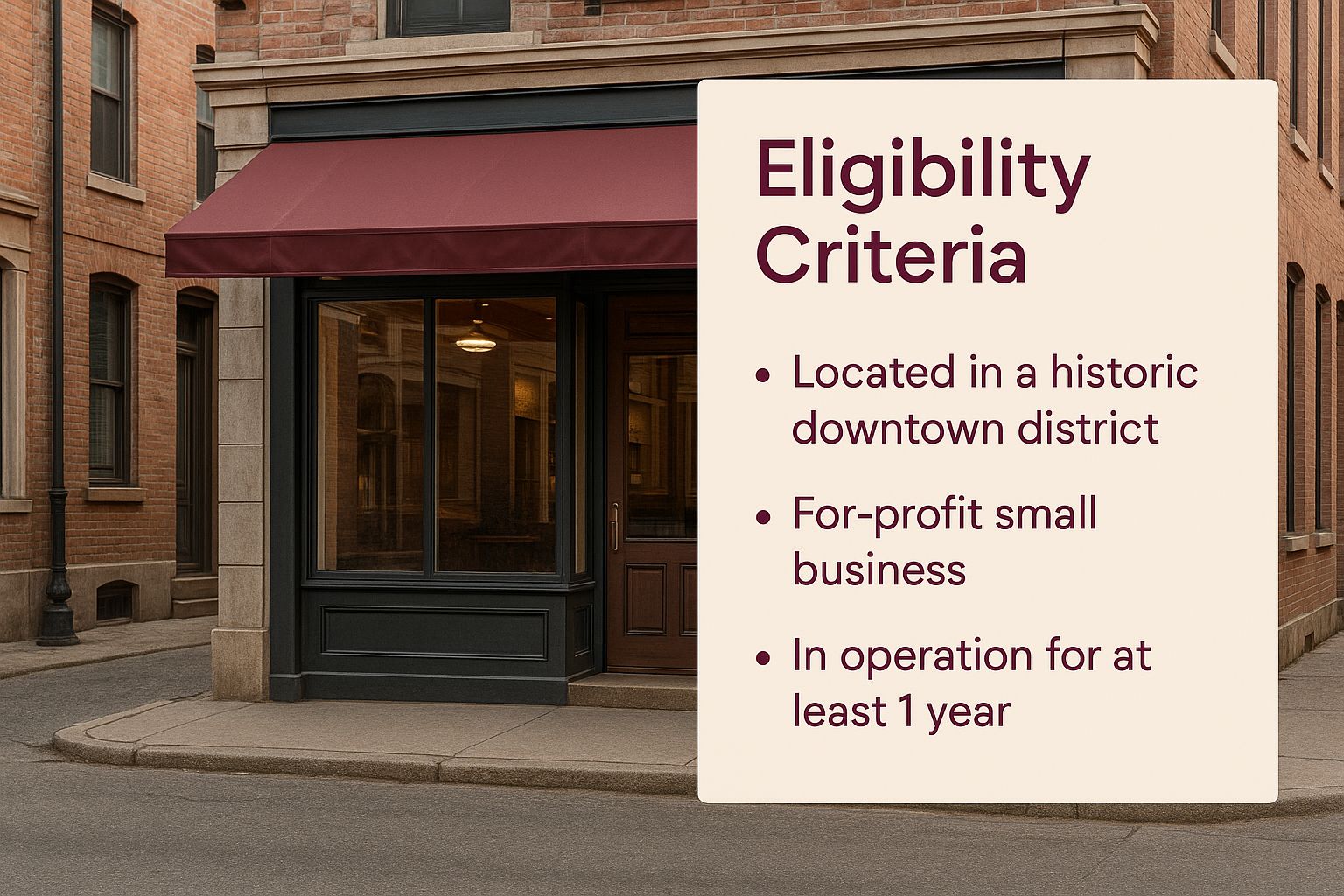
As you can see, eligibility isn't just one thing. It's a mix of factors that prove your project is both well-planned and a perfect match for the grantor's mission.
Uncover Private and Corporate Foundation Grants
Government funding isn't the only game in town. Private and corporate foundations are another powerful, and often overlooked, source for downtown revitalization grants. These organizations tend to have very specific missions, which means they can fund creative or niche projects that might not fit neatly into a government box.
Think of these as specialized tools for specific jobs. You might find a foundation dedicated to:
Historic Preservation: Funding to restore that landmark building on Main Street.
Public Art: Grants for murals, sculptures, or other community art projects.
Green Spaces: Support for creating parks, community gardens, or pedestrian-friendly walkways.
Small Business Support: Seed money to help local entrepreneurs open up shop.
Finding these grants requires a different kind of detective work. You’ll need to research national foundations focused on community development, as well as local or regional foundations started by prominent families or corporations in your area. These funders are often personally invested in the health of the communities they call home.
To see how all these pieces can fit together, check out our guide on unlocking economic potential through a downtown master plan. It offers a great framework for weaving different projects into a single, powerful vision that funders of all types will want to get behind.
Do You and Your Project Actually Qualify?
Before you pour a single minute into writing a grant proposal, you have to answer one critical question: are you even eligible? It’s a simple step, but one that’s so easy to overlook.
I’ve seen countless organizations waste precious time and energy applying for funds they never had a shot at winning. It’s like trying to open a lock with the wrong key—no matter how perfectly you write the proposal, it’s just not going to work. Taking a hard look at the requirements upfront ensures you’re chasing opportunities you can actually land.
Breaking Down the Core Eligibility Rules
Think of grant eligibility as a series of gates. You have to pass through every single one to even be considered. Most of the time, it boils down to three fundamental questions the funder needs answered: Who are you, where is the project, and what are you planning to do?
Most downtown revitalization grants will have very specific rules about:
Applicant Type: Are you the kind of organization they fund? Many grants are exclusively for specific entities, like city governments, 501(c)(3) non-profits, or formally recognized public-private partnerships.
Geographic Restrictions: Is your project in the right spot? The money might be restricted to a particular state, county, or a very specific, officially designated downtown district.
Project Focus: Does your idea align with their mission? A grant for historic preservation isn't going to pay for new construction. A fund for public art probably won't cover sidewalk repairs.
Missing the mark on just one of these is almost always an automatic disqualification. Getting this right from the start saves everyone a headache.
“This is a pivotal moment to strengthen relationships among local stakeholders and bring together new partners. This grant will enable us to develop a sustainable plan that will attract additional investments from public, private, and philanthropic partners.” – Brian Powell, Senior Director of Development, Grove City College
As Brian Powell points out, eligibility is also about showing you're ready to hit the ground running and can create a ripple effect—something every funder loves to see.
A Practical Checklist to See if You're a Fit
To build a truly compelling application, you need to have your project defined with razor-sharp clarity. This isn't just about ticking boxes; it's about being able to tell a powerful story to the right audience. Before you even start searching for grants, run through this internal checklist.
Your Eligibility Checklist
Define Your Legal Status: First things first, who are you on paper? A city government? A downtown development authority? A business improvement district or a registered non-profit? This is the first gate you need to clear.
Pinpoint Your Geographic Area: Be exact. Is your project located within the official downtown boundaries? Pull out the maps and official designations to prove your site is in the required zone.
Articulate Your Project Scope: What, exactly, are you doing? Nail down a one-paragraph summary. For instance: "We will rehabilitate the historic facade of the Miller Building at 123 Main Street to attract a new anchor tenant and preserve its architectural character."
Estimate Your Total Budget: What’s the price tag? You need a realistic project cost, broken down into major buckets like construction, design fees, and project management. A well-thought-out budget demonstrates you’ve done your homework.
Identify Expected Outcomes: How will you know if you succeeded? Define clear, measurable goals. Think in terms of specifics, like "create 15 new full-time jobs," "reduce storefront vacancy by 20%," or "increase annual foot traffic by 10%."
Completing this checklist does more than prep you for a single application. It gives you a master blueprint you can adapt for any downtown revitalization grant, making your entire funding strategy smarter and far more effective.
Crafting an Application That Can't Be Ignored
This is where the rubber meets the road. A winning grant application does more than just fill out forms and ask for a check; it tells a compelling story that grabs reviewers and makes them want to be part of your project. Think of it less like a homework assignment and more like a business plan for your community's future. Your mission is to convince the funding committee that your project is the single best investment they can make to achieve their own goals.
So many great ideas die at this stage. It’s usually not because the vision is flawed, but because the application itself is weak. A jumbled narrative, a fuzzy plan, or a messy budget can sink your chances before you even get started. Let's walk through how to build a proposal that’s clear, persuasive, and makes it incredibly easy for a busy reviewer to say "yes."
Start with a Powerful "Why"
Your needs statement is the absolute foundation of your proposal. It’s where you answer the big questions: Why this project? And why right now? A truly effective needs statement stands on two legs: cold, hard data and real human stories. You need both to make your case.
Data gives you credibility and paints the objective picture of the problem.
Weak: "Our downtown has a lot of empty buildings."
Strong: "Our downtown is wrestling with a 28% commercial vacancy rate, a number that's climbed 12% in the last five years. That translates to an estimated $1.2 million in lost local tax revenue every single year."
Once you've laid out the facts, you have to make them feel real. This is where storytelling comes in. Share a short anecdote about a lifelong resident who remembers when Main Street was the heart of the town, or a shop owner who's struggling to stay afloat because foot traffic has dried up. That emotional hook is what makes the data stick.
Your goal here is to create a genuine sense of urgency. The reviewer should finish this section thinking, "Wow, this community is facing a real challenge, and they understand it inside and out."
Show Them You Have a Plan
Okay, you've established the "why." Now you need to show them the "how." Your project plan is your roadmap from today's problem to tomorrow's success. It’s all about the nitty-gritty details that prove you’ve thought this through and have a firm grasp on what it will take to get it done.
Grant funders need to see a clear, logical timeline. Don't just give them a final deadline; break the project into distinct phases with specific, tangible milestones.
Example Project Timeline
Phase | Key Activities | Estimated Completion |
|---|---|---|
Phase 1: Pre-Development | Secure final architectural plans, obtain city permits, finalize contractor bids. | Months 1-3 |
Phase 2: Construction | Facade restoration, interior demolition, critical structural repairs, utility upgrades. | Months 4-9 |
Phase 3: Tenant Fit-Out | Customize interior for anchor tenant, install new branding and signage. | Months 10-11 |
Phase 4: Launch & Opening | Host a community-wide grand opening, kick off the marketing campaign. | Month 12 |
This level of detail screams competence. It shows your vision isn't just a pipe dream; it's a shovel-ready project managed by a team that knows what it's doing. Make sure to name who is responsible for each major task to show you have the right people in place.
Build Trust with a Transparent Budget
Nothing torpedoes a great application faster than a sloppy or suspicious budget. This is where you prove you’ll be a responsible partner. An inflated or vague budget is a massive red flag that signals poor planning at best.
Your budget needs to be detailed, honest, and easy to follow. Itemize every single expense, from the "hard costs" of construction to the "soft costs" like architect fees, permits, and marketing.
Get Granular: Instead of one line item for "Construction - $200,000," break it down into things like "Masonry Repair - $45,000," "New Commercial-Grade Windows - $30,000," and "Roofing Replacement - $25,000."
Explain Yourself: Briefly justify why each cost is necessary. For bigger ticket items, it’s a smart move to mention you’ve already secured multiple quotes to land a competitive price.
Show Your Skin in the Game: Clearly list the grant amount you’re asking for alongside all other funding sources. Are you getting matching funds from the city? Private donors? Your own organization? This proves the community is already bought in.
Define What Success Actually Looks Like
Finally, you have to tell them how you'll know if you've won. Funders aren't just giving away money; they're investing in results. You need to articulate exactly how you’ll measure the impact of their downtown revitalization grants. Vague promises like "making downtown better" just won't cut it.
Your outcomes need to be SMART: Specific, Measurable, Achievable, Relevant, and Time-bound.
Specific: What, exactly, will you do? (e.g., Fully rehabilitate the historic Miller Building at 123 Main Street).
Measurable: How will you count your success? (e.g., Create 10 new full-time jobs and activate 5,000 square feet of previously vacant commercial space).
Achievable: Is this goal realistic with your team and resources?
Relevant: Does this directly support the funder’s mission to boost local economies?
Time-bound: By when will you hit this goal? (e.g., Within 18 months of receiving the funds).
When you lay out your project with this level of clarity—from the urgent community need to the concrete, measurable results—you stop asking for a handout and start offering a partnership. That’s an investment opportunity grant reviewers will find very hard to pass up.
Real-World Examples of Downtown Revitalization
Theory and strategy are one thing, but nothing tells the story of downtown revitalization grants like seeing them in action. When you see how other communities have spun grant funding into real, tangible change, it delivers both the inspiration and the practical roadmap you need to get started.
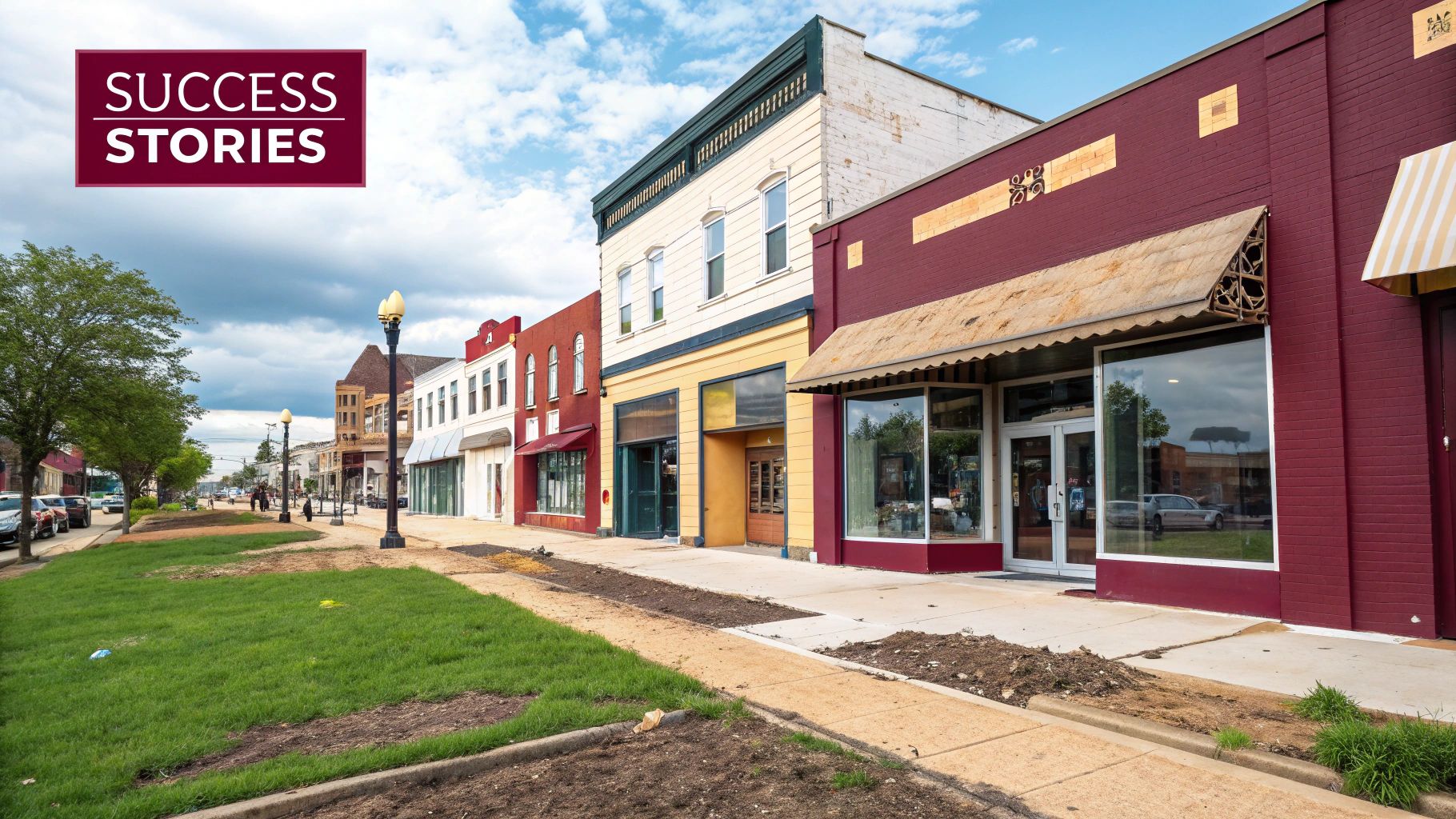
These stories go way beyond abstract numbers. They show the human side of smart investment and reveal how a single, well-managed project can send ripples through a community, sparking economic growth and restoring a sense of pride. Let’s look at a few ways grants have breathed new life into downtowns, one project at a time.
Restoring an Anchor Property to Reignite a Main Street
Picture a historic, three-story brick building sitting vacant on a prominent downtown corner. For years, its empty windows have stared out over a quiet street—a constant reminder of decline. This was the exact challenge facing a mid-sized town that managed to secure a historic preservation grant to bring its most iconic building roaring back to life.
The grant didn’t foot the entire bill, but it was the crucial seed money. It was the spark that ignited a mix of private investment and a small business loan. The goal wasn’t just about making repairs; it was about completely reimagining the building's place in the community.
The real magic of an anchor project is how it changes perception. When people watch the most neglected building become the most vibrant spot in town, it sends a powerful message: the entire downtown is worth investing in again.
This single grant-funded project had a massive ripple effect, as you can see in the table below, which is based on similar success stories from across the country.
Impact of a Historic Building Rehabilitation Grant
Metric | Before Grant | After Grant |
|---|---|---|
Storefront Vacancy | 1 vacant building (100%) | 0 vacant units (0%) |
Jobs Created | 0 | 18 new full-time jobs |
Annual Foot Traffic | Negligible | +25,000 visitors/year |
Private Investment Leveraged | $0 | $750,000 |
Today, the renovated building is home to a bustling farm-to-table restaurant on the ground floor, with professional offices and two modern apartments upstairs. It didn't just save a building. It created jobs, bumped up property values on the block, and brought evening foot traffic back to Main Street for the first time in a decade.
Boosting Business with a Strategic Signage Program
Sometimes, a big comeback doesn't need a multi-million-dollar construction project. A smaller, more focused grant can make just as big of a splash by fixing a common problem, like outdated and ugly business signs. A jumble of mismatched, faded signs can make an entire commercial district feel tired and uninviting.
Some states have recognized this and created specific grants to fix it. The Kansas Department of Commerce, for instance, launched a program to help cities improve their downtowns with high-quality, architecturally sensitive signage. With a $250,000 funding pool, the grant helps businesses and city leaders team up on projects that enhance the visual charm of historic main streets.
This type of program delivers some key wins:
Boosts Business Visibility: New, attractive signs help businesses pop, drawing in customers who might have otherwise walked right by.
Creates a Cohesive Look: By pushing for designs that complement the historic character of the buildings, the whole district starts to feel more unified and branded.
Drives Local Commerce: Many of these programs are set up to prioritize local sign makers and craftspeople, which keeps the grant money circulating right there in the community.
These examples prove that whether you’re restoring a landmark or just upgrading signs, downtown revitalization grants are powerful tools. They provide the spark needed to turn a community’s vision into a vibrant reality. Of course, for businesses to truly thrive in these renewed districts, modernizing their own operations is just as critical. A key strategy is embracing new platforms, and you can see a great example by exploring how The Ten District boosts local merchants with e-commerce and omni-channel support.
Leveraging Local Matching Funds for Success
Many downtown revitalization grants have a catch that can make or break your proposal: the local match. This isn't just a box to check. Grantors see matching funds as undeniable proof that your community is all-in and truly committed to seeing the project succeed.
Think of it like a community potluck. The grantor agrees to bring the main dish (the grant money), but the feast is only a true success if the community brings its own contributions to the table. This shared investment shows the project isn't just some top-down idea but a grassroots effort with real, local support.
Unlocking Creative Sources for Your Match
Securing your local match means you have to get creative and look beyond the city budget. While municipal funds are a great start, a truly powerful application shows a diverse mix of contributions that prove just how widespread the community's backing really is. The most successful projects pull from many different wells of support.
Consider these powerful avenues for building your local match:
Private Donations and Sponsorships: Tap into local businesses, philanthropic families, and community leaders who have a personal stake in seeing downtown thrive.
Fundraising Campaigns: Organize crowdfunding efforts or community events. This lets residents contribute directly and turns everyday citizens into active stakeholders in the project's future.
In-Kind Contributions: This is a crucial—and often overlooked—source of matching funds. The value of volunteer labor, donated professional services (like architectural or legal work), or gifted materials can all be calculated and counted toward your match.
The ability to secure a strong local match does more than just fulfill a requirement; it tells a compelling story of a community that is united, resourceful, and fully committed to seeing its downtown revitalization plans through to completion.
The Power of Matched Funds in Action
The impact of a local match goes far beyond just the dollars and cents. It multiplies the power of the original grant, often leading to bigger and more impactful projects than you ever thought possible. This model has proven itself time and time again in revitalization efforts.
A great example comes from Kansas, where the Historic Economic Asset Lifeline (HEAL) program is breathing new life into rural downtowns. The Kansas Department of Commerce recently awarded over $1.5 million to 19 projects. In turn, those communities rallied to match it with over $6.4 million in local dollars. This synergy created a total investment of nearly $7.9 million, transforming 96 buildings and sparking new economic energy. You can read more about how these projects are revitalizing downtowns across the state.
Building this kind of momentum is at the heart of any successful revitalization. To see how these principles are being put to work right here, check out our deep dive into Jenks' Downtown Master Plan and the city's long-term vision.
Common Questions About Revitalization Grants
Diving into the world of downtown revitalization grants can feel like learning a new language. You're bound to have questions. Getting clear, straightforward answers is what builds the confidence you need to take a project from a simple idea all the way to a ribbon-cutting ceremony.
Let's tackle some of the most common things people ask when they start seeking grant funding.
What Are the Most Common Application Mistakes?
So many promising applications get tossed aside because of simple, avoidable errors. The biggest culprits? A mismatched project scope that just doesn't line up with what the funder cares about, and a vague, poorly documented budget. Another common misstep is failing to tell a compelling story—you need data and personal accounts to create a sense of urgency and make a reviewer truly connect with your vision.
Think of a grant application as a competition. If you don't follow the instructions to the letter—like ignoring character limits or forgetting to attach a required document—you're giving them an easy reason to eliminate you before they even read your great idea.
How Long Does the Grant Process Take?
This is where patience becomes your best friend. The timeline can vary wildly. From the day you hit "submit" on your application, you could be waiting anywhere from three months to over a year for a decision.
Several things can affect this timeline:
Funding Source: Federal grants are notorious for long review periods, while a local community foundation might be able to give you an answer much faster.
Review Process: Some grants have to pass through multiple committees, with each one adding time to the clock.
Application Volume: If you're applying for a highly competitive national grant, you're one of thousands. That naturally slows everything down.
What Happens After We Win the Grant?
Winning the grant is incredible, but it's the starting line, not the finish line. Once the celebration is over, the real work begins. You'll need to sign a formal grant agreement, which is a legal contract that spells out all your responsibilities.
This almost always includes strict reporting requirements to prove the money is being used exactly as you promised. Get ready to provide regular progress updates, detailed financial accounting, and final reports that measure your project's success against the goals you laid out in your application. For more tips on generating community support both before and after you receive funding, explore these Jenks downtown fundraising ideas for a vibrant 2025.
At The Ten District, we believe in the power of community-driven growth. We provide a vibrant destination for locals and visitors to connect, shop, and celebrate. Discover what makes our district the heartbeat of Jenks.


Comments